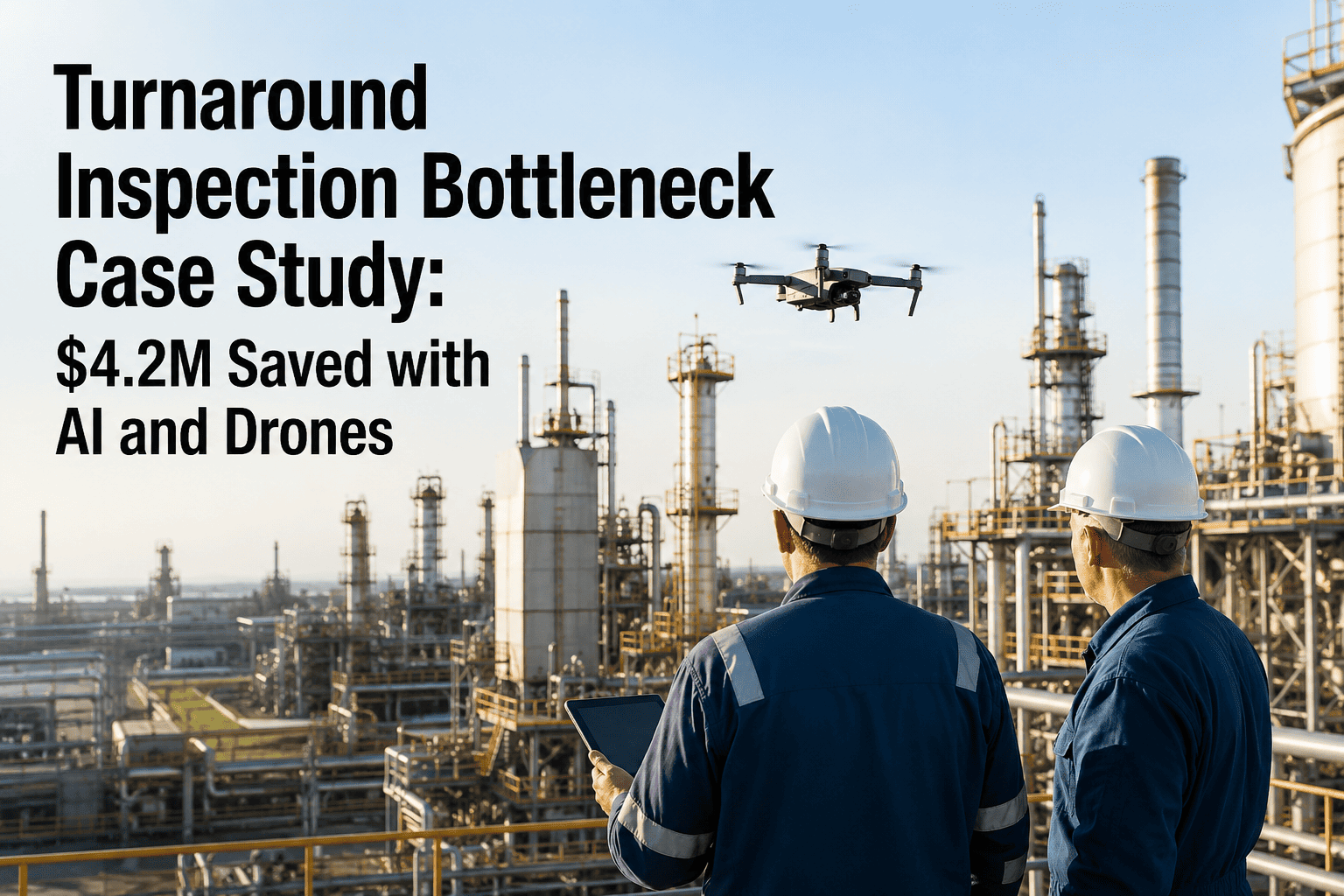
Every refinery turnaround has one phase that quietly eats the critical path: internal vessel and column inspection. Crews wait for scaffold to go up, wait again for confined space permits, and wait once more for inspectors to climb, photograph, and climb back down before the next work step can begin. A Gulf Coast refinery ran straight into this bottleneck on a recent turnaround, watching scaffold-dependent inspection cycles stretch day after day while contractor crews stood idle. By replacing manual scaffold climbs with drone and crawler-based AI inspection, the team cut the turnaround by 8 days and eliminated $4.2 million in scaffold and delay costs. Book a demo to see how the same approach could shorten your next turnaround.
The Scaffold Bottleneck That Cost One Refinery 8 Turnaround Days
iFactory Inspection AI replaces scaffold-dependent vessel and column inspection with drone and crawler data, cutting the single biggest hidden delay on the turnaround critical path.
Why Vessel Inspection Was the Real Critical Path, Not the Repair Work
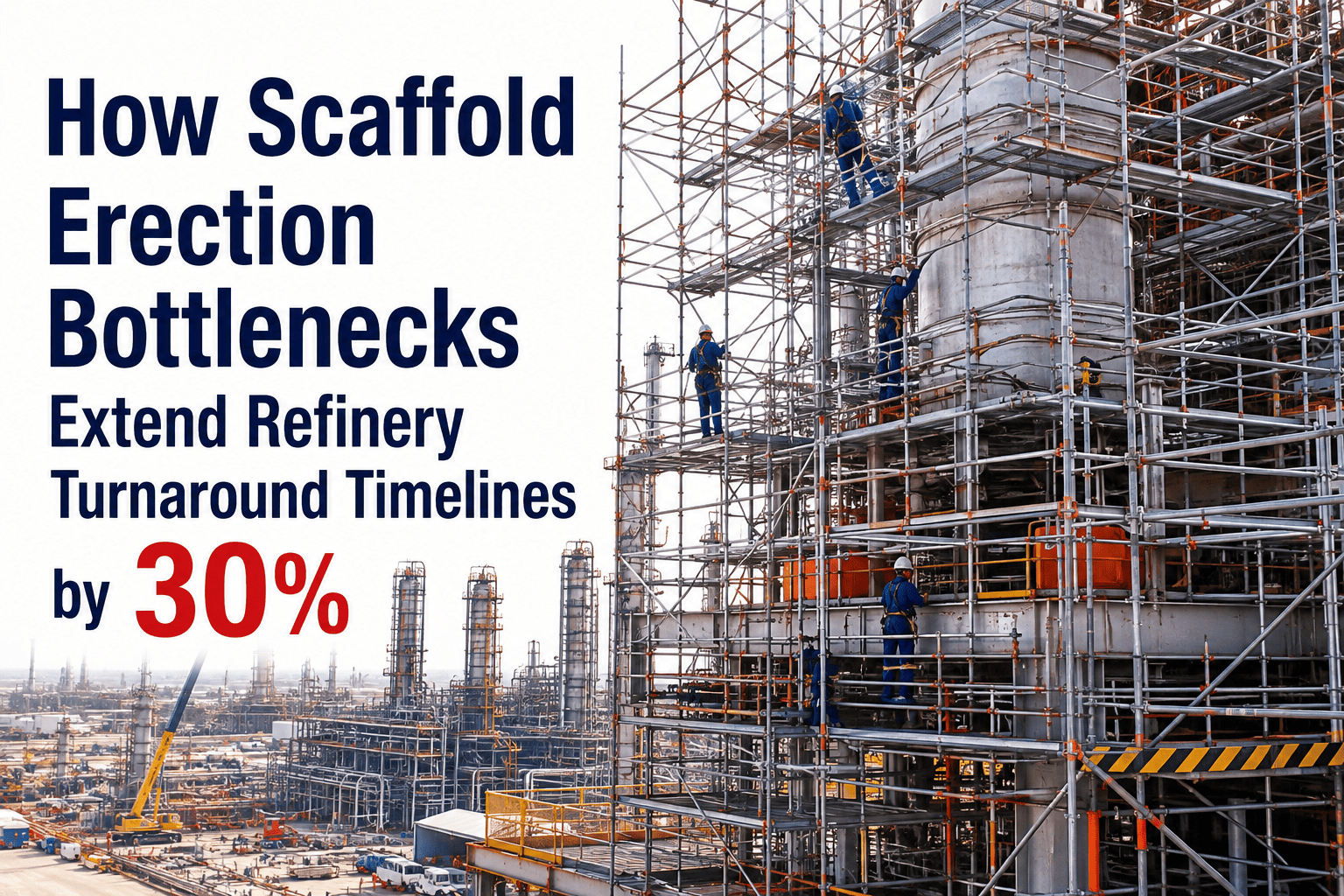
On paper, the turnaround schedule showed repair and replacement work as the longest chain of activity. In practice, every one of those repair steps was waiting on something upstream: a signed-off inspection report confirming wall thickness, weld integrity, or internal corrosion status. That report could not exist until an inspector physically reached the surface in question, and reaching that surface meant scaffold.
Across the full scope of the turnaround, scaffold-dependent inspection accounted for more schedule days than any single repair activity, mechanical work package, or catalyst change-out combined. The bottleneck was not the work itself. It was the access.
Turnaround planners had modeled the inspection phase using historical durations from prior outages, so the schedule risk was, in a sense, already priced in. What the model could not capture was how often a single delayed vessel pushed a chain of downstream activities later, because crews and cranes booked for the next work package had to wait, and rebooking them meant absorbing whatever gap existed in the shared schedule. A six-day scaffold build on one column was rarely just six days of cost. It was six days during which every dependent activity behind it also slipped, and turnaround schedules rarely have enough contingency built in to absorb that kind of compounding delay without extending the overall outage window.
Replacing Scaffold Access With Drone and Crawler Inspection Data
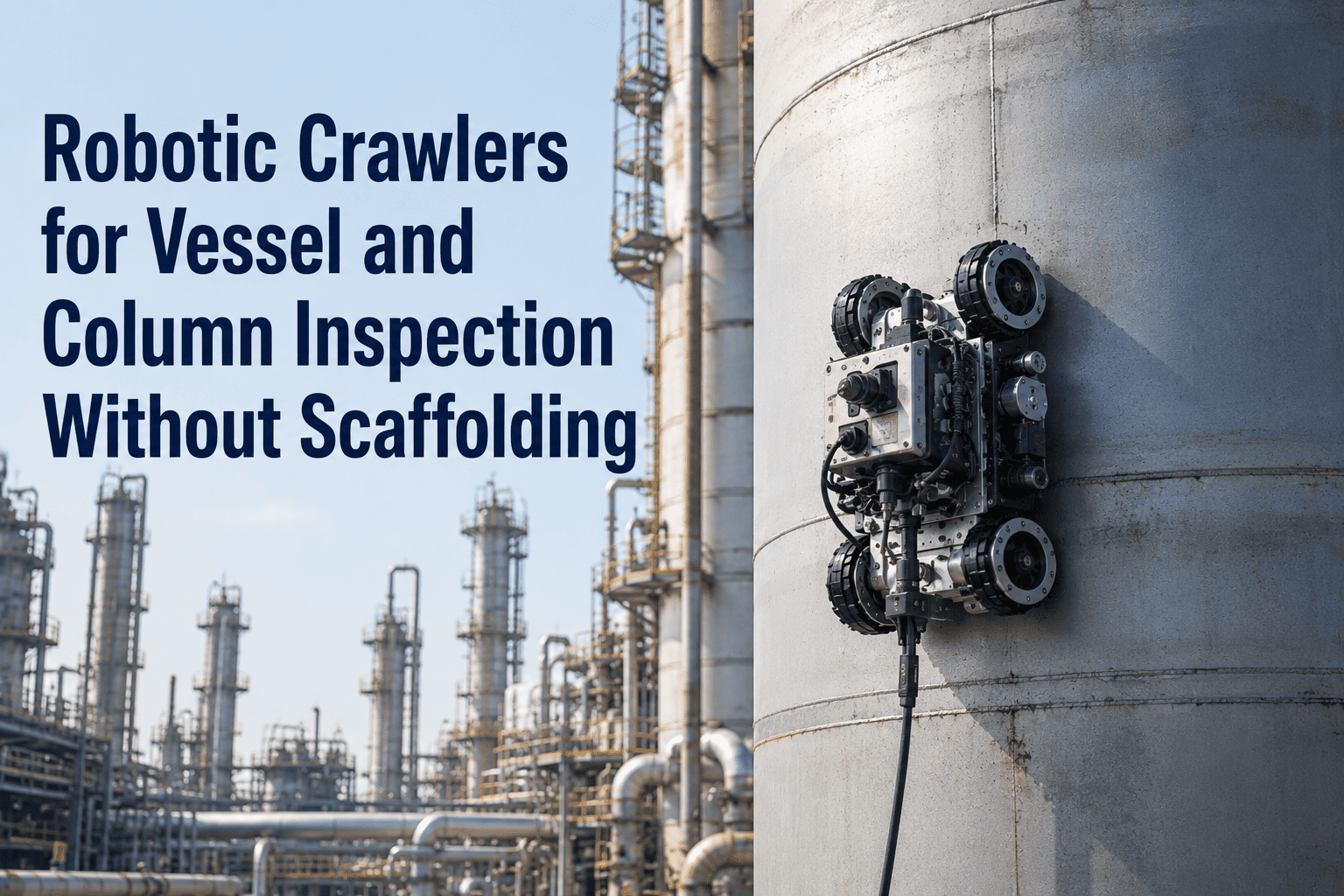
Instead of building physical access to every internal surface, the refinery deployed confined-space drones and magnetic crawlers to collect visual and thickness data directly, then ran that data through iFactory's AI inspection platform for automated defect detection and reporting.
The change did not require redesigning the turnaround from the ground up. Vessels were still isolated, purged, and prepared on the same schedule as before. What changed was the step that had always sat between vessel isolation and the first inspection finding. Rather than routing that step through weeks of scaffold planning, procurement, erection, and teardown, the refinery routed it through a two-person drone and crawler crew who could move from vessel to vessel as each one came available, capturing full-coverage data in hours instead of days. The inspection engineering team stayed involved throughout, reviewing AI-flagged findings and signing off on the same reports they would have produced under the old process, just on a much faster timeline and with a more complete dataset behind each decision.
Turnaround Timeline: Scaffold-Based vs Drone and Crawler Inspection
The clearest way to see the impact is side by side. The chart below compares the days consumed by inspection-related activity on the previous turnaround, which relied on scaffold access, against the most recent turnaround using drone and crawler inspection.
Combined, inspection-related activity dropped from roughly 17 days to just under 3 days per major vessel, and because this work sat directly on the critical path, the total turnaround duration fell by 8 days.
Where the $4.2 Million in Savings Actually Came From
The savings figure is not a single line item. It is the sum of eliminated scaffold spend, avoided extended-duration turnaround costs, and reduced labor hours across the inspection scope. Turnaround economics are dominated by the daily cost of the outage itself, since every day a unit sits down for turnaround represents idle capital, idle contractor labor, and, in most cases, lost production capacity that would otherwise be generating revenue. A schedule reduction of even a single day on a large unit turnaround is typically worth far more than most individual equipment repair line items, which is why the inspection bottleneck mattered so much to the overall economics of the outage.
Scaffold-Based Inspection vs Drone and Crawler AI Inspection
The table below lines up the two approaches across the factors that actually determine turnaround schedule risk and inspection cost. It reflects the same vessel scope inspected under both methods across consecutive turnaround cycles at the same site, so the comparison is not theoretical, it is a direct before-and-after on comparable assets.
| Evaluation Factor | Scaffold-Based Inspection | Drone and Crawler AI Inspection |
|---|---|---|
| Access Setup Time | 4 to 6 days per major vessel before inspection can begin | Under 1 day using existing manways, with no rigging or crane required |
| Confined Space Exposure | Every inspector entry requires a permit, atmospheric test, and standby rescue | Drone and crawler entries eliminate the need for personnel to enter the vessel |
| Surface Coverage | Limited to what the scaffold plan physically reaches | Full internal coverage regardless of geometry or vessel internals layout |
| Defect Detection Method | Manual visual review by a single inspector against limited time on platform | AI-assisted review of full imagery and thickness data with automated flagging |
| Report Turnaround | Typically 2 days after scaffold teardown and data compilation | Same-day findings available directly from captured inspection data |
| Crew and Equipment Cost | Scaffold rental, erection labor, teardown labor, and rescue standby crew | Two-person drone and crawler team with no scaffold materials required |
| Schedule Risk | Scaffold delays cascade directly into repair start dates on the critical path | Inspection removed from the critical path entirely in most vessel scopes |
None of these factors exist in isolation on a real turnaround schedule. A single day saved on access setup for one vessel can shift the start date of a downstream repair work package, which in turn can shift the availability of a shared crane or crew, which in turn can affect the completion date of the entire outage. That compounding effect is why an 8-day reduction in inspection-related activity translated into an 8-day reduction in overall turnaround duration rather than simply being absorbed as float elsewhere in the schedule.
Your Next Turnaround Doesn't Have to Wait on Scaffold
iFactory Inspection AI puts drone, crawler, and AI-assisted defect detection into your turnaround scope so inspection stops being the reason repair work starts late.
How the Program Was Deployed Across the Turnaround
The shift from scaffold-based to drone and crawler inspection was planned into the turnaround schedule months in advance, not improvised during execution. Treating it as a planned schedule change, rather than a same-cycle substitution, is what let the turnaround team actually pull repair work packages earlier instead of simply completing the old schedule faster than expected.
Measured Results From the Turnaround
Beyond the headline savings figure, the shift to drone and crawler inspection produced measurable improvements across schedule performance, safety exposure, and inspection quality.
The refinery's turnaround leadership also reported that inspection findings surfaced by the AI platform, including two early-stage corrosion sites that manual scaffold-based review had missed in the prior cycle, were closed out with scheduled repairs instead of becoming unplanned discoveries mid-turnaround. Catching those findings during the planned inspection window, rather than during a later run when the equipment was back in service, meant the repairs could be scoped, resourced, and executed within the existing turnaround plan instead of triggering an unplanned outage months later.
Turnaround planning teams at the refinery have since used the retained inspection dataset as a baseline for the next outage cycle, comparing new thickness readings against the archived data to track corrosion rates over time rather than treating each turnaround as a standalone snapshot. That trend data is now feeding directly into scope development for the following turnaround, helping planners identify which vessels are likely to need closer attention before the next inspection window even opens.
A Schedule Win That Also Reduced Fall-From-Height Exposure
Turnaround leadership tracked the safety implications of the change alongside the schedule and cost figures, because removing scaffold from the internal vessel inspection scope also removed the single largest source of at-height exposure in that part of the outage. Fall-from-height incidents are consistently cited across the industry as one of the leading causes of injury during refinery inspection work, and any change that structurally reduces the number of scaffold-based entries has a safety benefit that stands apart from the schedule and cost numbers.
Frequently Asked Questions
How much of a typical refinery turnaround budget goes toward scaffold for inspection access?
Scaffold spend tied specifically to inspection access, as opposed to scaffold needed for mechanical repair work, is frequently underestimated during turnaround budgeting because it gets bundled into a single overall scaffold line item. In practice, refineries commonly spend $250,000 to $500,000 per process unit per year on scaffold-related access, and a meaningful share of that is inspection-only access that produces no repair value on its own, simply a report. When that access is replaced by drone and crawler inspection, the freed budget and schedule capacity can be redirected toward the mechanical work that actually restores equipment condition. Book a demo to see how this breaks down against your own turnaround scope.
Can drones and crawlers really cover everything a scaffold-based inspector would see?
Yes, and in many cases coverage improves rather than declines. Scaffold plans are built to a fixed design and often leave gaps where platforms cannot physically reach, forcing inspectors to either skip an area or request a costly scaffold modification mid-inspection. Confined-space drones can maneuver into corners, around internals, and along tray structures that scaffold decking was never designed to reach, while magnetic crawlers hold consistent contact with shell surfaces for dense, repeatable thickness readings. The combination frequently delivers more complete coverage than the scaffold-based approach it replaces, not less.
Does AI-assisted defect detection replace the inspection engineer's judgment?
No, the AI layer is designed to support the inspection engineer, not substitute for their sign-off. Reviewing hours of raw drone footage or thousands of individual thickness readings by eye is slow and prone to missed findings simply due to volume and fatigue. iFactory Inspection AI processes that full dataset and surfaces the specific frames, locations, and thickness deviations most likely to represent a genuine defect, so the inspection engineer spends their time validating flagged findings and applying engineering judgment rather than scanning through unremarkable footage. The signed inspection report remains the engineer's professional determination. Contact support to learn more about how the review workflow is structured.
What types of vessels and assets are good candidates for drone and crawler inspection during a turnaround?
The strongest candidates are internal vessel spaces reached through standard manways, including fractionation columns, reactors, drums, and storage tanks, along with external shell surfaces on stacks, spheres, and large-diameter piping runs. Vessels with complex internals such as trays, packing, or distributor systems tend to see the largest schedule benefit, since scaffold access to those internals is typically slowest and most restrictive under traditional methods. Assets with unusual geometry, tight nozzle spacing, or extensive internal structure are exactly where scaffold-based access struggles most and where drone coverage tends to add the most value.
How far in advance should drone and crawler inspection be planned into a turnaround schedule?
Planning typically needs to start 10 to 12 weeks before the turnaround window to get the full schedule benefit, since the biggest gains come from rebuilding the integrated schedule around a shorter inspection duration rather than simply swapping the inspection method in place. This includes reviewing the vessel list for access candidates, mobilizing and testing equipment against representative internals, and briefing the turnaround planning team so repair work packages can be pulled earlier once inspection findings are available faster. Refineries that bring this planning in during execution rather than in advance typically capture only a portion of the available schedule and cost savings. Book a demo to start planning your next turnaround inspection scope.
Turn Inspection From Your Longest Delay Into Your Shortest Task
See what iFactory Inspection AI could save on scaffold, schedule, and labor across your next turnaround scope, vessel by vessel.