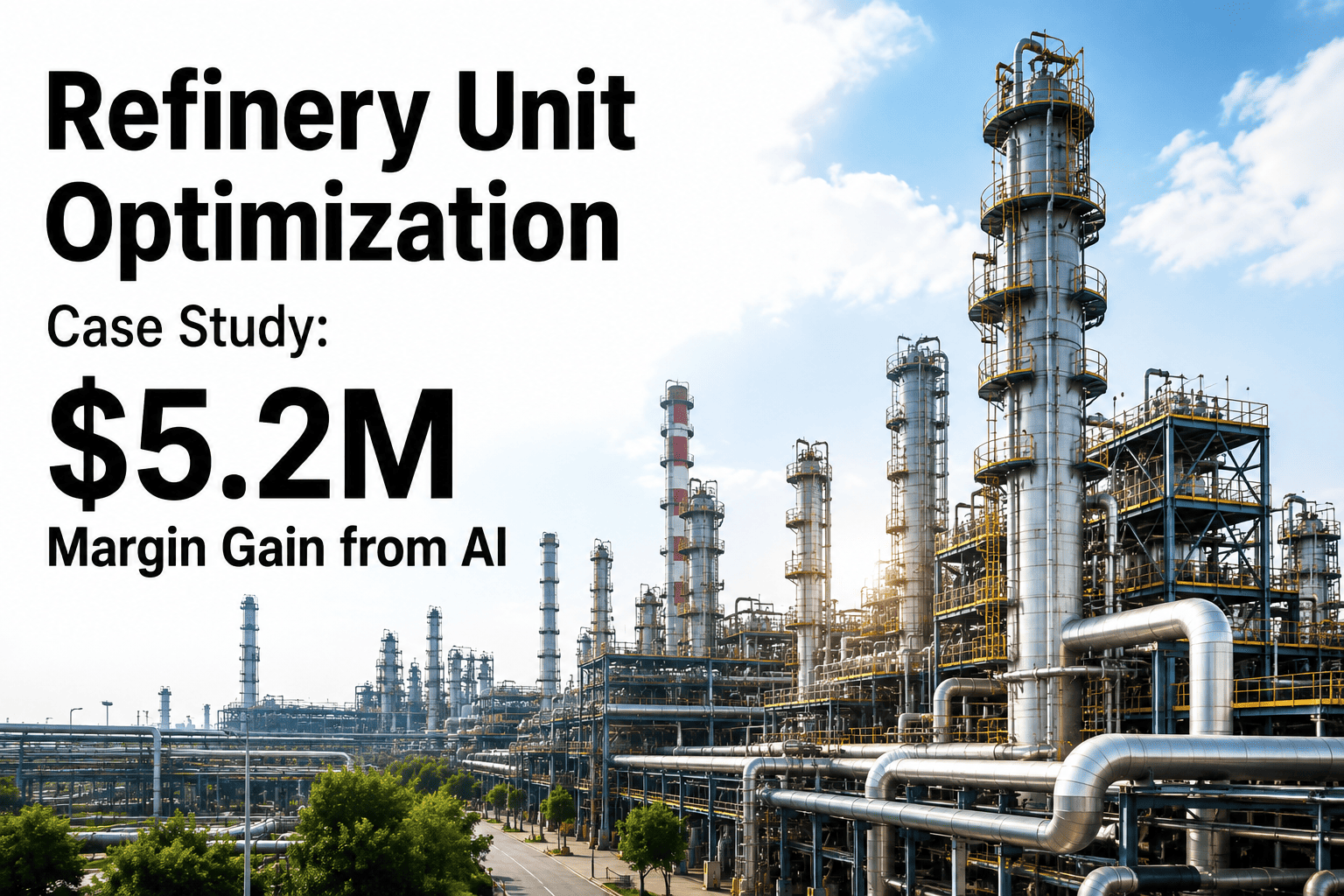
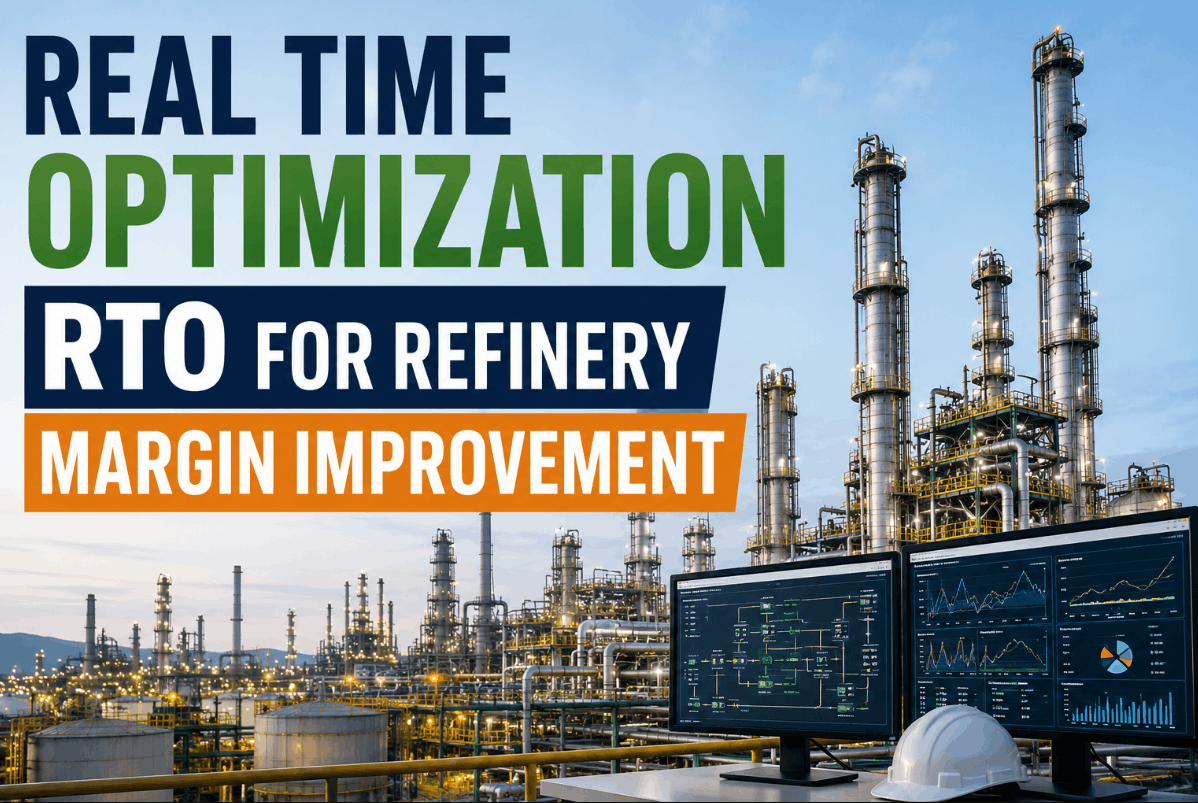
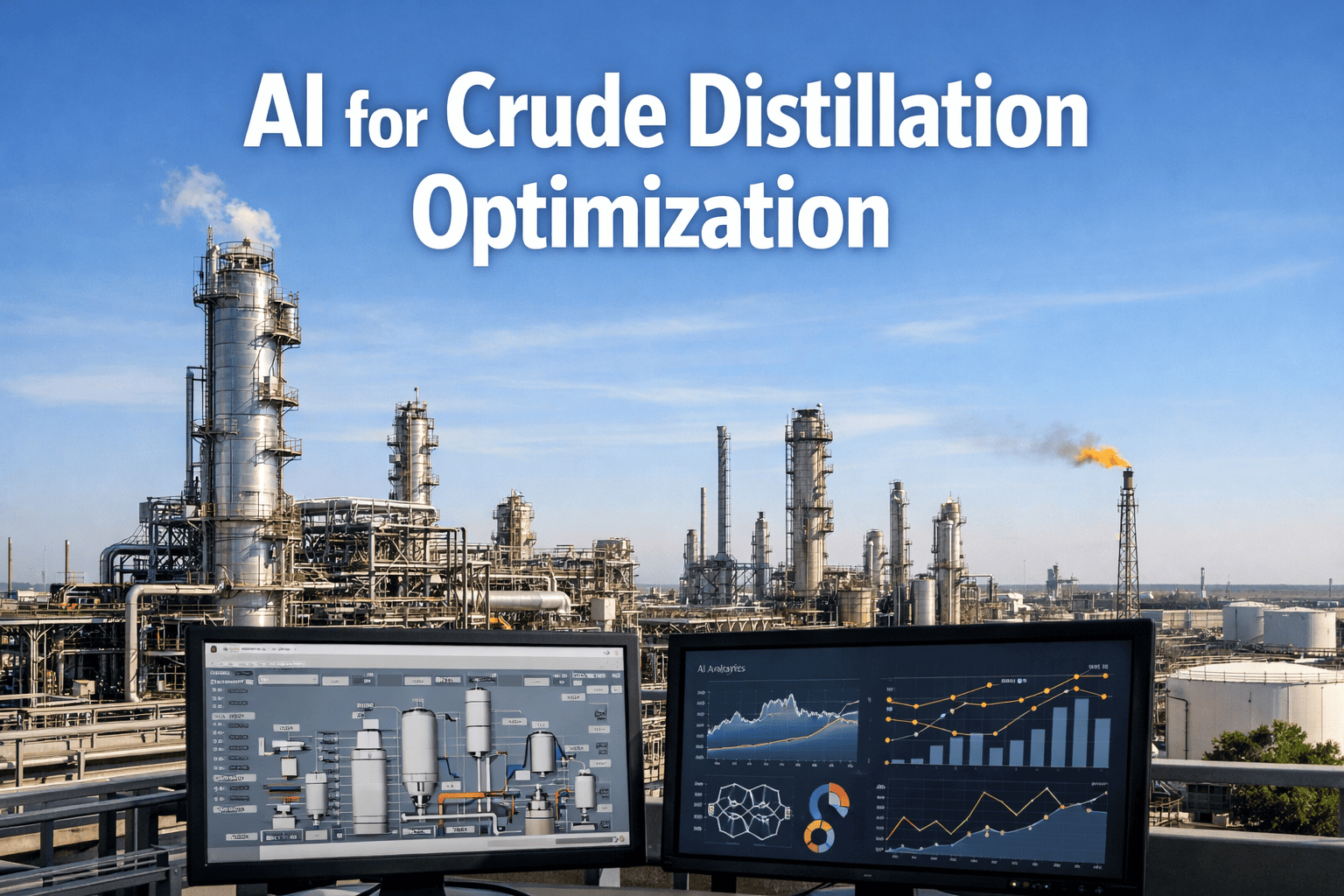
A 200,000 bpd refinery ran four major units — crude distillation, fluid catalytic cracking, catalytic reforming, and product blending — on advanced process control tuned years apart, each optimized in isolation against targets that hadn't been revisited since the last major turnaround. Twenty-four months of AI-driven optimization layered on top of that existing APC, closing the gap between what the units were achieving and what the plant's own operating history showed was actually possible, added $5.2 million in annual margin and cut energy consumption 18% across the four optimized units. None of it required new equipment, a shutdown, or a capital project — every dollar came from setpoints the plant could already reach but wasn't reaching consistently, and a working session with our team can walk through how the same approach applies to your own unit constraints.
Case Study · Refinery Margin Optimization
$5.2M in Annual Margin From AI Optimization Across Four Refinery Units
A composite 200,000 bpd refinery layered AI process optimization on top of its existing APC across the crude unit, FCC, reformer, and gasoline blending — recovering margin that static control targets were leaving on the table every single day.
18%
Energy reduction, optimized units
4
Units optimized in parallel
Where the Margin Was Hiding
Four Places a Well-Run Refinery Still Leaves Money on the Table
None of these four gaps show up as a single alarm or a single bad shift. Each one is a few cents per barrel, quietly repeated across every barrel processed, every day, for years — invisible until someone adds them up.
01
Conservative tower cut points on the crude unit
Cut points get set with margin for error built in and rarely revisited once the unit is running steady, so heavy vacuum gas oil that could be pulled into higher-value diesel stays in the lower-value residue stream instead.
02
Regenerator temperature margins the FCC doesn't need
Operators hold regenerator temperature well above the constraint during heavy feed campaigns as a habitual safety buffer, sacrificing conversion the unit's own catalyst and feed quality could actually support that day.
03
Reformer severity set to a weekly target, not today's feed
Octane targets get set on a planning cycle that runs days to weeks behind actual feed composition, so the unit runs at a severity that was correct when it was set and only approximately correct by the time it's followed.
04
Quality giveaway in the gasoline blend header
Blend recipes get built with a buffer against spec violations, which protects against off-spec product but routinely overdelivers octane, RVP, or sulfur margin that could have gone into cheaper blend components instead.
Why the Existing APC Wasn't Catching This
Advanced Process Control Holds a Target — AI Optimization Moves the Target
Every unit in this refinery already ran advanced process control, and none of these four gaps were a sign the APC was broken. APC does exactly what it's built to do: hold a set of variables tightly against a target calculated on a daily or weekly planning cycle. What it doesn't do is question whether that target is still the right one an hour after feed quality shifts, or whether the safety margin built into it years ago is still needed under today's catalyst age and crude slate. AI optimization sits on top of the same APC infrastructure and recalculates the economic optimum continuously from live plant data, rather than waiting for the next planning cycle to update the number the APC is holding. The distinction matters because most process engineers already suspect their units are leaving some margin unclaimed — the problem has never really been a lack of awareness, it has been a lack of a practical way to recalculate the optimum as often as conditions actually change without adding headcount to a planning team that is already stretched across dozens of units. Multivariable controllers were designed around linearized models because that was computationally practical decades ago, and those models still work well close to the design point they were built around. The trouble is that a refinery rarely operates exactly at its design point for long: crude slate shifts with sourcing decisions, catalyst activity declines steadily between regenerations and additions, and ambient conditions alter heat integration across every unit in ways a static model was never built to track. A model trained directly on the plant's own multi-year operating history captures those nonlinear interactions the way a linearized model structurally cannot, which is why the AI layer finds margin that a properly functioning APC, tuned correctly by a competent controls engineer, still leaves behind.
| Question | Advanced Process Control | AI Optimization Layer |
| How often is the target reset? |
Daily or weekly, from planning models |
Continuously, from live operating data |
| Does it see nonlinear unit behavior? |
Approximates with linearized models |
Trained directly on nonlinear plant history |
| Does it adapt to feed or catalyst changes? |
Only when the target is manually revised |
Adjusts as conditions change in real time |
| Where does it write setpoints? |
Directly to the control loop |
Into the same APC target, not around it |
Unit-by-Unit Breakdown
The Optimization Lever Behind Each Unit's Contribution
Four different units, four different mechanisms — the AI layer didn't apply one generic rule everywhere. It found the specific lever each unit's own data showed was available, and each lever contributed a different share of the total $5.2 million.
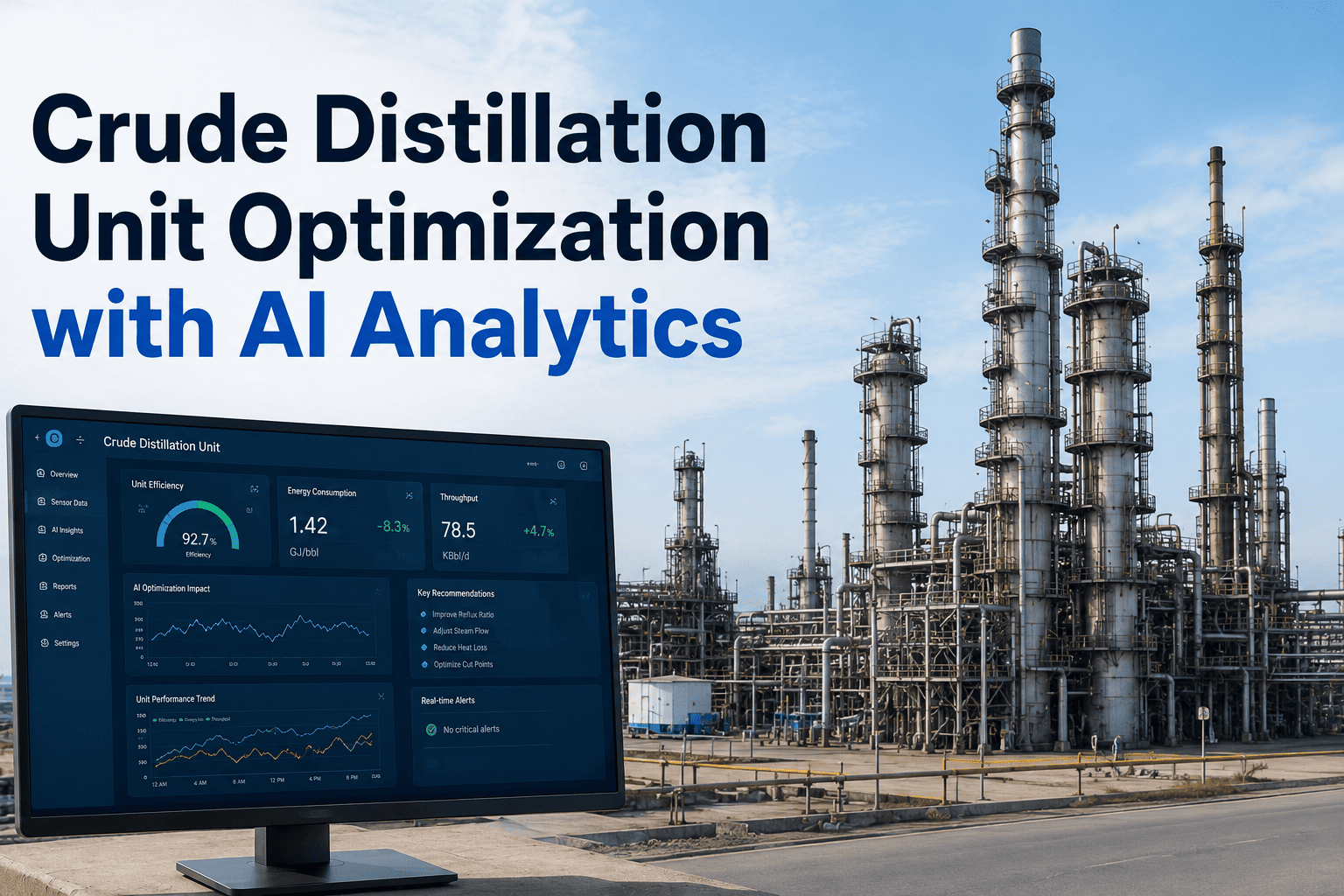
| Unit | Optimization Lever | Mechanism | Annual Margin Share |
| Crude Distillation Unit |
Deep-cut tower optimization |
Extended cut point recovers heavy VGO into diesel without off-spec risk |
$1.6M |
| Fluid Catalytic Cracker |
Regenerator temperature release |
Reduced unneeded thermal margin, recovering conversion on heavy feed days |
$1.9M |
| Catalytic Reformer |
Continuous severity adjustment |
Octane target reset against live feed composition instead of a weekly plan |
$0.9M |
| Gasoline Blending |
Real-time quality giveaway reduction |
Blend recipe tightened against live lab and inferential quality data |
$0.8M |
Combined Annual Margin Gain: $5.2 Million
Applied Example
How 2.1% of FCC Conversion Was Hiding in a Regenerator Temperature Habit
The FCC's regenerator had been run at a fixed temperature margin above its operating constraint during every heavy feed campaign for years, a buffer that had been added after a coke-formation incident long before most of the current operating team started. Trained on five years of the unit's own historian data, the AI optimization model identified that the plant was systematically over-cooling the regenerator during heavy feed campaigns specifically — sacrificing 2.1% conversion to hold a safety margin the current catalyst activity and feed quality profile did not actually require under those conditions. Releasing that margin in controlled increments, verified against live constraint monitoring rather than a fixed buffer, recovered conversion that had been sitting unused through every heavy feed campaign the unit had run for years. The FCC alone accounted for the largest single share of the refinery's total margin gain, and the mechanism behind it was not a new sensor or a new piece of equipment — it was a habitual buffer nobody had re-examined since the conditions that originally justified it had changed. What made the finding actionable rather than just interesting was the way it was verified before any setpoint moved in closed loop: the model's recommendation ran in advisory mode for the first several weeks, with a process engineer reviewing each suggested regenerator temperature reduction against live constraint monitoring — wet gas compressor load, slide valve differential, and stack emissions — before approving incremental releases. That verification step is also why the finding held up once the buffer was released: the model wasn't asked to trust a static safety margin was unnecessary, it was asked to prove it continuously against the actual constraints that mattered, which is a materially different and more defensible standard than simply removing a number because a spreadsheet said the plant could.
See What Your Own Units Are Leaving Behind
Every refinery's four leak points look a little different depending on crude slate, catalyst age, and unit configuration. A short session can show what the same category of gap looks like against your own historian data.
The Energy Side of the Same Optimization
Why 18% Energy Reduction Came From the Same Four Units, Not a Separate Project
Energy and margin optimization are usually run as two separate initiatives at most refineries, but on this deployment they came from the same underlying model because fired heaters and furnaces sit directly in the path of the same units being optimized for yield. Crude unit preheat trains, FCC main column reboil duty, and reformer charge heaters all represent a majority of each unit's controllable energy cost, and small reductions in unnecessary thermal margin — the same category of buffer behind the FCC regenerator finding — cut fuel gas consumption without sacrificing throughput or conversion, which is the distinction that makes an energy reduction actually improve margin instead of just shifting cost from one line item to another. Across the four optimized units, fired-heater and utility energy consumption fell 18% on a combined basis, driven by the same continuous setpoint recalculation that was closing the margin gap, not a separate energy-only initiative layered on afterward. This matters for how a refinery evaluates the deployment financially, because a project that only reduces energy without regard to throughput or conversion often looks good on a utility bill while quietly costing the plant more in lost production value than it saved in fuel gas — a trade most operations leaders would reject if the tradeoff were made visible in the same units. Tying the energy reduction to the same optimization model that was already respecting throughput and conversion constraints avoided that trap entirely, because the model was never asked to minimize energy in isolation; it was asked to maximize margin, and lower unnecessary thermal duty simply turned out to be part of how several of the four units got there. Preheat train fouling monitoring, furnace excess air trimming, and reboil duty matched to actual column loading rather than a fixed setpoint were the specific mechanisms behind most of the reduction, and all three had already existed as concepts in the plant's energy program — the AI layer's contribution was making the adjustment continuous rather than dependent on a quarterly energy audit catching the drift after months of accumulated waste.
Before You Start
What to Confirm Before Layering AI Optimization Onto Existing APC
Refineries that see margin recovery fastest usually walk in already knowing the answers to a short set of questions about their own control infrastructure.
| Question | Why It Matters |
| How many years of clean historian data exist per unit? |
Determines how confidently the model can learn each unit's real operating envelope |
| Is the existing APC writing setpoints reliably today? |
The AI layer optimizes the target the APC holds, so the underlying loop needs to be sound first |
| Are safety and quality constraints documented per unit? |
Defines the boundaries the optimization is never allowed to cross |
| Who approves a setpoint change on each unit? |
Shapes whether the model runs in advisory mode first or closed-loop from day one |
Common Questions
Refinery AI Margin Optimization — Frequently Asked
These are the questions process engineering and operations leadership teams ask most often before extending optimization on top of an existing APC.
Does this replace our existing advanced process control system?
No — the AI optimization layer writes into the same target the APC is already holding, rather than replacing the control loop itself, so the existing APC infrastructure stays in place and continues doing what it was built to do while the optimization layer recalculates what target it should be holding.
Book a demo to see how this connects to an APC system already in place at your site.
How long before a refinery sees measurable margin improvement?
Most deployments run in advisory mode first, generating recommendations an operator reviews and approves before any setpoint writes automatically, and measurable margin improvement is typically visible within the first few months once the model has learned enough of the unit's operating envelope to recommend with confidence.
Contact support to talk through a realistic timeline for your unit count.
Can this run safely without threatening product quality specs?
Yes — every recommendation is checked against the same quality and safety constraints the plant already enforces, and the model is built to close quality giveaway rather than push toward a spec violation, since the entire economic case depends on staying inside spec while reducing the unnecessary buffer around it.
Book a session to review how constraints are handled on your specific units.
Does every unit need to be optimized at once to see results?
No — this deployment optimized four units in parallel, but a single high-value unit like the FCC or crude tower can be started independently, and the margin case study on that one unit alone is usually enough to justify extending the same approach to the next unit in the sequence.
Ask our team about sequencing a rollout across your unit list.
What data does the model need before it can start recommending?
Historian data covering feed quality, unit operating conditions, and product quality results is the core requirement, and the model can begin working with whatever clean history currently exists in the historian rather than waiting for a separate data collection project to be completed first.
Book a call to review what your current historian coverage supports.
Find the Margin Your Own Historian Data Is Already Showing
iFactory layers AI optimization on top of your existing APC across crude distillation, FCC, reforming, and blending — recovering margin and cutting energy consumption without a shutdown, a capital project, or new equipment.