Forty wells, eighteen months, one basin. That is the scale most drilling optimization pilots never reach, because most stop after two or three wells once the novelty wears off and the results get harder to attribute to anything specific. This is what happened when an operator in the Permian Basin ran AI-driven drilling parameter optimization across a full multi-rig program instead of a pilot pad, and kept measuring after the initial excitement faded. You can see the same methodology applied to your own rigs by choosing to book a demo with our team.
CASE STUDY · DRILLING AI · PERMIAN BASIN DEPLOYMENT
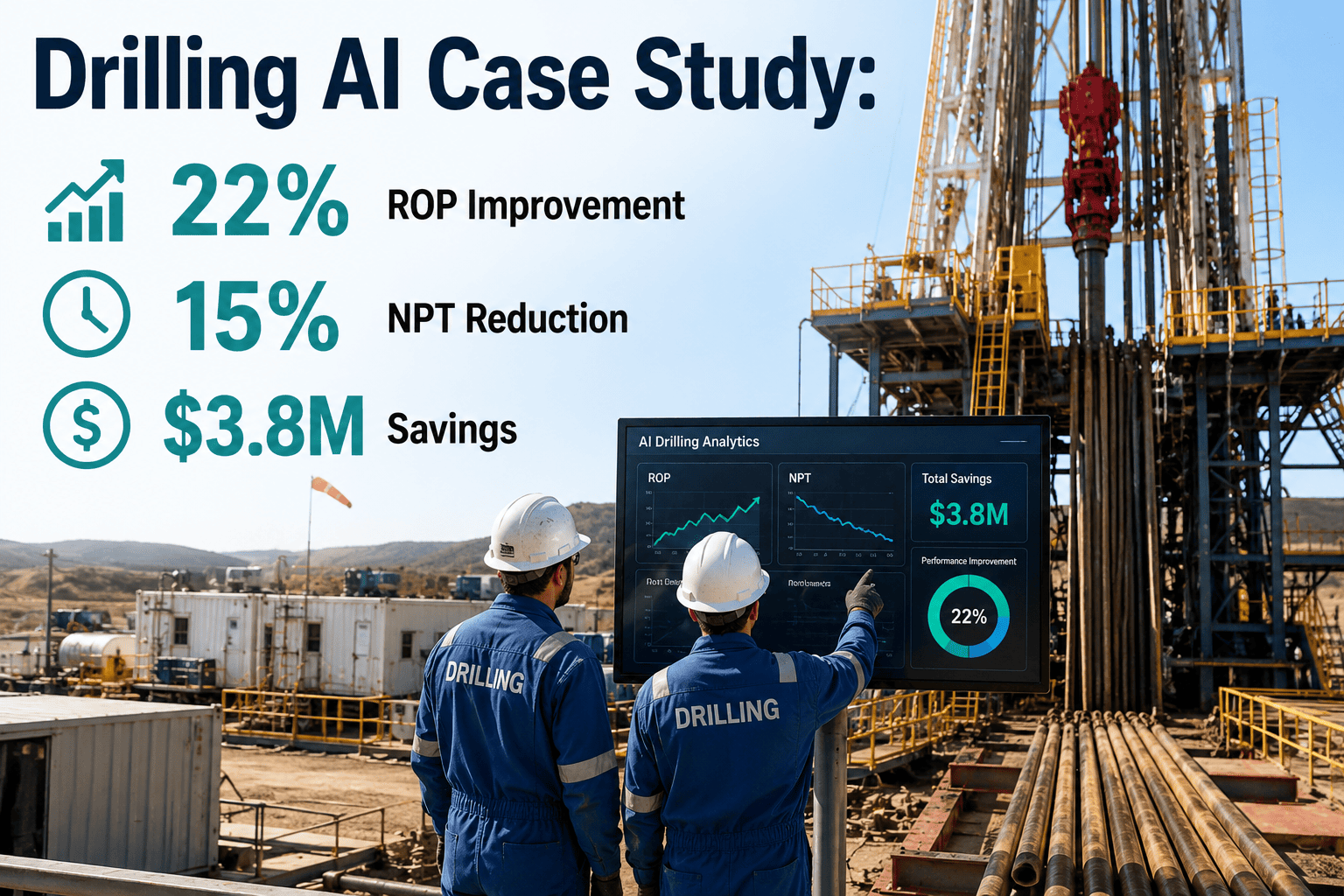
22% Faster Rate of Penetration, 15% Less Non-Productive Time, $3.8M Saved Across 40 Wells
An 18-month AI drilling optimization deployment across a Permian Basin multi-rig program improved average rate of penetration by 22%, cut non-productive time by 15%, and delivered $3.8M in measured drilling cost savings without a rig upgrade or a bit redesign.
CLIENT SNAPSHOT
BASIN
Permian Basin, Midland & Delaware sub-basins
PROGRAM SIZE
40 horizontal wells across 6 rigs
DEPLOYMENT WINDOW
18 months, staged rig-by-rig rollout
FORMATION TARGETS
Wolfcamp A/B, Spraberry, Bone Spring
THE CHALLENGE
Every Rig Was Drilling to a Different Standard of "Good"
Before this deployment, drilling parameters, weight on bit, RPM, flow rate, were set by each driller's individual experience with the formation, adjusted reactively when torque or vibration signatures suggested trouble. Two rigs drilling nominally identical laterals in the same formation could show ROP variance of 30% or more purely on driller-to-driller judgment differences, with no way to tell which approach was actually closer to optimal for the rock being drilled.
Reactive Parameter Adjustment
WOB and RPM changes were made after a drilling dysfunction was already visible in torque or vibration data, not ahead of it.
Inconsistent Driller-to-Driller Performance
ROP on comparable laterals varied significantly based on which crew and driller were on tour, with no formation-specific baseline to calibrate against.
Stick-Slip and Bit Wear Went Undetected Early
Downhole vibration conditions that accelerate bit wear were frequently only identified after ROP had already started declining.
THE SOLUTION
Formation-Calibrated, Continuously Updated Drilling Parameters
The deployment connected real-time WOB, RPM, flow rate, torque, and vibration data from the rig floor to an AI model trained on offset well performance and continuously updated formation property estimates as each new lateral confirmed or corrected the model's assumptions about the rock ahead of the bit.
1
Ingest Live Surface and Downhole Data
WOB, RPM, flow rate, torque, and MWD vibration data streamed continuously from each active rig into the optimization model.
2
Calibrate Against Formation Property Estimates
Offset well data and real-time drilling response refined estimates of rock strength and drillability along the current lateral path.
3
Recommend WOB/RPM Combinations to the Driller
Rather than replacing driller judgment, the system surfaced a recommended parameter window updated continuously as conditions changed.
4
Flag Stick-Slip and Bit Wear Signatures Early
Downhole vibration patterns consistent with early-stage stick-slip or bit wear were flagged before ROP decline became visible on the surface data alone.
RIG-BY-RIG RESULTS
Reactive Drilling Versus AI-Guided Drilling
Want the Same Kind of Result Documented Across Your Own Program?
iFactory brings this same live drilling-parameter optimization approach to your rigs, formation by formation.
WHERE THE $3.8M CAME FROM
Savings Broke Down Across Three Categories
Rig-Day Reduction From Faster ROP
~55%
NPT Reduction (Stick-Slip, Bit Trips)
~30%
Reduced Bit Consumption
~15%
WHAT ALMOST GOT MISSED
Lessons From the Rollout
Early Rigs Ran Advisory-Only Too Long
The first two rigs stayed in pure advisory mode for months past the point the recommendations had proven reliable, delaying the productivity gains that later rigs captured faster.
Formation Model Needed Local Recalibration
A model trained on Midland Basin offsets underperformed initially when applied unmodified to Delaware Basin laterals, until formation-specific recalibration was built in.
Driller Buy-In Took a Dedicated Training Pass
Crews that received a short, dedicated session on how the recommendation model worked adopted the guidance faster than crews given only a written procedure change.
Bit Wear Alerts Were Tuned Too Conservatively at First
Initial alert thresholds triggered more false positives than useful early warnings, and were retuned against actual dull-bit data from the first several wells before becoming reliably actionable.
WHAT THE DATA INFRASTRUCTURE ACTUALLY LOOKED LIKE
No New Sensors, But a New Data Pathway
The operator's existing WITSML feed already carried WOB, RPM, flow rate, and torque from each rig's surface system, and MWD tools already logged downhole vibration. What did not exist before the deployment was a pathway connecting that live stream to a model that could turn it into a recommendation the driller could act on inside the current shift, rather than a report reviewed the following week by a drilling engineer back in the office.
Building that pathway meant standardizing WITSML tag naming across all six rigs, since two of the older rigs used slightly different naming conventions from the fleet standard, and setting up a low-latency link so recommendations reached the doghouse display within seconds of a parameter change rather than on a delayed batch cycle. This infrastructure work, unglamorous as it was, consumed roughly a third of the first three months of the rollout.
WHO OWNED WHAT ACROSS THE PROGRAM
Three Roles, Three Different Views of the Same Well
Driller
Received the live recommended WOB/RPM window on the doghouse display and retained final authority to deviate based on feel and conditions the model could not directly observe.
Drilling Engineer
Reviewed formation calibration accuracy after each well and approved recalibration adjustments before they were rolled out to the next lateral in the same area.
Operations Manager
Tracked program-level ROP and NPT trends across all six rigs to decide when a rig was ready to move from advisory-only to a tighter recommended operating band.
FREQUENTLY ASKED QUESTIONS
Questions Drilling Engineers Ask About This Deployment
Did this require new rig instrumentation?
No new sensors were required for the core deployment. The program used existing WOB, RPM, flow rate, torque, and MWD vibration data already available on the rigs, with the optimization value coming from how that data was modeled and surfaced rather than from new hardware.
Book a demo to review what your current rig instrumentation already supports.
How long before results become measurable on a new program?
In this deployment, the first rigs showed measurable ROP improvement within the first few wells of advisory-mode operation, though the full 22% program average built over the 18-month rollout as later rigs benefited from a more mature, recalibrated formation model. Results scale with how much offset data is available to calibrate against at the outset.
Does this replace driller judgment on the rig floor?
No, the model surfaced recommended parameter windows to the driller rather than taking direct control of the drawworks or top drive. Drillers retained authority to deviate from the recommendation based on conditions the model could not see, and that human oversight was part of why adoption succeeded.
Contact our support team to discuss how advisory-mode rollout is typically structured.
How was the $3.8M savings figure calculated?
The figure combined measured rig-day cost avoidance from faster ROP, reduced NPT hours valued at standby day rate, and reduced bit consumption across the 40-well program, benchmarked against each rig's own pre-deployment baseline performance in the same formations.
Can this approach transfer to a different basin or formation?
Yes, though the case study above shows that transferring a model between sub-basins without recalibration underperformed initially. A formation-specific calibration pass using available offset data is a necessary first step before applying this methodology to a new area.
Book a demo to scope what a calibration pass would look like for your target formations.
Ready to See This Methodology Applied to Your Own Rigs?
iFactory can walk through how this same live drilling optimization approach would apply to your current program and formations.