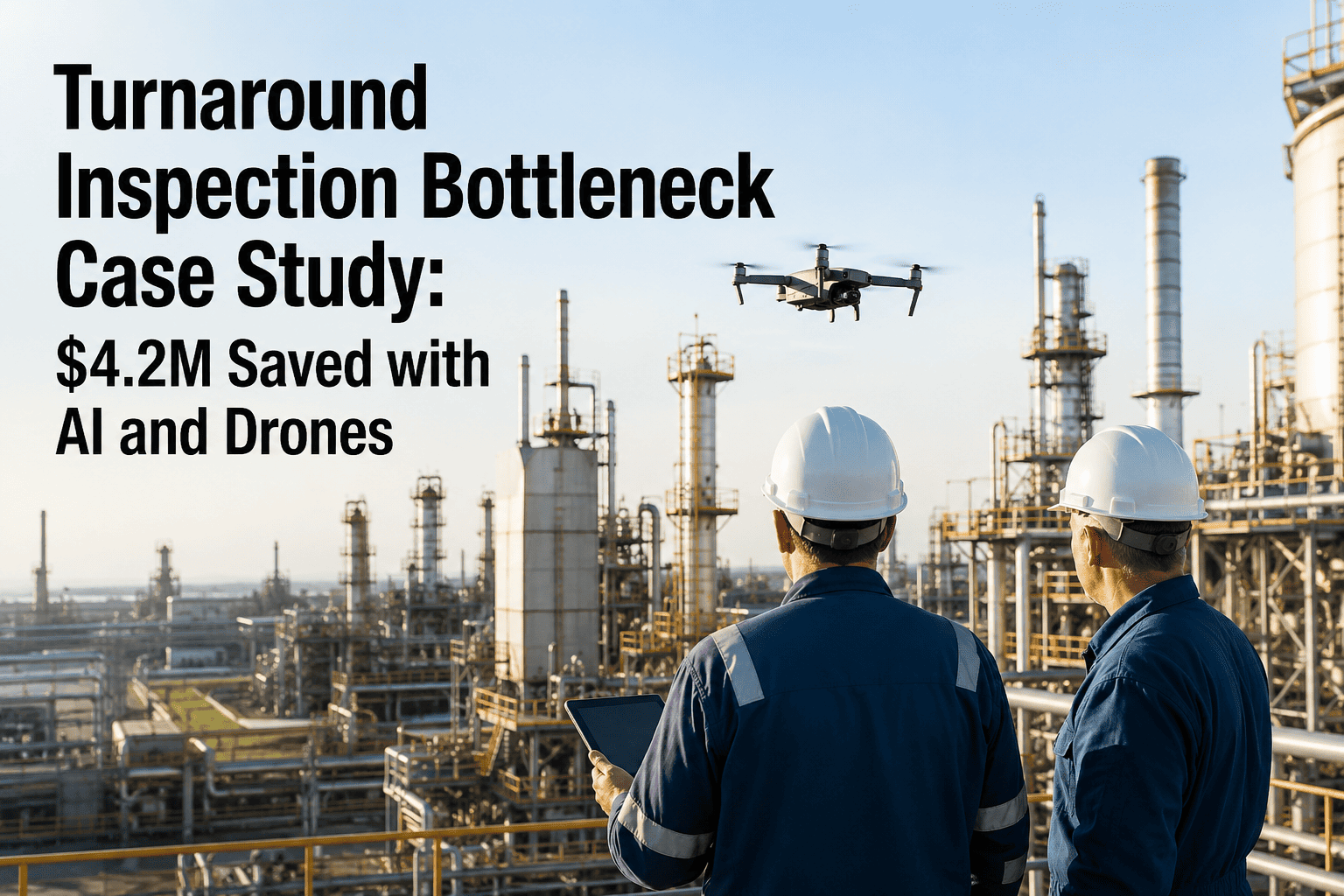
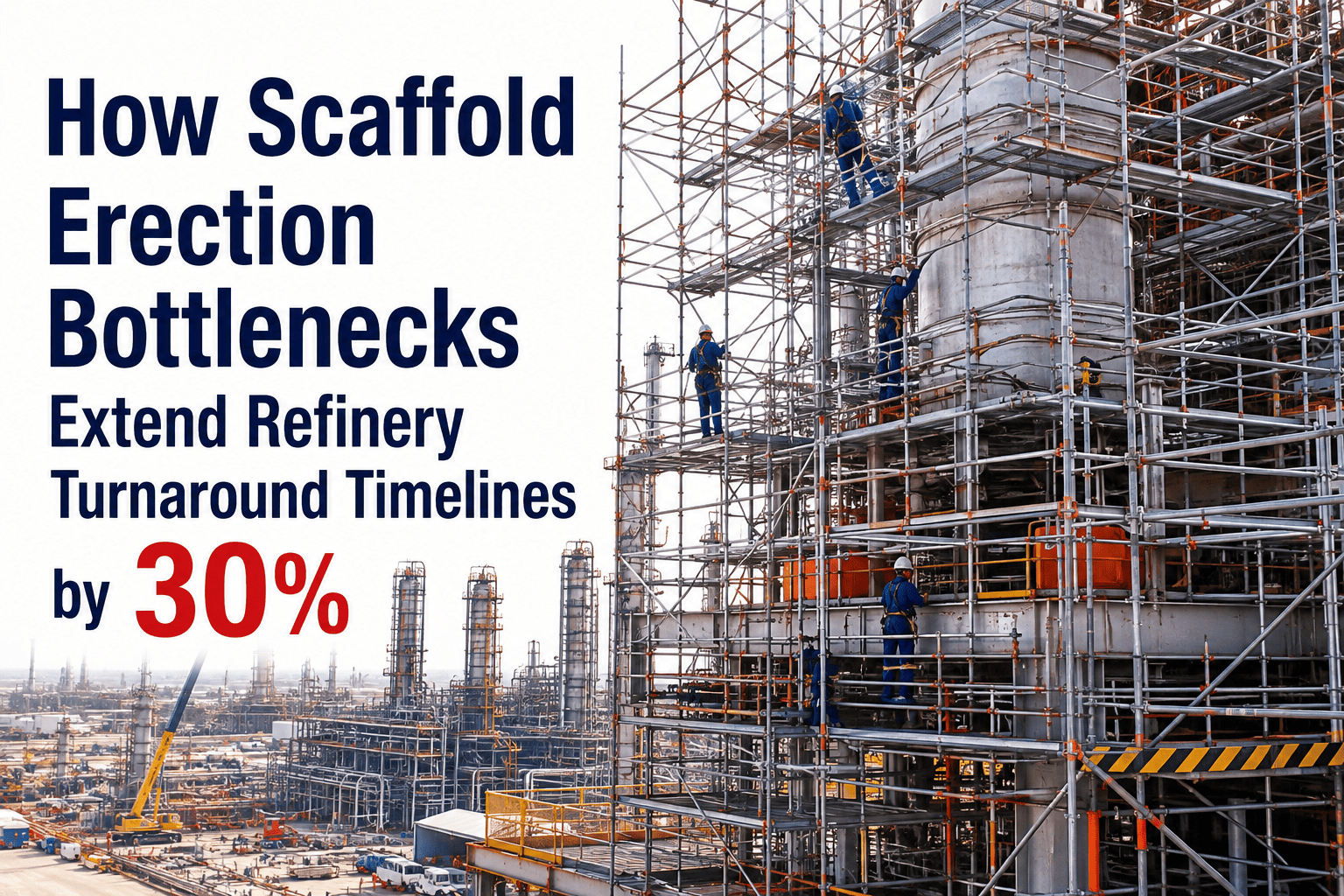
A flare stack inspection that used to take three days with a crane and a scaffold crew now takes two hours with a drone and a two-person team. Most scaffold requests during a turnaround exist for one reason: getting a human eye or a UT probe close enough to a surface to inspect it, not to perform hands-on repair. Drones can now do that part on their own, on roughly 60% of the visual and thickness-measurement scope that currently drives a scaffold call. See how iFactory's AI vision platform processes drone-captured inspection footage automatically into a same-day defect report.
AI Drone Inspection · Refinery Turnarounds
Most Inspection Scaffold Doesn't Need a Human On It. It Needs a Drone.
Columns, exchangers, flare stacks, and tank internals get scaffolded for visual and UT inspection more often than for repair. AI-powered drone inspection removes that dependency for the majority of these calls, leaving scaffold crews free to focus on the access work that genuinely requires hands and tools.
2 weeks → 4 hrsDiesel tank inspection time, scaffold vs indoor drone
70-85%Typical cost reduction vs traditional scaffold-based inspection
60%Share of scaffold-dependent inspections that drones can replace
What Actually Moves Off Scaffold
Three Inspection Categories, One Common Thread
Not every scaffold call is an inspection call, and not every inspection call needs a drone. The pattern that matters is simple: if the work requires eyes or a sensor near a surface but not hands on the equipment, it is a candidate for aerial or indoor drone replacement. If it requires torque, welding, or physical part replacement, scaffold stays.
Visual & Corrosion Survey
External column shells, exchanger heads, structural steel, and elevated piping runs get a full visual pass without a single scaffold board going up. High-resolution imagery captures the same defects a walk-down inspection would catch, geo-referenced for exact re-inspection later, and stitched into an orthomosaic that shows the entire structure at once rather than the narrow band a single scaffold setup would reveal.
Confined Space Internal Inspection
Indoor drones fly inside tanks, vessels, and flare stacks without purging, ventilating, or sending an inspector through a confined space entry permit process that alone can take a day to clear. The same flight also carries lighting sufficient to illuminate dark internal surfaces that a handheld inspection light would struggle to cover evenly.
Ultrasonic Thickness Mapping
UT-payload drones collect up to 250 thickness measurements per hour at height, producing API and EEMUA-compliant corrosion data without a crane, a rope access crew, or a multi-day scaffold build around the structure. The resulting point cloud of thickness readings is denser than what a manual grid survey typically covers in the same time window.
Side By Side
Drone Inspection vs. Scaffold-Based Inspection
The comparison is not close on any dimension that matters to a turnaround schedule, though scaffold retains one advantage worth being honest about: it puts a person physically at the surface, which some repair-adjacent inspection work still requires.
| Factor | Scaffold-Based Inspection | Drone-Based Inspection |
| Typical Deployment Time |
3-5 days mobilization |
24-48 hours |
| Inspection Duration |
2-3 days per structure |
2-6 hours per structure |
| Crew Size |
6-8 person crew |
2 person team |
| Typical Cost |
$25,000-$75,000+ |
$4,000-$30,000 |
| Coverage Per Setup |
10-15% of surface area |
90-100% of surface area |
| Confined Space Permit |
Usually required |
Often avoided entirely |
See Your Own Inspection Scope Split
Find Out What Percentage of Your Scaffold Requests Are Actually Inspection Calls
iFactory's engineering team reviews your last turnaround's scaffold work orders and flags which ones were inspection-only, drone-replaceable requests versus genuine hands-on access — no cost to scope the split.
How It Fits Into The Turnaround Workflow
From Flight Plan To Defect Report In One Shift
Drone inspection is not a bolt-on side activity. It replaces a specific step in the existing workflow, and it produces the same deliverable a scaffold-based inspection would, just faster and with better coverage.
1
Pre-Turnaround Flight Planning
Structures are mapped and flight paths are pre-programmed weeks before the outage, so the drone team can start capturing data the moment the unit is isolated and safe to enter, instead of spending the first day of the outage window figuring out a flight plan on site.
2
Capture
External visual, internal confined-space flight, or UT mapping is completed in a single deployment window, with the drone team on site for hours rather than days, and multiple structures often covered in the same shift.
3
AI Defect Detection
Captured imagery and UT data is processed through AI vision models trained on corrosion, pitting, and thickness-loss patterns, flagging findings for inspector review instead of requiring a human to scan every frame manually or squint at thousands of thickness readings by hand.
4
Targeted Scaffold Request
If a finding requires hands-on repair, a scaffold request goes out for that specific location only, already scoped and justified by the drone data, instead of a blanket structure built on a guess about where the problem might be.
Where This Applies On Your Site
Four Asset Classes Where Drone Replacement Has The Fastest Payback
Distillation Columns
External shell corrosion survey and internal tray visual inspection, replacing the scaffold cycle that otherwise consumes 6-9 days per column and freeing that crew for the hands-on tray work that still needs them.
Flare Stacks
UT thickness mapping at height, cutting a typical 3-day crane-and-scaffold inspection down to a 2-hour flight with comparable data quality and none of the crane rental cost that dominates a traditional stack inspection budget.
Storage Tanks
Indoor drone flights inside the tank shell eliminate the need to drain, purge, and scaffold the interior for a routine internal visual pass, often reducing a two-week inspection window to a single afternoon.
Elevated Piping & Structural Steel
Wide-area visual survey of pipe racks and structural members that would otherwise require scaffold at multiple setup points to achieve full coverage, completed in one continuous flight session across the entire rack.
The Numbers
What One Gulf Coast Refinery Recovered By Shifting Inspection Off Scaffold
A Gulf Coast refinery eliminated a substantial share of its annual scaffolding cost by adopting drone inspection for its pipeline network and storage facilities, running quarterly inspections that previously required extensive scaffold installations with a two-drone, three-person team instead. The pattern holds at turnaround scale as well as for routine inspection cycles.
Annual scaffolding cost eliminated (pipeline & storage)$450K
Flare stack inspection: crane/scaffold vs drone3 days → 2 hours
Flare stack inspection cost saved$150K
Coverage vs single scaffold setup6-10x more surface area
Field Perspective
The mistake shops make is treating drones as a replacement for the whole inspection program. They're a replacement for the access problem, not the judgment problem. What changes is that our inspectors stop spending three days waiting for scaffold and start spending three days actually reviewing data, which is a better use of a certified inspector's time by any measure.
Renata Osei
Inspection Program Manager, Downstream Refining · API 510/570 Certified · 16 years in mechanical integrity
Common Questions
Frequently Asked Questions
Does drone inspection meet the same compliance standards as scaffold-based NDT?
UT-payload drones collect data that meets API and EEMUA standards of inspection when operated with calibrated sensors and reviewed by a qualified inspector, the same requirement that applies to any thickness measurement regardless of how the probe reached the surface. The robot or drone is a data collection tool; a certified API 510 or API 570 inspector still makes the fitness-for-service determination.
Talk to our engineering team about compliance documentation for your specific asset class.
Can drones fully eliminate scaffold, or only reduce it?
Reduce, not eliminate. Roughly 60% of scaffold-dependent inspection calls are visual or UT scope that a drone can complete without a structure at all. The remaining scope, anything requiring hands-on repair, valve operation, or physical part replacement, still needs scaffold, rope access, or a lift. The value is in removing the inspection-only calls so scaffold crews focus entirely on genuine access work.
How much does a drone inspection program cost compared to what we currently spend on scaffold?
Facilities typically see 70-85% cost reduction on inspections that move from scaffold to drone, based on typical scaffolding expenditures of $250,000-$500,000 annually per unit against drone deployment costs in the $4,000-$30,000 range per structure. The exact figure depends on structure height, internal complexity, and how many repeat inspections a facility runs per year on the same assets.
What happens to the inspection data after the drone flight?
Captured imagery, thermal data, and UT measurements flow into an AI vision pipeline that flags likely defects for inspector review, producing a report with the same fields a manual walk-down inspection would generate. The underlying imagery and thickness data are also archived and geo-referenced, so future inspections can be directly compared against the same points on the structure.
Book a demo to see a sample defect report from a real drone flight.
Do we need to retrain our inspection team to use this, or hire a separate drone contractor?
Most facilities start with a contracted drone team for the first one or two turnarounds while internal inspectors get comfortable reviewing AI-flagged findings instead of raw footage. Facilities running frequent turnarounds or routine inspection cycles often bring drone operation in-house once the workflow is proven, since the operator skill requirement is lower than the certified inspection judgment that remains the actual bottleneck.
Ready to Cut the Scaffold Dependency
Stop Scaffolding Structures Just to Look at Them
iFactory's AI vision platform processes drone-captured visual and UT inspection data automatically, turning flight footage into a defect report your inspectors can act on the same day, without a structure being built first just to get a camera close enough.