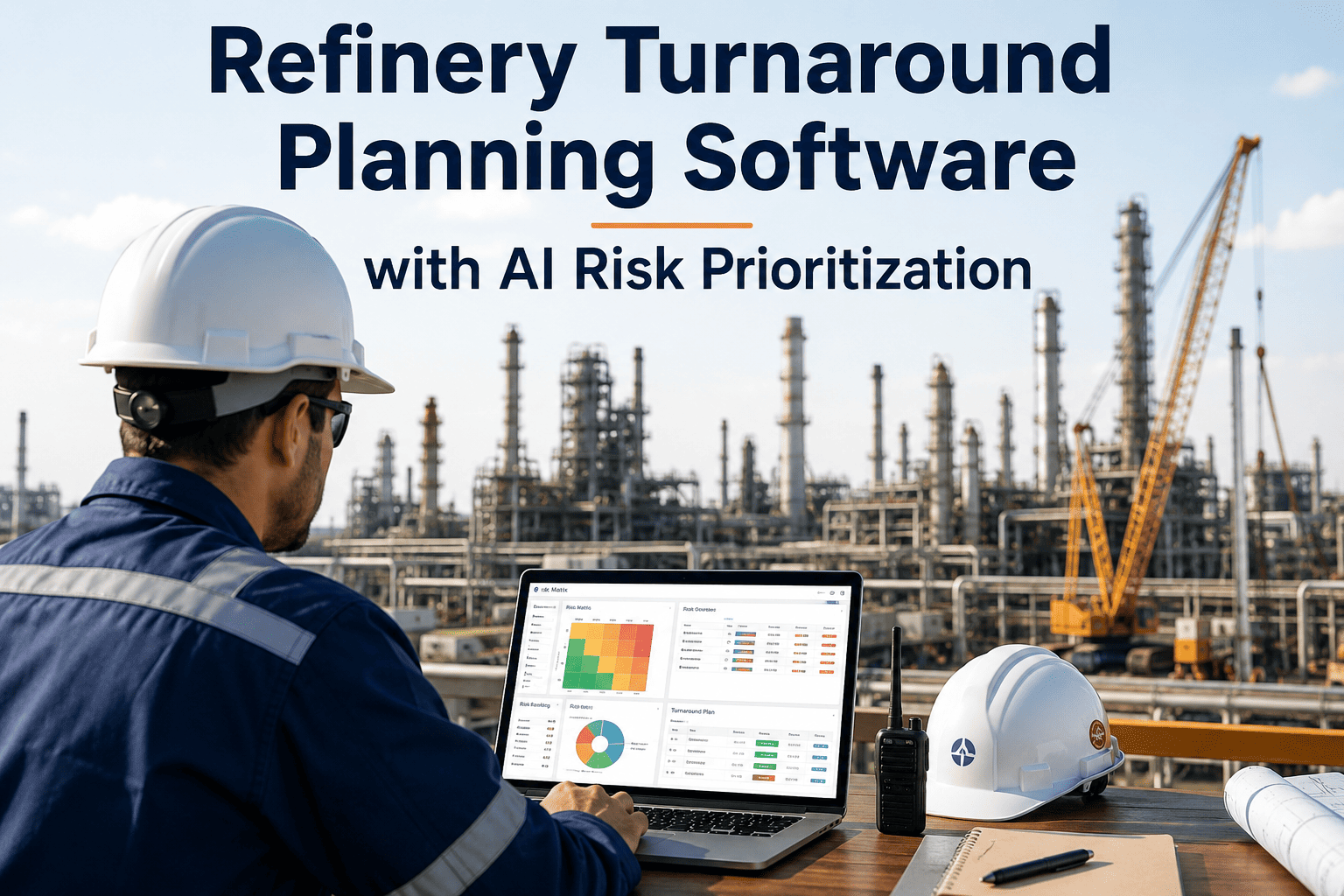
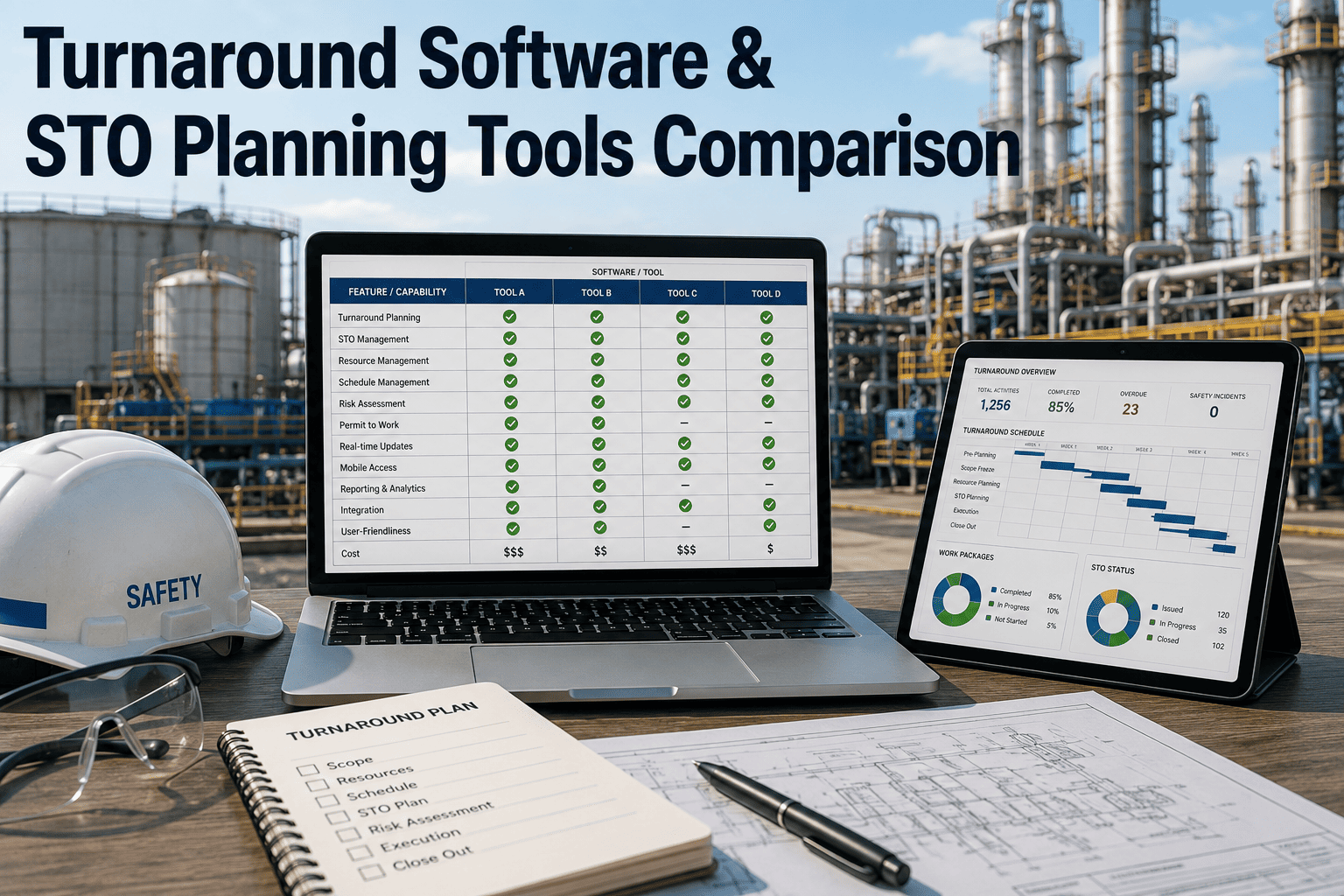
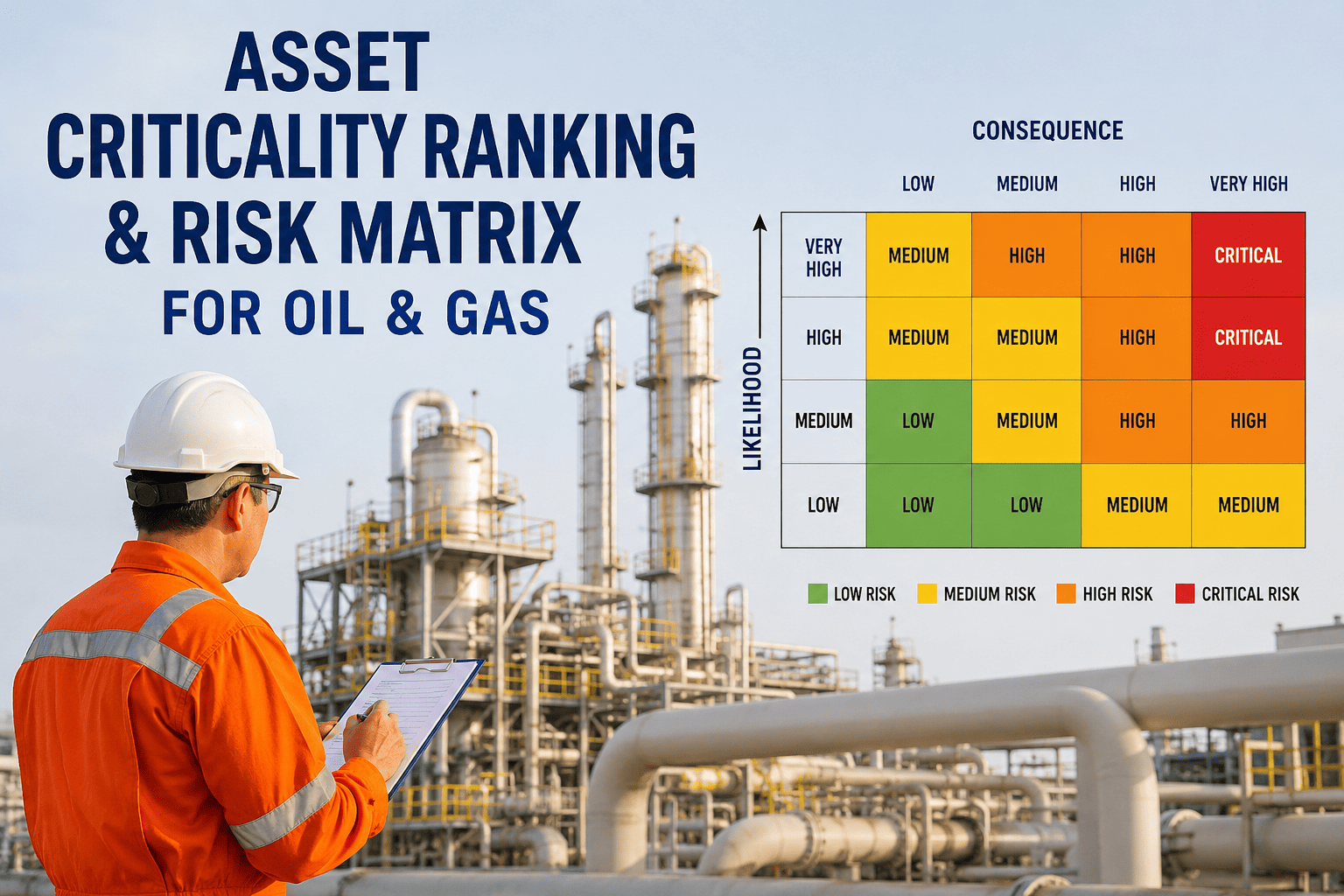
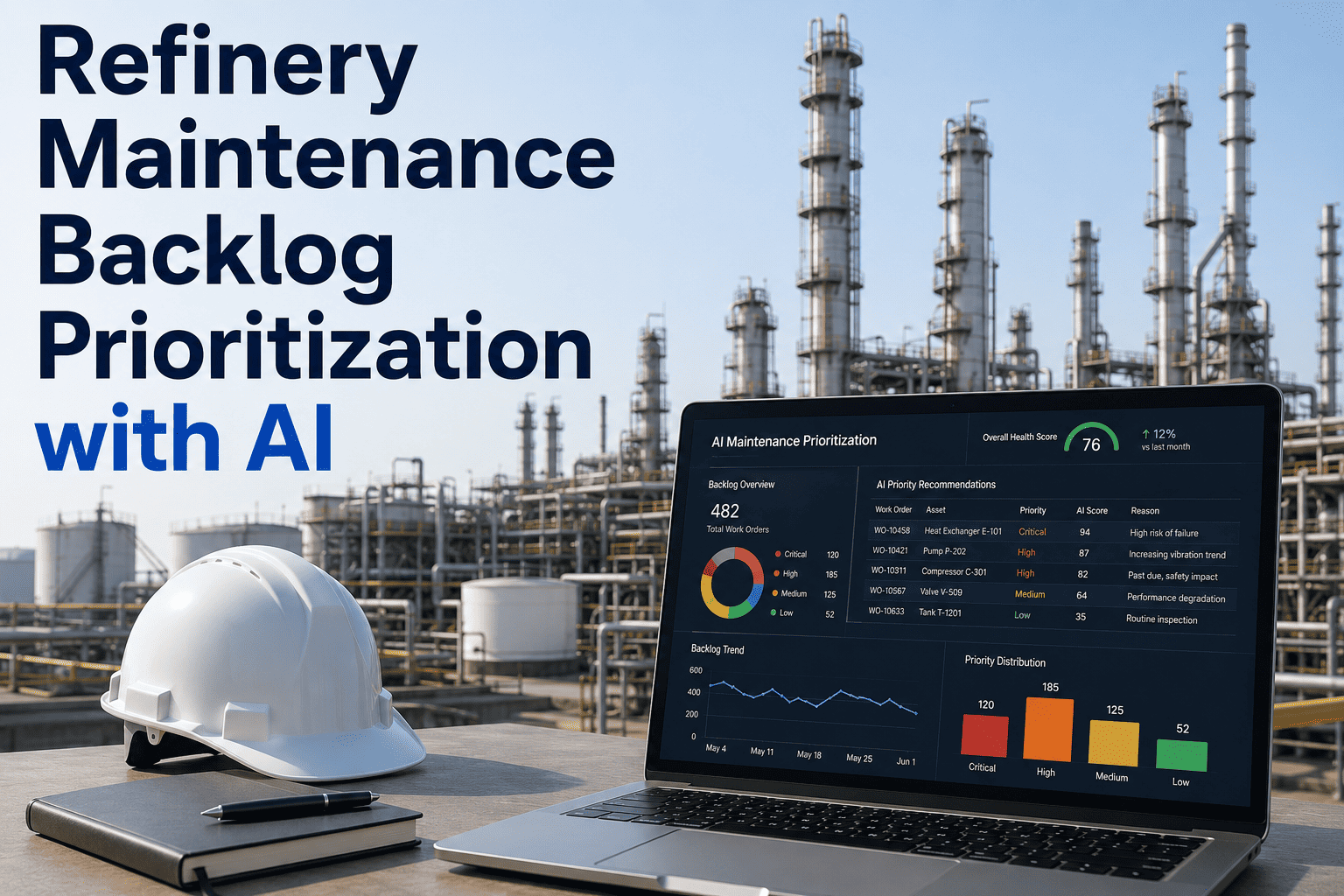
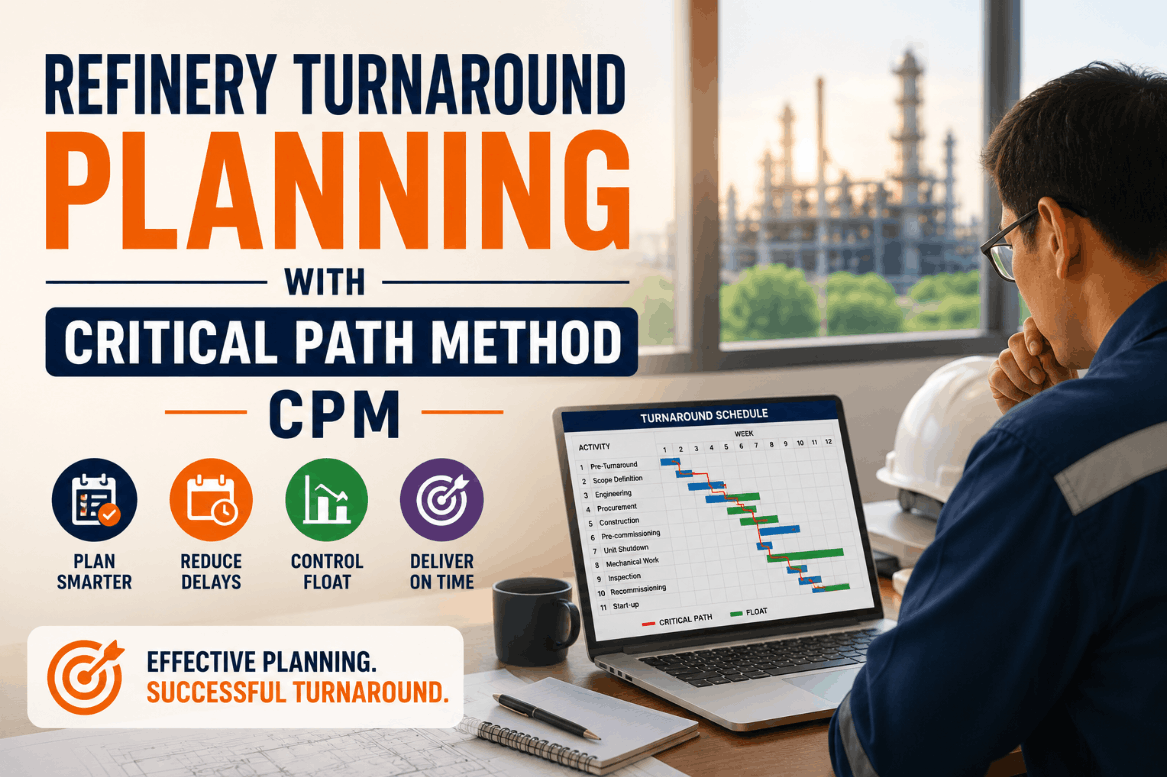
Refinery turnarounds are among the most complex, high-stakes events in the petroleum industry. A single delayed turnaround can cost between one and three million dollars per day in lost production, while poorly prioritized scope drives unplanned work that compounds those losses. Most refineries still rely on spreadsheet-based risk matrices and manual inspection review to decide which work items make the final turnaround scope. This approach cannot process the volume of inspection evidence, asset condition data, and maintenance backlog information needed to make optimal prioritization decisions under schedule pressure. See how AI-driven risk prioritization transforms your next turnaround by booking a demo with iFactory.
$1-3M
Average daily cost of a delayed refinery turnaround in lost production revenue
15-25%
Typical scope creep rate in turnarounds planned with manual risk matrices
10,000+
Work items requiring risk prioritization in a major refinery turnaround event
Stop Planning Turnarounds with Spreadsheets — AI Prioritizes Your Scope in Days, Not Weeks
iFactory's Maintenance Planning AI ingests your CMMS history, inspection evidence, and process data to score every turnaround work item by risk-weighted priority — eliminating manual matrix subjectivity and catching high-risk scope that spreadsheet reviews miss.
Where Turnaround Budgets Actually Leak: The Real Cost Breakdown
Industry data from over 200 refinery turnarounds shows that cost overruns follow a consistent pattern — and the largest single driver is not labor rates or material costs, but the failure to prioritize scope correctly during planning. When risk prioritization relies on manual review, high-consequence work items get buried in a backlog of 10,000-plus candidates, and their discovery during execution forces expensive scope additions, schedule shifts, and resource reallocation that cascade across the entire turnaround.
Scope Creep from Unprioritized Work
42%
Avg $21M per event
Schedule Delays from Resource Conflicts
28%
Avg $14M per event
Unplanned Work from Missed Inspection Findings
18%
Avg $9M per event
Rework from Incorrect Scope Definition
12%
Avg $6M per event
These four cost drivers share a common root cause: the planning team did not have a complete, risk-ranked view of all candidate scope when the final work list was frozen. AI-driven prioritization addresses this by scoring every work item against multiple risk dimensions simultaneously, ensuring that the 42% scope creep category is systematically reduced before the turnaround begins.
The 5-Phase AI Turnaround Planning Workflow
Effective turnaround planning with AI is not a single algorithm — it is a structured workflow that moves from raw data ingestion through risk scoring, scope ranking, resource optimization, and execution readiness monitoring. Each phase builds on the previous one, creating a traceable decision chain from inspection evidence to final work list that satisfies both operations leadership and PSM compliance auditors.
01
Data Ingestion
Historian process data, CMMS work order history, RBI and RBMI inspection records, previous TA reports, and safety critical equipment lists are ingested and mapped to a unified asset taxonomy.
02
Asset Risk Scoring
ML models trained on your refinery's operating history score each asset on failure probability, consequence severity, and degradation trajectory — producing a composite risk score for every piece of equipment.
03
Scope Prioritization
Every candidate work item is ranked by risk-weighted priority, with AI flagging items that manual review consistently underranks — particularly cross-unit dependencies and compound degradation patterns.
04
Resource Optimization
Prioritized scope is aligned with available craft labor, scaffolding capacity, equipment availability, and critical path constraints — producing a resource-loaded schedule that AI continuously rebalances.
05
Execution Readiness
AI monitors preparation milestones — material procurement, scaffold erection, permit completion, isolation verification — with risk-adjusted alerts that flag readiness gaps before execution delays.
Data Sources Powering AI Turnaround Risk Scoring
The accuracy of AI risk prioritization depends entirely on the breadth and quality of data feeding the models. iFactory's platform is built to ingest the six primary data sources that refinery turnaround planners already maintain — eliminating the need for new data collection workflows and instead extracting risk intelligence from systems that are already capturing the information but not analyzing it together.
Work order frequency, failure modes, repair costs, and mean time between failures for every asset in the turnaround boundary — providing the empirical basis for failure probability scoring.
RBI assessments, RBMI findings, UT thickness readings, radiography results, and corrosion coupon data — each mapped to specific assets and correlated with process operating conditions.
Temperature, pressure, flow, and composition trends that indicate accelerating degradation — particularly useful for identifying assets whose condition has changed since the last inspection cycle.
Scope execution records, punch list items, deferred work from prior turnarounds, and actual versus planned duration data — revealing recurring scope that manual planning consistently overlooks.
PSM mechanical integrity requirements, API inspection codes, environmental permit conditions, and jurisdictional mandate schedules that create non-negotiable scope items with compliance-driven priority.
Safety critical equipment inventories, process hazard analysis action items, and management of change records that define must-include scope with safety-driven prioritization above all other categories.
How AI Ranks Your Turnaround Scope: The Four-Tier Priority System
AI risk prioritization does not produce a simple ranked list — it classifies every work item into one of four priority tiers, each with a clear inclusion recommendation and supporting evidence chain. This tiered approach gives turnaround planners the structure to make defensible scope decisions while maintaining the flexibility to adjust boundaries based on schedule and budget constraints.
Tier 1
Critical — Must Include
Safety-critical equipment with active degradation, regulatory-mandated inspections, and assets with failure probability scores above the 90th percentile. AI flags these with full evidence chains linking inspection findings to consequence models.
Typically 15-20% of candidate scope
Tier 2
High — Strong Include
High-consequence assets with confirmed inspection findings, equipment showing accelerating degradation trends in historian data, and items deferred from previous turnarounds with worsening condition profiles.
Typically 25-30% of candidate scope
Tier 3
Medium — Conditional Include
Moderate-risk assets approaching condition limits, equipment with stable but concerning trends, and work items whose deferral risk is manageable within the next operating cycle. AI provides deferral cost estimates for each item.
Typically 30-35% of candidate scope
Tier 4
Low — Review for Deferral
Low-consequence items with no active degradation, condition-based work that does not affect reliability, and candidate scope driven by optimization rather than integrity. AI quantifies the risk of deferring each item.
Typically 20-25% of candidate scope
Traditional vs AI-Driven Turnaround Planning: A Direct Comparison
The gap between manual and AI-driven turnaround planning is not incremental — it is structural. Manual processes are limited by the number of work items a human team can review in the planning window, while AI processes the entire candidate scope against multiple risk dimensions simultaneously. This table shows the specific operational differences that translate into millions of dollars in avoided cost overruns.
| Planning Parameter |
Traditional Manual Approach |
AI-Driven with iFactory |
| Scope Items Evaluated |
500 to 1,500 items reviewed manually by planning team over 4 to 8 weeks |
10,000 to 50,000 items scored automatically in 2 to 3 days with full risk traceability |
| Risk Scoring Method |
5x5 probability-consequence matrix with subjective operator judgment |
Multi-parameter ML model using CMMS history, inspection data, and process trends |
| Inspection Integration |
Manual cross-reference of inspection reports with work order backlog |
Automated correlation of all inspection findings to asset risk scores in real time |
| Cross-Unit Dependencies |
Identified through planner experience and meetings — frequently missed |
AI maps equipment dependencies across units and flags compound risk patterns |
| Scope Creep Rate |
15 to 25% average scope addition during execution phase |
5 to 8% average with AI-validated scope freeze and deferral documentation |
| Compliance Documentation |
Assembled manually for PSM audits and PHA revalidation |
Auto-generated evidence chains linking scope decisions to inspection data and risk scores |
| Planning Cycle Time |
4 to 8 weeks from scope development to frozen work list |
2 to 3 days for initial risk-ranked scope; 2 to 3 weeks for full optimized plan |
Measurable Impact of AI Risk Prioritization on Turnaround Outcomes
Refineries that have adopted AI-driven turnaround planning report consistent, quantifiable improvements across the four metrics that matter most to turnaround leadership: scope control, schedule adherence, cost performance, and safety compliance readiness. These results are not projections — they are measured outcomes from deployed systems processing real turnaround data.
67%
Reduction in Scope Creep
From 18% average to 6% through AI-validated scope freeze with deferral justification
40%
Faster Prioritization
Planning cycle compressed from 6 weeks to under 4 days for initial risk-ranked output
23%
Shorter Turnaround Duration
Resource-optimized schedules with AI-rebalanced critical path reduce total event duration
$12M
Average Cost Savings
Per turnaround event through reduced scope additions, schedule compression, and avoided rework
iFactory connects directly to OSIsoft PI Historian, AspenTech IP21, SAP PM, and IBM Maximo — ingesting your refinery's turnaround-relevant data without manual reformatting. Models learn your specific asset risk profiles, seasonal operating patterns, and historical scope execution performance. Predictive alerts generate CMMS work orders with recommended interventions and procurement triggers tied to your turnaround timeline.
See Your Turnaround Scope Risk-Ranked in Under a Week — With Your Own Data
iFactory deploys AI risk prioritization on your refinery's actual CMMS and historian data in 4 to 6 weeks — with pilot risk scores on your highest-criticality unit delivered in week three. No data migration, no new software to learn, just a risk-ranked scope list that your planning team can use immediately.
What Turnaround Managers Report After AI Adoption
In our 2022 turnaround, we had 14 scope additions in the first week of execution that should have been caught in planning. Each one required us to pull scaffolding crews off the critical path and resequence downstream work. When we analyzed what happened afterward, the inspection findings for every one of those 14 items were in our RBI database during the planning window. The planning team simply did not have time to cross-reference 12,000 inspection records against 8,000 work order candidates manually. With AI prioritization on our 2024 turnaround, we caught those same patterns before scope freeze — our execution scope additions dropped to three items, and two of those were genuine new findings from pre-shutdown inspection.
Turnaround Planning Manager
Gulf Coast Refinery — Crude and Vacuum Units, 18 Years in Turnaround Planning
The most surprising result for us was not the scope reduction — it was the resource optimization. Our scaffolding contractor had been over-estimating scaffold requirements by 30 to 35 percent on every turnaround because they could not trust the scope list to stay stable. When AI gave us a risk-validated scope freeze with documented deferral justification, the contractor was willing to bid on actual planned scope rather than padded estimates. We saved over two million dollars on scaffolding alone, not because AI planned the scaffolding, but because AI made the scope predictable enough to plan scaffolding accurately.
Senior Turnaround Coordinator
Midwest Refinery — FCC and Alkylation Turnarounds, 14 Years
Frequently Asked Questions
Your Next Turnaround Scope Deserves AI-Driven Risk Prioritization — Not Another Spreadsheet Review
iFactory's Maintenance Planning AI scores every candidate work item against your inspection evidence, asset history, and process data — delivering a risk-ranked, compliance-ready scope list in days instead of weeks, with measurable reductions in scope creep, schedule delays, and execution cost overruns.
Risk-Weighted Scope Ranking
CMMS Work Order Generation
PI Historian Integration
PSM Compliance Documentation
4-6 Week Deployment