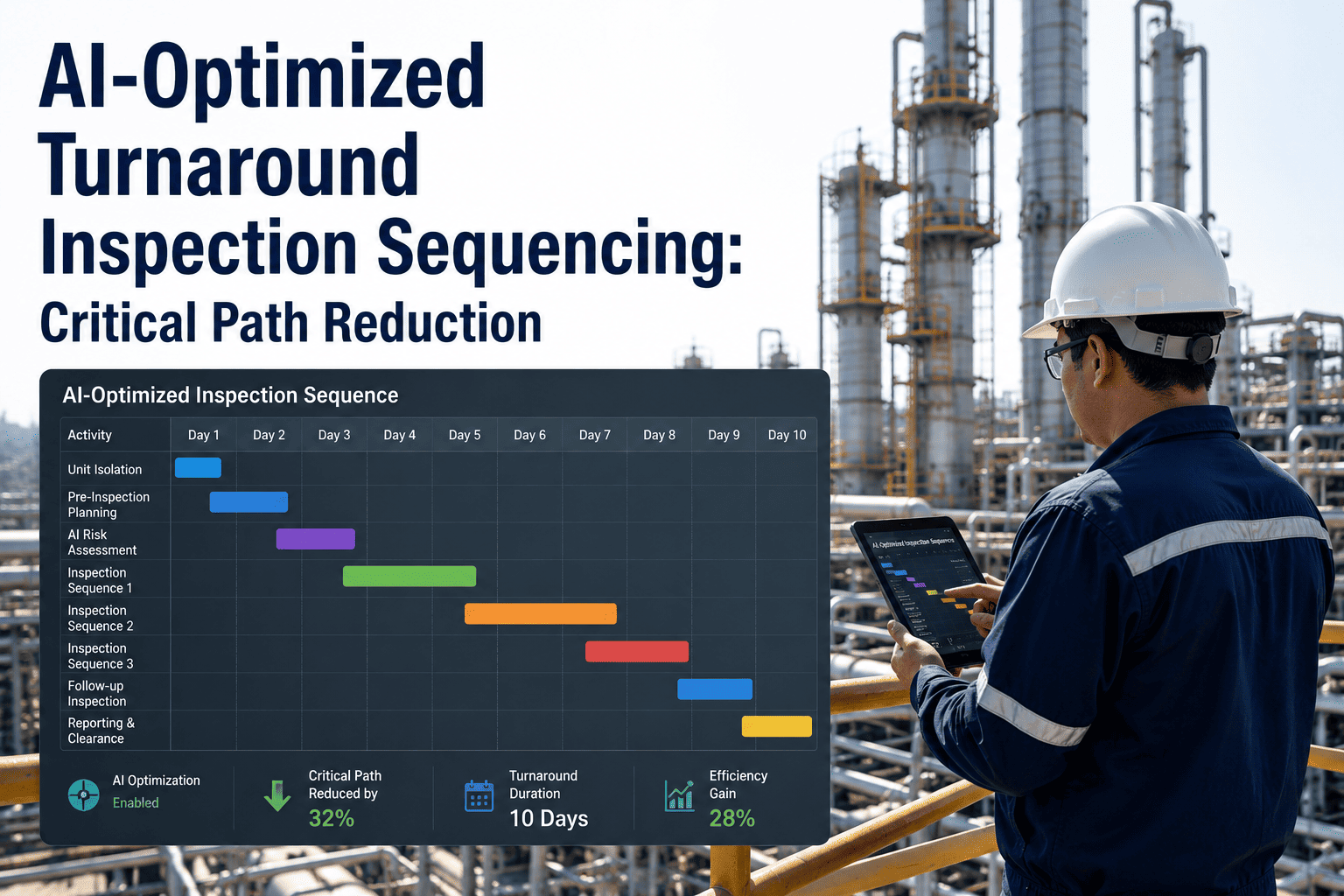
Ask a turnaround planner how inspection sequence gets decided and most will describe a spreadsheet, a planning meeting, and whoever shouts loudest about their unit's priority. The sequence rarely reflects what actually determines how fast inspection moves: equipment failure consequence, access dependencies, and crew availability on a given day. Manual planning can hold two of these three in its head at once, not all three across a hundred-item backlog, which is why AI-optimized sequencing shows measurable reductions in bottleneck duration. See how iFactory's scheduling engine rebalances all three constraints together as findings come in.
Turnaround Scheduling · Inspection Sequencing
Three Variables, One Sequence: Why Manual Planning Can't Keep Up
Equipment criticality, access dependencies, and crew availability all change daily during a turnaround. AI sequencing engines recalculate the optimal inspection order against all three every time one of them shifts — something a weekly planning meeting was never built to do.
25-40%Typical improvement in resource efficiency from AI-driven scheduling
15-35%Improvement in deadline adherence reported by early adopters
60-70%Reduction in crisis-mode emergency schedule recovery events
The Three-Variable Problem
What Has To Be Balanced Simultaneously, Not In Sequence
The reason manual planning struggles is not lack of effort. It is that these three variables interact — solving one in isolation frequently makes the schedule worse against the other two, and a human planner cannot re-run the full combination fast enough to see that before committing to a sequence.
Equipment Criticality
Ranked by consequence of failure, historical defect rate, and time since last inspection — pulled from RBI and CMMS data rather than a static priority list set months before the outage began and never revisited once execution starts.
Access Dependencies
Which inspections require scaffold, isolation, or confined space entry to be complete first, and which downstream mechanical work is waiting on that inspection's findings before it can be scoped, priced, and released for execution.
Crew Availability
Real-time capacity across NDT technicians, confined space attendants, and certified inspectors, who are shared across multiple units and cannot be double-booked without one assignment silently slipping and pulling the whole downstream sequence with it.
Manual vs. AI-Optimized
The Same Backlog, Two Different Sequences
The inspection scope does not change between these two approaches. What changes is the order work happens in, and that order alone is frequently the difference between finishing on schedule and running days over.
Manual Sequencing
Sequenced roughly by unit shutdown order, not by which findings would most affect downstream scope or which equipment carries the highest failure consequence
Re-sequencing happens at the next scheduled planning meeting, often a day or more after a conflict appears and crews have already sat idle
Crew conflicts discovered when two supervisors call for the same NDT technician on the same morning, with no fallback plan already in place
High-consequence equipment inspected in the same rough order as low-risk equipment nearby, simply because they happen to sit close together on the unit
AI-Optimized Sequencing
Sequenced by combined criticality, access readiness, and crew capacity score, recalculated continuously as conditions on the ground shift
Re-sequencing happens automatically the moment a finding, permit, or crew status changes, before it can idle a crew or stall a downstream task
Crew conflicts flagged before they happen, with an alternative sequence proposed in the same alert rather than left for a supervisor to improvise
Highest-consequence equipment moved to the front of the queue whenever capacity allows it, regardless of its physical position on the unit
See Your Backlog Re-Sequenced
Run Your Next Turnaround's Inspection List Through The Model
Send your current inspection backlog and crew roster and iFactory's engineering team will return an optimized sequence alongside your existing plan, so you can compare the two before committing to either.
How It Works
From Static Priority List To A Living Schedule
01
Score Every Item Against All Three Variables
Each inspection in the backlog gets a combined score from RBI criticality, access readiness, and current crew capacity, refreshed continuously rather than calculated once at scope freeze and left untouched through the rest of execution.
02
Generate The Sequence That Minimizes Idle Time
The model runs thousands of ordering permutations to find the sequence that keeps crews continuously busy while still prioritizing the highest-consequence equipment first, something no human planner can realistically test by hand within a planning cycle.
03
Flag Conflicts Before They Happen
When two work packages need the same crew on the same day, the system surfaces the conflict and a proposed alternative before either supervisor discovers it the hard way on the morning both crews show up expecting the same technician.
04
Re-Sequence Automatically As Conditions Change
A new finding, a delayed permit, or a crew calling in short reruns the optimization in minutes, and the updated sequence pushes to every affected crew's work list immediately instead of surfacing at the next status meeting.
Measured Impact
What Improves And By How Much
| Metric | Manual Planning Baseline | AI-Optimized Range |
| Resource Efficiency |
Baseline |
+25-40% |
| Deadline Adherence |
Baseline |
+15-35% |
| Manual Scheduling Overhead |
Baseline |
-30-60% |
| Emergency Schedule Recovery Events |
Baseline |
-60-70% |
| Inspection Bottleneck Duration |
Baseline |
-25-40% |
These ranges reflect a consistent pattern across facilities that adopted digital scheduling tools: the gain comes less from any single dramatic fix and more from removing the daily accumulation of small conflicts and idle-crew hours that a manual planning cadence cannot catch in real time.
Field Perspective
The thing that convinced our planning team wasn't the schedule getting shorter on paper. It was watching the Tuesday morning fire drill disappear — the one where two supervisors both need the same UT technician and someone has to lose. When the system catches that Sunday night instead of Tuesday at 6 a.m., you get days back that never show up as a single dramatic save, just as a turnaround that stopped bleeding time in a hundred small places.
Devon Whitfield
Turnaround Scheduling Manager, Refining & Petrochemical · 14 years in shutdown planning
Common Questions
Frequently Asked Questions
Does AI sequencing replace the turnaround planning team, or work alongside them?
Alongside. The model generates and continuously updates the optimal sequence, but planners still validate the output, apply operational judgment the model doesn't have visibility into, and make the final call on any sequence that gets pushed to crews. The value is removing the manual recalculation burden, not removing the planner's decision authority.
Talk to our engineering team about how the handoff works in practice.
What data does the scheduling engine need to start producing useful sequences?
At minimum, the current inspection backlog with RBI or criticality scores, the access and permit status for each item, and a live crew roster with certifications and availability. Facilities with CMMS and RBI systems already in place typically get a usable model running within four to six weeks, with the first optimized sequence available well before that on the highest-criticality unit.
How often does the sequence actually change once the turnaround starts?
Frequently — that's the point. A single new inspection finding, a permit delay, or a crew calling in short can shift the optimal order for dozens of downstream items, and the system recalculates within minutes rather than waiting for the next scheduled planning meeting. Most facilities see meaningful re-sequencing events multiple times per shift during peak execution.
Can this integrate with the scheduling software we already use?
Is this only useful for large multi-week turnarounds, or does it help shorter outages too?
Shorter outages benefit proportionally more from tight sequencing because there is less schedule slack to absorb a conflict. A three-day unit outage with a crew scheduling error has almost no room to recover, while a six-week turnaround can sometimes reshuffle around a delay without it showing up in the final number. Facilities running frequent short outages often see the fastest measurable payback.
Ready to Stop Re-Planning By Hand
Let The Schedule Rebalance Itself When Conditions Change
iFactory's turnaround scheduling engine scores your inspection backlog against criticality, access readiness, and crew capacity simultaneously, and keeps recalculating the optimal sequence throughout execution instead of once at scope freeze.