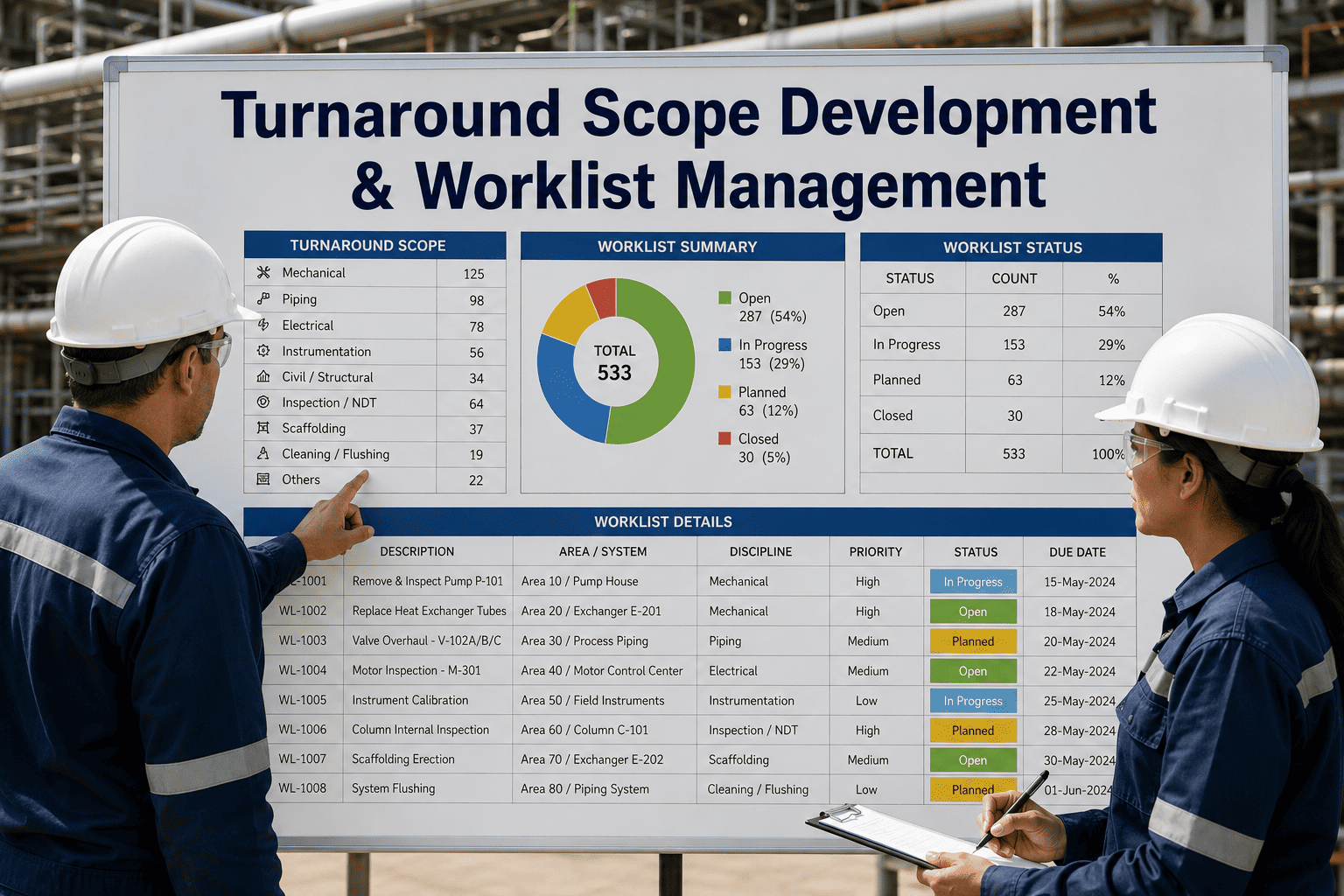
A turnaround worklist that gets finalized on the fly, once a vessel is already open and the clock is already running, is how a planned three-week shutdown quietly becomes a five-week one. Every additional day a unit sits offline costs real production, and the single biggest driver of turnaround overruns is not the work crews already know about, it is the inspection findings nobody planned for because the NDE program was scoped too loosely to catch them early. Getting method selection, crew sizing, and data management right before the first blind comes off is what separates a turnaround that finishes on schedule from one that discovers its real scope halfway through. Planning teams building their next TAR inspection program can book a demo to see how a connected worklist keeps findings from turning into schedule surprises.
TURNAROUND INSPECTION · NDE PLANNING · VESSELS & HEAT EXCHANGERS
Plan the Inspection Program Before the First Blind Comes Off
Vessels, columns, and heat exchangers only give up their real condition once. Here is how to match NDE methods to damage mechanisms, size the crew correctly, and keep every finding traceable from the first scan to mechanical completion.
T-90
Typical planning window before shutdown for finalizing the inspection worklist
100%
Common requirement for ECT coverage of stainless tube bundles per operator specifications
5 methods
UT, RT, MT, PT, and ECT form the traditional core of a vessel and exchanger NDE program
10-15%
Recommended overage on gaskets and fasteners to absorb field variances found during opening
Matching NDE Method to Damage Mechanism, Not Habit
The most common planning shortcut is defaulting to the same NDE method used on the last turnaround simply because it worked then. A stronger approach starts from the expected damage mechanism for each piece of equipment, driven by its materials of construction, process exposure, and design history, and only then selects the method that actually detects that mechanism. A vessel with a known history of localized corrosion needs volumetric coverage capable of mapping thickness variation, not a handful of spot UT readings that can miss a pit sitting between grid points.
This is exactly where risk-based inspection data earns its keep during planning. Equipment already carrying a consequence-of-failure rating for toxic, flammable, or product-loss scenarios should drive both the rigor of the method selected and the frequency of tube-bundle pulls, rather than treating every exchanger on the worklist as equally urgent. Matching effort to actual risk is what keeps a turnaround's NDE budget focused on the equipment that can least afford a missed flaw.
CONNECTED TAR WORKLIST
Stop Scoping Findings on the Fly
See how a connected inspection worklist ties findings directly to fitness-for-service decisions and schedule impact in real time.
Sizing the Inspection Crew Without Guesswork
Crew sizing is one of the easiest turnaround planning inputs to get wrong in either direction. Too few certified inspectors and technicians relative to the worklist stretches inspection hold points into the critical path, delaying every downstream repair decision behind them. Too many idle crew members sitting on standby for equipment that is not yet accessible burns budget without shortening the schedule at all. The worklist itself, broken down by method and equipment count, is the input that should drive crew sizing, not a fixed ratio carried over from the last shutdown regardless of scope.
UT / PAUT Technicians
Scaled to shell and nozzle scan area plus expected repeat scans on flagged locations
ECT / Tube Crews
Scaled to total tube count across all bundles scheduled for pull and inspection
MT / PT Technicians
Scaled to weld inspection points and surface examination hold locations
API Inspection Authority
Scaled to hold points requiring certified sign-off before closure or blind removal
The Planning Timeline That Keeps Findings From Becoming Surprises
T-90
Scope and Method Selection
Finalize the equipment worklist and match NDE methods to each item's known damage mechanisms.
T-60
Crew and Long-Lead Procurement
Size inspection crews against the confirmed worklist and issue purchase orders for long-lead items.
T-7
Readiness Review
Confirm scope, materials, contractors, and inspection hold points are aligned and schedule-ready.
T-0
Execution and Hold Points
Execute inspections at each hold point, logging findings before any equipment is closed.
Where Findings Most Often Blow the Schedule
Wall Loss Below Minimum
High schedule risk
Tube Bundle Fouling
Moderate risk
Weld Indication Found
Moderate risk
PRD Bench Test Fail
Lower risk
Relative frequency with which each finding type introduces unplanned scope during turnaround execution.
Fitness-for-Service Decisions Under Schedule Pressure
Every below-minimum thickness reading or unexpected weld indication forces the same question under real time pressure: repair now, defer to a monitored inspection interval, or replace the component outright. Fitness-for-service assessments exist to answer that question with engineering rigor rather than schedule urgency, but they only work when the underlying inspection data is complete and trustworthy the moment the finding surfaces. A reading that cannot be immediately compared against nominal wall thickness, prior inspection history, and the applicable code minimum forces a conservative and often expensive decision made under pressure rather than an informed one.
This is where inspection data management becomes a scheduling tool as much as a compliance one. Findings logged directly against asset history, with immediate access to the last inspection record and the governing code criteria, let engineers make a fitness-for-service call in minutes rather than hours. Multiply that time savings across dozens of findings over a three-week turnaround and the difference between a fast, connected data workflow and a slow, paper-based one becomes measured in real schedule days.
Heat Exchanger Bundles Deserve Their Own Playbook
Heat exchanger tube bundles fail differently than vessel shells, and treating bundle inspection as a smaller version of vessel inspection tends to under-scope it. Bundle condition needs to be assessed for fouling, tube erosion, tube sheet cracking, and baffle damage as distinct failure modes, each requiring its own inspection technique and its own repair-or-replace decision. A bundle that passes eddy current testing with no significant tube wall loss can still be a bad candidate for reinsertion if baffle damage is compromising flow distribution across the tube field.
The repair-or-replace decision itself needs to happen before reinsertion, not after, since a bundle sent back into service with an undocumented condition assessment becomes an unknown quantity the next time the unit shuts down. Recording cleaning method, hydrotest results, and the final condition assessment against the specific bundle serial number, rather than a generic exchanger record, is what makes the next turnaround's planning meaningfully faster than this one's.
What Turnaround Planners Are Saying
We used to find out about scope growth from a phone call from the field days after a vessel was already open. Now every finding is logged against the asset the moment the technician records it, so the planning team sees scope creep the same day it happens instead of the week after.
Turnaround Planning Lead, Gulf Coast Refinery
Frequently Asked Questions
How far in advance should the NDE worklist be finalized?
Most well-run turnarounds finalize the equipment worklist and method selection around ninety days before shutdown, giving enough lead time to size crews correctly and procure any specialized equipment or long-lead materials the confirmed scope requires. Finalizing later than this tends to force reactive crew sizing once the shutdown is already underway, which is one of the more common and avoidable sources of schedule slip. Teams building out this timeline can review their own planning workflow through
support.
How does risk-based inspection data change the NDE scope?
Equipment carrying a higher consequence-of-failure rating under a risk-based inspection program should receive more rigorous NDE coverage and shorter reinspection intervals than lower-consequence equipment, even if both items are the same age and material. This keeps inspection effort proportional to actual risk rather than spreading a fixed level of scrutiny evenly across every vessel and exchanger on the worklist regardless of what a failure there would actually cost.
What is the difference between ECT, RFT, and NFT for tube inspection?
Eddy current testing works well on non-ferromagnetic tube materials like stainless steel and copper alloys, while remote field testing and near field testing are typically selected for ferromagnetic tubing such as carbon steel, where standard eddy current methods lose sensitivity. Choosing the wrong method for the tube material is a common planning mistake that produces unreliable results and can force a costly re-inspection mid-turnaround once the data is reviewed and found unusable.
Should every heat exchanger bundle be pulled every turnaround?
Not necessarily. Bundle pull frequency is typically set using a combination of API 510 requirements and risk-based inspection consequence ratings, meaning higher-risk bundles get pulled and inspected more frequently than lower-risk ones on a fixed schedule tied to actual condition history. Pulling every bundle every turnaround regardless of history adds cost and schedule time without a proportional increase in safety assurance for bundles with a consistently clean inspection history.
How should inspection data be managed during execution?
Findings should be logged against the specific asset record at the moment they are collected, with immediate visibility into prior inspection history and the applicable code minimum, so fitness-for-service decisions can be made quickly rather than after the data works its way through a separate reporting process. Facilities can
book a demo to see how connected inspection data shortens the time between a finding and a repair-or-defer decision.
Digital As-Built Data Is Changing How Turnarounds Are Scoped
Laser scanning and 3D as-built capture are increasingly used ahead of a turnaround to validate piping fit, confirm dimensional data, and tie directly into the integrity database that tracks inspection margins over time. Instead of a field crew discovering during execution that as-built conditions do not match old drawings, the scan resolves that mismatch during planning, when a schedule adjustment is far cheaper than a field rework decision made under time pressure. This is particularly valuable for older units where original construction drawings have drifted from reality through decades of repairs, replacements, and modifications that were never fully reflected in the documentation.
The value compounds across turnaround cycles rather than resetting each time. A high-resolution as-built model captured during one shutdown becomes the baseline for comparison during the next, making it far easier to trend dimensional changes, corrosion progression, or support degradation over years instead of relying on inspectors' memory or scattered historical reports to reconstruct that trend manually.
Why the Punch List Discipline Matters as Much as the Inspection Itself
Every turnaround generates findings that cannot reasonably be resolved before startup without extending the schedule, and the discipline of maintaining a clean punch list is what keeps those deferrals safe rather than becoming forgotten liabilities. A punch list item needs the same rigor as any other finding: a documented reason it can be safely deferred, a defined monitoring plan if applicable, and a firm date by which it must be closed in the post-startup window. Punch list items that lack any of these three elements have a tendency to slip past their intended closure date indefinitely.
Pre-startup safety review sign-off should specifically confirm that every deferred item has this complete deferral justification on file, not just that a punch list exists. Facilities that treat the punch list as a tracked, owned document rather than a running note tend to close post-startup items measurably faster than those that let the list become an informal catch-all with no accountability attached to each entry.
TAR INSPECTION PLANNING
Give Every Finding a Home the Moment It Happens
Walk through how a connected worklist and data system fits your next vessel and exchanger turnaround.