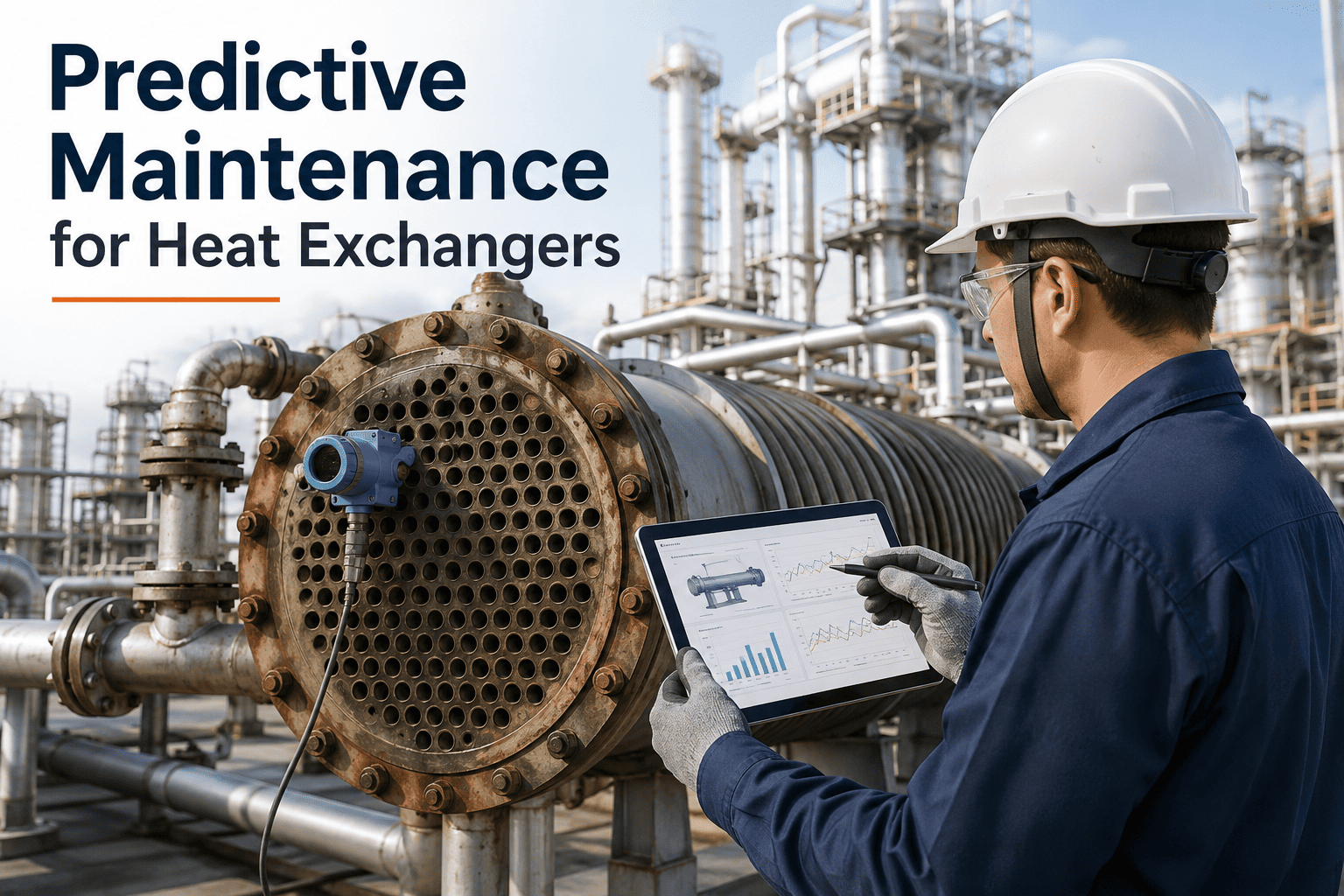
Heat exchangers are the silent workhorses of oil & gas, chemical processing, and power generation plants, often operating under extreme thermal and corrosive conditions for years without direct inspection. However, gradual fouling, localized corrosion, and sudden tube leaks can cause severe efficiency losses and unplanned shutdowns costing millions. Traditional maintenance strategies—either reactive or time-based—fail to capture the dynamic nature of heat exchanger degradation. By contrast, AI-driven predictive maintenance continuously analyzes thermal performance data, pressure drops, and process variables to detect early signs of fouling, predict corrosion rates, and pinpoint tube leaks before they escalate. This article provides an enterprise-grade, technically detailed guide to implementing predictive maintenance for shell-and-tube and plate heat exchangers, covering sensor architecture, machine learning models, ROI calculations, and integration with plant-wide analytics. Book a Demo to see how iFactory can transform your heat exchanger reliability.
Transform Heat Exchanger Reliability with AI
Predict fouling, corrosion, and tube leaks before they disrupt production. Optimize cleaning schedules and extend asset life.
Understanding Heat Exchanger Degradation Mechanisms
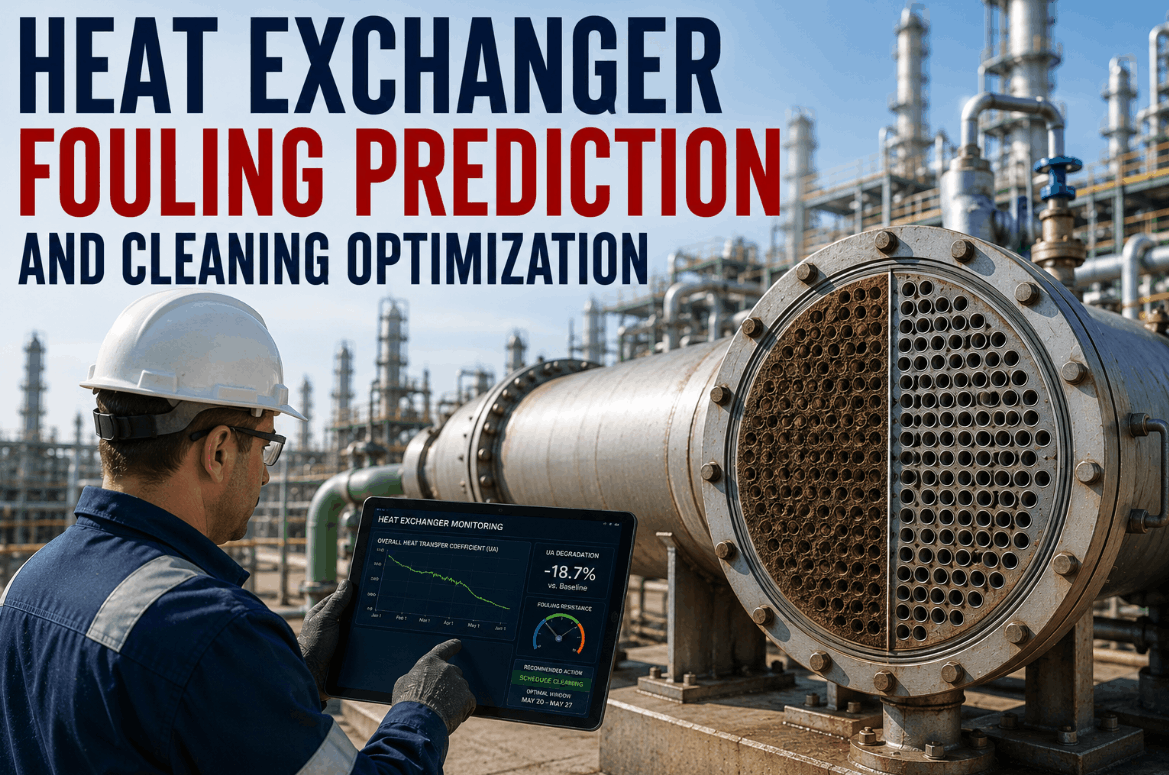
Heat exchangers in oil & gas service face three primary degradation modes: fouling, corrosion, and tube leaks. Fouling is the accumulation of unwanted deposits on heat transfer surfaces, which increases thermal resistance and reduces overall heat transfer coefficient (U). Common foulants include scaling (calcium carbonate, barium sulfate), organic deposits (biofilms, wax), and particulate matter (sand, corrosion products). Corrosion, often localized as pitting or stress corrosion cracking, leads to material loss and potential leakage. Tube leaks can occur due to corrosion, erosion, or mechanical fatigue, causing cross-contamination between process streams and safety hazards.
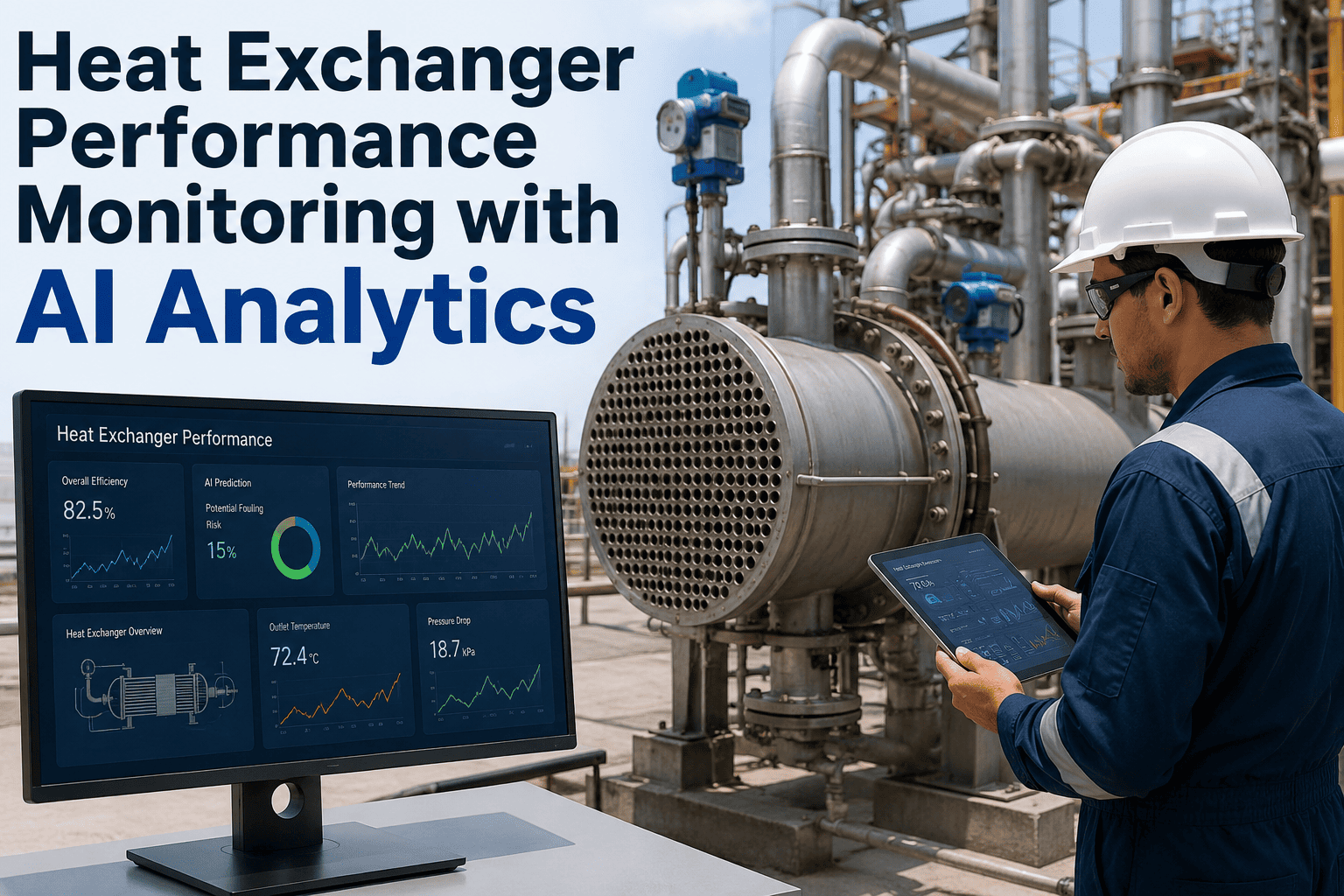
Predictive maintenance leverages continuous monitoring of key performance indicators (KPIs) such as fouling factor (Rf), overall heat transfer coefficient (U), pressure drop (ΔP), and temperature approach. By analyzing trends in these parameters, AI models can distinguish between reversible fouling (e.g., soft deposits that can be cleaned) and irreversible degradation (e.g., corrosion thinning). The goal is to trigger cleaning or inspection actions at the optimal time—neither too early (wasting resources) nor too late (risking failure).
Critical Parameters for AI-Driven Monitoring
Fouling Factor (Rf)
Calculated from the difference between clean and actual overall heat transfer coefficient. Rf trends indicate deposit accumulation rate. AI models use Rf to predict when cleaning is cost-effective.
Overall Heat Transfer Coefficient (U)
Derived from flow rates, inlet/outlet temperatures, and surface area. A declining U signals fouling or reduced flow. Machine learning can forecast U decay curves.
Pressure Drop (ΔP)
Increases as fouling narrows flow passages. Sudden ΔP changes can indicate tube blockage or leak. AI analyzes ΔP vs. flow to detect anomalies.
Temperature Approach
Difference between outlet temperatures of hot and cold streams. Widening approach indicates reduced heat transfer. Used for early fouling detection.
Implementation Roadmap for Heat Exchanger PdM
Sensor Deployment & Data Acquisition
Install temperature sensors (RTDs/thermocouples) on inlet/outlet of both streams, flow meters, and pressure transmitters. Ensure data is collected at 1-minute intervals and stored in a historian (e.g., OSIsoft PI, Aspen InfoPlus.21).
Data Preprocessing & Feature Engineering
Clean data by removing outliers, handling missing values, and aligning timestamps. Compute derived features: Rf, U, ΔP, approach temperature, and fouling rate (dRf/dt). Normalize features for model training.
Model Development & Training
Train supervised learning models (Random Forest, XGBoost) on historical data with labels from maintenance logs (cleaning events, corrosion findings). Use time-series models (LSTM, Prophet) for forecasting fouling factor. Validate with cross-validation.
Deployment & Real-Time Monitoring
Deploy models in a cloud or edge environment. Set up dashboards showing real-time U, Rf, and ΔP trends with alerts for abnormal deviations. Integrate with CMMS for automated work order generation.
Continuous Improvement & Retraining
Monitor model performance (MAE, RMSE) and retrain periodically with new data. Incorporate feedback from inspection results to improve prediction accuracy over time.
Ready to Optimize Your Heat Exchanger Maintenance?
Leverage AI to predict fouling and corrosion, reducing unplanned downtime and maximizing efficiency.
Machine Learning Models for Fouling & Corrosion Prediction
For fouling prediction, regression models such as Gradient Boosting and Neural Networks are trained to forecast the fouling factor (Rf) over a future horizon (e.g., 7, 30, 90 days). Features include historical Rf, process variables (flow, temperature, pressure), and time-based features (elapsed time since last cleaning). Classification models (e.g., Random Forest, SVM) can predict whether a tube leak will occur within a specified window, using features like vibration, acoustic emission, and ΔP variability.
Corrosion prediction often requires more sophisticated approaches due to the localized nature of attack. Deep learning models (CNNs) can analyze ultrasonic thickness measurements and process data to predict corrosion rates. Alternatively, physics-informed neural networks (PINNs) incorporate first principles (e.g., electrochemical corrosion models) to improve generalization. The output is a corrosion rate map that identifies high-risk areas for targeted inspection.
Ensemble methods combining multiple models (e.g., stacking XGBoost, LSTM, and a physics-based model) typically yield the best performance, with R² values exceeding 0.85 for fouling factor prediction in industrial case studies. Regular retraining (e.g., monthly) ensures models adapt to changing process conditions.
Cost-Benefit Analysis of Heat Exchanger Predictive Maintenance
| Parameter | Without PdM (Reactive/Time-Based) | With PdM (AI-Driven) |
|---|---|---|
| Average annual downtime (hours) | 120 | 36 |
| Cost of unplanned downtime ($/year) | $2,400,000 | $720,000 |
| Cleaning events per year | 6 | 4 (optimized) |
| Cleaning cost ($/event) | $50,000 | $50,000 |
| Bundle replacement interval (years) | 5 | 7 |
| Annual bundle depreciation ($) | $200,000 | $142,857 |
| Total annual cost | $3,100,000 | $1,362,857 |
| Annual savings | - | $1,737,143 |
Table 1: Estimated annual savings from predictive maintenance for a typical shell-and-tube heat exchanger in a refinery (100,000 bpd capacity). Assumes PdM implementation cost of $150,000 (sensors, software, integration) with a payback period of less than 2 months.
Sensor Technologies for Real-Time Monitoring
Temperature Sensors
RTDs and thermocouples with ±0.1°C accuracy for inlet/outlet streams. Wireless options (e.g., Emerson Rosemount) reduce installation cost.
Pressure Transmitters
Differential pressure transmitters (e.g., Yokogawa EJX) measure ΔP across exchanger. Accuracy ±0.04% of span.
Flow Meters
Coriolis or ultrasonic meters for both streams. Provide mass flow with ±0.1% accuracy, essential for energy balance calculations.
Acoustic Emission Sensors
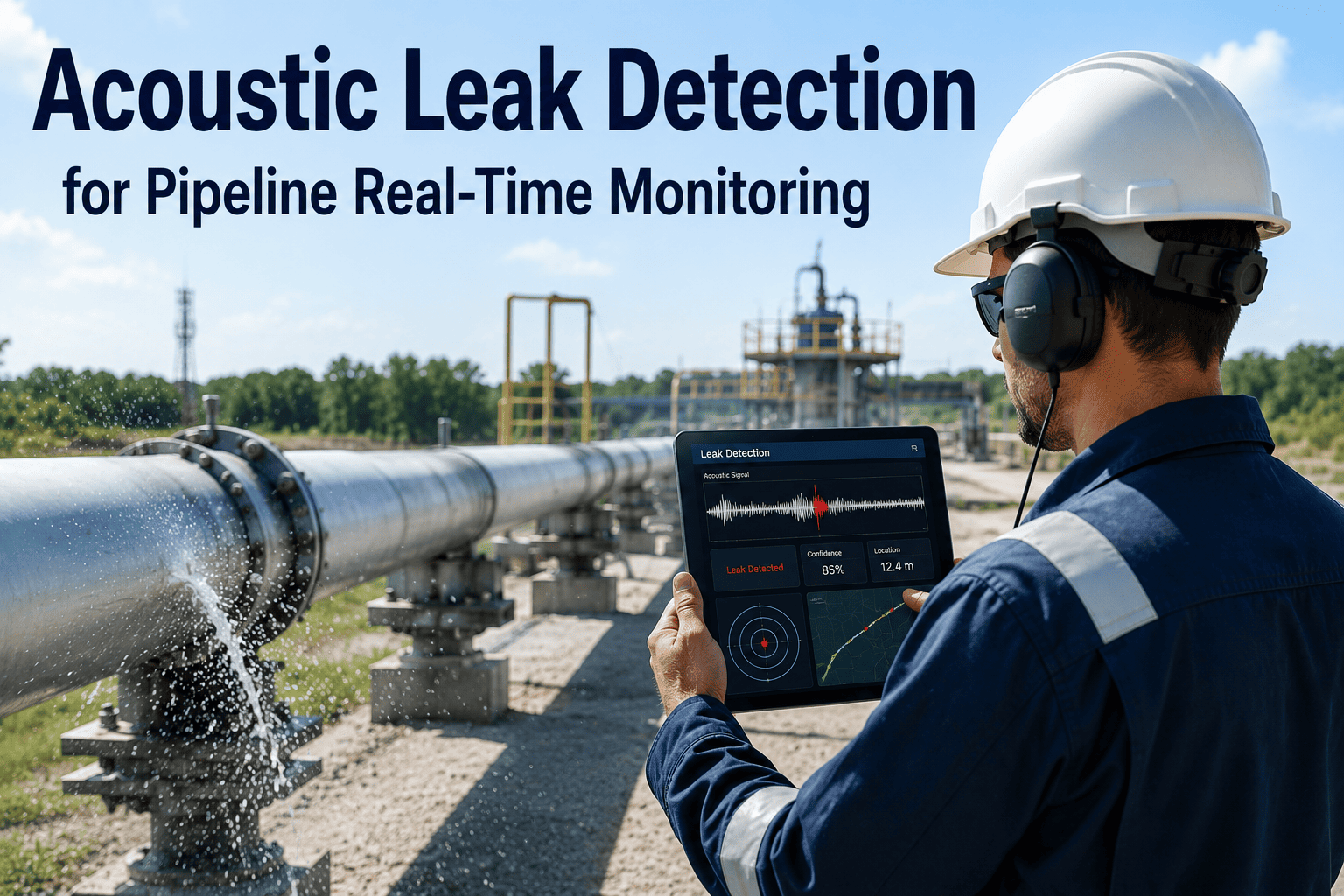
Piezoelectric sensors detect high-frequency stress waves from tube leaks or corrosion cracking. Enable early leak detection before ΔP changes.
Integrating PdM with Plant-Wide Analytics Platforms
To maximize value, heat exchanger predictive maintenance must be integrated with broader plant analytics systems such as iFactory's Smart Factory Analytics suite. This involves streaming real-time data from edge devices to a cloud-based data lake, where AI models run inference and generate alerts. Integration with the CMMS (e.g., SAP PM, Maximo) enables automatic creation of work orders when cleaning or inspection is recommended. Dashboards in tools like Power BI or Grafana provide plant-wide visibility, showing heat exchanger health scores, predicted remaining useful life, and cost savings.
APIs (REST, MQTT) facilitate data exchange between the PdM system and existing control systems (DCS, SCADA). Security and data governance are critical; ensure encrypted communication and role-based access control. iFactory's platform supports out-of-the-box connectors for major historians and CMMS, reducing integration effort by up to 60%.
Frequently Asked Questions
How does AI differentiate between reversible fouling and permanent degradation?
AI models analyze the rate of change of the fouling factor (dRf/dt) and its response to process changes. Reversible fouling (e.g., soft organic deposits) typically shows a gradual, linear increase in Rf that can be reversed by chemical cleaning. Permanent degradation (e.g., corrosion thinning) manifests as a step change or accelerating trend in U or ΔP that does not recover after cleaning. Machine learning classifiers trained on historical data with labels from post-cleaning inspections can achieve >90% accuracy in distinguishing these modes. Contact our support team for detailed case studies.
What is the minimum data history required to train a reliable model?
For fouling prediction, a minimum of 12 months of continuous hourly data is recommended, covering at least two cleaning cycles. This allows the model to learn the full fouling-to-cleaning cycle. For corrosion prediction, 24+ months of data with at least one inspection event is preferred. If historical data is limited, transfer learning from similar exchangers or synthetic data generation can bootstrap model development. Book a Demo to discuss your data readiness with our experts.
Can predictive maintenance work for plate heat exchangers with gaskets?
Yes, but the approach differs slightly. Plate heat exchangers are more prone to gasket failure and channel blockage. AI models should include additional features like plate pack temperature distribution (using infrared sensors) and differential pressure across individual plates. Vibration analysis can also detect loose plates or gasket extrusion. iFactory's platform supports custom model configurations for plate heat exchangers. Contact us for a tailored solution.
How do you handle sensor drift or failure in a PdM system?
Robust PdM systems include sensor health monitoring algorithms that detect drift (e.g., using redundant sensors or mass balance checks). If a sensor fails, the system can switch to virtual sensing using soft sensors (e.g., inferring temperature from nearby measurements). Data imputation techniques (e.g., KNN, MICE) fill gaps until the physical sensor is replaced. iFactory's platform includes automated sensor validation and failover mechanisms. Book a Demo to see how we ensure data reliability.
What is the typical ROI timeline for heat exchanger PdM?
Based on our deployments in oil & gas refineries, the payback period ranges from 3 to 8 months. Key drivers are the value of avoided downtime and extended bundle life. For a single large exchanger (e.g., 50 MW duty), annual savings can exceed $1.5 million. The ROI calculation includes sensor installation ($20k-$50k), software licensing ($30k-$60k/year), and integration services ($50k-$100k). Contact our team for a free ROI assessment.
Start Your Heat Exchanger AI Journey Today
Stop reacting to failures. Start predicting them. Unlock millions in savings with iFactory's predictive maintenance platform.