A single unplanned fired heater tube rupture can take a crude unit or reformer offline for weeks, and the difference between a controlled tube replacement during a planned turnaround and an unplanned outage almost always comes down to one thing — whether anyone was tracking remaining tube life before the tube told you itself. Fired heaters run their tubes at the edge of what the metallurgy can tolerate, because that is where thermal efficiency lives, and creep damage accumulates quietly for years before a bulge, a hot band, or a thinning wall finally shows up on an inspection report. For refinery reliability engineers and fixed equipment inspectors, the real question is not whether a heater coil will eventually need replacing — it always will — but whether you can see it coming early enough to plan around it instead of reacting to it. That is exactly the gap that connected tube wall thickness, skin temperature, and creep monitoring closes, and it is worth understanding in detail before your next turnaround scope is locked. Talk to our support team about what heater monitoring coverage looks like for your unit.
Why Fired Heater Tubes Fail Quietly Until They Don't
Radiant and convection tubes in a fired heater operate simultaneously under internal pressure, external firing heat flux, and whatever fouling or coking has built up on the process side — a combination that drives two deterioration mechanisms at once. Creep is the slow, temperature-driven strain accumulation that eventually leads to bulging and rupture, and it accelerates sharply with even small increases in metal skin temperature, which is why a tube running 20-30°F hotter than its design basis for an extended period can burn through decades of assumed remaining life. Corrosion and oxidation attack the tube wall from the inside and outside simultaneously, thinning the section that is left to carry pressure. Turnaround-interval inspections, typically every three to six years depending on jurisdiction and unit criticality, capture a snapshot of thickness and hardness at whatever points the inspector could physically access with scaffolding or rope access, but they say nothing about what happened to skin temperature between those two snapshots. A tube that spiked into an accelerated creep regime for a few months during a process upset can look identical, on paper, to a tube that ran cool and steady the whole cycle — until the metallurgy tells a very different story at the next shutdown.
| Monitoring Question | Turnaround-Interval Inspection | Continuous Monitoring Program |
|---|---|---|
| Tube wall thickness trend | Two or three data points across a multi-year cycle; trend line is a rough estimate | Ongoing measurement history builds an actual thinning-rate curve per tube segment |
| Skin temperature excursions | Not captured unless a thermocouple happened to be installed and logged at that location | Every excursion above design basis is logged with duration and severity for creep-life recalculation |
| Coverage of tube population | Limited to accessible tubes and rows reachable within the outage window | Full coil coverage across radiant and convection sections on a repeatable basis |
| Remaining life confidence | Single-point estimate, often conservative to cover data gaps between outages | Rolling remaining-life calculation updated as new thickness and temperature data arrives |
The Three Data Streams That Actually Predict Tube Life
Ultrasonic thickness measurement, whether from fixed sensors, robotic crawlers, or periodic smart-pigging runs through the coil, establishes the actual metal loss rate at each monitored location. Tracked over successive readings, this becomes a thinning-rate curve rather than a single number, which is the input that separates a tube with years of margin left from one approaching minimum required thickness under the next process condition change.
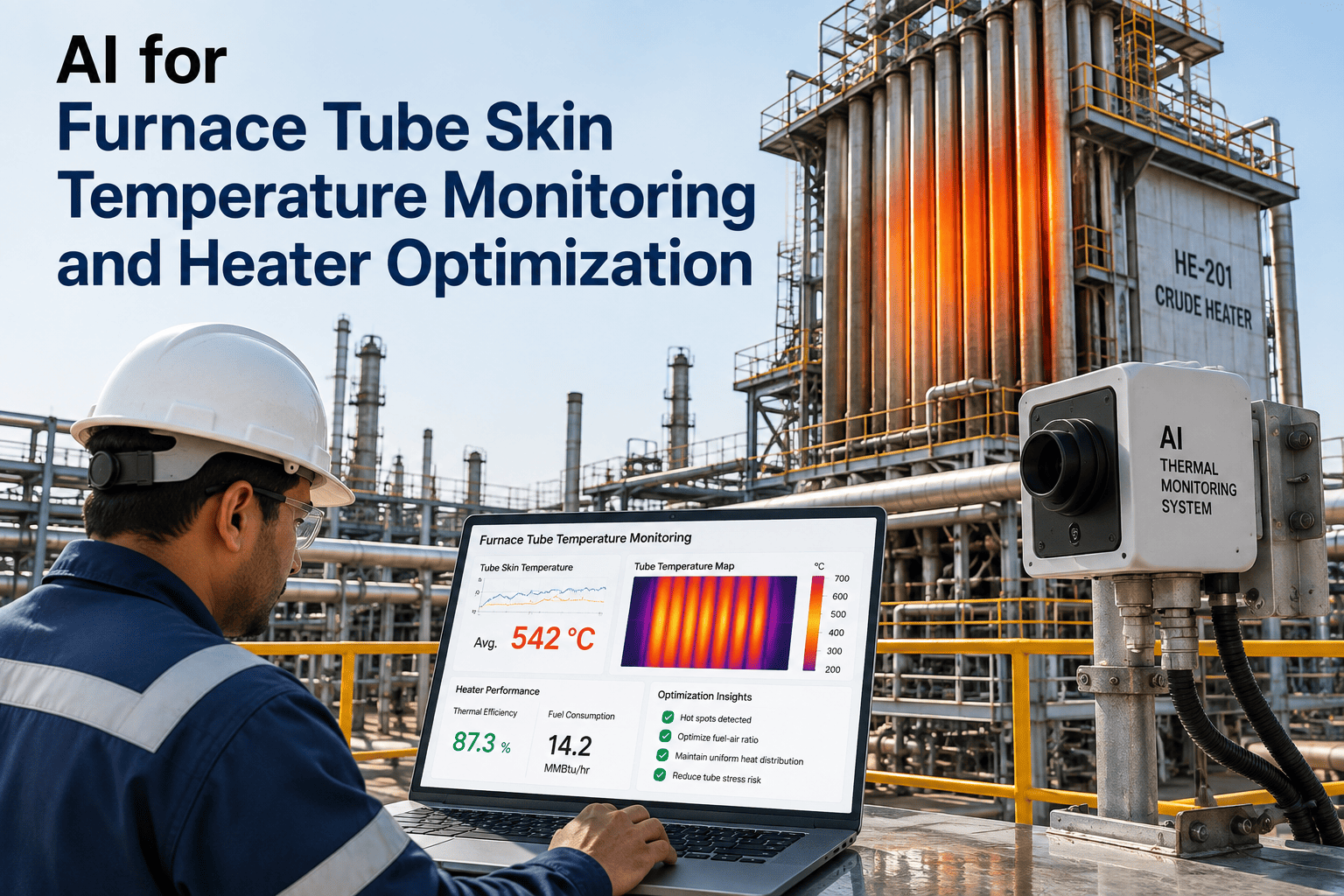
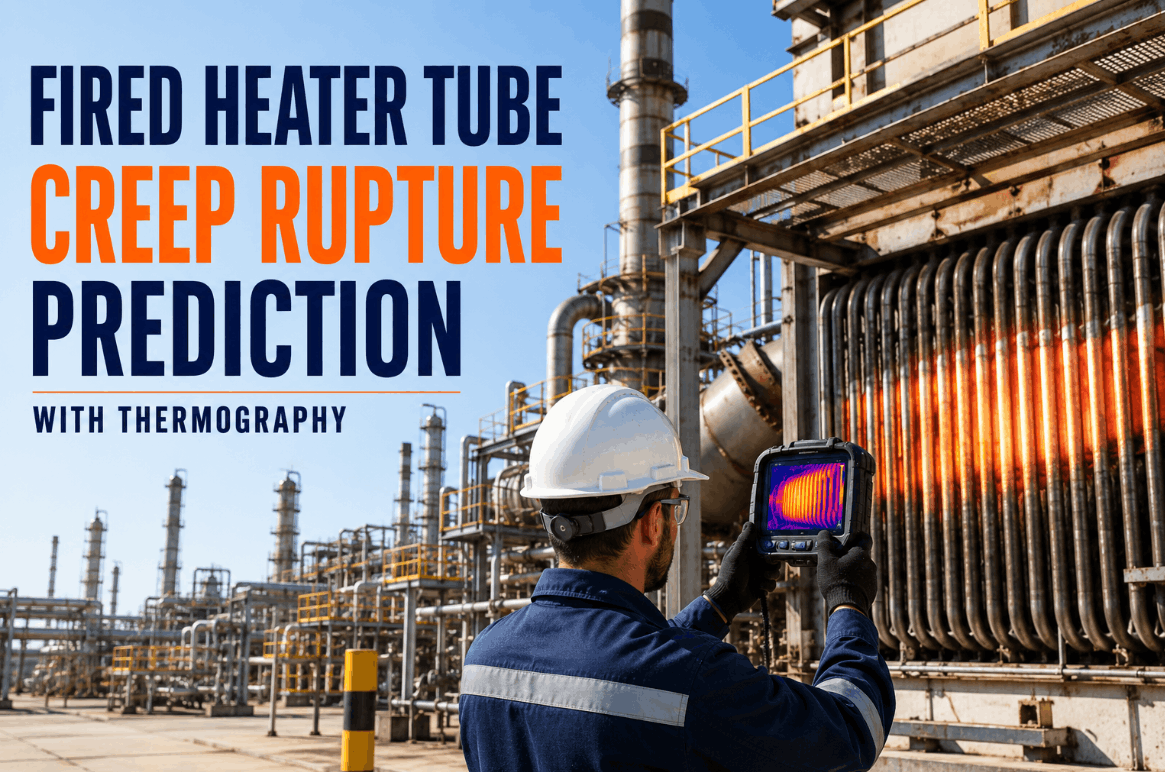
Infrared and thermocouple-based skin temperature monitoring across the radiant section identifies hot bands, uneven firing, and localized flame impingement long before they show up as visible tube deformation. Because creep rate is exponentially sensitive to temperature, catching a 15-20°F hot spot early and correcting the burner pattern or firing rate can add years back onto a tube's effective life.
Diameter and ovality measurement, whether by laser scanning during an outage or by strain gauges left in place between outages, tracks the physical bulging that accompanies advanced creep. Combined with thickness and temperature history, this data feeds Larson-Miller or Omega-method remaining-life calculations consistent with API 579-1 / ASME FFS-1 fitness-for-service methodology, turning three separate readings into one defensible remaining-life number.
Turning Monitoring Data Into a Defensible Remaining-Life Number
Collecting thickness and temperature data is only half the job — the value shows up when that data feeds a structured remaining-life methodology that a mechanical integrity engineer can actually stand behind at a management-of-change review. Platforms built for fired heater reliability take the accumulated thickness readings, temperature history, and known material properties for the installed alloy and run them through recognized creep-life models, flagging tubes that are approaching a defined remaining-life threshold well ahead of the next scheduled turnaround. That lead time is what lets a reliability team make a real choice: order long-lead alloy tube replacements in advance, adjust firing patterns to slow the creep rate on a marginal tube, or plan a targeted tube replacement during the next outage rather than discovering the problem mid-cycle and forcing an unplanned shutdown. Book a demo to see how this remaining-life calculation runs against your own heater's tube population.
| Value Driver | Typical Annual Impact | How It's Measured |
|---|---|---|
| Avoided unplanned outage | $500K - $2M per event avoided | Forced outage frequency before vs. after monitoring deployment; lost production days avoided |
| Extended campaign length | 15-25% longer run between tube replacements | Actual tube replacement interval compared to prior campaign history |
| Optimized tube ordering | Reduced expedite premiums on long-lead alloy tube material | Lead time between remaining-life alert and turnaround date versus tube procurement cycle |
| Inspection labor efficiency | Reduced scaffolding and rope-access inspection hours per turnaround | Inspection man-hours per turnaround before vs. after continuous monitoring adoption |
Building a Tube Monitoring Program Without Disrupting the Heater
Reliability teams considering a shift from periodic inspection to continuous monitoring are usually most concerned with one thing — whether adding sensors or monitoring hardware means touching the heater in a way that requires an outage of its own. In practice, a well-designed program is layered onto the existing inspection cadence rather than replacing it outright.
- 1Baseline the current tube population — material, wall schedule, design temperature, and the last several turnarounds' worth of thickness readings, to establish where each tube already sits on its creep-life curve.
- 2Install skin temperature monitoring on the radiant section first, since firing-related hot spots are usually the fastest win and require no process interruption to instrument during a routine shutdown.
- 3Layer in thickness monitoring — fixed sensors on high-risk tube runs, or scheduled robotic and smart-pigging surveys on the broader coil — timed to existing outage windows wherever possible.
- 4Run the combined data through remaining-life calculations aligned with API 573 inspection guidance and API 579-1 / ASME FFS-1 fitness-for-service methodology, refreshed as new readings come in.
- 5Feed remaining-life flags directly into the turnaround planning and CMMS process so tube replacement scope is locked in months ahead rather than discovered during the outage itself.
A Reliability Engineer's View From the Field
I spent the better part of fifteen years scheduling fired heater turnarounds around inspection reports that were, at best, an educated guess about what had happened to those tubes since the last outage. We would find a tube at 60 percent of minimum thickness and have no real way of knowing whether it got there gradually or took a hard hit during a six-month period when a burner was firing unevenly. Once we started trending skin temperature and thickness continuously across two of our crude heaters, the picture changed completely — we could see exactly which tube rows were running hot, correct the firing pattern, and watch the creep rate on those tubes actually slow down on the next set of readings. We extended one heater's campaign by almost two years past what the original inspection data would have supported, simply because we finally had the data to justify it. For anyone still planning tube replacements off a single inspection snapshot, the case for continuous monitoring is not really about the technology — it's about how much money and downtime you're leaving on the table without it.
Where Fired Heater Monitoring Fits Into Your Broader Reliability Program
Fired heater tube monitoring rarely exists in isolation — the same reliability platform that tracks tube wall thickness and skin temperature typically also carries refractory condition, burner performance, and stack emissions data, because all four influence each other. A refractory hot spot changes local skin temperature. A burner running rich shortens tube life through both heat flux and internal fouling. Bringing these signals into one connected view, rather than separate spreadsheets maintained by different departments, is what lets a reliability engineer make one decision — adjust firing, schedule a tube replacement, or extend the campaign — with the full picture in front of them instead of a partial one. Facilities that consolidate fired equipment monitoring this way consistently report fewer surprises at turnaround scoping meetings, because the remaining-life story has already been built incrementally over the prior operating cycle rather than reconstructed under time pressure once the heater is shut down and the scaffolding is up. The same connected view also helps justify capital requests for tube replacement well ahead of the outage date, since a finance or operations stakeholder reviewing a remaining-life trend line built from months of actual data is a very different conversation than one built around a single inspector's judgment call at the eleventh hour. Over several turnaround cycles, that difference compounds — each campaign gets planned with more lead time, fewer expedite fees on long-lead alloy material, and a tighter match between the tube replacement scope and what the metallurgy actually needs.
Frequently Asked Questions — Fired Heater and Furnace Tube Monitoring
Remaining life calculations combine measured wall thickness trends, skin temperature history, and known material properties for the installed tube alloy into a creep-life model, typically following the Larson-Miller parameter or MPC Omega methodology referenced in API 530 and API 579-1 / ASME FFS-1 fitness-for-service guidance. Rather than a single static number, the calculation updates as new readings arrive, so a tube that was projected to reach minimum thickness in four years can be recalculated to two years if a temperature excursion accelerates its creep rate, or extended if firing corrections slow it back down. This rolling approach gives reliability engineers a defensible, auditable basis for turnaround planning decisions rather than relying on a conservative estimate frozen at the last inspection date. Our team can walk through how this calculation applies to your specific tube metallurgy — reach out to support with your heater details.
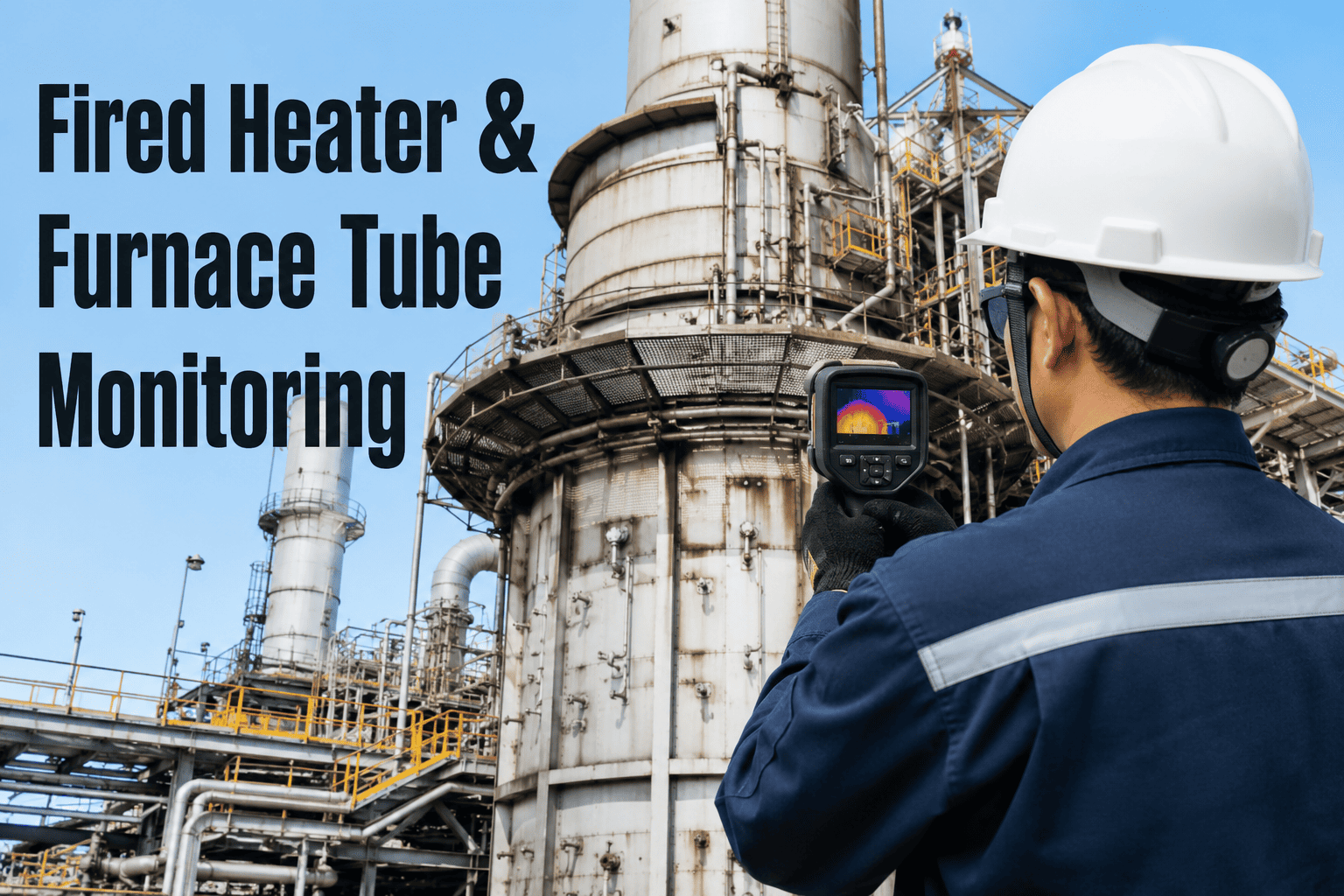
Most monitoring instrumentation, including fixed skin temperature sensors and permanently mounted ultrasonic thickness transducers, is installed during an already-scheduled outage or turnaround rather than requiring a dedicated shutdown. Infrared-based temperature surveys can often be conducted while the heater is running, giving an immediate read on firing distribution without any process interruption at all. For thickness monitoring on tube runs that are difficult to access while online, robotic crawler surveys or smart-pigging runs are typically scheduled to coincide with a planned outage window, so the monitoring program is layered onto the existing turnaround cadence rather than adding new downtime. Facilities usually start with the highest-risk tube rows first and expand coverage incrementally across subsequent outages.
Payback timing depends heavily on whether the program avoids even a single unplanned outage during its first year, since a forced tube failure and associated production loss commonly costs two to four times what a planned tube replacement during a scheduled turnaround would cost. Facilities running heaters with a documented history of tube-related trips or unplanned outages tend to see the fastest payback, often within the first monitoring cycle, because the avoided-cost case is already proven by their own operating history. Facilities with a clean recent history still benefit through extended campaign length and better long-lead procurement timing for replacement tubes, which shows up over a full turnaround cycle rather than in the first year. Book a demo to get a payback estimate built on your own heater's outage and turnaround history.
Yes — continuous monitoring is designed to complement, not replace, the periodic visual and thickness inspections already required under API 573 inspection practice for fired boilers and heaters. Turnaround inspections remain the point at which physical access, hammer testing, and detailed visual assessment of refractory and tube supports occur, while continuous monitoring fills in the multi-year gap between those inspections with an ongoing thickness and temperature trend line. The combination gives inspectors a much stronger starting point at the next turnaround, since they already know which tube rows have been trending toward a remaining-life threshold rather than discovering it cold during the outage.
Remaining-life alerts and thickness or temperature trend data are fed directly into the CMMS platform your reliability and maintenance planning teams already use, generating a work order or turnaround scope item automatically once a tube crosses a defined remaining-life threshold rather than requiring someone to manually cross-reference a separate monitoring dashboard. This keeps tube replacement decisions inside the same planning workflow used for every other turnaround scope item, with full traceability back to the thickness and temperature history that triggered the flag. Standard integrations cover the CMMS and reliability platforms most commonly used across refining and petrochemical operations.