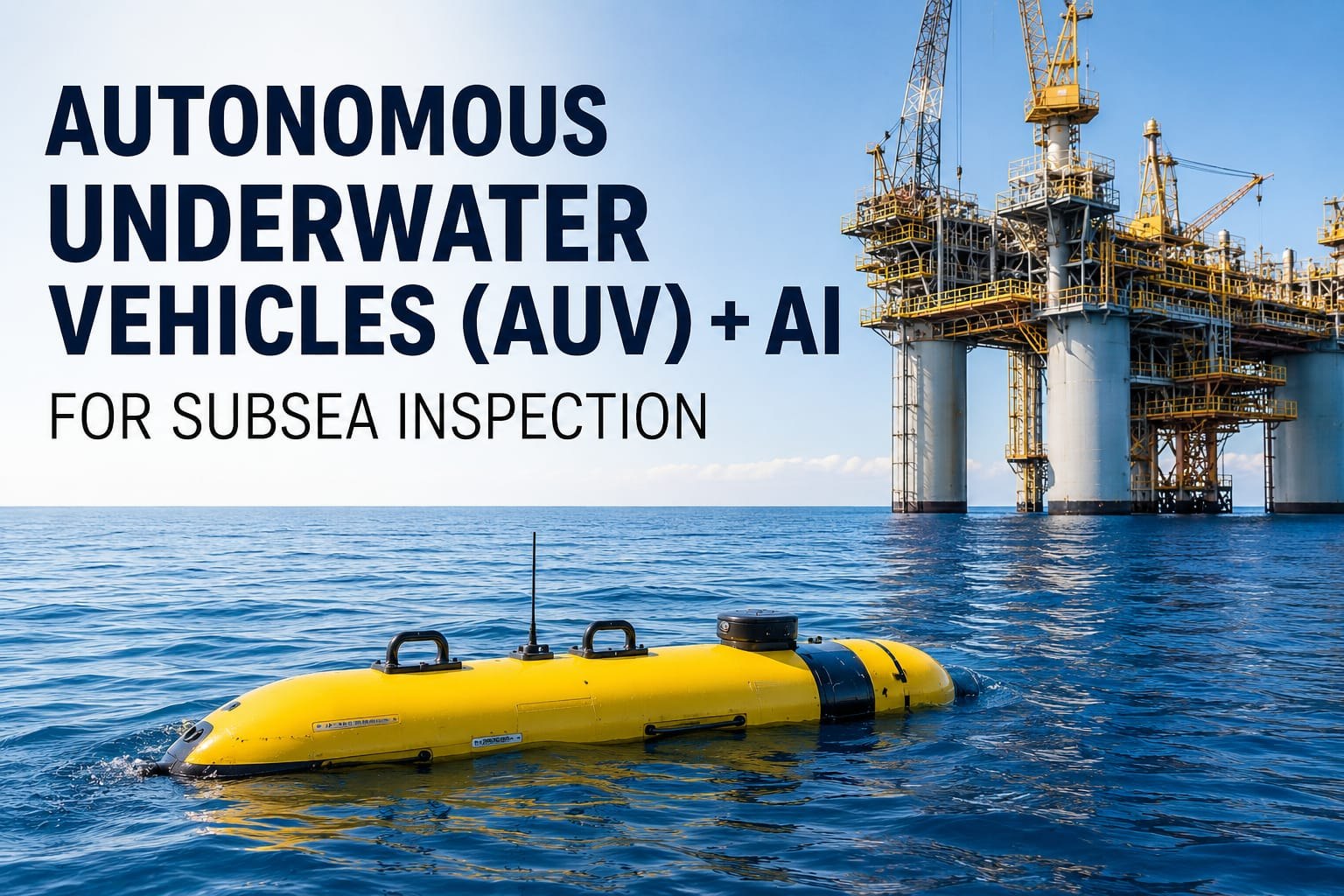
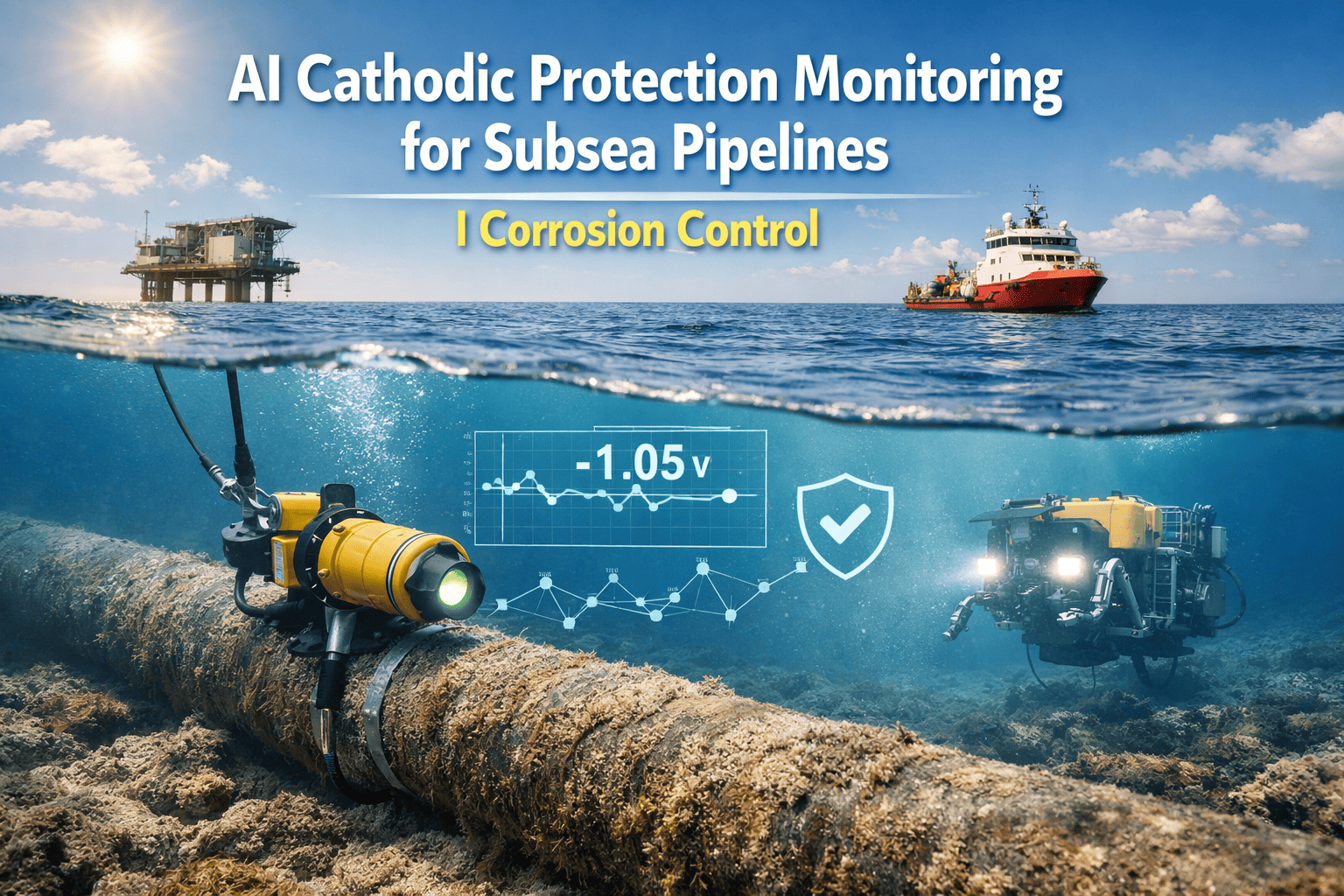
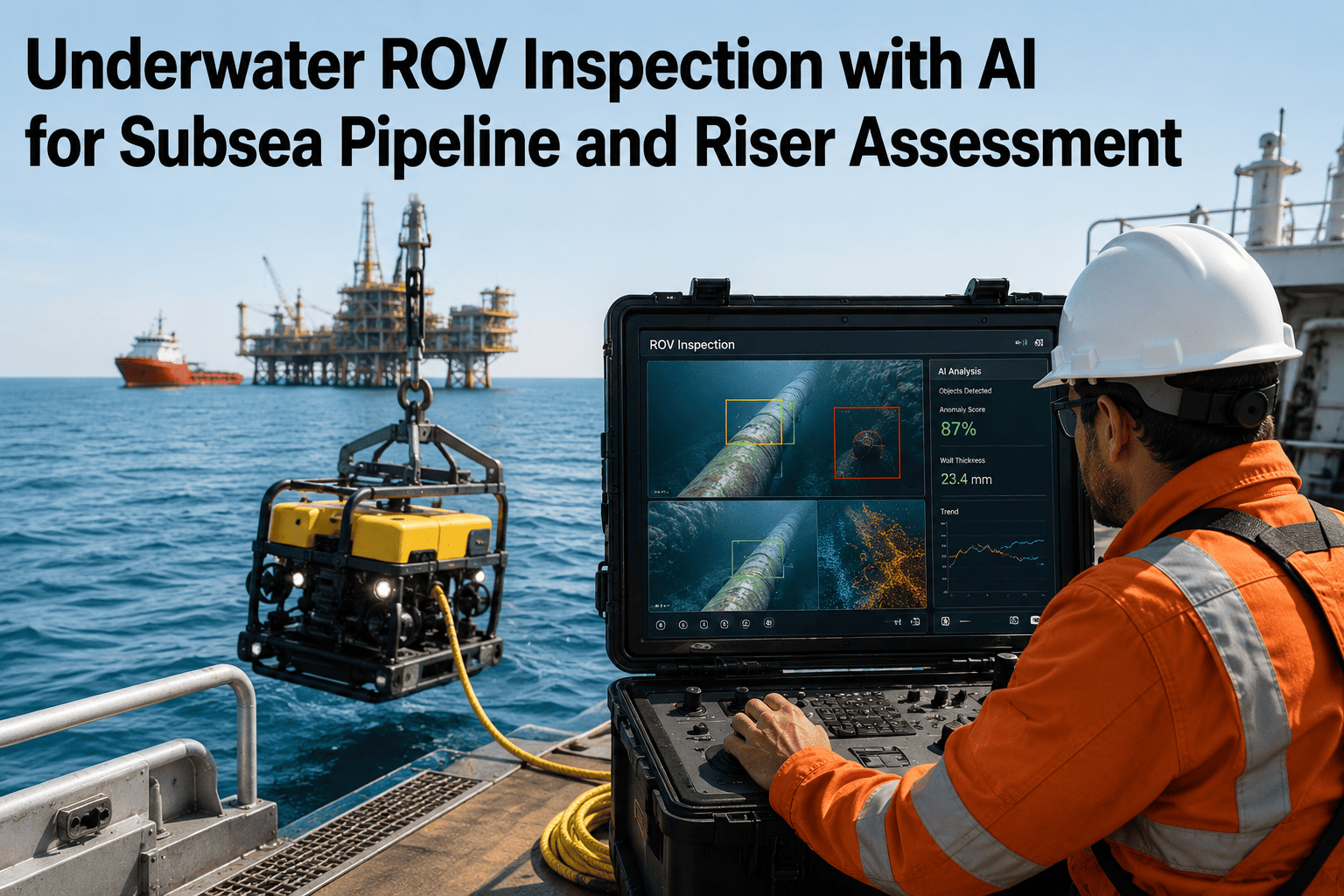
A subsea pipeline inspection has always been, at its core, a video review problem. An ROV pilot on a support vessel flies the vehicle along kilometers of pipe, the cameras stream 4K video back to a control cabin, and somewhere in that footage sit the anomalies that matter — a patch of dropped concrete coating, a scour under the pipe that has grown into a free span, an anode that has depleted faster than schedule, a dent that was not there last inspection cycle. Traditionally those anomalies are found by human eyes: the pilot in the moment, and later a data analyst reviewing the recorded footage frame by frame. It works, but it is slow, expensive, and inconsistent between pilots and between reviewers. AI-equipped ROV inspection changes the economics by moving defect detection from subjective human review to automated, repeatable computer vision. Teams modernizing their subsea integrity workflows can Book a Demo to see how iFactory automates pipeline, riser, and cathodic-protection inspection.
SUBSEA INSPECTION · AI VISION · PIPELINE + RISER + CP
AI-Equipped ROV Inspection for Subsea Pipeline and Riser Integrity Assessment
Automated computer vision on ROV video streams replaces subjective pilot interpretation with consistent, repeatable defect classification — corrosion, coating loss, free spans, dents, marine growth, and anode depletion, all detected, ranked, and reported from the same 4K footage pilots already collect on every survey pass.
3.2×
Pipeline length covered per operating day vs diver-based schedules
94%
Corrosion severity classification accuracy on trained models
100×
More data points per inspection station than legacy radiography
Why Subsea Inspection Has Been Ripe for AI for a Decade — and Why It's Finally Here
The subsea oil and gas industry has been collecting ROV inspection video for decades. Every operator has a tape library — or now a hard-drive vault — measured in petabytes, containing recordings of every pipeline, riser, jumper, spool, PLET, and manifold their fleet has surveyed since HD cameras became standard. In principle, all the information needed to track asset condition over time is sitting in those recordings. In practice, that information is locked behind the labor cost of human review. A single pipeline survey can generate 40 to 80 hours of footage; multiplied across a portfolio of dozens of pipelines inspected annually, the analyst effort required to look at every frame simply is not available.
What changes with AI is the review side of the equation. Modern computer vision models trained on labeled subsea imagery can process an ROV video stream in real time or faster than real time, flagging anomalies with confidence scores and pixel-level segmentation. The pilot still flies the ROV — the AI does not replace piloting judgment, and intervention tasks like anode replacement still require human-operated manipulators. What the AI replaces is the second pass: the reviewer sitting at a workstation weeks after the survey, scrubbing through footage looking for defects that then need to be reported, ticketed, and tracked. Recent research on YOLO-based pipeline monitoring has demonstrated that even in the low-visibility, high-turbidity conditions typical of many offshore fields, deep learning models trained on domain-specific datasets can deliver reliable defect detection at operational scale.
The Four Subsea Survey Types AI Now Automates
Subsea inspection is not one activity — it is a bundle of distinct surveys that all happen on the same ROV dive but produce different data streams and answer different questions. AI adds value differently to each one. Understanding which survey type maps to which AI capability is the first step in scoping an automation program that actually delivers, rather than one that automates the easy 20% and leaves the hard 80% to the same manual review workflow.
01
General Visual Inspection (GVI)
Camera-based survey of the entire pipeline length and riser exterior, looking for gross damage, coating condition, marine growth, third-party interference, and general asset state.
AI roleReal-time frame-by-frame defect classification, marine growth quantification, coating breach detection, and anomaly logging with GPS-tagged position on the pipeline route.
02
Close Visual Inspection (CVI)
High-resolution close-up video of specific components — flange joints, valve bodies, bend stiffeners, bell mouths, anodes, and any anomaly flagged during GVI that needs a second look.
AI roleDefect measurement (crack length, corrosion pit depth via stereo cameras), anode volume remaining estimation, and consistent grading against a defect taxonomy across the whole fleet.
03
Cathodic Protection (CP) Survey
Contact or proximity potential measurement along the pipeline using a stab probe or field-gradient sensor, verifying that the sacrificial anode system is protecting the steel from external corrosion.
AI roleAutomatic correlation of CP readings to pipeline position, anomaly clustering (regions of under-protection), and prediction of anode remaining life from voltage trends and measured anode volume.
04
Free-Span & Depth-of-Burial Survey
Multibeam sonar or profiler survey along the pipeline to identify sections where seabed erosion has left the pipe unsupported (free spans) or where sediment has built over the pipe.
AI roleAutomated free-span length and height extraction from sonar point clouds, comparison against previous surveys to identify growing spans, and fatigue-relevant reporting for engineering review.
The Sensor Stack: What an AI-Equipped ROV Actually Carries
An AI-equipped inspection ROV is not radically different from a conventional inspection ROV in hardware — the same vehicle can serve both modes. What changes is the sensor payload emphasis, the on-board or shore-side compute for inference, and the data pipeline that turns raw sensor streams into structured defect reports. The stack below reflects what production inspection ROVs commonly carry on integrity survey campaigns, and where AI processing enters each channel.
HD/4K Cameras
Primary visual channel — forward, downward, and side-looking cameras with LED or HMI lighting for GVI and CVI. Stereo pair configurations enable dimensional measurement of defects.
AI processes frames for defect classification, semantic segmentation of pipe versus seabed versus marine growth, and dimensional measurement of anomalies against known scale references.
Multibeam Sonar
Bathymetric mapping of the pipeline and surrounding seabed, producing point clouds that show pipe elevation, burial depth, and free-span geometry independent of water clarity.
AI extracts pipeline centerline, computes free-span length and height, and compares consecutive survey point clouds to detect seabed movement and pipe displacement over time.
CP Probe
Stab or proximity probe measuring pipeline-to-seawater potential and field-gradient values that indicate whether the cathodic protection system is delivering the required protective current.
AI correlates readings to precise position on the pipeline, identifies clusters of under-protection, and predicts anode replacement timing from measured volume plus voltage trends.
Advanced NDT Modules
ROV-deployed technologies such as Acoustic Resonance Technology and Pulsed Eddy Current Testing Array that measure remaining wall thickness through marine growth and coatings without surface preparation.
AI processes the dense grid of thickness readings to generate wall-thickness heat maps, flag localized thinning, and calculate remaining strength factor for engineering assessment.
Navigation Suite
USBL positioning, DVL bottom-tracking, inertial navigation, and depth sensor combined to give the ROV — and every observation it makes — an accurate position on the pipeline route.
AI fuses navigation streams to attach precise geospatial coordinates to every defect detection, so anomalies can be revisited on future dives and trended across survey campaigns.
Environmental Sensors
Turbidity, temperature, salinity, and current sensors that record the conditions during the survey and provide context for image quality and sensor performance interpretation.
AI models are conditioned on environmental data so defect confidence scoring accounts for visibility conditions, and low-confidence detections in poor visibility are flagged for revisit.
The Defect Taxonomy: What Modern Subsea AI Actually Detects
A well-trained subsea AI model does not detect "defects" as a single category — it classifies observations into a defect taxonomy that maps to engineering decisions. The taxonomy below reflects the defect categories that most subsea integrity management programs care about, and that modern AI vision models have been trained to identify with production-grade accuracy. Each defect type carries different risk implications and different response actions, which is why the classification detail matters — a corrosion pit near a weld is a different engineering problem from generalized coating loss, even though both fall under "corrosion" in an untrained taxonomy.
| Defect Category |
What AI Looks For |
Risk Implication |
Typical Response |
| External Corrosion |
Pitting, general metal loss, rust staining on exposed steel where coating has failed |
Wall-thickness reduction, eventual loss of pressure containment |
Wall-thickness measurement, remaining-strength calculation, repair planning |
| Coating Damage |
Concrete coating chips, FBE holidays, disbondment, cracking, mechanical impact damage |
Precursor to external corrosion once steel is exposed to seawater |
Coating repair scheduling, CP survey to confirm protection at the exposed area |
| Free Spans |
Sections of pipeline unsupported by seabed, span length and height above seabed |
Vortex-induced vibration, fatigue damage, potential pipeline failure |
Engineering assessment of allowable span, remediation with rock dump or grout bags |
| Dents & Deformation |
Local geometric deformation from anchor drag, dropped objects, or trawl gear impact |
Stress concentration, reduced fatigue life, possible pressure limitation |
Dimensional survey, engineering fitness-for-service assessment |
| Marine Growth |
Percentage coverage, thickness estimate, type classification (hard vs soft growth) |
Added weight, altered hydrodynamics on risers, obscures other defects |
Cleaning schedule, inspection window management, coating protection assessment |
| Anode Depletion |
Volume remaining, surface pitting pattern, mechanical attachment integrity |
Loss of cathodic protection when anodes fully depleted, leading to steel corrosion |
Anode replacement scheduling based on remaining life projection |
| Third-Party Damage |
Anchor scars, dragged objects, fishing gear entanglement, unauthorized structures |
Immediate physical damage plus ongoing integrity risk if left in place |
Documentation for regulatory notification, removal planning, damage assessment |
The taxonomy is not static — it evolves as fleet operators encounter new defect types and as AI models are retrained on expanded labeled datasets. What matters operationally is that the same taxonomy is applied consistently across every survey, every operator, and every pipeline in the portfolio, so that an anomaly logged on one survey can be compared meaningfully to the same anomaly on the next. Consistency is exactly what AI classification delivers that human-only review cannot — the same model applies the same criteria on Monday morning and Friday night, on year one of a program and year ten.
GVI · CVI · CP · FREE-SPAN — ALL FROM ONE AI PLATFORM
One Model Stack Covering Every Survey Type in Your Annual Inspection Plan
iFactory ingests ROV video, sonar point clouds, and CP probe streams into a unified pipeline integrity picture with defect tagging, position correlation, and trend comparison against prior surveys — so every dive contributes to one asset record.
Where AI Beats Human Review, and Where Humans Still Beat AI
Honest scoping of an AI inspection program starts with acknowledging that AI and human reviewers have different strengths. AI does not replace experienced subsea integrity engineers — it changes what those engineers spend their time on. The comparison below reflects what production deployments across operators like TotalEnergies and other major operators have shown in the past several years, and what practitioners honestly report about the current state of the technology.
WHERE AI CLEARLY WINS
ConsistencySame defect classification criteria applied to every frame regardless of reviewer fatigue, experience, or time of day
SpeedReal-time or faster-than-real-time processing of video streams that would take days of human review
Comparison across surveysAutomatic matching of anomalies at the same position across consecutive inspections to detect growth
Dimensional measurementPixel-accurate defect sizing when stereo cameras and scale references are available
Never gets tiredHour 40 of survey footage reviewed with the same care as hour 1, unlike human analysts
WHERE HUMANS STILL WIN
Novel defect typesRecognizing something that does not match any training class, and deciding whether it matters
Context integrationWeighing visual observations against operating history, prior inspections, and engineering judgment
Ambiguous casesDeciding between similar-looking classifications that the model flags with low confidence
Repair prioritizationWeighing detected defects against production impact, weather windows, and vessel availability
Regulatory communicationExplaining findings to regulators, classification societies, and internal governance
The productive division of labor is straightforward. AI does the first pass on every frame of every survey, produces a triaged list of anomalies with confidence scores and position data, and populates the integrity management system. Human integrity engineers spend their time on the triage output — validating high-confidence detections, adjudicating low-confidence ones, and applying engineering judgment to the repair prioritization. The bottleneck moves from "we cannot review all the footage" to "we can look at every genuine anomaly," which is a fundamentally different and much more valuable place for the engineering team to spend its time.
The Inspection Workflow: From Vessel Deployment to Integrity Report
A modern AI-assisted subsea inspection campaign runs through six distinct workflow phases, from mobilization on the support vessel to the final integrity report signed off by the operator's engineering team. Each phase has a specific data output that feeds the next, and the AI adds value at multiple points in the chain rather than as a single "inspection" step. The workflow below reflects how operators like TotalEnergies and their inspection contractors have structured campaigns that deliver on the 3x productivity improvements reported in Indonesian FPSO deployments.
P1
Campaign Planning & Baseline Loading
Prior inspection findings, pipeline route, engineering criticality data, and known anomalies are loaded into the platform. The AI baseline is set — the model knows where previous defects sit and what to compare new observations against on the same pipeline sections.
P2
ROV Deployment & Survey Execution
The ROV is launched from the support vessel and flown along the pipeline route, capturing video, sonar, CP, and NDT data streams. On-vessel or on-ROV AI inference flags anomalies in real time, giving the pilot immediate feedback for revisit or additional close inspection of specific points.
P3
Automated Data Processing & Anomaly Extraction
Full video streams and sonar point clouds are processed by the full model stack, extracting the complete anomaly list with position tags, defect classifications, dimensional measurements, and confidence scores. Automated matching against prior surveys identifies new versus growing anomalies.
P4
Human Review & Adjudication
The subsea integrity team reviews the AI-produced anomaly list — validating high-confidence findings, adjudicating ambiguous cases with expert judgment, and adding engineering context. The review focuses on the anomalies that matter, not on scrubbing every frame of raw footage.
P5
Fitness-for-Service Assessment
Confirmed defects are fed into engineering fitness-for-service calculations — remaining strength factor for corrosion, span-fatigue analysis for free spans, dent assessment for deformation. The AI-measured dimensions provide the input data that used to require costly separate metrology dives.
P6
Integrity Report & Repair Planning
The final integrity report — the deliverable for the operator's engineering governance and any regulatory reporting — is generated with defect summaries, position maps, trend charts against prior surveys, and prioritized repair recommendations. The same data seeds the next campaign's baseline in Phase 1.
A Field Scenario: The FPSO Riser Inspection That Ran on Schedule
Consider an FPSO operator managing a set of flexible risers connecting the vessel to subsea wells. The inspection program calls for annual close visual inspection of each riser from the hang-off to the touchdown point, plus general visual and CP survey of the associated flowlines out to the wellheads. Historically the campaign took three to four weeks of vessel time and generated 60 to 80 hours of high-priority footage that then required six to eight weeks of analyst review before the integrity report could be finalized. Repair decisions consequently lagged inspection by two to three months — an uncomfortable gap in a high-value asset program.
On an AI-equipped campaign, the same fleet of risers and flowlines is surveyed with the same ROV and the same underlying video quality. What changes is the review chain. Real-time AI inference on the support vessel flags anomalies during the dive itself, so the pilot revisits questionable areas immediately rather than needing a second dive weeks later. Post-dive automated processing produces the full anomaly list within days of the campaign ending, not months. The integrity team reviews a triaged list of perhaps 200 flagged anomalies rather than sixty hours of raw footage, and the report is issued while the vessel is still on location — which means repair decisions can be made while the intervention window is still open.
The value story here is not about the AI being smarter than the analyst. The analyst is still the one making the engineering call on each anomaly. The value is about time — moving the inspection-to-decision cycle from months to days, so that the operational rhythm of the asset matches the rhythm of the inspection program. On FPSOs and other production assets where every day of deferred repair carries measurable risk exposure, that time compression is often the entire business case for AI-assisted inspection.
The Underwater Vision Problem: Why Subsea AI Is Harder Than Surface AI
One reason subsea AI has taken longer to mature than surface-based inspection AI is that underwater imaging is fundamentally harder than imaging in air. Water absorbs light — with red wavelengths gone within a few meters and blue-green wavelengths dominating at depth. Suspended particulate matter scatters light and produces backscatter that reduces contrast. Currents move the ROV during exposure, blurring frames. Marine growth, sediment resuspension from the ROV's own thrusters, and biological activity all contribute noise to the image. A defect that would be obvious in an above-water photograph can be nearly invisible in raw underwater footage.
Modern subsea AI addresses these challenges through a combination of image enhancement and domain-specific model training. Deep learning-based image enhancement techniques compensate for water column effects, restoring contrast and color balance before defect detection models process the frames. YOLO-family object detection models — YOLOv8 and YOLOv11 among the most current variants — have been benchmarked specifically for subsea pipeline monitoring in low-visibility conditions, and image segmentation variants of these architectures deliver pixel-accurate delineation of pipe structures and defects even in challenging turbidity. Training data is curated from actual subsea inspection footage rather than repurposed from surface applications, so the model learns the specific visual signatures of subsea corrosion, marine growth, and coating damage rather than trying to generalize from unrelated imagery.
Frequently Asked Questions
Does AI inspection replace ROV pilots and inspection analysts, or does it work alongside them?
AI works alongside experienced ROV pilots and integrity engineers rather than replacing them. The pilot still flies the vehicle, makes real-time decisions about vehicle control, and handles any intervention tasks such as anode replacement or minor cleaning that require manipulator work. Integrity engineers still make the engineering calls on defect severity, fitness-for-service, and repair prioritization. What AI eliminates is the repetitive analyst work of scrubbing through raw video looking for anomalies — the model produces a triaged list of findings with position data and confidence scores, and the engineers spend their time on the judgment calls rather than the visual search. This makes the same team capable of covering more assets more thoroughly, rather than reducing the team headcount.
How accurate is AI defect detection on subsea pipelines compared to human review?
Modern AI models trained on domain-specific subsea inspection datasets achieve corrosion severity classification accuracy in the 94% range and comparable numbers on marine growth quantification, coating breach detection, and free-span extraction — validated against expert analyst review and independent classification society assessment. Accuracy varies by defect type and by water visibility conditions, which is why confidence scores travel with every detection and low-confidence findings in poor visibility are flagged for revisit or human adjudication. The important comparison is not "AI vs perfect analyst" — it is "AI + engineer review vs engineer review of raw footage," and the combined workflow consistently outperforms the traditional workflow on both speed and reliability. Teams evaluating specific accuracy claims for their asset class can
Book a Demo to review validation data.
Can existing ROV fleets be used, or does AI inspection require specialized vehicles?
Existing inspection-class ROV fleets can typically be used without hardware replacement. The AI runs on the video and sensor streams the ROV already produces, so the main integration work is capturing those streams into the inspection platform and, optionally, running some inference on-vessel or on-ROV for real-time pilot feedback. Vehicle upgrades sometimes make sense — adding stereo cameras for dimensional measurement, or upgrading to 4K where older HD systems are still in service — but these are optional enhancements rather than prerequisites. The economics usually favor working with the existing fleet and adding the AI processing layer on the topside data pipeline, which lets operators start realizing value on the next campaign rather than waiting for a fleet refresh.
How does AI subsea inspection integrate with existing pipeline integrity management systems?
The output of an AI subsea inspection program is designed to feed exactly the same integrity management systems that operators already use — pipeline anomaly registers, fitness-for-service calculation tools, and repair planning workflows. The AI produces structured data with defect classifications, positions, dimensions, and confidence scores that map to the standard fields in these systems. This means adoption does not require replacing the operator's existing integrity governance — it means feeding better, faster, and more consistent data into it. iFactory support engineers at
iFactory Support can advise on integration patterns for common pipeline integrity management platforms and CMMS environments.
What kinds of defects still require close-up dive follow-up even after AI processing?
Any defect that requires precise dimensional measurement beyond what stereo camera photogrammetry can deliver — for example, a corrosion pit depth measurement that needs to be within tenths of a millimeter for a fitness-for-service calculation — typically still requires a close-up CVI or a specialized NDT deployment. Similarly, wall thickness measurement through coatings requires ROV-deployed NDT modules such as acoustic resonance or pulsed eddy current technology. AI vision from standard cameras is highly effective for defect detection, classification, and coarse dimensioning, but the precision measurement step for critical defects often warrants a targeted NDT return visit. What AI changes is the efficiency of identifying which specific locations warrant that targeted follow-up — instead of blanket NDT of long pipeline sections, the operator can direct precision measurement precisely where the AI has flagged the highest-priority anomalies.
SUBSEA AI · ROV VIDEO · PIPELINE + RISER INTEGRITY
Turn Every Hour of ROV Footage Into Structured Integrity Intelligence
iFactory delivers end-to-end AI subsea inspection — video ingestion, defect detection, position tagging, prior-survey comparison, and integrity reporting — proven on FPSO risers, subsea pipelines, and flowline networks. Book a walkthrough tailored to your specific asset portfolio and existing ROV fleet.
.png)