Oil and gas operators have known for decades that equipment lifecycle decisions — when to inspect, when to intervene, when to replace — shape plant profitability as directly as crude prices do. What has changed in 2025 is that AI has made it possible to manage those decisions with a precision that was previously out of reach: predicting failure 7–21 days in advance, dynamically recalculating remaining useful life as conditions shift, and integrating lifecycle intelligence directly into CMMS workflows without expanding engineering headcount. AI equipment lifecycle oil gas programs are no longer experimental. They are a proven operational capability delivering measurable reductions in unplanned downtime, inspection cost, and capital expenditure across upstream, midstream, and downstream environments. Operators ready to move from fixed-interval lifecycle management to AI-driven continuous intelligence who Book a Demo with iFactory get a facility-specific lifecycle gap assessment before any platform commitment is made.
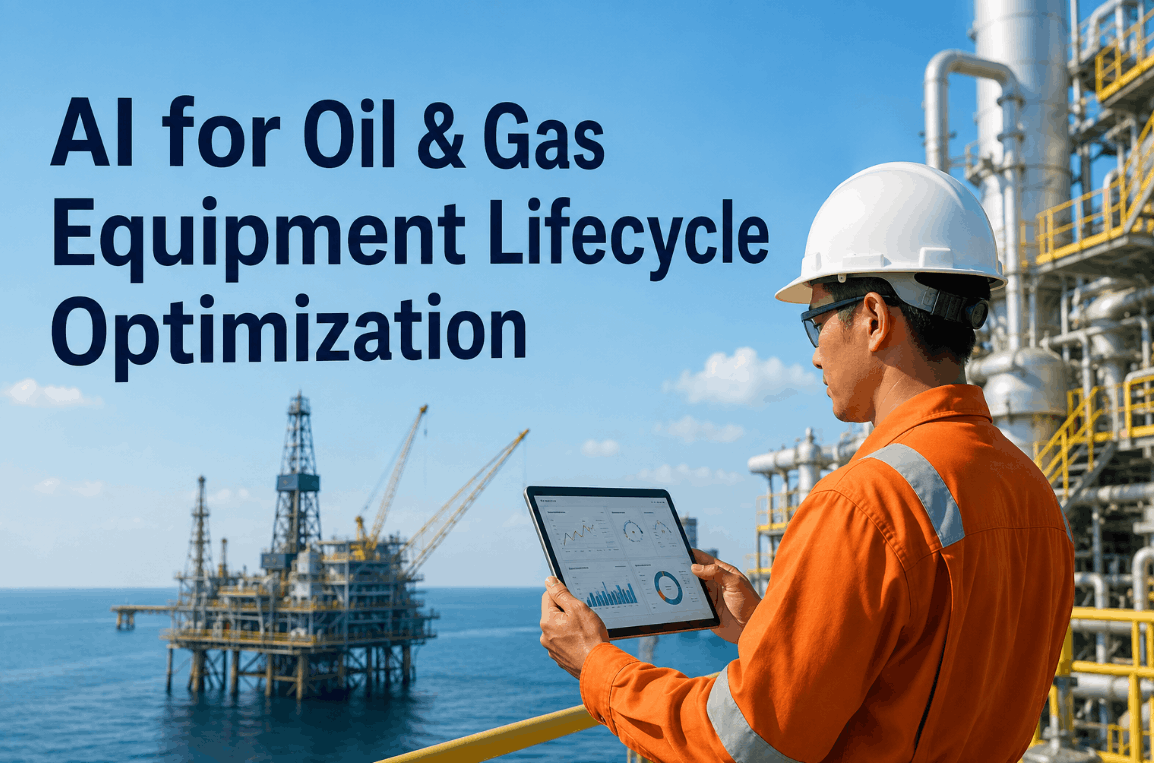
AI for Oil & Gas Equipment Lifecycle Optimization
The oil and gas operator's definitive guide to AI-driven equipment lifecycle management — predicting failures 7–21 days ahead · dynamic remaining useful life calculation · API 580/581-aligned risk-based inspection · CMMS-integrated predictive work orders · on-prem or cloud · live in 6–12 weeks.
Why AI Equipment Lifecycle Optimization Is Different From Traditional APM
Traditional asset performance management in oil and gas operates on a fundamentally static logic — inspection intervals are fixed at commissioning based on design assumptions, corrosion rates are estimated from industry tables rather than measured from actual operating data, and remaining useful life projections are recalculated only at scheduled turnaround events. This approach was engineered for a world where continuous sensor data didn't exist and computing was expensive. That world ended a decade ago, but most lifecycle programs haven't caught up.
AI equipment lifecycle optimization replaces static assumptions with dynamic intelligence — continuously recalculating equipment health scores, remaining useful life projections, and inspection interval recommendations as real operating data streams in. The difference in operational outcome between the two paradigms is not marginal. It is the difference between a compressor failure that surprised your operations team on a Saturday night and one your maintenance team addressed three weeks before it happened. Reliability teams evaluating the gap between their current program and AI-native capability who Book a Demo with iFactory consistently identify high-consequence degradation pathways their existing systems had completely missed.
| Lifecycle Dimension | Traditional Fixed-Interval APM | iFactory AI Lifecycle Optimization | Performance Gap |
|---|---|---|---|
| Failure Detection Lead Time | 0–3 days (threshold alarms only) | 7–21 days (predictive AI models) | 5–10× earlier detection |
| Inspection Interval Basis | Fixed calendar; design assumptions | Dynamic; actual operating conditions | Risk-calibrated intervals |
| RUL Calculation Frequency | Turnaround events only (1–4 yr) | Continuous; updated with every data point | Always-current projection |
| Corrosion Rate Source | Industry tables / design estimates | Measured from actual process chemistry data | Asset-specific accuracy |
| Turnaround Scope Basis | Conservative; over-scoped by 20–30% | Data-validated; right-sized to condition | 15–25% cost reduction |
| CMMS Work Order Generation | Manual scheduler entry | Auto-generated from AI health score alerts | 100% traceability per WO |
| Regulatory Compliance Records | Manual maintenance; periodic gaps | Automated; continuously updated | Zero audit documentation gaps |
The Four-Phase AI Equipment Lifecycle Architecture
AI lifecycle optimization in oil and gas is not a single-point capability. It is an integrated intelligence architecture that operates across every phase of equipment life — from commissioning data ingestion through end-of-life capital decision support. Understanding how AI contributes at each phase is essential for identifying where the largest near-term value sits in any specific facility.
Commissioning & Baseline Intelligence
Material certificates, weld inspection records, hydrostatic test data, and manufacturer performance curves are ingested at commissioning — establishing an asset-specific baseline that all subsequent AI lifecycle models reference. Design parameters, material grades, and fabrication records that remain in paper files in traditional programs become searchable, model-ready data in an AI platform.
Operating Phase Health Monitoring
Continuous sensor data, periodic inspection results, and maintenance event records feed AI health models that track degradation trajectories against expected design life curves. Anomaly detection identifies deviations 7–21 days before they escalate to threshold alarms — providing maintenance intervention windows that eliminate emergency response costs.
Turnaround Optimization & FFS Assessment
AI-generated turnaround scope recommendations based on actual asset condition data eliminate the conservative overscoping that inflates planned shutdown costs by 20–30%. Fitness-for-service assessments per API 579 are automated using real-time inspection data inputs, generating remaining useful life projections that feed capital planning decisions without requiring manual engineering calculation.
End-of-Life Capital Decision Intelligence
FFS-based RUL projections under multiple operating scenarios give asset managers a data-validated decision window for replacement investment — eliminating both premature retirement of serviceable assets and run-to-failure surprises. Portfolio-level risk visualization enables capital allocation decisions based on risk-adjusted ROI rather than engineering judgment alone.
AI Lifecycle Optimization Across Critical Equipment Classes
Not all equipment classes degrade by the same mechanisms or carry the same consequence of failure. An effective AI equipment lifecycle oil gas program deploys equipment-class-specific AI models — calibrated to the failure modes, inspection methods, and operating constraints that actually apply to each asset type. Engineering teams building class-specific programs who Book a Demo with iFactory receive a detailed capability mapping against their specific fleet before any deployment decision.
Pressure Vessels & Columns
Physics-informed AI models correlate process chemistry, operating temperature, and material properties to generate vessel-specific corrosion rate predictions. Automated FFS per API 579 calculates retirement date projections updated with every UT thickness measurement.
Rotating Equipment
AI health monitoring combines vibration spectrum analysis, process performance trending, and lube oil condition data to detect bearing wear, impeller degradation, and seal deterioration 7–14 days before threshold alerts. Efficiency degradation tracking identifies performance loss before it becomes a reliability event.
Pipeline & Piping Systems
AI corrosion rate models process water chemistry, soil conditions, and cathodic protection data to generate segment-specific wall thinning projections. Internal corrosion monitoring integrates with ILI tool data to maintain continuously updated fitness-for-service status across pipeline assets.
Heat Exchangers
Continuous monitoring of fouling factor trends, pressure drop, and thermal efficiency identifies tube bundle degradation months before it causes process temperature excursions or unplanned cleaning events. AI models predict cleaning intervals from actual service data rather than fixed schedules.
Fired Heaters & Furnaces
AI tube metal temperature modeling identifies tube segments approaching creep damage thresholds weeks before they reach critical limits. Burner performance monitoring detects flame impingement patterns that accelerate localized tube degradation — a failure mode periodic thermography misses between intervals.
Safety & Relief Systems
AI lifecycle models track safety device test intervals against process service severity — inlet pipe corrosion, backpressure history, process fluid fouling tendency — to optimize test frequency based on actual device degradation risk rather than fixed regulatory minimums.
Risk-Based Inspection and AI Lifecycle Intelligence
Risk-based inspection — the methodology defined in API 580/581 for prioritizing inspection resources based on the combined probability and consequence of failure — has been standard practice in oil and gas mechanical integrity programs for two decades. The limitation of traditional RBI is that it is a point-in-time assessment: probability of failure is calculated once during an RBI study, and the resulting inspection intervals remain static until the next formal reassessment, typically every 3–5 years.
AI asset management oil gas changes this fundamentally by treating RBI as a continuous, dynamic process. Every sensor reading, every inspection data point, and every operating condition change feeds the AI RBI model in real time — continuously recalculating probability and consequence of failure for every equipment item in the mechanical integrity boundary. Inspection intervals self-adjust as risk evolves. High-consequence assets that develop anomalies receive accelerated inspection recommendations automatically. Low-risk assets in benign service extend their intervals without requiring manual engineering review.
Probability of Failure (PoF) Modeling
Continuous CalculationAI PoF models integrate damage mechanism libraries per API 581, real-time process chemistry data, operating temperature and pressure history, and material performance data to generate continuously updated failure probability scores — replacing static PoF calculations that become inaccurate the moment operating conditions deviate from RBI study assumptions.
Consequence of Failure (CoF) Assessment
Dynamic WeightingCoF models are updated when plant configuration changes affect release consequence — new inventory, modified operating conditions, adjacent equipment status, or regulatory reclassification. AI CoF tracking ensures that high-consequence equipment is never misclassified at a lower risk tier because the consequence calculation is stale from a multi-year-old RBI study.
Dynamic Inspection Interval Optimization
API 580/581 AlignedInspection interval recommendations are generated and updated continuously as PoF and CoF calculations evolve — and pushed directly to the CMMS as automatically generated work orders with full risk documentation attached. Mechanical integrity teams receive API 580/581-aligned inspection interval justification for every work order, eliminating manual documentation preparation for regulatory and insurance audits.
Expert Perspective: What Separates AI Lifecycle Programs That Deliver ROI From Those That Stall
The AI lifecycle programs that stall — and we see this pattern consistently across refining and upstream — are the ones that led with the platform and treated data foundation as an afterthought. You cannot run accurate remaining useful life models on an asset register with missing inspection history, mismatched hierarchy, and corrosion rates from textbook tables. The facilities that reach positive ROI inside 12 months spent the first two months on asset data quality — cleaning the register, migrating inspection history, mapping sensor coverage gaps. That phase feels slow, but it is the entire foundation. Every week you invest in data quality at the start pays back tenfold in model accuracy over the following year.
Real Operator Outcomes: AI Lifecycle Optimization in Practice
Midstream gas transmission operator with 1,400 miles of pipeline and chronic corrosion management challenges
A midstream gas transmission operator managing 1,400 miles of pipeline across varying soil conditions and operating pressures. Corrosion rates were estimated from industry tables rather than measured from actual operating data. Internal inspection intervals were fixed at 7 years regardless of segment-specific risk. Three ILI runs in five years had identified corrosion anomalies that required immediate remediation — at an average cost of $4.2M per event including production loss.
Mid-size Gulf Coast refinery with 340 critical rotating equipment assets and high unplanned maintenance costs
A mid-size refinery operating 340 critical rotating equipment assets — centrifugal pumps, compressors, and turbines — across crude, naphtha, and FCC units. Unplanned failures averaged 14 events per year at an average repair cost of $180,000 each, plus $420,000 average production loss per event. Maintenance resources were allocated by equipment class and age rather than by actual equipment health condition.
Neither scenario matches your operation? Operations leaders evaluating AI asset management oil gas programs who Book a Demo with iFactory receive a projected outcome analysis with 12-month implementation roadmap specific to their asset fleet and operating environment.
AI Lifecycle Intelligence That Pays Back Within 12 Months.
A single avoided unplanned shutdown event in a midsize refinery typically recovers the entire annual cost of an AI lifecycle platform. Layered with inspection cost reductions from risk-based prioritization and turnaround scope optimization, the financial case for AI equipment lifecycle oil gas programs is compelling at any scale of operation.
Conclusion: Building an AI Equipment Lifecycle Program That Compounds in Value Over Time
AI equipment lifecycle optimization in oil and gas is not a single-technology fix — it is a capability platform that compounds in value over time as historical data accumulates, failure models become more accurate, and the gap between AI-enabled facilities and calendar-based programs widens further each operating year. The operational and financial case is asymmetric: the cost of an AI lifecycle platform is fixed and predictable; the value delivered — avoided unplanned shutdowns, optimized turnaround scope, deferred capital replacement — is variable and grows.
For oil and gas operators managing aging assets under tightening margins and increasing regulatory scrutiny of mechanical integrity programs, the decision to move from fixed-interval lifecycle management to AI-driven continuous intelligence is not a question of whether — it is a question of how fast. Reliability engineering teams ready to assess the fit between iFactory's AI lifecycle platform and their specific asset portfolio are encouraged to Book a Demo with the iFactory oil and gas team this week.
Frequently Asked Questions
What is AI equipment lifecycle optimization in oil and gas?
It is the continuous application of machine learning models, IoT sensor integration, and predictive analytics to monitor equipment health, dynamically calculate remaining useful life, and optimize inspection and maintenance decisions — replacing fixed-interval calendar-based programs with condition-based AI intelligence.
How does iFactory's AI lifecycle platform integrate with existing CMMS systems like SAP PM or IBM Maximo?
iFactory connects bidirectionally to SAP PM, IBM Maximo, and Infor EAM via standard APIs — automatically generating predictive work orders from AI health score alerts and receiving completion data back to close the model training feedback loop.
How long does AI equipment lifecycle platform deployment take in an oil and gas facility?
A phased deployment covering data foundation, predictive model activation, and CMMS integration typically spans 6–12 weeks for initial go-live on priority equipment classes, with full facility coverage completed within 6–12 months depending on asset count and data readiness.
Does iFactory support API 580/581 risk-based inspection compliance documentation?
Yes — iFactory's RBI models are built on API 580/581 methodology, generating continuously updated probability and consequence of failure assessments with audit-ready inspection interval documentation that satisfies RAGAGEP requirements and OSHA PSM mechanical integrity record-keeping obligations.
What is the typical ROI timeline for AI equipment lifecycle optimization in oil and gas?
Most facilities realize initial ROI within 6–12 months through avoided unplanned downtime events and inspection resource optimization, with full program ROI documented within 12–18 months as predictive model accuracy improves and turnaround scope optimization savings are realized.
Equipment lifecycle intelligence is measurable. Unplanned downtime is not inevitable.
AI lifecycle optimization turns oil and gas equipment from a cost center defined by the next failure into a managed asset whose degradation trajectory you know, whose maintenance needs you anticipate, and whose capital replacement you plan on your schedule — not the equipment's. iFactory's oil and gas engineering team is available this week to size the opportunity for your specific operation.
-rollout.png)