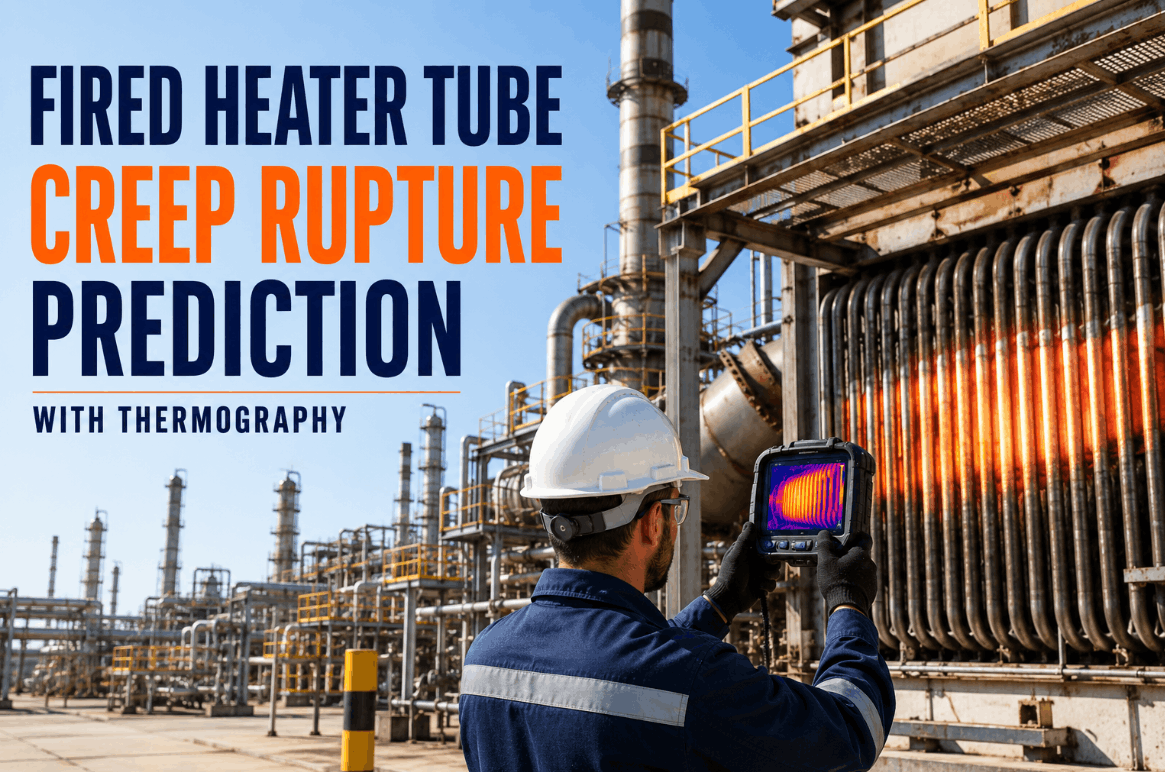
Fired heater tube creep rupture is one of the highest-consequence failure modes in U.S. refinery and petrochemical operations — a tube rupture in a radiant section can take a process unit offline for 30 or more days, triggering not just lost throughput but emergency refractory repair, delayed coking decontamination, and unplanned catalyst regeneration costs that accumulate fast. The root cause is almost always the same: tube metal temperatures exceeded metallurgical design limits for too long, and no one had the continuous visibility to intervene before consumed creep life crossed the point of no return. Facilities that Book a Demo with iFactory are finding that continuous skin temperature monitoring, AI-correlated IR thermography, and real-time API 530-based remaining life calculations give reliability engineers exactly the advance warning needed to plan a tube bundle replacement during a scheduled turnaround rather than respond to a rupture event during peak production.
Predict Tube Creep Rupture Before It Costs You 30+ Days of Downtime
iFactory's AI platform delivers continuous tubeskin temperature analytics, IR thermography correlation, and API 530 remaining life calculations — purpose-built for refinery and petrochemical fired heater integrity programs.
Why Fired Heater Tubes Fail by Creep — and Why Traditional Monitoring Misses It
Creep is a time-dependent, thermally activated deformation mechanism. When a fired heater tube operates above its creep threshold temperature — typically around 800°F (427°C) for carbon steel, and at higher thresholds for chrome-moly alloys — applied stress causes the metal to slowly elongate and thin even without exceeding its yield strength. Over thousands of operating hours, this accumulated strain leads to visible bulging, measurable wall thinning, and ultimately stress rupture. The insidious aspect of creep damage is that it is cumulative and largely invisible to periodic inspection until tertiary creep begins — the accelerating phase immediately preceding rupture. Coke deposition on tube interiors insulates the inner wall, driving up outer skin temperatures to levels that greatly accelerate creep consumption. Flame impingement on localized tube sections creates hot spots that are missed entirely by widely spaced manual thermocouple readings. The overwhelming majority of steam boilers and fired heater tubes operating at elevated temperatures are ageing and within creep threshold temperature ranges, carrying inherent stress rupture risk when not continuously and accurately monitored.
Coke Deposition Hot Spots
Internal coke buildup insulates tube walls, forcing outer skin temperatures well above design limits and dramatically accelerating creep damage accumulation in localized zones.
Flame Impingement
Burner misalignment or combustion instability creates localized flame contact that pushes tube skin temperatures beyond metallurgical limits within hours, invisible to standard thermocouple grids.
Wall Thinning & Oxidation
High-temperature sulfidation, naphthenic acid corrosion, and carburization progressively thin tube walls — reducing the cross-section that carries hoop stress and advancing creep rupture timing.
Below-Design Inlet Temperature
Operating below design steam inlet temperature causes unexpected condensation in intermediate passes, creating thermal fatigue cycles and localized stress concentrations that initiate cracking at tube bends.
Tubeskin Thermocouples, IR Thermography, and the Data Layer That Unifies Them
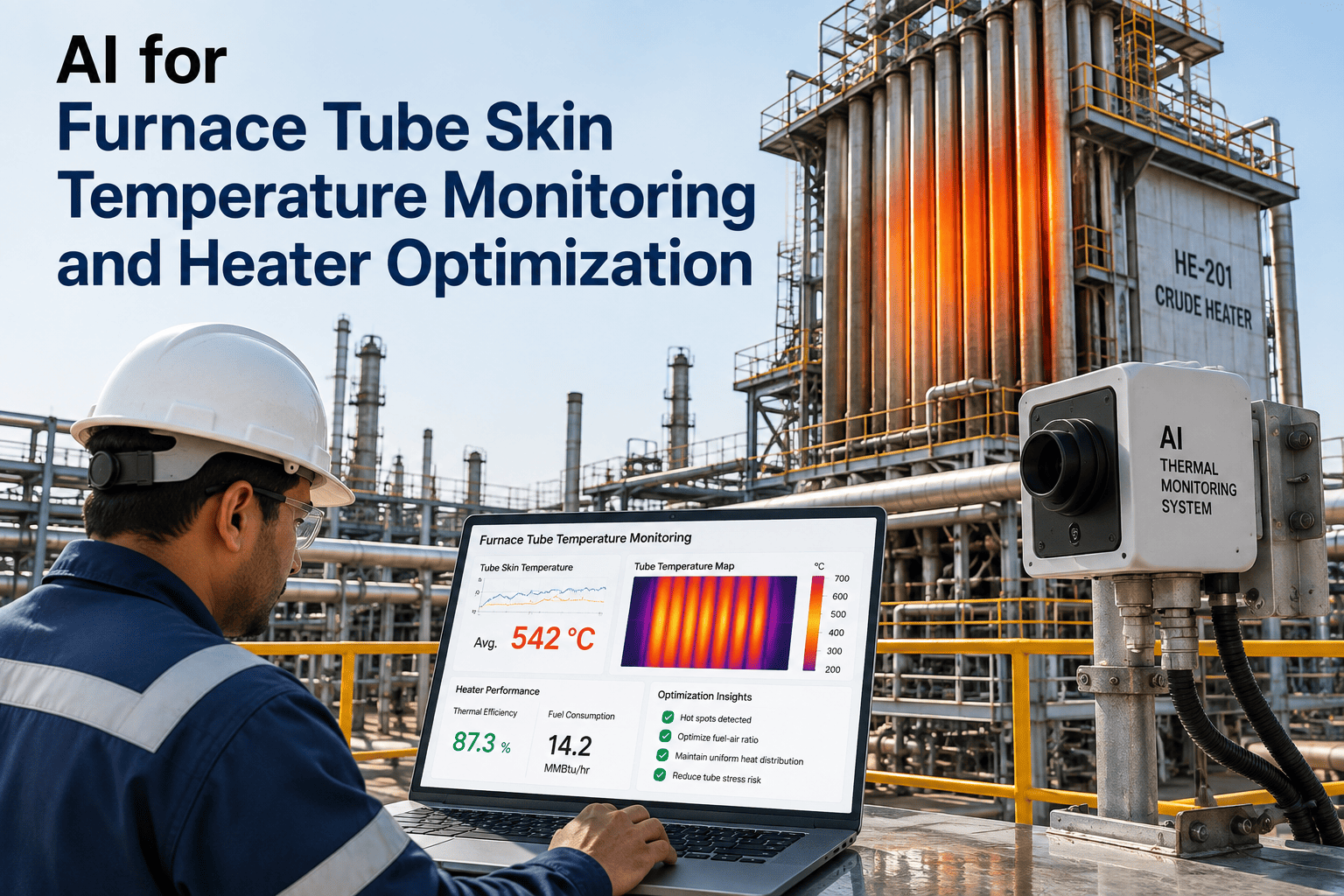
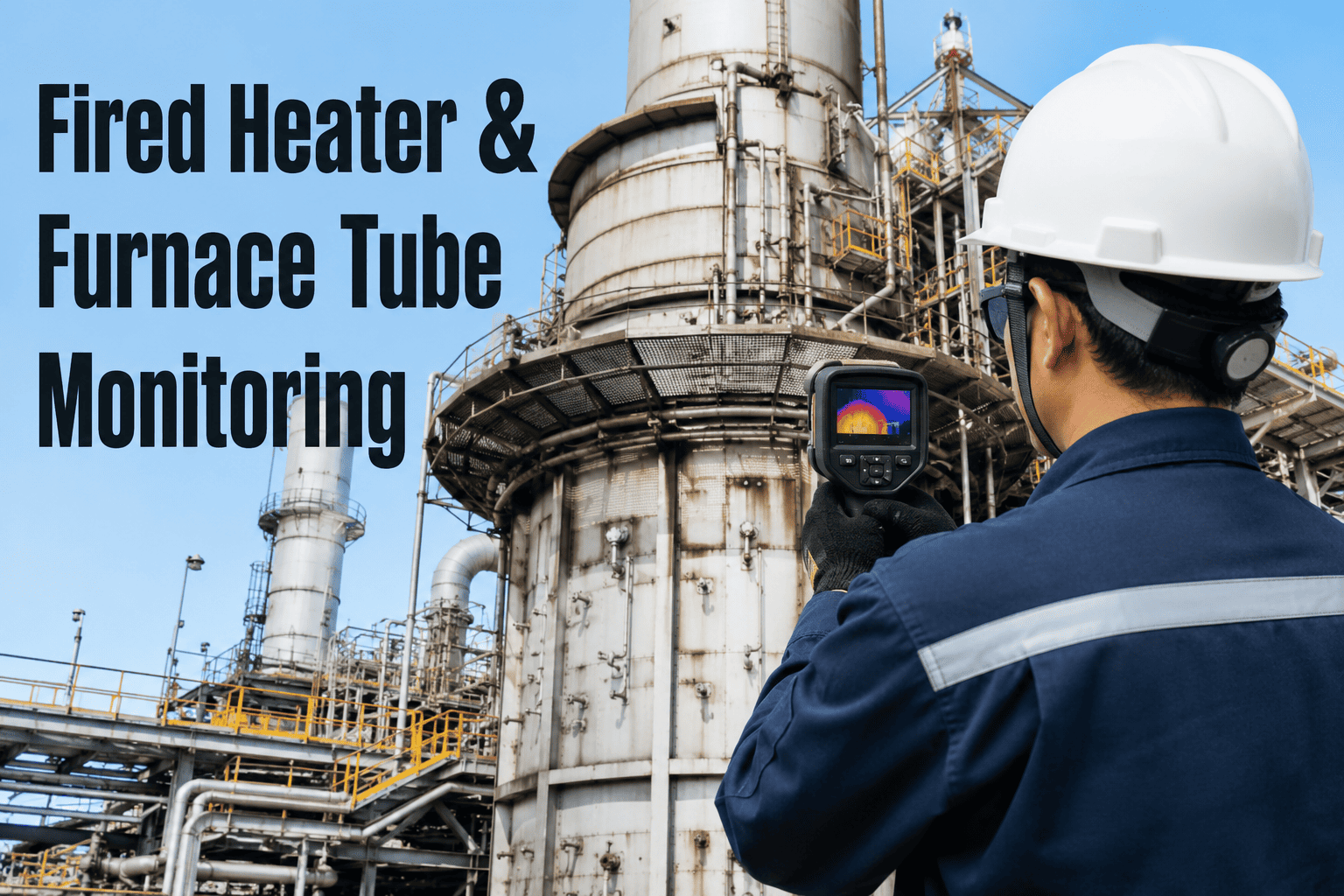
For the past 30 years, infrared thermometry has been the backbone of tube metal temperature monitoring in refining and chemical furnaces, used to track temperature levels and variations that determine performance limits and reliable tube life. But IR thermography on its own is a periodic snapshot — a technician walking the heater floor during an observation window, not a continuous safety net. Tubeskin thermocouples provide the continuous data stream, but their accuracy depends critically on correct installation and weld quality; underestimating tube temperature poses significant safety risk by masking creep damage accumulation until it is too late for planned intervention. iFactory integrates both data sources — thermocouple streams and periodic IR scans — into a single AI intelligence layer that validates readings against each other, flags sensor drift, and maintains a continuously updated tube health model. Reliability engineers who Book a Demo frequently identify measurement gaps in their existing thermocouple coverage that leave hot spots undetected between planned IR surveys.
Tubeskin Thermocouple Continuous Monitoring
iFactory ingests high-frequency tubeskin thermocouple data from all radiant and convection section instruments, applying statistical process control to detect temperature excursions, sensor drift, and inter-tube hot spot development in real time. Accurate temperature determination using tubeskin thermocouples is essential for API 579 Part 10 remaining life calculations, and iFactory automates the data quality validation step that manual programs routinely skip.
IR Thermography Integration and AI Enhancement
When IR scan data is uploaded to the platform — whether from handheld surveys or permanently mounted radiometric cameras — iFactory's AI overlays the thermal map against the live thermocouple baseline, identifying spatial temperature gradients that indicate coke zones, flame impingement areas, or refractory hot faces. Heat transfer calculations convert surface thermography readings into estimated tube metal temperatures for locations without direct thermocouple coverage, extending life assessment to the full tube bundle.
API 530 / API 579 Remaining Life Calculations — Automated and Dynamic
API 530 tubes are typically designed for 100,000 hours using minimum expected creep properties for the tube material. The remaining life of a service-exposed heater tube is controlled by creep-rupture life, elastic life, or the retirement thickness set by the owner. iFactory automates the Larsen-Miller and Omega method calculations continuously — not only during turnaround reviews — updating consumed life fraction as operating conditions change, and projecting the remaining useful life window with confidence intervals that procurement and scheduling teams can act on directly.
The Four Stages of Creep Damage — and Where iFactory Intervenes
Creep damage follows a well-defined progression from primary through tertiary phases. Traditional inspection programs only find damage when it reaches visible bulging — which already means tertiary creep is underway. iFactory's continuous monitoring model is built to intervene at Stage 1 and Stage 2, where the remaining life window is still manageable and planned repair is still a choice.
Primary Creep — Temperature Exceedance Detected
Skin temperatures begin exceeding design allowable limits — driven by coke buildup, flame impingement, or process upsets. No visible damage yet. iFactory flags the temperature exceedance event, logs consumed life fraction against the API 530 Larsen-Miller curve, and projects the impact on remaining tube life if the condition persists. This is the ideal intervention window: a decoking run or burner adjustment restores operating conditions without tube replacement. Facilities that Book a Demo typically find multiple Stage 01 events in historical data that were never flagged by their existing systems.
Intervention Window: 180+ Days AheadSecondary Creep — Accumulated Life Fraction Rising
Sustained elevated temperatures accumulate consumed life fraction measurably. Wall thinning from combined corrosion and creep begins to narrow the safety margin. iFactory's remaining life model shows consumed fraction trending toward the 60–80% threshold, triggering an engineering review notification. Tube replacement can be scoped into the next planned turnaround with standard lead times for tube bundle procurement.
Intervention Window: 60–180 Days AheadTertiary Creep — Visible Bulging and Accelerating Strain
Tube deformation becomes measurable — sagging, bowing, or visible bulging of the tube wall. The Omega method calculation shows accelerating strain rate in the tertiary regime. At this stage, continued operation is a calculated risk. iFactory generates a priority alert with projected days to rupture under current operating conditions, enabling a controlled shutdown for emergency tube replacement before a forced rupture event.
Intervention Window: Days to WeeksStress Rupture — Forced Outage, 30+ Day Recovery
Tube rupture triggers emergency shutdown. Refractory damage, hydrocarbon release, potential fire, and 30 or more days of unit downtime follow. Tube bundle replacement under emergency conditions costs 3–5× a planned replacement due to premium labor, expedited shipping for long-lead alloy tube materials, and extended unit isolation for inspection of adjacent components. iFactory's entire value proposition is keeping your program at Stage 01 and Stage 02.
Emergency Response — Cost Exceeds $1M+Traditional Tube Life Management vs. iFactory AI-Driven Continuous Monitoring
Most U.S. refineries still manage fired heater tube integrity through a combination of annual borescope inspections, periodic IR surveys, and manual API 530 spreadsheet calculations performed during turnaround planning. This approach evaluates historical data reactively, using single maximum operating data points when anomalies occur — leading to highly conservative results that either trigger premature tube replacements or miss developing creep damage between inspection windows. iFactory replaces this piecemeal model with a continuous, AI-driven integrity program.
| Integrity Activity | Traditional Method | iFactory AI Approach | Risk Reduction |
|---|---|---|---|
| Skin Temperature Monitoring | Fixed thermocouple grid + periodic IR walk | Continuous tubeskin telemetry + sensor drift validation | Eliminates hot spot blind zones between IR surveys |
| Creep Life Calculation | Manual API 530 spreadsheet at turnaround | Automated Larsen-Miller & Omega method, updated in real time | Consumed life fraction tracked continuously, not once per cycle |
| Coke / Hot Spot Detection | Visual observation or operator rounds | AI-driven temperature gradient anomaly detection | Identifies coke zones weeks before tube damage threshold |
| IR Thermography Analysis | Manual report, filed post-survey | Thermal scan uploaded; AI correlates against live sensor baseline | Converts thermography from snapshot to predictive intelligence |
| Tube Replacement Planning | Conservative calendar-based schedule | Condition-based with remaining life confidence intervals | Extends tube bundle life up to 30% beyond conservative estimates |
| ERP Procurement Trigger | Manual requisition at turnaround kickoff | Auto-generated PR in SAP/Oracle when life threshold crossed | Eliminates emergency premium on long-lead alloy tube materials |
"We had a CDU charge heater where tubeskin readings had been trending 15°F above baseline for six weeks — the kind of slow drift that never trips an alarm in a standard SCADA setup. iFactory's AI flagged the trend as consistent with coke formation in the lower radiant pass and estimated that continuing at current skin temperatures would consume an additional 8% of design life per month. We scheduled a targeted decoking during the next planned maintenance window and avoided what the remaining life model projected as a probable tube failure within the following two turnaround cycles. The engineering review alone saved us the cost of the platform for two years."
From Reactive Rupture Response to Proactive Tube Life Management
Fired heater tube creep rupture is not an unpredictable event — it is the outcome of insufficient visibility into a well-understood degradation process. The physics of creep damage, the role of skin temperature in accelerating consumed life fraction, and the API 530 framework for calculating remaining life have been established for decades. What has been missing in most U.S. refinery integrity programs is the continuous data infrastructure to make those calculations dynamic rather than periodic. iFactory closes that gap by connecting tubeskin thermocouples, IR thermography, and process operating data into a live remaining life model that tells your reliability team exactly where each heater tube stands — every day, not just at turnaround. For operations running CDU charge heaters, coker heaters, vacuum heater services, or reformer radiant sections, the difference between detecting creep damage at Stage 01 and responding to a Stage 04 rupture is measured in millions of dollars and months of lost production. Book a Demo with iFactory's fired heater integrity team to map your existing instrumentation against the monitoring framework and build a deployment plan that integrates with your current turnaround cycle.
Fired Heater Tube Creep Rupture Monitoring — Frequently Asked Questions
What is the primary standard used for fired heater tube remaining life calculations?
API 530 (Calculation of Heater-Tube Thickness in Petroleum Refineries) using the Larsen-Miller method governs creep-rupture design, while API 579-1/ASME FFS-1 provides the Omega method for remaining life assessment of service-exposed tubes — both are automated continuously within iFactory's platform.
How does iFactory detect hot spots that fixed thermocouples miss?
iFactory integrates periodic IR thermography scan data with live thermocouple streams, using AI-driven heat transfer calculations to estimate tube metal temperatures across the full radiant section — including locations without direct sensor coverage.
Can iFactory integrate with existing SCADA and DCS systems at the refinery?
Yes. iFactory connects via OPC-UA, Modbus, and standard historian interfaces (OSIsoft PI, Aspen InfoPlus.21) and integrates with SAP and Oracle ERP to automate procurement triggers when remaining life thresholds are crossed.
How does coke deposition affect creep life consumption rate?
Coke acts as thermal insulation on tube interiors, forcing outer skin temperatures above design limits — iFactory detects the resulting temperature elevation and recalculates the accelerated creep life consumption rate in real time.
What heater services is the platform applicable to beyond CDU charge heaters?
iFactory's fired heater tube monitoring is applicable across all high-temperature refinery and petrochemical heater services including coker heaters, vacuum heaters, reformer radiant sections, and hydrocracker preheat furnaces.
Stop Managing Tube Creep with Spreadsheets. Start Predicting It with AI.
iFactory's industrial AI platform delivers continuous fired heater tube integrity monitoring — from skin temperature analytics to automated remaining life calculations — purpose-built for U.S. refinery reliability teams.