Gearbox vibration analysis is the most reliable early warning system for rotating equipment faults in industrial plants, yet thousands of gearboxes operate without continuous vibration monitoring until a tooth fracture or bearing seizure forces an emergency shutdown. Every gear mesh generates a distinct vibration signature at the gear mesh frequency and its harmonics, and every fault mode — pitting, spalling, scuffing, tooth cracking, or broken teeth — creates a corresponding modulation pattern in that signature that trained analysis can decode weeks or months before catastrophic failure. If your condition monitoring program does not track gear mesh frequency amplitudes, sideband patterns, and order-normalized spectra, you are not diagnosing gearbox health — you are waiting for a failure event to announce itself at the worst possible time.
Gear Mesh Frequency Analysis: The Foundation of Gearbox Diagnostics
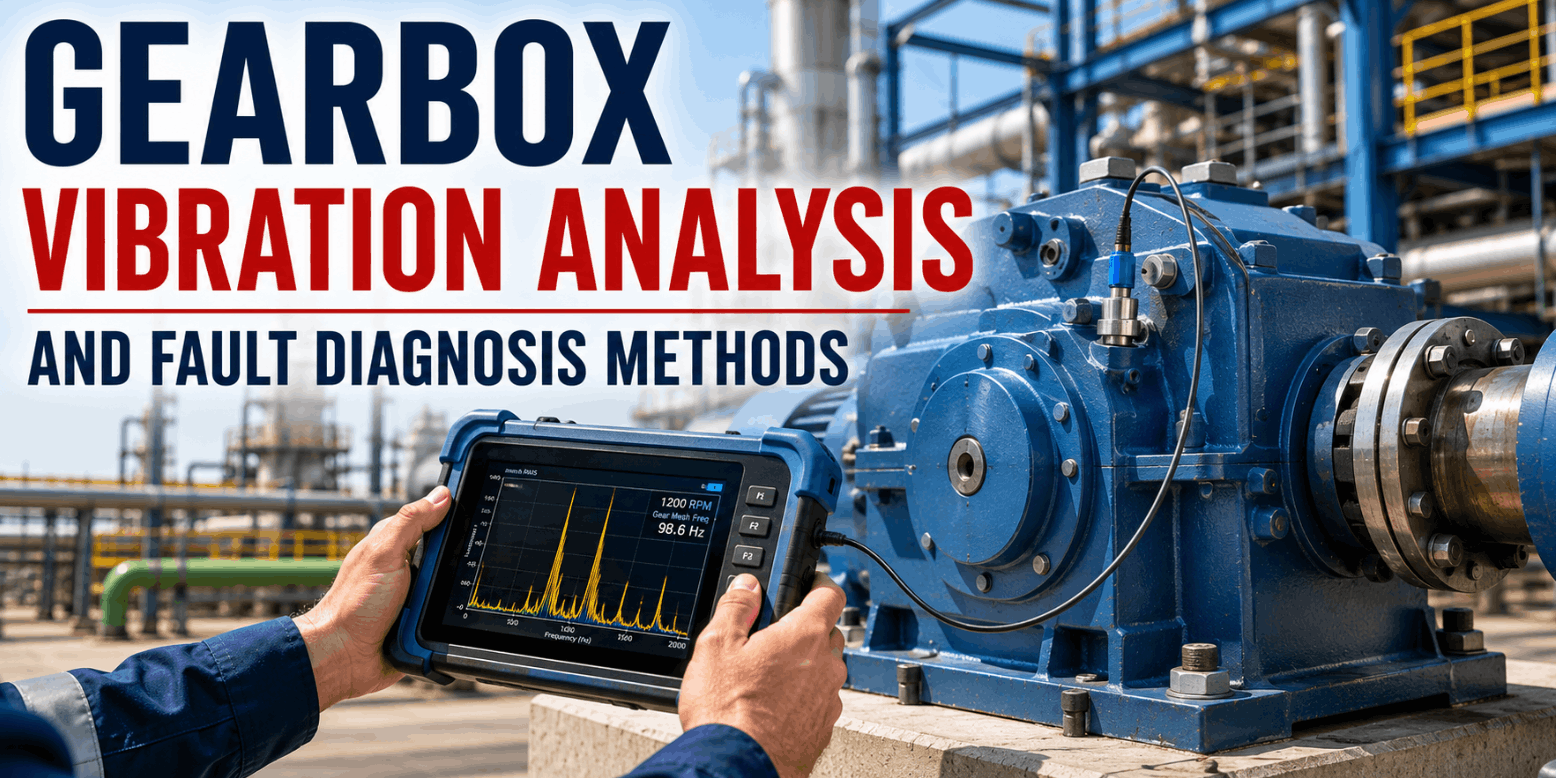
The gear mesh frequency is the fundamental vibration frequency generated as gear teeth engage and disengage during rotation. It is calculated as the product of the number of teeth on a gear and its rotational speed in revolutions per second: GMF = (teeth × RPM) / 60. In a healthy gearbox, GMF appears as the dominant peak in the vibration spectrum, accompanied by lower-amplitude harmonics. The amplitude, harmonic structure, and sideband pattern around GMF carry detailed information about gear condition, alignment quality, tooth surface integrity, and lubrication effectiveness. Without continuous GMF tracking, the earliest indicators of gear degradation — rising sideband amplitudes at 1× shaft speed spacing — remain invisible until secondary damage produces vibration levels that trigger a high-level alarm, at which point the failure is already advanced. Book a Demo to see iFactory's gear mesh frequency monitoring in action.
| Gearbox Configuration | Pinion Teeth | Gear Teeth | Input Speed (RPM) | GMF Calculation | GMF Value (Hz) |
|---|---|---|---|---|---|
| Single Reduction — Centrifugal Compressor Drive | 23 | 87 | 1,800 | 23 × 1,800 / 60 | 690 Hz |
| Single Reduction — Cooling Tower Fan Drive | 19 | 95 | 1,200 | 19 × 1,200 / 60 | 380 Hz |
| Double Reduction — Conveyor Drive | 17 (input) | 71 (intermediate) | 1,500 | 17 × 1,500 / 60 | 425 Hz |
| Planetary — Mill Drive | 13 (sun) | 42 (ring) | 980 | 13 × 980 / 60 | 212 Hz |
5 Gearbox Failure Modes Identified by Vibration Signature Analysis
Each gearbox failure mode produces a distinct and repeatable vibration signature that can be identified through systematic spectrum and waveform analysis. These signatures are the language of gearbox diagnostics, and learning to read them is the difference between planned maintenance and emergency replacement. iFactory's AI platform automatically classifies these fault signatures across your entire gearbox fleet, flagging developing defects at their earliest detectable stage. Book a Demo for a fleet-level fault assessment.
Sideband and Order Analysis: Detecting Gearbox Faults Months Before Failure
Sidebands are the most diagnostically valuable feature in a gearbox vibration spectrum. They appear as frequency peaks on either side of the gear mesh frequency and its harmonics, spaced at multiples of the shaft running speed. A healthy gearbox produces minimal sideband amplitude. As a gear fault develops — pitting, wear, or a cracked tooth — the amplitude and number of sidebands increase proportionally with the severity of the defect. Sideband analysis converts this pattern into a quantifiable fault severity metric that tracks defect progression over time. Order analysis extends this capability to variable-speed gearboxes by normalizing the frequency axis to shaft speed multiples, ensuring that GMF and sideband components remain identifiable regardless of operating speed. Book a Demo to see how iFactory automates sideband analysis across your fleet.
- Gear faults detected when vibration exceeds ISO 10816 alert thresholds — typically at spalling stage
- Misdiagnosis between gear wear and bearing wear due to overlapping frequency ranges
- Sideband patterns evaluated manually by vibration analyst — reviewed quarterly at best
- Variable-speed operation creates frequency shifts that mask developing gear faults
- Root cause of gear failure determined during teardown inspection, not during operation
- Maintenance triggered by calendar interval or alarm event — not by actual gear condition
- Gear faults flagged when sideband amplitude rises 15% above baseline — pitting stage detection
- AI classification separates gear, bearing, and shaft fault signatures from single spectrum
- Sideband amplitude, count, and spacing tracked continuously per gear mesh pair
- Order-normalized spectra maintain diagnostic clarity across full speed range
- Fault progression trend line identifies acceleration rate — predicts failure window
- Condition-based maintenance triggered by actual defect progression — not calendar date
| Fault Severity Stage | Sideband Characteristic | GMF Amplitude Trend | Time Waveform Feature | Typical Remaining Life | Recommended Action |
|---|---|---|---|---|---|
| Healthy | No significant sidebands | Stable baseline | Sinusoidal, no impact events | Not applicable | Continue routine monitoring |
| Early Pitting | Sidebands appear at 1× shaft speed, amplitude < 30% of GMF | Slight increase (< 10%) | Minimal modulation visible | 3 to 6 months | Increase monitoring frequency |
| Moderate Pitting | Multiple sideband pairs visible, amplitude 30–60% of GMF | Moderate increase (10–25%) | Clear amplitude modulation at shaft period | 1 to 3 months | Plan replacement at next outage |
| Advanced Spalling | Dense sideband families, amplitude > 60% of GMF | Significant increase (> 25%) | Pronounced impacts at shaft rotation rate | 1 to 4 weeks | Schedule immediate replacement |
| Pre-Failure (Crack) | Broadband noise elevation, sidebands merge into raised noise floor | Erratic — rapid fluctuation | High-energy impact events with ring-down | Hours to days | Emergency shutdown and replacement |
The 4-Step Gearbox Vibration Monitoring Protocol
Deploying an effective gearbox vibration monitoring program requires a structured approach that integrates sensor placement, baseline acquisition, threshold configuration, and fault progression tracking. iFactory's AI platform automates each step, enabling reliability teams to scale gearbox monitoring across dozens or hundreds of assets without proportional increases in analyst workload. Book a Demo for a guided walkthrough of the platform.
We had been monitoring our mill gearboxes with handheld vibration collectors on a monthly route for six years. Every month we collected data and sent it to our reliability engineer for analysis. Every month the reports came back with acceptable vibration levels. Then a primary mill pinion gear lost a tooth at 2:00 AM on a Saturday. The unplanned downtime cost us $720,000 in lost production and emergency repairs. When we reviewed the vibration data from the month before the failure — data we had collected and approved as acceptable — the sideband pattern was clearly visible at 1× shaft speed around the fourth GMF harmonic. Our reliability engineer had been looking at overall vibration levels per ISO 20816, which were still within the alert zone. The sideband signature was there. We just were not looking for it. iFactory's AI caught a similar sideband pattern on a different mill gearbox within the first week of deployment — and gave us five weeks of warning to plan the replacement during a scheduled outage instead of an emergency shutdown.
Frequently Asked Questions
Gear mesh frequency is the vibration frequency generated when gear teeth engage, calculated as teeth multiplied by shaft speed. Its amplitude trends, harmonic structure, and sideband modulation are the primary diagnostic indicators used to detect pitting, wear, cracking, and misalignment in gearbox systems.
Sidebands are frequency peaks that appear on either side of the gear mesh frequency, spaced at multiples of the shaft running speed. Their amplitude and quantity increase proportionally with gear surface damage, making sideband analysis the most sensitive method for detecting early-stage pitting and tooth defects.
Sideband analysis detects developing pitting and gear tooth defects 3 to 6 months before spalling or tooth fracture occurs, depending on load severity. This warning window enables planned maintenance scheduling rather than emergency shutdowns triggered by secondary damage.
Order analysis normalizes the frequency axis to multiples of shaft running speed, ensuring gear mesh frequency and sideband components remain identifiable at any operating speed. This eliminates frequency smearing and enables consistent fault tracking across speed changes in variable-speed drives and process cycling.
A triaxial accelerometer at each bearing housing location provides radial and axial vibration data sufficient for complete gearbox diagnostics. For critical assets, an additional accelerometer at the gear mesh zone and a tachometer for order tracking enable phase analysis and precise sideband diagnostics.
Conclusion: Sideband Analysis Is the Gearbox Diagnostics Gap You Cannot Afford to Ignore
The gap between a gearbox that is healthy and one that is about to fail is measured in sideband amplitudes. When reliable tooth surface gradually degrades into pitting, spalling, and fracture, the vibration signature changes in a predictable sequence that continuous monitoring detects at every stage. Without sideband analysis and GMF trend tracking, the earliest indicators of gearbox distress remain invisible until secondary damage produces vibration levels high enough to trip a protective relay. By the time that relay trips, the gearbox has already sustained damage that multiplies repair costs and extends downtime by days or weeks. iFactory's AI-powered vibration analysis platform closes that gap by continuously monitoring gear mesh frequencies, sideband patterns, and order-normalized spectra across your gearbox fleet — converting raw vibration data into actionable fault intelligence that gives your maintenance team the warning time they need to plan interventions, not react to failures.