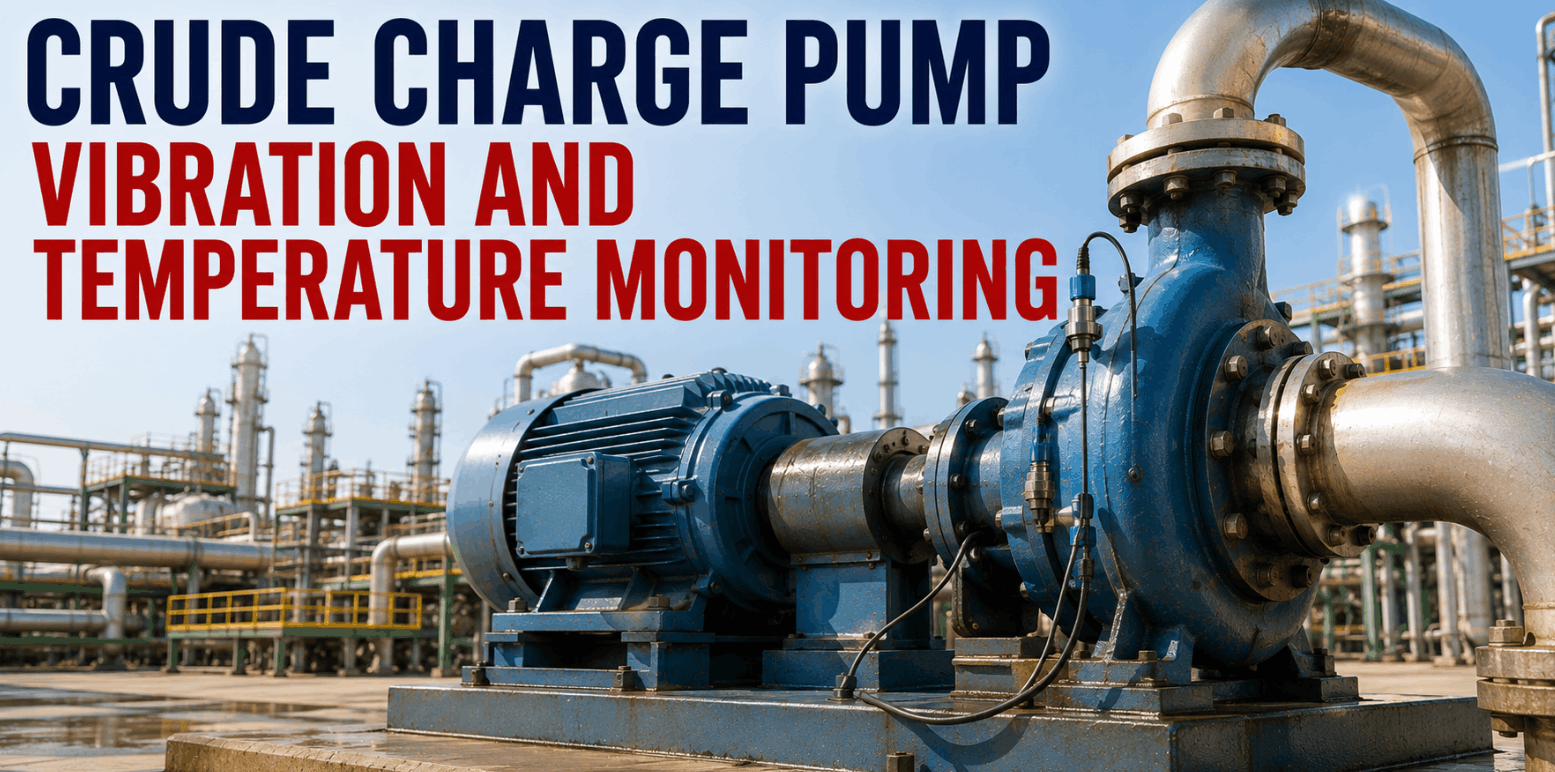
Crude charge pumps are the most critical rotating assets in any petroleum refinery — they feed unprocessed crude oil from storage to the Crude Distillation Unit, making them the first line of process availability. When a charge pump fails, the CDU feed stops, and every downstream unit from the naphtha hydrotreater to the vacuum distillation tower faces a feedstock starvation event that can take days to recover. Despite this criticality, a significant fraction of refineries still rely on walk-around vibration data collection and quarterly oil analysis to monitor pumps that operate at 300+ horsepower, handle crude temperatures exceeding 700°F, and tolerate the variable feedstock quality that accelerates bearing and seal degradation faster than any constant-duty pump in the plant. iFactory's continuous vibration and temperature monitoring platform closes that protection gap.
Continuous Vibration and Temperature Monitoring for Your Most Critical Refinery Pumps
iFactory connects vibration sensors, bearing RTDs, and process data into a single predictive dashboard — flagging bearing degradation, cavitation, and misalignment before they become CDU feedstock events.
API 610 Vibration Monitoring Parameters for Crude Charge Pumps
API 610 is the governing standard for centrifugal pumps in refinery service, specifying vibration acceptance criteria at the bearing housing and shaft locations under both performance test and field operating conditions. For crude charge pumps operating at 1,500 to 3,600 RPM, the standard mandates an unfiltered bearing housing vibration velocity not exceeding 3.0 mm/s RMS for overhung (OH2) and between-bearing (BB1–BB5) configurations. For discrete frequency components — typically at 1× and 2× shaft speed — the limit is 2.0 mm/s RMS. These thresholds are not arbitrary; they are derived from decades of field data correlating vibration amplitude with bearing life reduction factors. When bearing housing vibration exceeds 4.5 mm/s RMS continuously, bearing L10 life drops by approximately 50% compared to operation within API 610 acceptance limits. Book a Demo to see how iFactory applies these standards in its monitoring platform.
| Pump Configuration | API 610 Type | Bearing Housing Limit (Unfiltered) | Discrete Frequency Limit | Shaft Vibration Limit (Peak-to-Peak) | Measurement Location |
|---|---|---|---|---|---|
| Overhung — Horizontal | OH2 | 3.0 mm/s RMS | 2.0 mm/s RMS | N/A | Drive-end bearing housing |
| Between-Bearing — Single Stage | BB1, BB2 | 3.0 mm/s RMS | 2.0 mm/s RMS | 51 µm (2.0 mils) | Both bearing housings |
| Between-Bearing — Multistage | BB3, BB4 | 3.0 mm/s RMS | 2.0 mm/s RMS | 41 µm (1.6 mils) | Each stage bearing housing |
| Double Casing — High Pressure | BB5 | 3.0 mm/s RMS | 2.0 mm/s RMS | 36 µm (1.4 mils) | Thrust and radial bearing housings |
| Vertically Suspended | VS1–VS6 | 5.0 mm/s RMS | 3.0 mm/s RMS | 89 µm (3.5 mils) | Motor mounting flange / thrust bearing |
5 Crude Charge Pump Failure Modes Detected by Vibration and Temperature Monitoring
Each failure mode produces a characteristic vibration signature and temperature response that iFactory's AI monitoring platform identifies and classifies automatically — enabling reliability teams to intervene at the earliest detectable stage rather than after secondary damage has occurred. Book a Demo for a fleet-level assessment of your charge pump monitoring program.
Bearing Temperature Limits and Alarm Configuration
API 610 paragraph 6.10.2.4 specifies the bearing temperature acceptance criteria for centrifugal pumps in refinery service. For pumps equipped with bearing temperature sensors — typically RTDs embedded in the bearing outer ring or oil bath — the maximum allowable bearing metal temperature is 93°C (200°F). For pressurized oil lubrication systems, the oil outlet temperature must not exceed 70°C (160°F), with a maximum temperature rise from inlet to outlet of 28°C (50°F). For ring-oiled or splash-lubricated systems, the maximum oil sump temperature is 82°C (180°F). These limits are not arbitrary safety margins; they are derived from lubricant oxidation kinetics and bearing material fatigue properties. Operating a rolling element bearing continuously at 100°C rather than 80°C reduces the lubricant's useful life by approximately 50% and accelerates inner ring fatigue propagation by a comparable factor. iFactory's temperature trending module tracks each bearing point against its dynamic baseline, accounting for load and ambient temperature variations, and generates alerts when the temperature trendline crosses thresholds that predict the 93°C limit will be reached within 14 days — not when it is breached. Book a Demo to see iFactory's predictive temperature alerting in action.
| Temperature Monitoring Point | API 610 Limit | iFactory Warning Threshold | iFactory Alarm Threshold | Escalation Action |
|---|---|---|---|---|
| Bearing Metal / Outer Ring | 93°C (200°F) | 80°C (25% margin) | 90°C (pre-trip alert) | Immediate operator notification |
| Oil Outlet (Pressurized System) | 70°C (160°F) | 60°C | 68°C | Cooler performance review |
| Oil Sump (Ring-Oiled System) | 82°C (180°F) | 72°C | 80°C | Oil change and bearing inspection |
| Seal Flush Outlet | Per manufacturer | 8°C above baseline | 15°C above baseline | Seal face inspection |
| Bearing Housing Surface | Per manufacturer | 65°C | 80°C | Trend analysis — predicts bearing path |
Building a Predictive Charge Pump Trending Dashboard
The diagnostic value of vibration and temperature data is not in the individual measurement — it is in the trend. A bearing housing reading of 2.8 mm/s RMS may be acceptable per API 610 if the pump has operated at that level for months, but the same reading demands immediate investigation if the pump has been trending upward from a baseline of 1.2 mm/s over the preceding four weeks. iFactory's predictive dashboard is built around this principle: every measurement is referenced against its dynamic baseline, trend direction, and acceleration rate to produce a single actionable severity score per asset rather than a collection of raw data points that require manual analysis. Book a Demo to configure a charge pump dashboard for your refinery.
We were monitoring our four crude charge pumps with a monthly vibration route and quarterly oil analysis for eight years. Our reliability engineer was one of the best in the business — he could read a spectrum faster than anyone on my team. But he could not be at the pump house 24 hours a day, and pump bearing defects do not wait for the first of the month. One Tuesday afternoon, the B charge pump tripped on high bearing temperature. The bearing outer ring temperature went from 78°C to 107°C in 37 minutes. The seal failed 11 minutes after that. We lost crude feed to the CDU for 14 hours. The production loss, seal replacement, bearing replacement, and shaft sleeve repair cost us $940,000 total. When we looked at the vibration data from the route three weeks before the failure, the bearing defect frequencies were clearly visible in the spectrum at levels that our engineer would have flagged immediately if they had been on his screen in real time. iFactory's continuous monitoring detected the same bearing defect frequency pattern on our A charge pump within the first month of deployment — and we had five weeks of warning to plan the replacement. We replaced that bearing during a planned turnaround. The continuous monitoring paid for itself on that single event.
Frequently Asked Questions
API 610 requires bearing housing unfiltered vibration velocity below 3.0 mm/s RMS for overhung and between-bearing pumps, with discrete frequency components limited to 2.0 mm/s RMS. Exceeding these limits indicates that corrective action should be planned before bearing fatigue life is significantly reduced.
API 610 limits bearing metal temperature to 93°C (200°F) maximum. For pressurized oil systems, the oil outlet temperature must stay below 70°C with a maximum 28°C rise across the bearing. Continuous operation above these thresholds accelerates lubricant oxidation and bearing fatigue exponentially.
iFactory's continuous monitoring detects bearing defect frequency excitation 3 to 6 weeks before the bearing housing vibration crosses the API 610 alarm threshold. This warning lead time is sufficient to plan replacement during a scheduled turnaround rather than responding to an emergency trip event.
An accelerometer on each bearing housing in the radial horizontal and vertical directions, plus one axial measurement per bearing housing, provides complete vibration coverage. Two bearing RTDs per housing and one seal flush temperature sensor per seal enable full thermal monitoring. A tachometer or proximity probe for shaft RPM enables order tracking.
Most refineries achieve full ROI within 6 to 12 months, driven by avoidance of a single crude charge pump failure that would cause 12 to 24 hours of CDU feedstock loss. Secondary savings from increased bearing life, reduced energy consumption, and optimized spare parts inventory accelerate the payback period.
Conclusion: The Protection Gap Between Monthly Vibration Routes and Real-Time Monitoring
The gap between monthly vibration data collection cycles is where crude charge pump failures occur. Bearing defects, seal degradation, and cavitation do not align their progression timelines with walk-around schedules. When a charge pump fails at 2:00 AM on a Sunday, the root cause is rarely a sudden material defect — it is a defect that began weeks earlier, produced a measurable vibration and temperature signature, and progressed undetected because no continuous monitoring system was in place to detect the trend. iFactory's continuous vibration and temperature monitoring platform closes that gap by applying API 610 and ISO 20816 analytical frameworks at 10-minute intervals across every measurement point on every charge pump in your refinery — converting raw sensor data into predictive fault intelligence that gives your reliability team the lead time they need to plan interventions rather than respond to emergencies.
Your Crude Charge Pumps Are Telling You Their Condition Every Minute. iFactory Listens.
iFactory's continuous vibration and temperature monitoring platform applies API 610 and ISO 20816 diagnostic frameworks at 10-minute intervals across every measurement point on your charge pumps — delivering months of warning for developing bearing, seal, and hydraulic defects. Deployed in 180+ refineries worldwide.