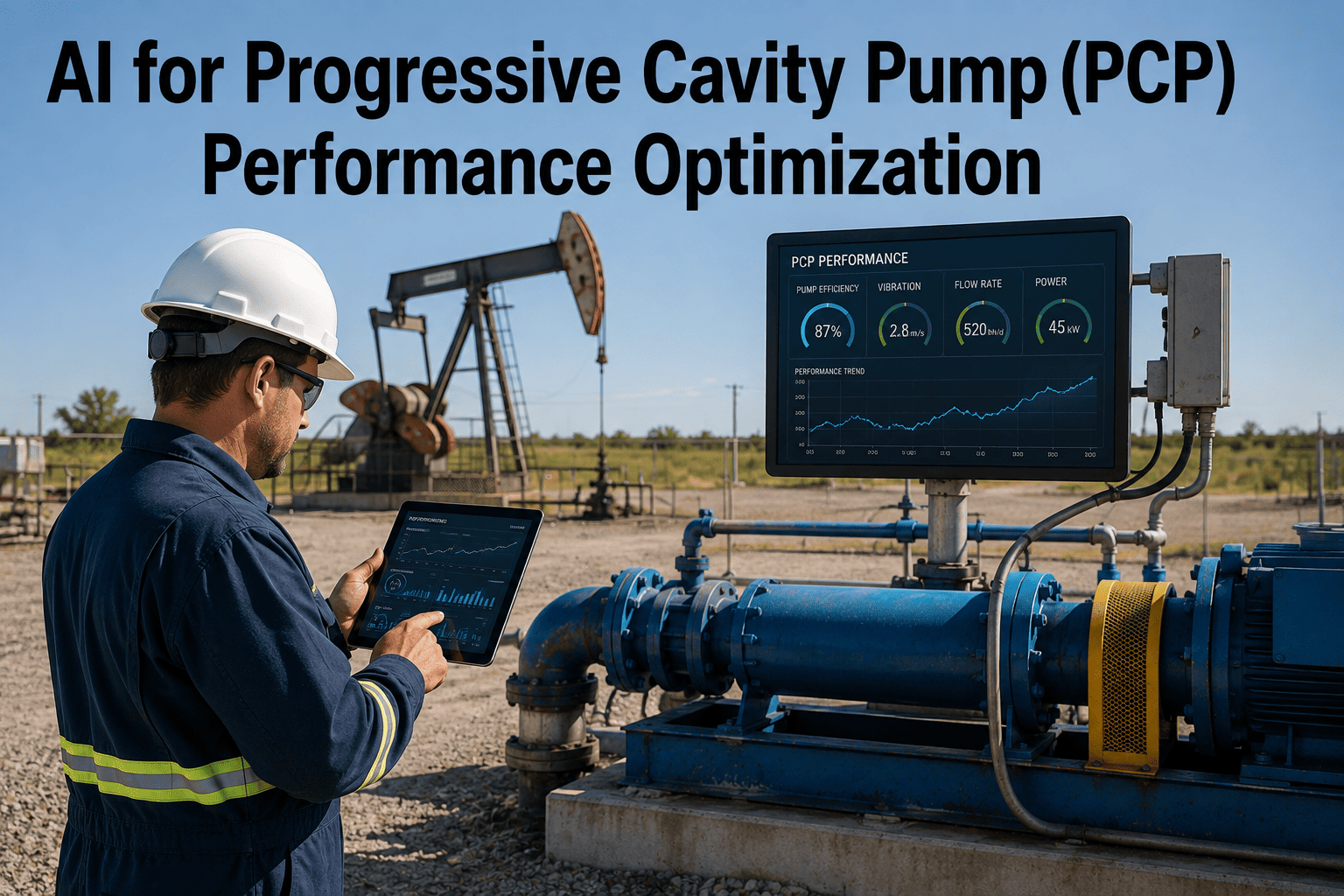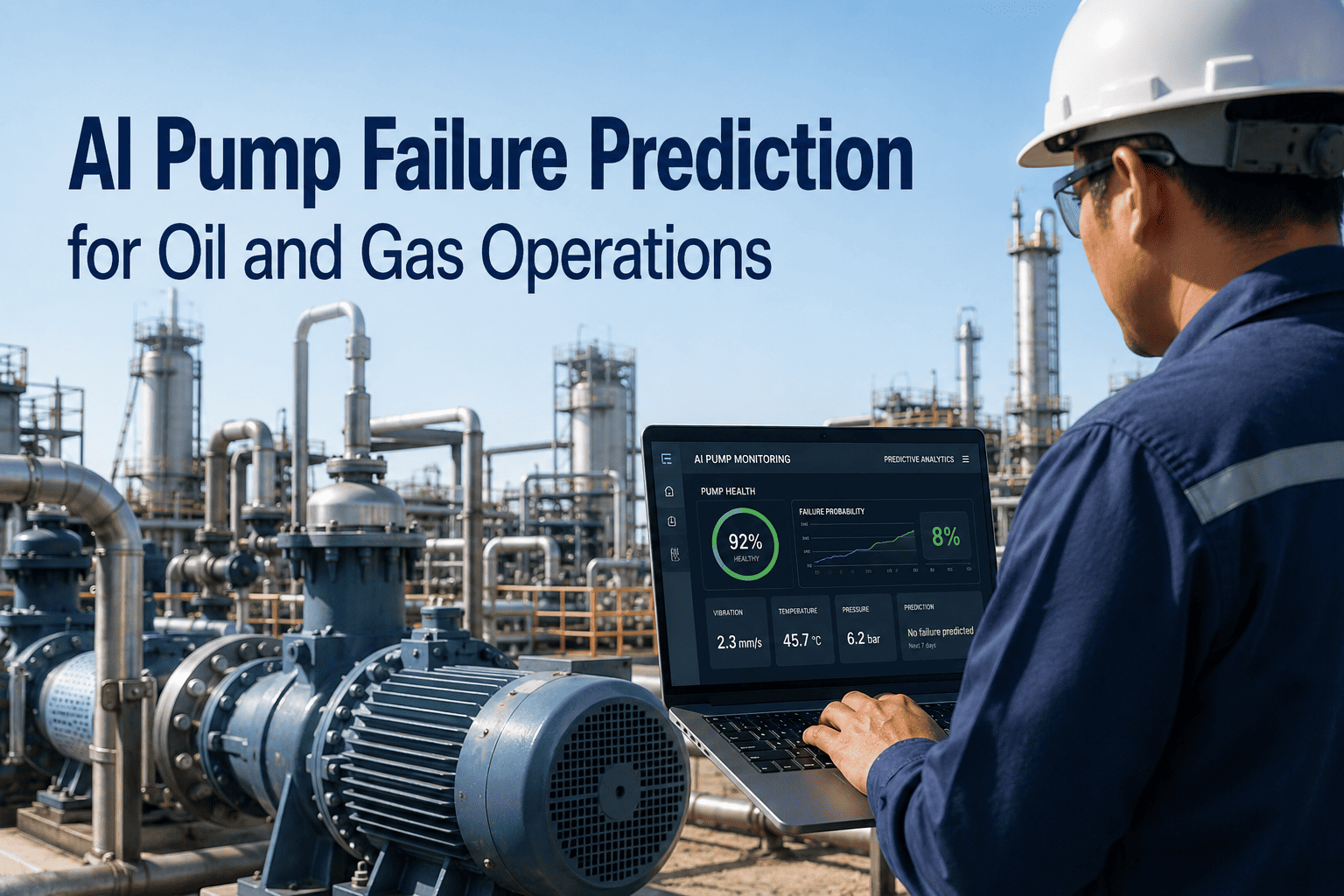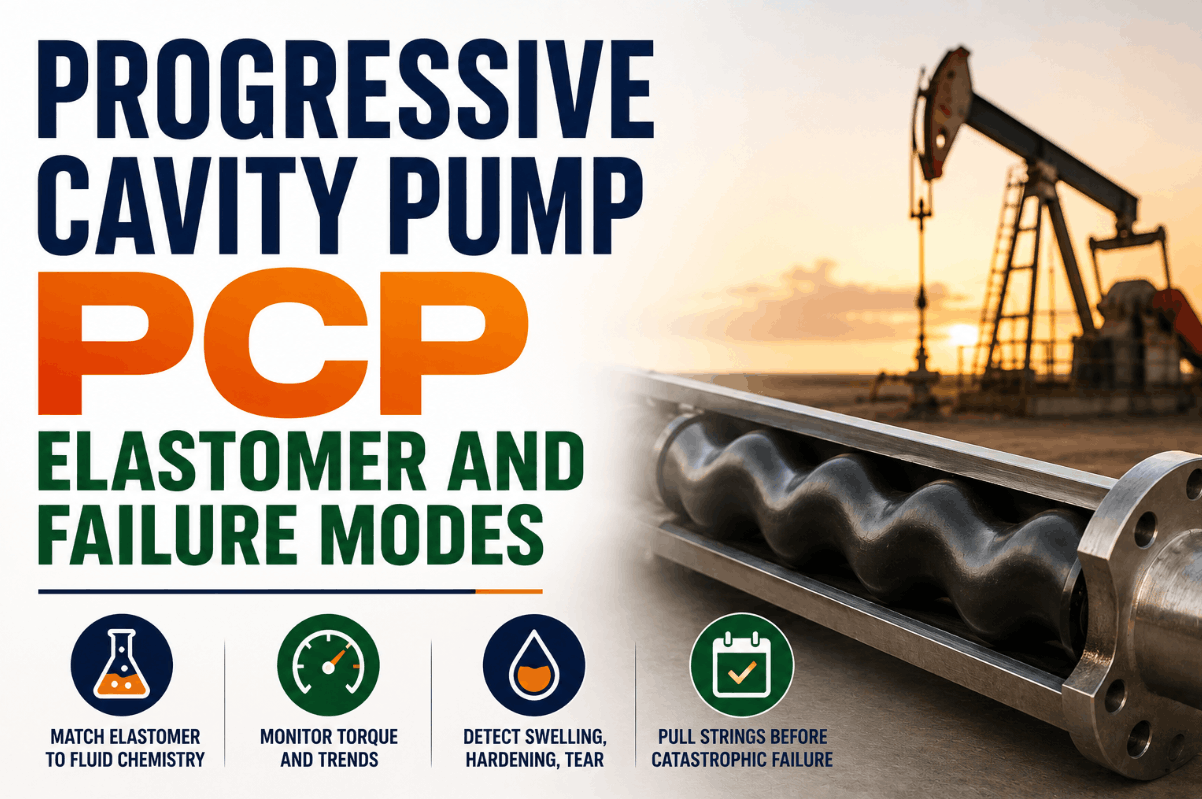
Progressive cavity pumps are the workhorse of heavy oil, viscous fluid, and high-solids production across the Permian Basin, San Joaquin Valley, Canadian oil sands, and unconventional fields where centrifugal or beam pump lift simply cannot handle the fluid properties. The PCP's ability to produce high-viscosity crude, sandy produced water, and gas-charged emulsions at controlled, pulse-free flow rates makes it irreplaceable in a significant segment of U.S. and Canadian artificial lift — but it also makes PCP operations uniquely vulnerable to a failure mode that no other pump type shares at the same frequency or severity: elastomer degradation. The stator elastomer is the heart of every PCP. It forms the interference-fit seal against the rotor that creates the helical cavities responsible for fluid displacement, and it is exposed continuously to produced fluid chemistry, temperature, gas, and mechanical stress that degrade it through swelling, hardening, tearing, and chemical attack. When the elastomer fails, the interference fit is lost, slippage replaces displacement, and the well loads fluid. The question is whether that failure is detected early enough to pull the pump string on a planned schedule — or whether it is discovered when the rotor grinds metal-to-metal against a destroyed stator, converting a pump pull into a milling job. iFactory's AI-driven monitoring platform tracks PCP torque signatures, downhole temperature, rod speed, and production flow rate continuously, detecting elastomer degradation patterns weeks before catastrophic failure and enabling planned string pulls that cost a fraction of emergency workovers. Book a Demo to see how iFactory deploys PCP health monitoring across your artificial lift fleet.
Protect Your PCP Fleet from Elastomer Failure Before It Costs a Workover
iFactory AI monitors PCP torque, speed, downhole temperature, and production flow rate continuously — detecting stator swelling, hardening, and tearing weeks before failure and generating planned pull recommendations that reduce emergency workover costs by 40–60%.
How PCP Stator Elastomers Fail: The Four Degradation Pathways That Drive Workovers
Elastomer failure is not a single event — it is a degradation process that unfolds over weeks or months through one or more of four distinct chemical and mechanical pathways. Each pathway leaves a different signature in PCP operational data, and each requires a different elastomer selection response. Understanding the mechanism is the prerequisite for selecting the right material and for knowing which monitoring parameters to track. Book a Demo to see how iFactory classifies elastomer degradation mode from your existing PCP controller and SCADA data.
Matching Elastomer Chemistry to Fluid Conditions: A Practical Selection Framework
The single most impactful decision in PCP system design is elastomer selection — yet it is frequently made on the basis of availability or cost rather than fluid chemistry compatibility. The table below maps common produced fluid conditions to the elastomer compounds that deliver the longest run life under those conditions, and identifies the monitoring parameters iFactory uses to validate that the selection is performing as designed.
| Fluid Condition | Primary Failure Risk | Recommended Elastomer | Avoid | iFactory Monitoring Focus |
|---|---|---|---|---|
| Heavy crude, low aromatics | Sand abrasion, thermal hardening | HNBR (medium-hard grade) | Soft NBR in high-solids wells | Torque variability, production efficiency trend |
| Aromatic-rich crude / condensate | Swelling, interference increase | FKM / Viton, HNBR high-saturation | Standard NBR — severe swelling risk | Progressive torque rise, downhole temperature |
| High H₂S sour environment | Sulfur embrittlement, cracking | HNBR sulfur-resistant grade | Standard NBR, EPDM | Torque drop indicating stator cracking |
| SAGD / thermal recovery (high temp) | Heat hardening, interference loss | HNBR high-temp grade (≥180°C) | NBR, soft durometer compounds | Downhole temperature vs. slip rate correlation |
| High GOR / free gas ingestion | Dry run, explosive decompression | HNBR with gas-resistant formulation | Polyurethane — CO₂ hydrolysis risk | Intake pressure, motor amp spike on gas slug |
| High produced water, CO₂ | Hydrolysis, chemical attack | FKM / HNBR with acid resistance | Ester-based polyurethanes | Efficiency trend vs. produced water chemistry log |
PCP Health Monitoring: The iFactory Data and Analytics Stack
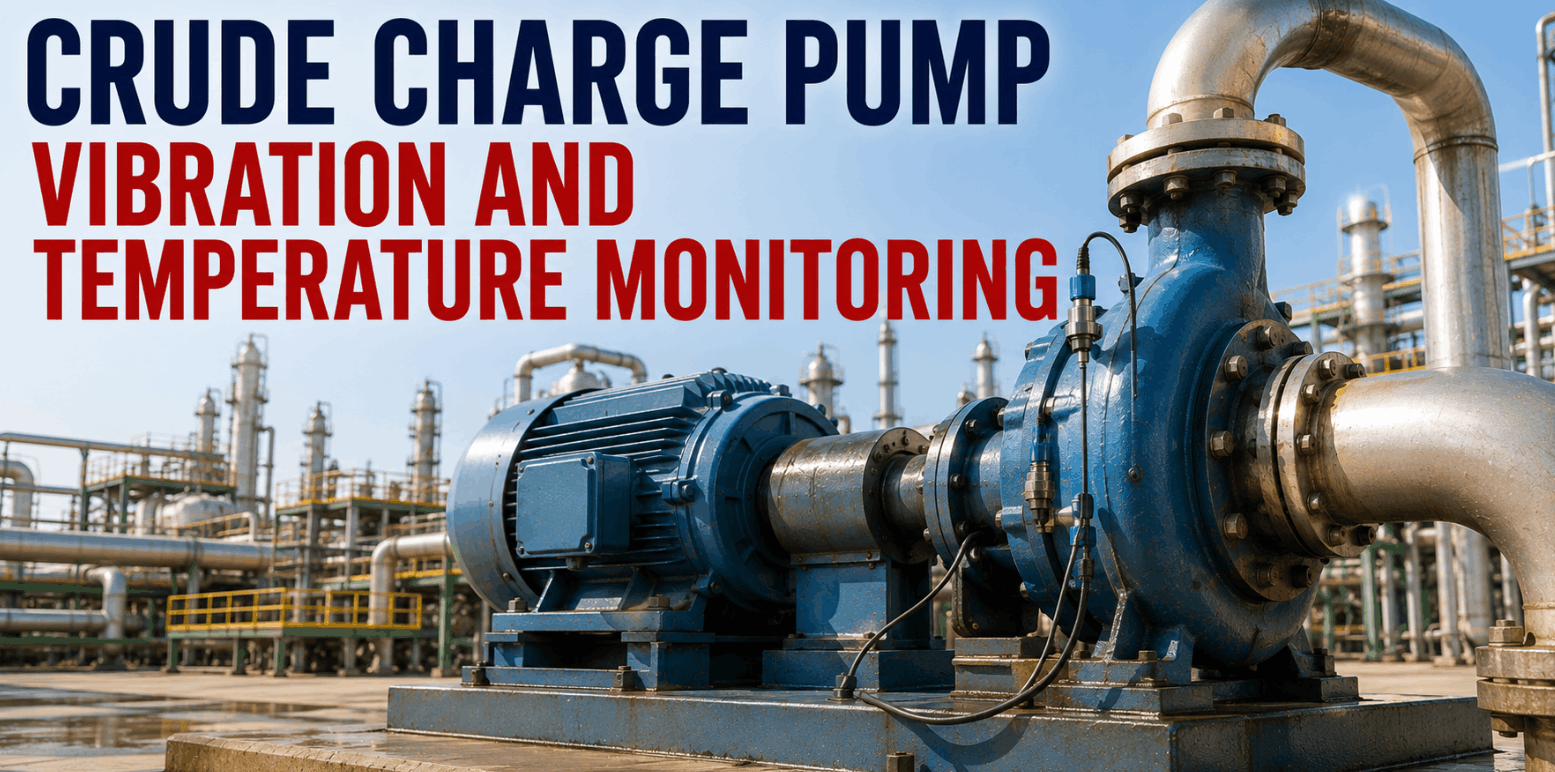
Reliable PCP elastomer monitoring requires integrating four data streams that are rarely analyzed together in conventional field operations: surface torque from the drive head or VFD, rod speed from the controller, downhole temperature from a permanent gauge (if available), and wellhead production flow rate. iFactory's platform ingests all four streams continuously, applies AI models trained on PCP failure signatures, and generates actionable diagnostics without manual card pulls or site visits. Book a Demo to map iFactory's connector architecture to your PCP controller and SCADA infrastructure.
Surface Torque and VFD Data Ingestion
iFactory connects to PCP drive head torque sensors, VFD output data, and controller telemetry via OPC-UA or Modbus TCP — ingesting motor current, operating torque, rod RPM, and drive fault codes on a continuous basis. For wells without downhole gauges, surface torque is the primary elastomer health proxy: progressive torque increase indicates swelling; torque decline with maintained speed indicates slip from interference loss or stator tearing.
Production Efficiency and Slip Rate Calculation
iFactory computes real-time pump volumetric efficiency by comparing actual wellhead flow rate against theoretical displacement at the measured rod speed — a ratio that directly quantifies stator-to-rotor slippage. Declining efficiency at constant speed is the clearest early indicator of elastomer wear, interference loss, or valve damage. The platform tracks efficiency trend against the well's established baseline and alerts when deterioration rate exceeds a configurable threshold.
AI Failure Mode Classification and Severity Scoring
Combined torque, efficiency, temperature, and flow data are processed by iFactory's ML classification model, trained on failure signatures from PCP installations across heavy oil, unconventional, and SAGD operations. The model outputs a failure mode classification — swelling, hardening, abrasion, slip, or dry run — with a severity score and estimated remaining run life window. Classifications include confidence scores and the supporting sensor evidence that drove each determination.
Planned Pull Recommendation and Work Order Generation
When the severity score and deterioration rate indicate that a pump pull is approaching, iFactory generates a prioritized pull recommendation with a confidence window — intervene within 7 days, 30 days, or next planned maintenance cycle. Pull recommendations auto-generate work orders in your CMMS (SAP PM, Maximo, or Infor EAM) with classification evidence, production impact estimate, and recommended replacement elastomer grade based on the detected failure mode and fluid chemistry profile.
Reactive vs. Predictive PCP Management: What the Numbers Show
The financial case for continuous PCP elastomer monitoring is built on two levers: converting emergency workovers to planned pulls, and catching elastomer material mismatches before they destroy equipment. The comparison below reflects measured outcomes from PCP fleets operating under reactive maintenance programs versus iFactory AI continuous monitoring — aggregated across heavy oil and unconventional U.S. and Canadian operations.
| KPI | Reactive Maintenance | iFactory Continuous Monitoring | Improvement |
|---|---|---|---|
| Average PCP Run Life | 8–14 months | 18–36 months | 2–3× longer |
| Emergency Workover Rate | 60–70% of pulls unplanned | Under 15% unplanned | ~78% reduction |
| Average Workover Cost | $55,000–$120,000 (emergency) | $22,000–$48,000 (planned pull) | 40–60% lower |
| Elastomer Failure Detection | Detected at catastrophic failure or production collapse | Detected 2–6 weeks before failure threshold | Weeks earlier |
| Rotor Damage Rate | 30–45% of pulls involve rotor replacement | Under 8% of pulls require rotor replacement | ~82% reduction |
| Engineer Time per Well per Month | 60–90 minutes (field visit, manual review) | 8–12 minutes (review AI alerts, approve orders) | 85% time reduction |
VFD Speed Optimization and Dry-Run Protection: Closing the Control Loop
Elastomer monitoring is the diagnostic layer. VFD speed optimization is the intervention layer that acts on what the diagnostics reveal. iFactory integrates with your PCP drive VFD to implement two critical real-time interventions that extend elastomer life and prevent catastrophic dry-run events — both governed by configurable operator approval workflows. Book a Demo to see how iFactory's closed-loop VFD integration works in your field architecture.
Automatic Speed Reduction on Gas Slug Detection
When iFactory detects a gas slug entering the pump — evidenced by a sudden drop in motor amperage and intake pressure, followed by a torque spike — the platform commands the VFD to reduce rod speed to the minimum displacement rate within seconds. This keeps the elastomer wetted with fluid through the gas slug passage, preventing the dry-run condition that can destroy a stator in under five minutes of unlubricated operation. Speed reduction commands are logged with a timestamp, duration, and the sensor evidence that triggered the intervention.
Efficiency-Based Speed Optimization Across the Production Day
PCP volumetric efficiency is not constant across the operating day — it varies with fluid temperature, GOR fluctuation, and reservoir inflow variation. iFactory's continuous efficiency calculation identifies operating windows where the pump is running at suboptimal speed for current inflow conditions — over-speed generating excess shear stress on the elastomer, or under-speed leaving production potential uncaptured. Speed recommendations are issued in configurable step increments with operator approval gating, building an efficiency-optimized speed profile that reduces elastomer mechanical stress while maintaining target production rate.
Expert Review: What PCP Field Engineers Miss When Managing Elastomer Health
The following observations reflect field engineering experience across heavy oil PCP operations in the Permian Basin, California, and Canadian oil sands. These patterns recur across operators of all sizes and represent the most common sources of avoidable PCP workover spending.
The most persistent misunderstanding in PCP elastomer management is the treatment of torque as a safety parameter rather than a diagnostic parameter. Most operators set a high torque shutdown limit to protect the drive head and surface equipment — and treat any torque reading below that limit as acceptable. But the diagnostic signal in torque is not the absolute value; it is the trend. A well whose torque has increased 18% over 45 days while speed and production have held constant is telling you that the stator bore is tightening from swelling, and that the interference-induced heat being generated right now is accelerating degradation. If that trend is not being tracked, the information is there and going unused.
The second pattern is elastomer selection made on cost rather than chemistry. In fields where multiple operators share service company vendors, NBR is often specified as the default because it is inexpensive and broadly available — even on wells producing aromatic-rich crude where NBR will swell to failure in 60–90 days. HNBR costs more per stator but delivers 3–5× the run life in aromatic environments, making its total cost-per-barrel-produced a fraction of the NBR alternative. Book a Demo to see how iFactory's failure mode classification guides elastomer selection decisions at the well level.
Conclusion: PCP Elastomer Failure Is Predictable — the Data to Predict It Already Exists
Every PCP installation generates the data needed to predict elastomer degradation before it becomes a workover. Torque trends encode swelling and interference loss. Efficiency trends encode slip and stator bore wear. Temperature and intake pressure trends encode thermal hardening and gas ingestion risk. The gap between that diagnostic potential and the reactive maintenance reality in most PCP operations is not a data availability problem — it is a data utilization problem. Continuous AI-driven monitoring closes that gap by processing every available data stream from every well in real time, classifying the degradation mode, and generating a prioritized pull schedule weeks before catastrophic failure converts a planned pump pull into an emergency rod fishing and milling job. The investment in monitoring pays for itself with the first avoided emergency workover on any well in the fleet.
Frequently Asked Questions: PCP Elastomer Monitoring
What PCP controllers and VFD platforms does iFactory connect to for torque and speed data?
iFactory integrates with major PCP drive systems including Weatherford, Moyno, and Seepex controllers and VFD platforms from ABB, Schneider, and Siemens via OPC-UA or Modbus TCP — covering the full range of drive configurations common in U.S. and Canadian heavy oil and unconventional PCP operations without requiring controller replacement.
Can iFactory monitor PCP health without a permanent downhole pressure and temperature gauge?
Yes. Surface torque trend analysis and volumetric efficiency calculation from VFD and wellhead flow rate data deliver reliable elastomer health diagnostics without downhole gauges — covering the majority of PCP installations where permanent downhole instrumentation is not cost-justified.
How does iFactory distinguish elastomer swelling from other causes of progressive torque increase?
iFactory's ML model separates swelling-driven torque increase from fluid viscosity change, rod string wear, and seal drag by cross-correlating torque trend with rod speed, production rate, downhole temperature, and fluid GOR — producing a multi-parameter signature that is characteristic of swelling alone and distinct from other torque-increasing failure modes.
What is the typical deployment timeline from VFD integration to live elastomer health monitoring?
VFD and controller data integration typically completes within 1–2 weeks; AI model baseline establishment from historical torque and production data and activation of elastomer health alerts follows within 30 days of live data collection across the well fleet.
Does iFactory's platform support multi-vendor PCP fleets where different stator compounds are in use across the same field?
Yes. iFactory maintains a well-level configuration that records the installed elastomer grade, stator geometry, and last pull date for each PCP — applying the appropriate failure signature model for that specific elastomer compound and adjusting alert thresholds based on the material's known degradation characteristics in the well's fluid environment.
Connect iFactory to Your PCP Fleet and Start Monitoring Elastomer Health in Weeks
iFactory AI integrates with your existing PCP controllers, VFDs, and SCADA infrastructure — delivering continuous torque trend analysis, volumetric efficiency monitoring, AI failure mode classification, and automated pull scheduling across your full artificial lift fleet with no field hardware replacement required.