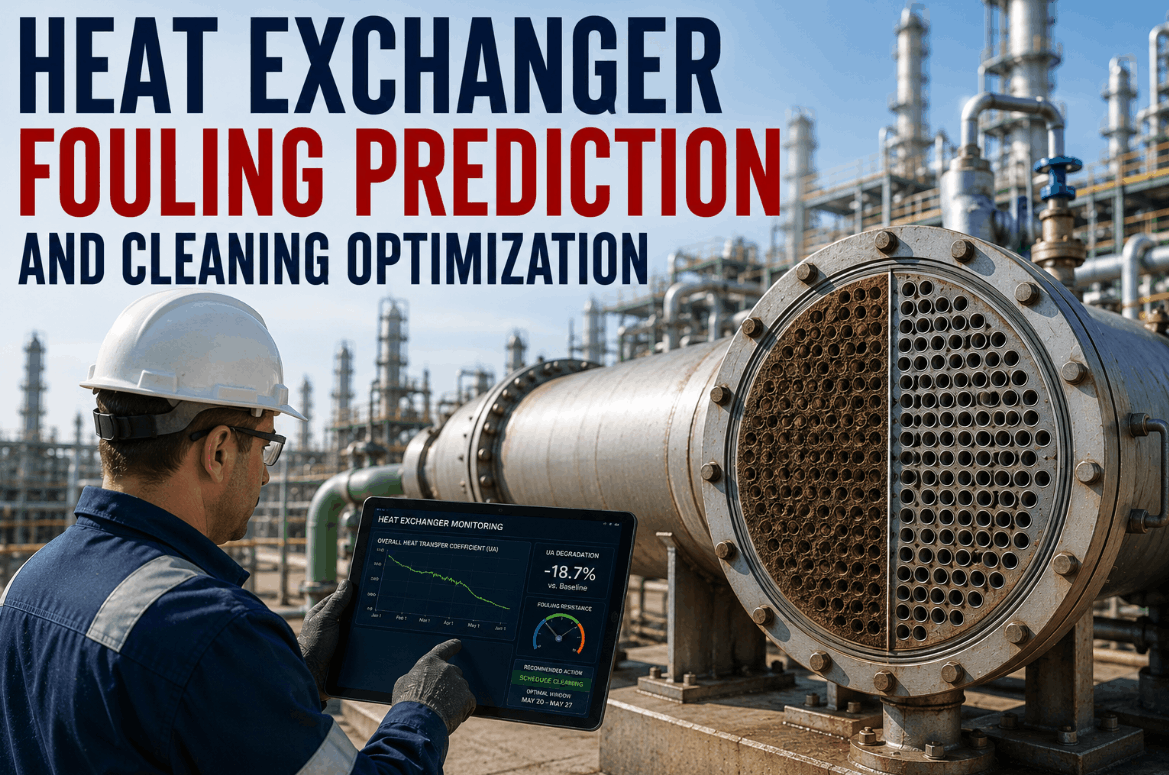
Refineries lose 5–15% of total energy consumption to fouled heat exchangers — and the cost is almost entirely preventable. The crude preheat train is the most fouling-sensitive heat transfer system in the refinery: as exchangers foul, the inlet temperature to the fired heater drops, fuel consumption rises, and throughput margins erode. Yet in most refineries today, exchanger cleaning decisions are still driven by calendar schedules, fixed pressure drop limits, or intuition accumulated over years of operating experience. None of these methods identify the optimal cleaning moment — the point where the next marginal BTU of fouling costs more in fuel and lost preheat than the cost of a cleaning intervention. iFactory's heat exchanger fouling prediction platform closes this gap by continuously tracking overall heat transfer coefficient (UA) degradation across every exchanger in the crude preheat train, applying fouling rate models calibrated to each service, and delivering cleaning window recommendations that maximize recovered preheat against maintenance cost. Refineries that have deployed iFactory's fouling analytics platform are reporting 8–13% reductions in fired heater fuel gas consumption and cleaning interval extensions of 20–35% through better optimization of when exchangers are pulled for bundle cleaning.
Why UA Degradation Tracking Is the Foundation of Any Fouling Management Program
The overall heat transfer coefficient U, combined with the exchanger surface area A, is the single most informative indicator of exchanger health in crude service. As fouling deposits accumulate on tube and shell surfaces, thermal resistance increases, UA falls, and the temperature approach between the hot and cold streams degrades. Monitoring pressure drop alone misses early-stage fouling in services where deposit formation is gradual and non-particulate — exactly the crude oil fouling regime where wax precipitation, asphaltene deposition, and coking produce high-resistance films before any measurable hydraulic restriction. iFactory calculates UA continuously from real-time process data — inlet and outlet temperatures on both sides, flowrates, fluid properties from the refinery's assay database — using corrected mean temperature difference (CMTD) accounting for multi-pass configurations and bypasses. The result is a continuous UA trend for every exchanger, updated each process scan, against which the platform applies fouling rate models to project remaining effective life before the next cleaning is required.
The value of continuous UA tracking versus monthly or quarterly performance reviews is the detection of rate changes — accelerated fouling associated with crude slate changes, temperature excursions above the asphaltene onset temperature, or waterside deposits from cooling water chemistry upsets. A fouling rate that doubles in response to a new crude blend will be visible in the UA trend within 24–48 hours. A calendar-based review will not detect it until the next scheduled data pull, by which point weeks of degraded preheat recovery have already been absorbed as excess fired heater fuel cost.
The Four Fouling Mechanisms That Dominate Crude Preheat Train Performance
Crude preheat train fouling is not a single phenomenon. The fouling mechanism active in a given exchanger depends on the service temperature, crude composition, velocity regime, and metallurgy — and the appropriate monitoring approach, threshold logic, and cleaning response differs by mechanism. iFactory's fouling library covers each mechanism with service-specific models calibrated during commissioning against the refinery's historical cleaning records and crude assay data.
How iFactory Determines the Optimal Cleaning Window — Not Just That Fouling Is Occurring
Knowing that an exchanger is fouling is not the same as knowing when to clean it. The optimal cleaning decision requires balancing four variables simultaneously: the current energy penalty from reduced UA, the projected energy penalty trajectory if cleaning is deferred, the cost and downtime of the cleaning intervention, and the improvement in UA that will actually be recovered based on the deposit type and cleaning method. iFactory's cleaning optimization engine solves this balance continuously, updating the recommended cleaning window as process conditions and fouling trajectories evolve.
Crude Preheat Train Monitoring: What iFactory Tracks Across the Full Train
A crude preheat train may contain 15–40 individual exchangers in a mid-size refinery, each in a different service, each with a different fouling profile and a different consequence for the overall preheat temperature at the heater inlet. iFactory deploys a train-level view that shows the UA health of every exchanger simultaneously, ranked by current energy impact, with drill-down to the per-exchanger trend and cleaning window. The table below shows the monitoring parameters and analytics approach applied across the main exchanger service categories in a typical atmospheric crude unit preheat train.
| Train Position | Typical Service | Primary Fouling Mechanism | iFactory Monitoring Parameters | Cleaning Trigger Basis |
|---|---|---|---|---|
| Cold-end train (100–160°C) | Desalted crude vs. atmospheric residue | Wax deposition, salt bridging | UA trend, wall temperature vs. WAT, salt content from desalter data | UA degraded to 70% of clean baseline; wall temperature within 10°C of WAT |
| Mid-train (160–240°C) | Crude vs. heavy gas oil or light vacuum gas oil | Asphaltene onset (moderate), mixed organic | UA trend, AOT margin tracking, Rf vs. TEMA threshold | Rf exceeds TEMA fouling factor for service; AOT margin below 15°C |
| Hot-end train (240–320°C) | Crude vs. vacuum resid or slop | Asphaltene precipitation, early coking | UA trend, tube skin temperature model, deposit hardness proxy from rate of Rf change | Rf rate acceleration detected; skin temperature model indicates coking onset approach |
| Pre-heater service (>320°C) | Crude vs. HVGO or coker gas oil | Coke formation, thermal decomposition | UA trend, fouling resistance vs. decoking threshold, pressure drop compound monitoring | Rf at 60% of TEMA coke-service threshold — earlier trigger before hard coke forms |
| Condensate coolers (any position) | Crude or process streams vs. cooling water | Scale, biofouling (shell-side), crude-side organic | UA trend with shell/tube-side resistance split, cooling water quality integration | Shell-side Rf exceeds cooling water service threshold; tube-side tracked separately |
The train-level view is updated continuously and accessible from the refinery operations dashboard, the process engineer's workstation, and the maintenance planning interface. Cleaning recommendations from iFactory are sequenced against unit turnaround schedules to optimize cleaning timing without forcing unnecessary production interruptions — Book a Demo to see how the train-level dashboard works for a crude unit of your configuration.
The Quantified Cost of Fouling Deferral: What One Month of Suboptimal Cleaning Timing Costs
The financial case for analytical cleaning optimization is most clearly made not in the cost of the platform but in the cost of operating without it. The following comparison is based on a representative mid-size U.S. refinery crude unit — 100,000 BPSD, 30-exchanger preheat train, natural gas-fired crude heater at $4.80/MMBtu — and illustrates how energy cost accumulates when cleaning decisions are calendar-driven rather than data-driven.
- Cleaning intervals fixed at 6 or 12 months regardless of fouling rate
- Exchangers cleaned when UA has often degraded 35–50% below clean baseline
- No visibility into which exchangers in a parallel train network contribute most energy penalty
- Cleaning crews scheduled on availability, not on economic optimal timing
- Preheat temperature at heater inlet averages 8–14°C below achievable with optimized cleaning
- Incremental fuel gas cost from excess fired heater duty: $85,000–$160,000/month
- Some exchangers cleaned early (wasted maintenance spend); others cleaned late (avoidable energy loss)
- Cleaning window calculated individually per exchanger based on real-time fouling rate and energy penalty
- UA degradation threshold for cleaning trigger set at the economic optimum — not a fixed percentage
- Train-level ranking identifies the 2–3 exchangers delivering the highest ROI from cleaning at any given time
- 14–30-day advance cleaning recommendation gives maintenance planning sufficient lead time
- Preheat temperature recovery of 6–12°C at heater inlet within 90 days of program deployment
- Fuel gas cost savings: $75,000–$145,000/month versus pre-deployment baseline
- Cleaning frequency reduced 20–35% overall — fewer pulls, same or better energy performance
Expert Review: Why Refineries Need a Platform, Not a Spreadsheet, to Manage Exchanger Fouling
I have spent 24 years in refinery heat integration and heat exchanger network design, and the single most consistent finding across every crude unit performance review I have conducted is that exchanger cleaning decisions are being made without a reliable picture of what the current UA is, what the fouling rate has been since the last cleaning, or what the actual energy penalty in dollars per day is at that moment. Process engineers know their train is fouling. They don't know which exchanger to prioritize, whether the fouling rate has changed, or whether deferring the next cleaning by three weeks is a good decision or a costly one. A spreadsheet with monthly temperature grabs cannot answer those questions. A properly deployed UA tracking system with fouling rate modeling and economic optimization can. The ROI case is not complex: in a 100,000 BPSD crude unit, recovering 8°C of preheat train temperature is worth $80,000–$130,000 per month in fuel gas. The analytics platform that delivers that recovery costs a fraction of that in annual operating cost. The question is not whether the investment makes sense. The question is how long the refinery will continue paying the fuel gas penalty while deciding.
Conclusion: Fouling Prediction and Cleaning Optimization Deliver Recoverable Energy — If the Data Is Used
Crude preheat train fouling is not a maintenance problem that can be solved by cleaning more often. It is an information problem: the refinery does not have reliable, continuous visibility into UA degradation rates across each exchanger, and therefore cannot make economically sound decisions about when to clean, which exchangers to prioritize, and how much the current fouling profile is costing in excess fired heater fuel. iFactory's fouling prediction platform solves the information problem directly — continuous UA tracking, mechanism-specific fouling rate models, real-time energy penalty quantification, and cleaning window optimization that converts degradation data into a maintenance schedule that maximizes preheat recovery at minimum total cost.
The recoverable energy is real and measurable. Refineries that deploy analytical fouling management consistently recover 8–12°C of preheat train temperature within the first 90 days — translating directly to fired heater fuel savings that deliver full platform payback within a single quarter. The fouling is happening. The data to manage it optimally is already being generated. The question is whether that data is connected to an analytics layer that converts it into timely, economically justified cleaning decisions. To see how iFactory deploys for a crude unit of your configuration, Book a Demo with our refinery engineering team.
Frequently Asked Questions
UA (overall heat transfer coefficient × area) measures thermal performance directly and detects high-resistance fouling films long before they cause hydraulic restriction, whereas pressure drop only responds to deposits with significant physical bulk — meaning pressure-based monitoring misses early-stage asphaltene and coke fouling until UA has already degraded substantially.
iFactory translates current UA degradation into lost preheat duty (MMBtu/hr), converts that to incremental fired heater firing rate using heater efficiency, and applies real-time fuel gas price to produce a live $/day penalty for each exchanger — updated every process scan so the cost of deferring cleaning is always visible.
Yes — iFactory connects to OSIsoft PI, Aspen InfoPlus.21, Honeywell PHD, and other common process historians via read-only OPC-UA or REST connectors, and integrates with SAP PM, Maximo, and other CMMS platforms for work order generation; typical connectivity deployment takes 2–4 weeks without requiring DCS configuration changes.
iFactory detects fouling rate changes in the UA trend within 24–48 hours of a crude slate change and updates the projected cleaning window immediately — alerting the process engineer when a new blend is accelerating fouling rates above the historical baseline for that service.
For a 100,000 BPSD crude unit, fuel gas savings from optimized cleaning typically exceed the full platform investment cost within the first operating quarter — payback under 90 days is the common outcome when preheat train temperature recovery of 8–12°C is achieved at current U.S. natural gas prices.