A single quadruped robot can complete 40 to 60 inspection points during a shift in a high-temperature or hazardous zone — the same window in which a human inspector, slowed by PPE, heat stress limits, and confined-space entry procedures, typically completes six to eight. Multiply that gap across a refinery running four or five distinct hazard zones simultaneously, each with its own robot type, battery envelope, and Ex-zone restriction, and the coordination problem stops being about any single robot's capability and starts being about fleet-level orchestration. Most refineries that deploy their first inspection robot solve that one robot's routing well and then discover, at robot number four, that nothing is actually managing the fleet as a fleet. If your program has outgrown single-robot scheduling, schedule a robot fleet assessment with the iFactory team.
Deployment Guide · Multi-Zone Robotic Inspection
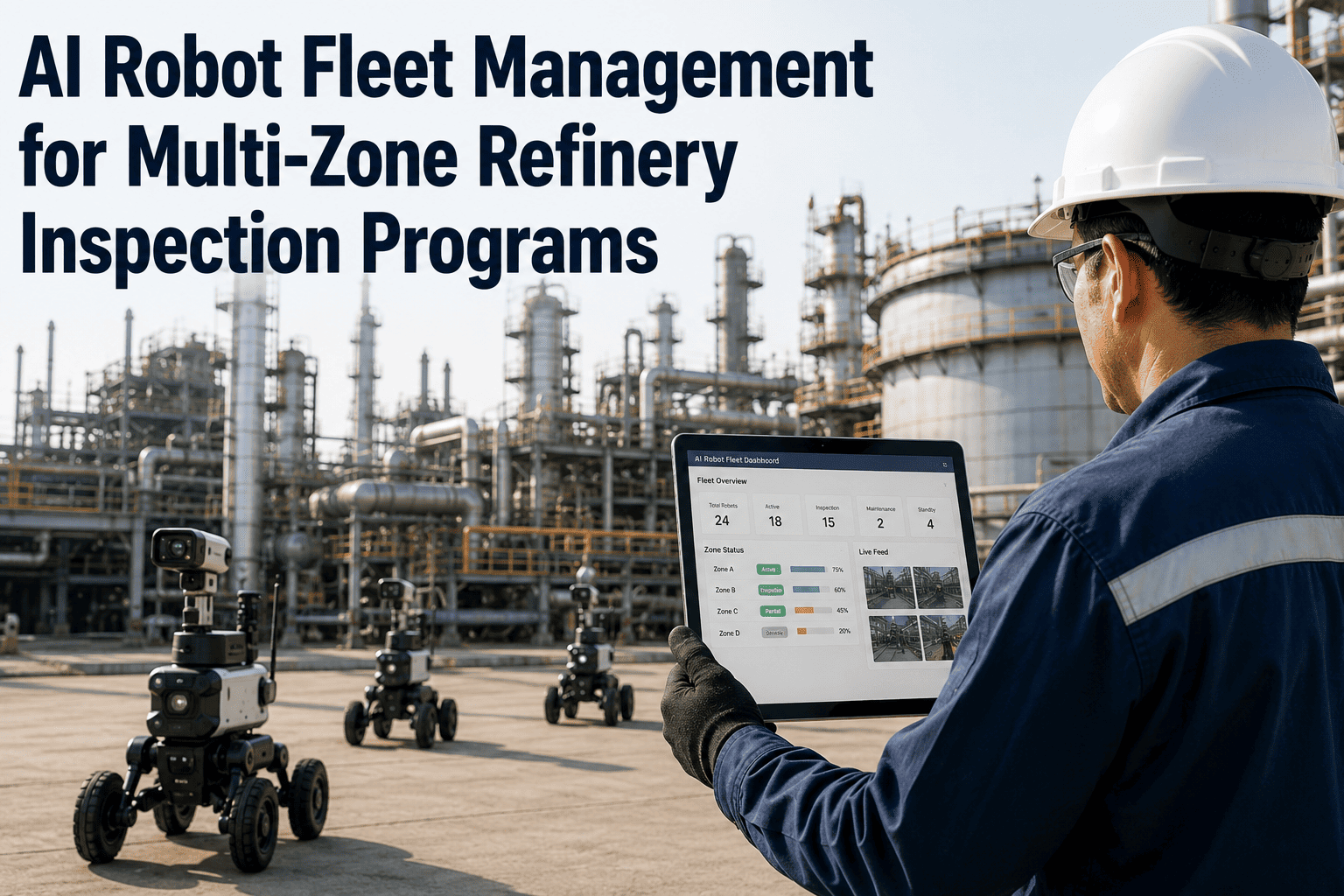
AI Robot Fleet Management for Multi-Zone Refinery Inspection Programs
Coordinating quadrupeds, crawlers, drones, and fixed patrol robots across simultaneous hazard zones — patrol routing, battery handoff, data offloading, and Ex-zone compliance managed from one console instead of four vendor apps.
40–60
Inspection points a quadruped robot covers per shift versus 6–8 for a human inspector in the same hazard zone
4–6 wks
Typical time to reach supervised patrol runs on a focused single-zone pilot
75%
Reduction in inspector exposure to high-hazard zones reported after sustained robotic patrol adoption
Fleet Composition Layer
No Single Robot Covers Every Zone — the Fleet Has to Be Heterogeneous
A refinery is not one environment. It is a collection of environments with different footing, different atmospheres, different temperatures, and different Ex-zone classifications stitched together into a single site. A robot fleet built for that reality has to assign the right platform to each zone rather than force one robot type to attempt everything.
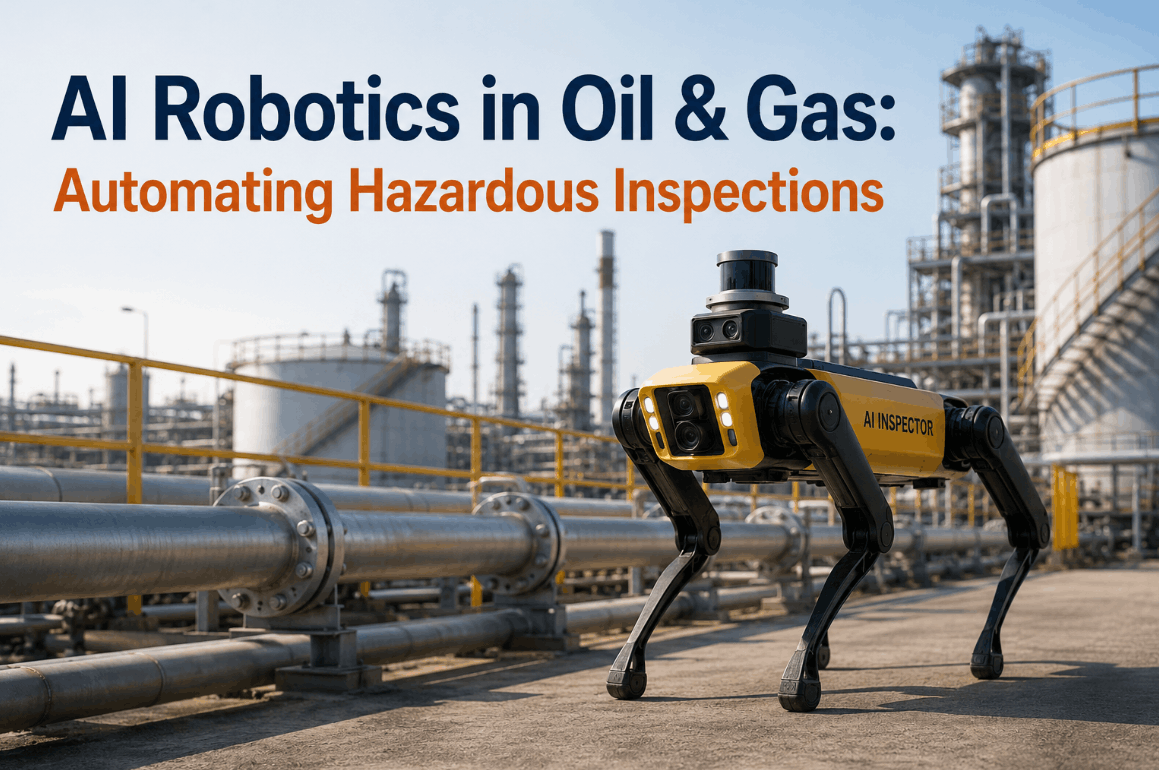
Quadruped Robots
Process units, pump rows, compressor houses, stairs and uneven terrain
Thermal imaging, acoustic emission, gas detection, 360° visual
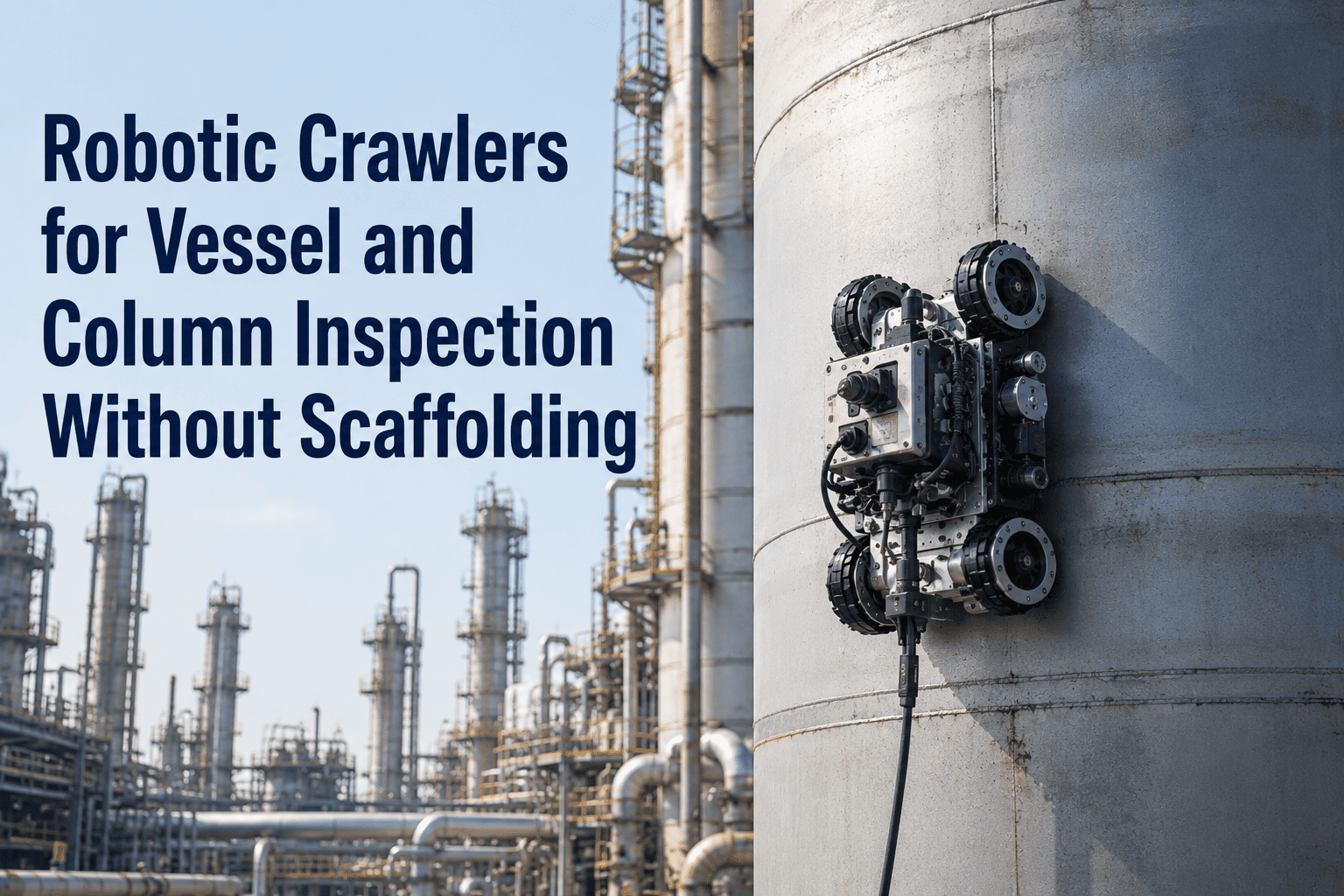
Wheeled Crawlers
Confined vessel interiors, pipe racks, tank bottoms, ladle and drum inspection
Ultrasonic thickness, visual crawler cameras, corrosion mapping sensors
Aerial Drones
Flare stacks, tank roofs, elevated piping, tall structure exteriors
Optical gas imaging, high-resolution zoom, LiDAR mapping
Fixed Patrol Robots
Continuous high-hazard bays where 24/7 rail-mounted coverage outperforms mobile patrol
Continuous thermal, fixed-point gas sensing, always-on visual feed
Where a robot cannot enter directly — inside a reactor during a live process, for example — it is positioned to cover the surrounding zones where thermal, acoustic, and gas readings remain the most diagnostic indicators of a developing problem.
Fleet composition planning also has to account for the fact that these platform types age and require maintenance differently. Quadrupeds and crawlers accumulate joint and actuator wear on a schedule tied to distance traveled, while drones wear primarily on flight hours and rotor cycles, and fixed patrol units have almost no mechanical wear at all beyond their sensor heads. Treating the fleet's own preventive maintenance program as a single undifferentiated schedule, rather than one calibrated per platform type, is one of the more common reasons a fleet's uptime quietly degrades over its first year in service.
Coverage Comparison
What Changes When Inspection Frequency Stops Being Rationed
Human inspection frequency on hazardous equipment is rationed by necessity — PPE donning time, heat stress limits, confined-space permits, and headcount all cap how often a person can safely walk a route. Robotic patrol removes most of those constraints, which changes the entire inspection cadence rather than simply speeding up the existing one. The practical effect is that asset classes which previously received a weekly walk-by can move to a daily or twice-daily pass without adding a single person to the inspection headcount, and the consistency of that cadence turns out to matter almost as much as the frequency itself.
| Factor |
Human Inspection |
Robotic Fleet Patrol |
| Points covered per shift |
6–8 in high-hazard zones |
40–60 per robot, continuously |
| Data captured per checkpoint |
Visual observation, occasional photo |
Thermal, acoustic, gas, and visual simultaneously |
| Exposure to hazard zone |
Full shift duration inside the zone |
Zero — operators monitor remotely |
| Consistency across shifts |
Varies by inspector experience and fatigue |
Identical route, sensor calibration, and threshold every pass |
| Overnight and weekend coverage |
Reduced staffing, longer gaps between passes |
Unchanged — fleet patrols on a fixed schedule regardless of shift |
See Your Fleet Coverage Gap
Most Refineries Are Running Robots as Isolated Pilots, Not as a Fleet
iFactory's Robot Fleet Console unifies quadrupeds, crawlers, drones, and fixed patrol units under one operational view — deployment schedules, mission analytics, anomaly alerts, and robot-health monitoring in a single dashboard instead of four vendor portals.
Battery and Handoff Logic
The Fleet-Management Problem Nobody Notices Until Robot Number Four
A single robot's charging schedule is trivial — send it to dock when the battery drops below a threshold. A fleet of robots covering overlapping zones with staggered patrol schedules is a genuinely different coordination problem, and it is the point where most single-robot pilots start to break down as they scale.
01
Reserve capacity sizing
Battery capacity is sized to cover the full planned patrol route plus roughly 20% reserve, accounting for obstacle detours and unplanned re-routing around active maintenance work.
02
Staggered charging windows
Charging windows are staggered across the fleet so at least one robot per zone remains mission-ready at all times, rather than every robot in a zone charging on the same cycle and leaving a coverage gap.
03
Zero-gap handoff
For continuous coverage on critical assets, the outgoing robot's final checkpoint triggers the incoming robot's departure automatically, closing the gap between one robot docking and the next one beginning its route.
04
Health-based intervention
Battery state-of-health is tracked continuously rather than waiting for runtime to fall below the operational threshold — cell balancing or scheduled replacement at the right stage extends usable battery service life meaningfully compared to a reactive replacement policy.
Data Offloading Layer
Where the Sensor Data Goes Once the Robot Docks
A single patrol pass on a well-instrumented robot generates gigabytes of thermal, acoustic, gas, and visual data. Across a fleet running continuous patrols, that volume compounds quickly, and how it moves off the robot determines whether the fleet's data is useful within minutes or sits unreviewed for days.
Edge pre-processing
Anomaly detection runs on the robot itself before data leaves the device, so a critical thermal reading triggers an alert immediately rather than waiting for a full data dump to complete at the dock.
Docked high-bandwidth transfer
Full-resolution imagery and raw sensor logs transfer over a wired or high-bandwidth wireless connection at the charging dock, avoiding the congestion that would come from streaming everything live over a plant-wide wireless network.
Prioritized upload queue
Findings flagged as critical during the patrol are queued for upload first, ahead of routine passing-inspection data, so the highest-value information reaches the analytics engine before lower-priority footage.
Local buffering for connectivity gaps
Robots operating in areas with weak wireless coverage buffer data locally and complete the transfer once back in range, so a temporary connectivity gap in a remote zone does not translate into lost inspection data.
The design goal is the same one that governs the rest of the fleet architecture — a critical finding should reach a technician's work order queue in minutes, not whenever someone happens to log into a robot's storage drive to pull the day's files.
Task Allocation Layer
How the Fleet Decides Which Robot Goes Where, and When
Route planning for a single robot is a simple sequencing problem. Route planning for a heterogeneous fleet across shared corridors, overlapping hazard zones, and mixed inspection priorities is a resource-allocation problem, and the logic behind it determines whether the fleet behaves as a coordinated system or as several robots that happen to share a facility. Getting this layer wrong does not usually show up as a dramatic failure — it shows up gradually, as coverage gaps that nobody notices until an asset that should have been inspected daily turns out to have gone eight days without a pass because two robots kept deferring to each other on a shared corridor.
Risk-weighted scheduling
Patrol frequency is assigned based on asset criticality rather than a flat schedule — safety-critical pumps and compressors receive daily or twice-daily passes, while lower-risk equipment follows a weekly or monthly cycle.
Real-time task reassignment
If a robot goes into an error state or its battery drops below the safe-return threshold mid-route, its remaining checkpoints are automatically reassigned to the nearest available robot rated for that zone.
Collision and congestion avoidance
Shared corridors between zones are actively managed so that robots do not converge on the same walkway or stairwell at the same time, which becomes a real operational risk once a fleet exceeds three or four active units.
Shift-window scheduling
Routes can be programmed to run during shift handovers or planned maintenance windows specifically, avoiding interference with active production while ensuring equipment is assessed when operators are transitioning.
Zone Compliance Layer
Enforcing Ex-Zone Boundaries Automatically, Not by Operator Memory
Every robot in a refinery fleet carries a specific hazardous-area rating, and the consequence of a robot crossing into a zone beyond its certification is not a software bug — it is a safety incident. Standard-duty platforms handle Zone 2 and unclassified areas. ATEX/IECEx-certified units rated for Zone 1 explosive atmospheres — coke oven corridors, pickling lines, and similar high-risk areas — are a distinct category of equipment with their own certification and maintenance requirements. A fleet console that enforces patrol boundaries programmatically, refusing to route a Zone-2-rated robot into a Zone-1 area regardless of how the route was drawn, removes a category of risk that manual route planning cannot fully close on its own.
This same zone registration also needs to survive facility changes. Turnarounds, temporary scaffolding, and shifting process boundaries can all move where a Zone 1 classification actually applies on the ground, even when the paperwork has not caught up yet. A static zone map baked into a robot's firmware at commissioning becomes a liability the first time the plant's hazard boundaries move and nobody updates the robot's routing rules to match. Programs that treat the zone map as a living document — reviewed alongside process safety updates rather than only during robot commissioning — avoid the situation where a robot is technically following its last known instructions while operating against a hazard boundary that has since shifted.
Implementation Roadmap
From Single-Zone Pilot to Fleet-Wide Coverage
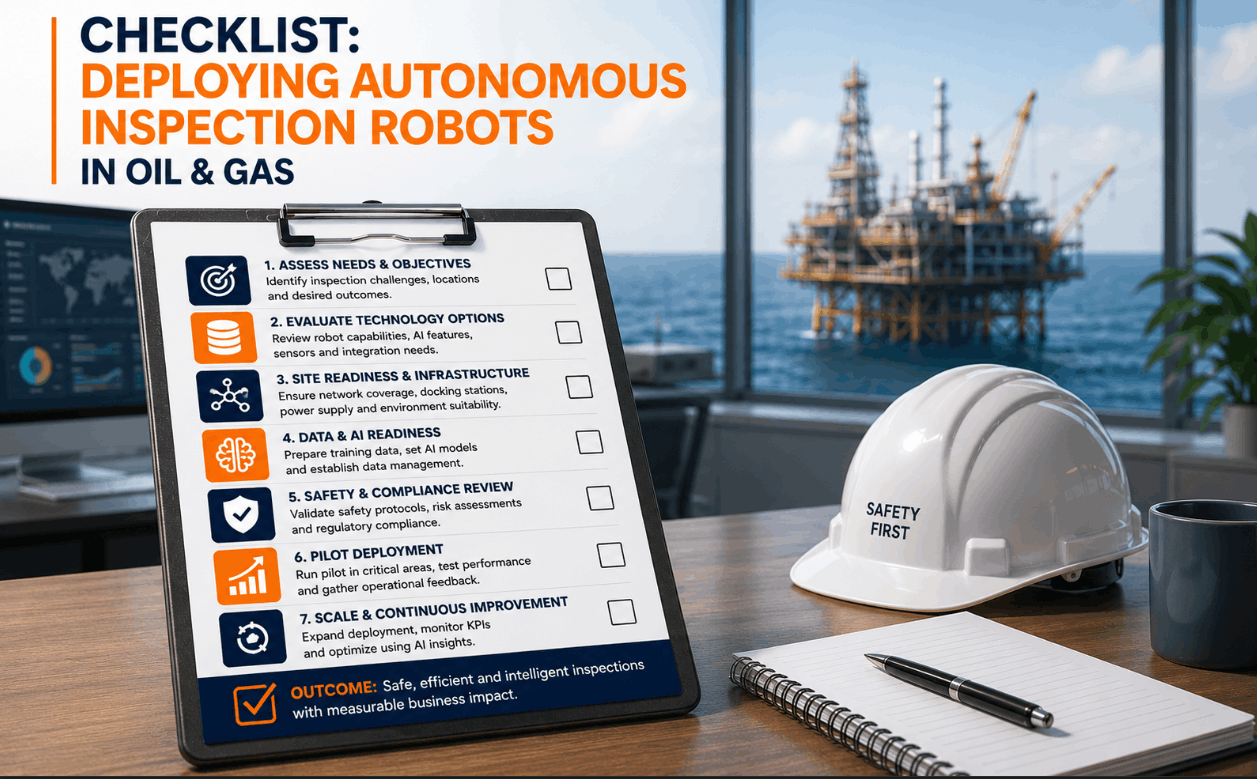
Weeks 1–4
Focused Zone Pilot
Deploy one robot type in the highest-value zone. Reach supervised patrol runs, validate sensor readings against known asset conditions, and establish the checkpoint-to-work-order pipeline.
Weeks 5–10
Autonomous Operation
Move the pilot zone to fully autonomous patrol. Tune anomaly thresholds using accumulated data, and begin planning the second and third robot types for adjacent zones.
Weeks 11–16
Multi-Zone Expansion
Bring additional robot types online across new zones. Consolidate all platforms into a single fleet console, configure zone restrictions, and validate the staggered charging and handoff logic under real load.
Ongoing
Fleet Health and Optimization
Track robot-health metrics — battery state, sensor calibration status, route completion rate, mission success rate — with the same discipline applied to the assets the fleet inspects. Review the zone map alongside every process safety update, and treat any coverage-frequency drift as a scheduling problem to fix that week rather than a trend to revisit at the next quarterly review.
KPI Reference
Metrics That Prove a Robot Fleet Is Actually Performing
Route Completion Rate
Above 95%
Percentage of scheduled patrol routes completed without abort or reroute. A sustained drop signals sensor drift, map mismatch, or an obstacle pattern change.
Finding-to-Work-Order Conversion
100% automated
Every critical or warning finding should auto-generate a work order with asset ID, media, and location — manual re-entry defeats much of the fleet's value.
Robot Utilization
Track weekly
Share of available fleet time spent actively patrolling versus charging, in error state, or idle awaiting task assignment.
Zone Coverage Frequency
Matched to risk score
Actual patrol frequency per zone compared against the risk-weighted target frequency — gaps here point directly at fleet capacity shortfalls.
Mean Time to Alert
Under 5 minutes
Elapsed time from a critical sensor reading being captured to a work order landing in a technician's queue — the number that actually reflects data offloading and pipeline speed.
Fleet Uptime
Above 90%
Share of the fleet mission-ready at any given time, accounting for scheduled charging, maintenance, and any units temporarily out of service.
Practitioner Perspective
The mistake almost every site makes with its first inspection robot is treating it as a single-asset deployment instead of the first unit in a fleet. That works fine for robot number one. By robot number three, someone is manually checking three different vendor apps to see which units are charging, which are mid-route, and which just threw an error, and the coordination overhead starts to eat the labor savings the robots were supposed to create. The sites that get this right treat fleet management as its own discipline from day one — even when they are only running one robot — because the console, the zone restrictions, and the handoff logic need to already exist before the second and third robots arrive, not get bolted on afterward. It is a much smaller lift to build that foundation into a single-robot pilot than to retrofit it onto a fleet that has already grown organically past the point where anyone can track it in a spreadsheet.
Dana Okafor
Robotics & Digital Inspection Program Lead · 12 years deploying autonomous inspection fleets across refining, chemicals, and steel · Former Field Robotics Engineer for a multi-site energy operator
Frequently Asked
Robot Fleet Management — Common Questions from Refinery Operations Leaders
Do we need one robot type or several to cover a full refinery?
Almost every successful multi-zone deployment uses more than one robot type, because no single platform is well suited to every environment a refinery contains. Quadrupeds handle stairs, uneven terrain, and process unit walkways; wheeled crawlers cover confined vessel interiors and tank bottoms; aerial drones inspect flare stacks and elevated structures; and fixed patrol robots deliver continuous coverage in high-hazard bays where mobile patrol alone would leave gaps. A unified fleet console that normalizes data from all platform types into the same asset records is what makes a heterogeneous fleet manageable rather than four separate monitoring problems.
Book a fleet assessment to see which combination fits your zone map.
How does the fleet know which robots are certified for which hazard zones?
Each robot is registered in the fleet console with its Ex-zone certification — standard duty, Zone 2 rated, or ATEX/IECEx Zone 1 rated — and the console enforces those boundaries programmatically rather than relying on the operator drawing routes correctly by hand. A robot rated only for Zone 2 simply cannot be dispatched into a Zone 1 area, regardless of how the patrol route was configured, which closes off a category of human error that manual planning cannot fully eliminate on its own. This same registration also drives the maintenance schedule for each unit, since Zone 1-rated robots carry additional inspection and calibration requirements tied to their certification.
What happens when a robot's battery runs low or it enters an error state mid-patrol?
A well-configured fleet monitors battery level and operational status continuously, and when a robot drops below its safe-return threshold or throws an active error, its remaining checkpoints for that route are automatically reassigned to the nearest available robot rated for that zone, with the incomplete pass logged so it is picked back up on the next scheduled cycle rather than silently dropped. This is the core difference between managing a single robot and managing a fleet — a single-robot deployment simply has a coverage gap until someone notices and intervenes, while a properly orchestrated fleet closes that gap without a human in the loop.
Reach out to our support team for a walkthrough of how reassignment logic is configured for your zone layout.
How long does it take to go from a single-robot pilot to full multi-zone fleet coverage?
A focused pilot covering one priority zone typically reaches supervised patrol runs within four to six weeks and autonomous operation by week eight to ten. Expanding from that first zone into a genuine multi-zone fleet with several robot types and a unified console generally takes an additional two to three months, since each new zone requires its own route validation, sensor threshold tuning, and Ex-zone registration before it can be trusted to run autonomously. Sites that plan for the fleet-console architecture from the start of the pilot, rather than retrofitting it later, tend to move through this expansion phase noticeably faster.
What data does a robot fleet actually generate, and where does it need to go?
Every patrol pass generates thermal scans, acoustic signatures, gas readings, and timestamped visual imagery at each checkpoint, and the value of that data depends entirely on where it routes next rather than on the volume collected. Findings above a configured threshold should auto-generate a prioritized work order with the asset ID, supporting media, and location already attached, so a technician receives an actionable ticket rather than a raw sensor feed to interpret manually. Routing every robot type's data into the same asset records — regardless of which platform captured it — is what lets a maintenance team review a single asset history instead of stitching together outputs from several disconnected robot vendor portals.
Book a session to see the checkpoint-to-work-order pipeline applied to a zone layout similar to yours.
Ready to Manage Your Robots as a Fleet, Not as Separate Pilots?
One Console for Every Zone, Every Robot Type, Every Battery Cycle
iFactory's Robot Fleet Console unifies quadrupeds, crawlers, drones, and fixed patrol robots into a single operational view — mission scheduling, anomaly alerts, zone-restriction enforcement, and robot health monitoring in one place, connected to the same AI analytics engine that turns findings into prioritized work.