Every turnaround worklist starts too big. Operations wants a dozen deferred repairs done while the unit is finally open, reliability wants every borderline inspection finding addressed, and capital projects wants to slip in an upgrade that has been waiting for a shutdown window for two years. None of that is unreasonable on its own — the problem is that no single group is forcing all of it through the same filter, against the same schedule and budget constraints, before the worklist gets treated as committed scope. Turnarounds that manage this well do not have smaller wish lists than the ones that struggle; they have a disciplined scope development process that turns a raw list of opportunities into a frozen, resourced worklist months before the shutdown begins. Our scope management specialists can walk through how that filtering process should work for your next TAR.
From a Thousand Opportunities to One Frozen Worklist
Why Worklist Discipline Decides the Whole Turnaround
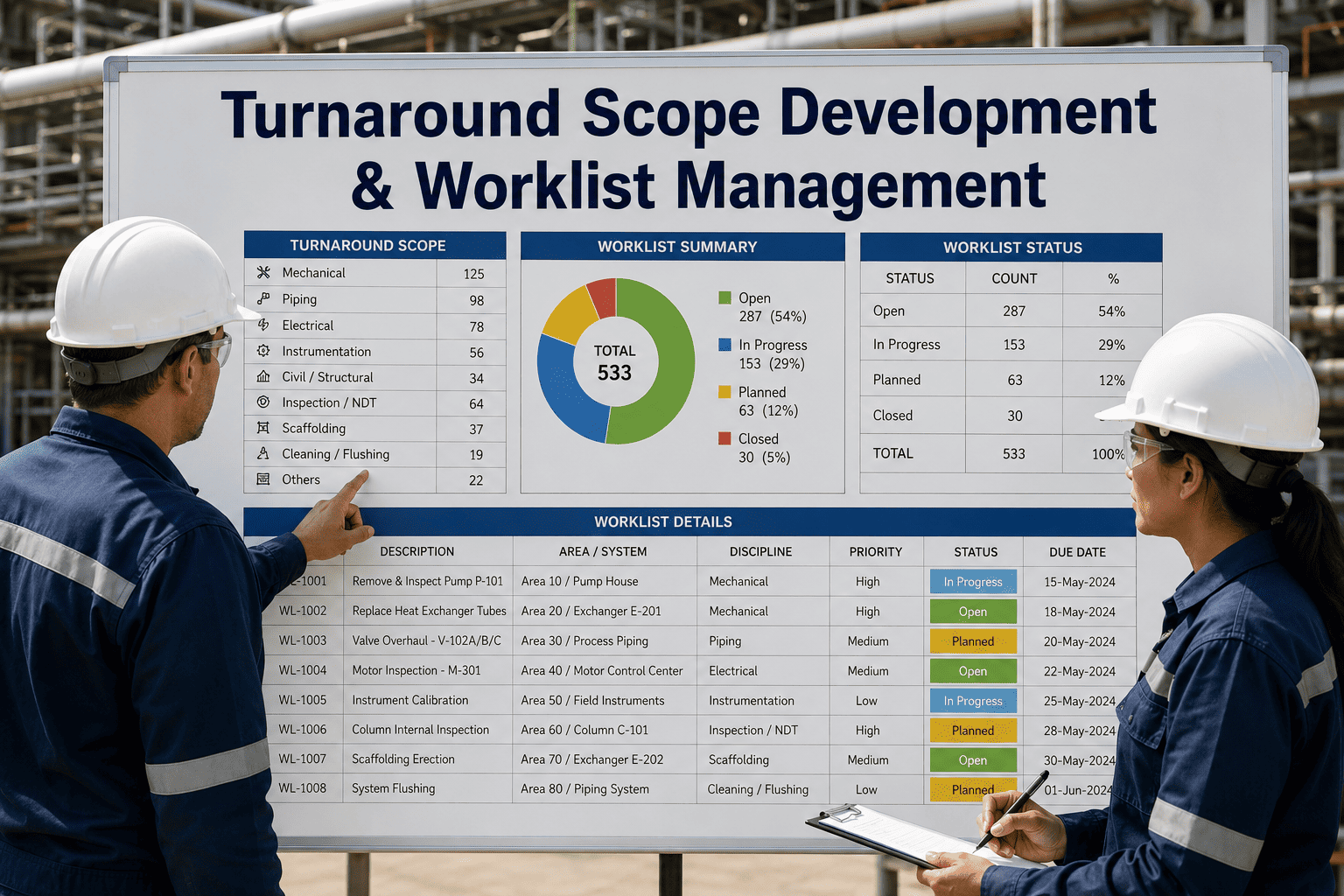
The worklist is the single document that every other part of turnaround planning is built around. The critical path schedule is sequenced against it, the materials list is derived from it, the contractor headcount is estimated from it, and the cost estimate is rolled up from it. If the worklist is unstable — if items keep getting added, removed, or re-scoped after the schedule and budget have already been built around an earlier version — every downstream plan built on top of it inherits that instability. This is why scope development deserves its own dedicated process rather than being treated as a single approval step buried inside the broader planning timeline.
The organizations that manage this well treat the worklist the way a capital project manages a design freeze: as a document that gets progressively harder to change as the project matures, with each stage gate closing off a category of changes that were acceptable earlier but become disruptive later. A raw opportunity identified eighteen months out can still be evaluated, cost-estimated at a rough order of magnitude, and either advanced or dropped without much consequence. The same item identified six weeks before shutdown has already missed the window for proper cost estimation, materials procurement, and schedule integration — which is exactly why the scope freeze gate exists as a hard checkpoint rather than a soft guideline.
This progressive tightening also changes how conversations about the worklist actually happen inside the organization. Early in the cycle, when the funnel is wide and cost estimates are still rough, the right conversation is exploratory — what should we consider, what data do we still need, which items deserve a closer look before the next stage. By the time the worklist reaches the freeze gate, the conversation has to shift entirely to defense — why does this item belong in the frozen scope, what happens if it is deferred, and what specifically has to be true for it to be reopened later through formal change control. Facilities that never make that shift, and keep treating every worklist conversation as exploratory right up until execution, are the ones that end up with a worklist nobody can actually plan against with confidence.
The Scope Development Funnel
Scope development works best when it is visualized as a funnel rather than a list, because the whole point of the process is volume reduction at every stage. A turnaround worklist that starts with several hundred raw opportunities across operations, reliability, inspection, and capital projects input should end with a much smaller, resourced set of items that the schedule and budget can actually absorb without excessive risk.
The gap between each stage is where the real planning work happens. Screening removes items that duplicate existing scope, fall outside the turnaround's defined battery limits, or can be deferred to routine maintenance without meaningful risk. Scope challenge forces the item's owner to defend its inclusion against the schedule and cost impact it introduces, which is usually where the largest volume reduction happens. Cost estimation and approval is where the remaining items get a real number attached instead of a rough guess, and the frozen worklist is what everyone downstream — scheduling, procurement, contracting — actually builds their plans against.
Tracking the volume at each stage of the funnel also gives the turnaround steering committee an early diagnostic signal about how the planning cycle is actually progressing, independent of the calendar date. A funnel that is still holding four hundred items at the scope challenge stage with only six months left before shutdown is a clear warning sign that the challenge process is not moving fast enough to reach a stable worklist in time, regardless of what the master schedule says the current phase should be. Conversely, a funnel that narrows too aggressively too early can be a sign that legitimate reliability or safety items are being screened out under time or budget pressure before they get a fair challenge review. Watching the shape of the funnel over time, not just the final count, is what lets a steering committee catch either failure mode while there is still time to correct it.
Worklist Prioritization Tiers
Not every item on a turnaround worklist carries the same consequence if it gets deferred, and treating them all as equally urgent is one of the fastest ways to blow the schedule and the budget at the same time. A tiered prioritization framework forces a consistent, defensible answer to the question every scope challenge session eventually asks: if the schedule or budget has to give, what actually has to stay in scope?
This tiering matters most when the schedule or budget comes under pressure late in the planning cycle, which happens on almost every turnaround. Without a pre-agreed prioritization framework, that pressure gets resolved through whoever argues loudest in the room rather than through a consistent standard applied across the whole worklist. With the framework in place, the scope challenge team can defer Priority 3 items with confidence long before touching anything in Priority 1, and that decision has already been agreed to well before the pressure actually arrives.
The Scope Challenge Process, Step by Step
Scope challenge is the single meeting-heavy phase of scope development, and it is also the phase most often skipped or rushed on turnarounds that end up with an unstable worklist. Done properly, it is a structured, multi-session process rather than a single approval meeting.
Cost Estimation Accuracy by Worklist Stage
Cost estimation accuracy should improve at every stage of scope development, and expecting a firm number too early is one of the more common mistakes in turnaround budgeting. A class 5 estimate at the opportunity stage is meant to support a go/no-go decision, not to be defended as the final turnaround budget.
| Estimate Class | Typical Stage | Accuracy Range | Primary Use |
|---|---|---|---|
| Class 5 | Raw opportunity identification | -50% to +100% | Initial go/no-go screening |
| Class 4 | Scope challenge review | -30% to +50% | Priority tier and challenge decisions |
| Class 3 | Cost estimation and approval | -20% to +30% | Budget authorization and worklist freeze |
| Class 2 | Detailed planning phase | -10% to +20% | Contract award and schedule baseline |
| Class 1 | Execution readiness | -5% to +10% | Final control budget and job packages |
Scope Change Control After the Freeze Gate
Freezing the worklist does not mean nothing can ever be added again — it means every addition after that point has to go through a formal change control process rather than an informal request routed around the schedule owner. The distinction matters because emergent findings genuinely do surface once equipment is opened up during the turnaround, and the process needs a legitimate path for handling those without simply reopening the whole worklist to informal pressure.
| Change Type | Approval Path | Schedule Impact |
|---|---|---|
| Emergent safety finding | Immediate turnaround manager approval, logged against contingency reserve | Absorbed within held float where possible |
| Emergent reliability finding | Reliability and turnaround manager joint review | Evaluated against critical path before approval |
| Discretionary scope addition | Formal change board with cost and schedule impact statement | Typically deferred unless float clearly available |
| Scope reduction or deferral | Standard change board review | Can free float for higher-priority emergent items |
What a Disciplined Scope Process Actually Delivers
The value of a structured scope development and worklist management process shows up less in the planning phase itself and more in how the turnaround performs once the unit is down and the schedule is being executed against a worklist that everyone trusts.
Common Worklist Pitfalls That Undermine the Process
Most of the scope development failures that show up during execution trace back to a small, recurring set of process gaps rather than any single bad decision. Recognizing these patterns early is usually enough to correct them before they compound into schedule or budget risk later in the planning cycle.
| Pitfall | Why It Happens | Correction |
|---|---|---|
| Worklist carried over unchanged | Prior turnaround's list reused as a starting point without re-screening | Require fresh justification tied to current inspection and reliability data |
| Single-department scope ownership | One group drives the worklist without cross-functional challenge | Route every item through the cross-functional steering committee |
| Estimate class mismatch | Class 5 numbers treated as firm budget too early | Enforce progressive estimate classes tied to each funnel stage |
| No documented priority tier | Items evaluated ad hoc without a consistent standard | Publish and apply the three-tier priority framework from the start |
The common thread across all four of these patterns is that they are process gaps, not judgment failures on the part of any individual planner. A worklist that gets carried over unchanged from the prior turnaround is often simply the path of least resistance when there is no formal requirement to re-justify each item against current data. The fix in every case is the same: make the discipline structural, built into the funnel and the tiering framework, rather than dependent on any one person remembering to apply it consistently across a two-year planning cycle with dozens of contributors.