Industry data shows that Book a Demo isn't the first thing most maintenance leaders think about when a turnaround budget starts slipping—but it should be. Roughly 80% of refinery and chemical plant turnarounds finish over their original budget, and high-complexity events average 20% cost overruns with 30% schedule overruns layered on top. The single largest driver isn't a surprise equipment failure or a contractor dispute. It's scope creep: work quietly added after the freeze date, discovery items approved without a second look, and a change process that exists on paper but isn't enforced in the field. iFactory gives turnaround leaders a governed digital workflow to lock scope, route every change through a defined approval chain, and cap discovery work before it consumes the contingency budget.
Why 70–80% of Turnarounds Still Blow Their Budget
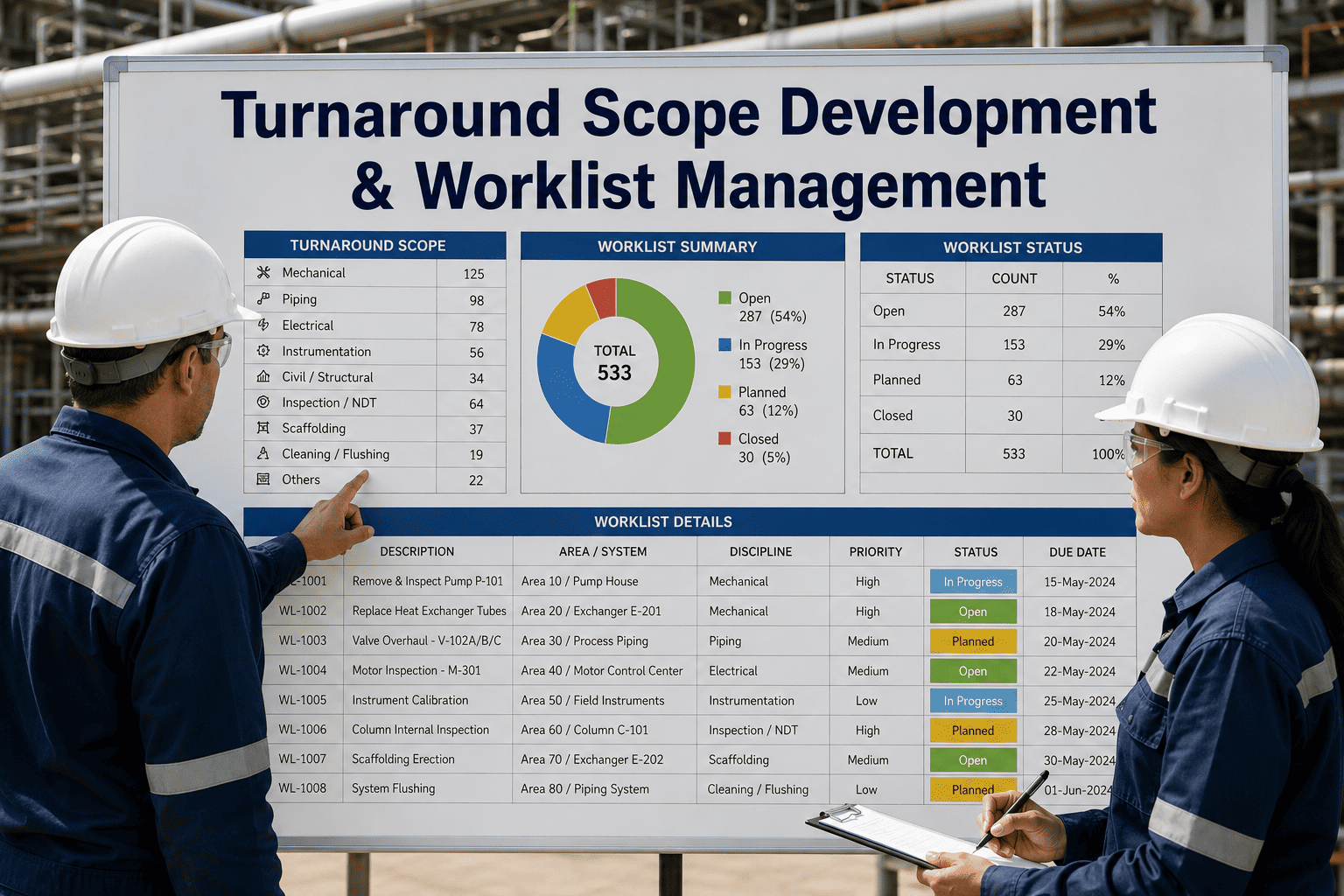
Turnaround cost overruns rarely come from one catastrophic failure. They accumulate from dozens of small, individually defensible decisions that bypass the formal change process. A planner adds a "quick" valve replacement after freeze because a contractor is already on-site. A discovery finding gets approved verbally in the field without a cost impact review. Industry benchmarking shows that scope grows an average of 19% between freeze and execution, and that growth correlates directly with both cost and schedule overrun. iFactory's Digital Twin and AI Vision modules give planning teams a verified baseline of asset condition before freeze, reducing the unknowns that typically surface as expensive discovery work mid-event. Book a Demo to see how a locked, auditable scope baseline changes turnaround outcomes.
Scope Freeze: The Line That Actually Protects Your Budget
A scope freeze is only effective if it's enforced as a hard governance gate, not a soft target date. Once frozen, every work item should be locked into the cost estimate, the labor plan, and the material procurement schedule. iFactory turns this principle into an operational workflow rather than a calendar reminder.
Baseline Scope Lock
At the freeze date, iFactory snapshots the approved work list, associated cost estimate, and labor-hour allocation into an immutable baseline record that all future change requests are measured against.
Automated Freeze Alerts
Any attempt to add, modify, or expand a work order after the freeze date automatically flags the item as "post-freeze" and routes it into the change governance queue instead of the standard work list.
Escalating Approval Thresholds
Late scope additions carry a higher cost and schedule risk than pre-freeze work. iFactory applies escalating approval requirements—the closer to execution, the higher up the sign-off chain a change must go.
Live Variance Reporting
Reliability leads and turnaround managers see a real-time dashboard comparing frozen baseline cost against current approved scope, so budget drift is visible the day it happens, not at closeout.
Digital Change Board: Routing Every Late Addition Through Governance
When scope changes are approved verbally in the field or over email, there's no consistent record of who authorized the spend or why. iFactory replaces that informal process with a structured digital change board that every late scope item must pass through before it touches a work order.
| Change Request Type | Traditional Manual Process | iFactory Governed Workflow |
|---|---|---|
| Contractor-identified "quick add" | Verbally approved on-site, no cost record created | Logged as a change request with cost/schedule impact attached before approval |
| Discovery finding during inspection | Approved by whoever is available, often without budget check | Routed to change board with live remaining-contingency balance shown |
| Engineering-driven scope expansion | Added directly to work list, freeze date ignored | Flagged as post-freeze, requires escalated sign-off per governance tier |
| Safety-critical emergent work | Fast-tracked with no formal documentation trail | Expedited approval path that still logs full audit trail and cost impact |
| Vendor-recommended "while we're in there" add-on | Accepted to avoid re-mobilization cost, scope unchecked | Evaluated against risk-based deferral criteria before approval |
Discovery Work Caps: Containing the Unknown Without Stalling Execution
Discovery work—the corrosion, fouling, or mechanical wear found only once equipment is opened—is unavoidable. The risk isn't that discovery work exists; it's that it gets approved without a ceiling, consuming contingency budget that was set aside for the entire event. iFactory applies a structured discovery work cap so reliability teams can react quickly to genuine findings without losing financial control of the turnaround. Book a Demo to see how discovery caps are configured for your facility's risk tolerance.
Before execution, the turnaround steering team sets a discovery work allowance as a percentage of total contingency—commonly a tiered threshold by unit or work package. As inspectors log new findings in the field, iFactory tracks cumulative discovery spend against that allowance in real time. When a work package approaches its cap, the system automatically escalates new requests to senior approval instead of allowing routine sign-off, forcing a deliberate decision on whether to defer, descope elsewhere, or formally expand contingency. This single control point is where most uncapped turnarounds quietly lose their final cost number.
Risk-Based Scope Selection: Cutting What Doesn't Need to Be There
Not every item that makes it onto a draft work list needs to be executed during this event. Rigorous risk-based scope review—asking whether each item can be safely deferred, performed during normal operations, or reduced in scope—is one of the most effective overrun-prevention tools available, with some facilities deferring 20–30% of draft scope without increasing operational risk.
Challenge Every Work List Entry
Each proposed item is evaluated against asset condition history, prior turnaround data, and inspection records inside iFactory's Digital Twin before it earns a place in the frozen scope.
Tag Deferrable vs. Must-Do Work
Work items are classified by risk tier, making it clear during budget reviews which scope is safety-critical, condition-driven, or genuinely discretionary.
Lock the 80% Repeatable Baseline
A consistent core scope, built from prior turnaround history, anchors the budget early and limits the portion of the event exposed to late-stage estimating uncertainty.
Carry Findings Into the Next Cycle
Closeout data, including every approved and rejected change request, feeds directly into the next turnaround's scope development, tightening estimating accuracy cycle over cycle.
Scope governance only works if the change process is faster than the temptation to skip it. Once our change board had real-time cost visibility instead of a spreadsheet someone updated weekly, contractors stopped routing around it—because the approved path was actually quicker than the workaround.
— Turnaround Manager, North American Refining Operator
Expert Perspective: Why Governance Beats Heroics in Turnaround Cost Control
Reliability and turnaround professionals consistently point to the same conclusion: turnarounds rarely fail because of execution-day heroics gone wrong. They fail because of decisions made—and not formally reviewed—months before the unit ever goes cold. A scope freeze without enforcement is just a date on a calendar. A change board without real-time cost visibility is a rubber stamp. The facilities that consistently land close to their original number treat scope governance as a continuous discipline that starts at the prior turnaround's closeout and runs through every change request during execution, not as a single milestone meeting. iFactory's role is to make that discipline operational: a locked baseline, an enforced approval chain, and a live view of contingency burn that gives turnaround leadership the same visibility in week one of the event as they had on the freeze date. Book a Demo to walk through the governance workflow with our team.
Bringing Cost Control Back Into Turnaround Execution
Turnaround cost overruns are largely a governance problem, not a labor or equipment problem. The data is consistent across the industry: most overruns trace back to scope that entered the plan after freeze without a disciplined review, and discovery work that consumed contingency without a ceiling. iFactory addresses both at the source—an enforced scope freeze, a digital change board with real-time cost visibility, and configurable discovery work caps that protect the contingency budget without slowing down legitimate field decisions. The result is a turnaround program where the final cost number actually resembles the one approved at freeze.
Frequently Asked Questions: Turnaround Scope and Cost Governance
What exactly is a scope freeze, and when should it happen?
A scope freeze is the formal point after which no new work is added to the turnaround plan. Best practice sets this date a year or more before execution, giving planning teams time to lock labor, materials, and procurement.
Does a discovery work cap mean genuine safety issues get delayed?
No. Safety-critical findings follow an expedited approval path. The cap applies to discretionary discovery scope, ensuring it's still reviewed against budget rather than approved automatically.
How does iFactory's change board differ from a manual approval email chain?
Every change request carries a live cost and schedule impact, routes to the correct approval tier automatically, and is permanently logged—removing the ambiguity of verbal or email-based approvals.
Can iFactory integrate with our existing turnaround scheduling tools?
Yes. iFactory's scope and change governance data syncs with standard scheduling and CMMS/ERP systems, so approved changes flow into the execution schedule without duplicate data entry.
How much can disciplined scope governance actually save on a turnaround?
Facilities applying rigorous risk-based scope review have deferred 20–30% of draft work without raising risk, directly reducing the late-stage scope growth that drives most cost overruns.