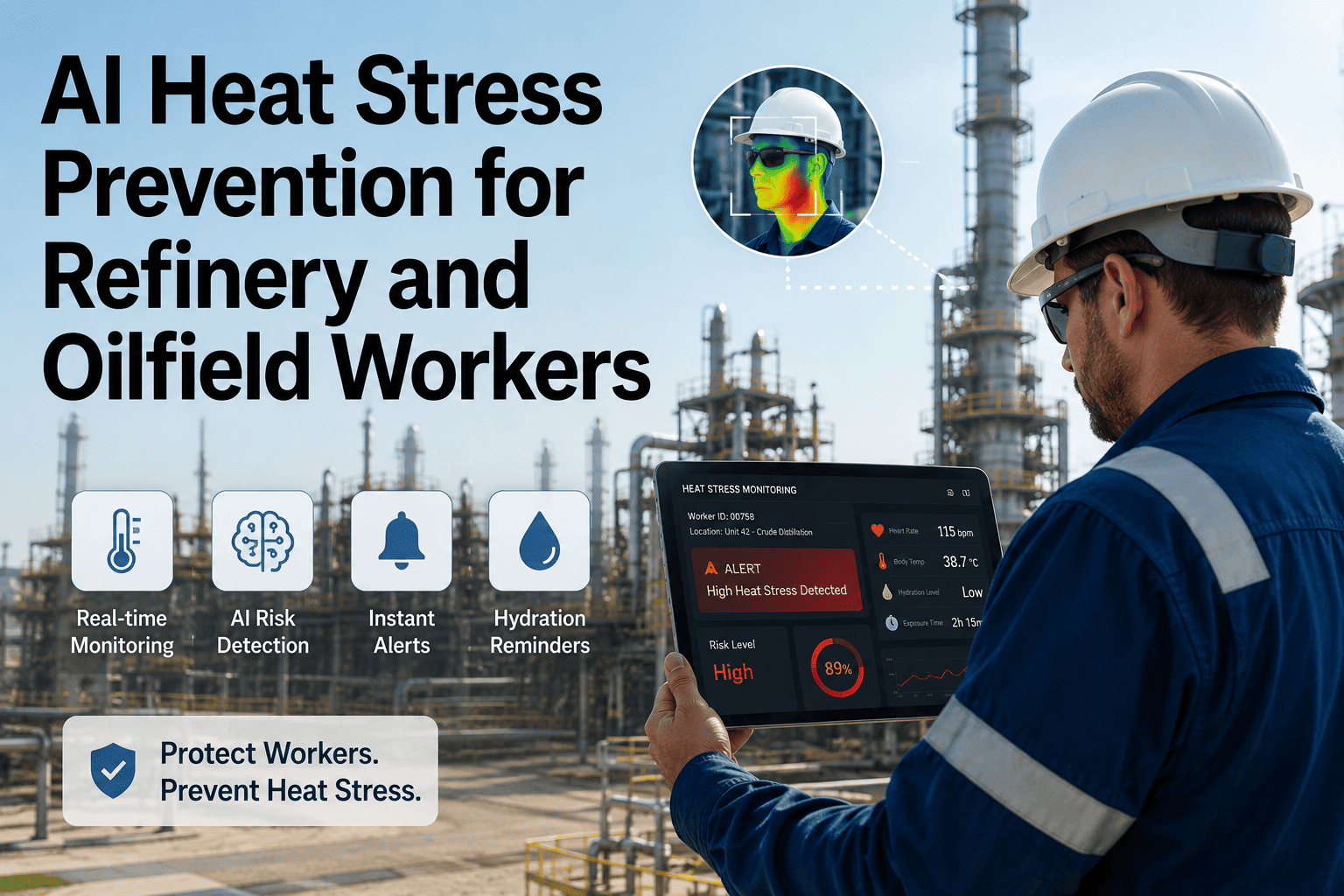
A WBGT reading of 88°F on the ambient monitor tells a safety team almost nothing about which specific worker on the unit is actually approaching a dangerous core temperature, because two people standing in the same heat, wearing the same PPE, doing the same task, can be at completely different points on the heat illness curve depending on hydration, acclimatization, and how many hours they have already logged that shift. Area-based heat monitoring protects the average worker reasonably well and protects the individual worker barely at all, which is exactly the gap that turns a preventable heat illness into a stretcher call on a refinery unit or wellsite. See how iFactory combines ambient WBGT data with individual wearable physiological readings to flag heat risk before it becomes a medical event.
Worker Safety · Heat Illness Prevention
The Thermometer on the Wall Isn't Watching the Worker on the Unit
AI that combines ambient temperature, humidity, and WBGT readings with individual physiological data from wearables to predict heat stress before core temperature reaches a dangerous threshold.
103°FCore temperature where heat stroke risk becomes acute
2–3Workers on the same crew who can carry very different individual risk at the same ambient reading
HoursHow much earlier individualized monitoring can flag rising risk than an area WBGT alarm
Why Area Monitoring Falls Short
WBGT Tells You the Environment, Not the Worker
Wet bulb globe temperature is a genuinely useful environmental measure — it accounts for humidity, radiant heat, and air movement in a way a simple air temperature reading cannot. But WBGT describes the ambient condition every worker on that unit is exposed to equally, while the actual heat illness risk any individual worker carries depends heavily on factors the area sensor has no way to see: how hydrated that worker is, whether they are acclimatized to the heat after weeks on the job or new to it this week, what PPE burden they are carrying, and how many continuous hours of physical exertion they have already logged that shift. Two workers standing three feet apart under an identical WBGT reading can be at meaningfully different points on the heat illness progression curve, and area-based alarms have no mechanism to distinguish between them.
Caution
WBGT below 80°F — standard work/rest cycles
Extreme Caution
WBGT 80–87°F — increased hydration, work/rest monitoring
Danger
WBGT 88–89.9°F — individual physiological monitoring becomes critical
Extreme Danger
WBGT 90°F+ — area alarms alone are insufficient for safe work planning
Individual Physiological Signals
What a Wearable Actually Adds to the Ambient Picture
Heart Rate Trend
A sustained elevated heart rate that doesn't recover during scheduled breaks is one of the earliest individual indicators that a worker's body is struggling to dissipate heat effectively, well before symptoms become visible to a supervisor.
Skin Temperature
Rising skin temperature combined with reduced sweat response signals that the body's cooling mechanism is beginning to fall behind the heat load, a pattern area sensors have no way to detect on an individual basis.
Movement and Exertion Pattern
Accelerometer data showing slowing pace, altered gait, or reduced task efficiency can reflect early cognitive and physical impairment from rising core temperature before a worker themselves recognizes the change.
Cumulative Exposure History
Hours already worked in heat that shift, combined with the worker's acclimatization status over recent weeks, materially changes their individual risk profile at any given ambient WBGT reading.
Individual Risk, Not Just Area Risk
Know Which Specific Worker Needs a Break, Not Just That the Unit Is Hot
iFactory combines ambient WBGT data with individual wearable readings so heat stress risk is tracked per worker, not averaged across the whole crew.
Approach Comparison
Area-Based Alarms vs. Individualized Heat Risk Monitoring
| Factor | Area WBGT Alarm Only | Individualized AI Monitoring |
|---|
| Accounts for hydration status | No | Yes, via physiological trend |
| Accounts for acclimatization | No | Yes, via exposure history |
| Detects early physiological strain | No | Yes, hours before symptoms |
| Distinguishes between workers on same crew | No | Yes, per-worker profile |
| Triggers targeted vs. blanket work/rest cycles | Blanket only | Targeted to at-risk individuals |
Program Elements
Building an Individualized Heat Stress Prevention Program
Ambient Monitoring Baseline
Continuous WBGT readings across work zones, giving the environmental context every individual reading is evaluated against throughout the shift.
Wearable Deployment
Physiological monitoring wearables issued to crews working in the highest-exposure zones, tracking heart rate, skin temperature, and exertion pattern continuously.
Individual Risk Thresholds
Alert thresholds calibrated per worker where possible, accounting for acclimatization status rather than applying one fixed threshold to every worker regardless of heat exposure history.
Supervisor Escalation Path
A clear, practiced protocol for what happens when an individual alert fires — mandatory break, hydration, or medical evaluation — so the alert translates into action rather than sitting unactioned on a dashboard.
High-Exposure Task Types
Which Tasks Carry the Highest Individual Heat Risk
Not every task at a given WBGT reading carries the same individual risk, because physical exertion level changes how fast a worker's core temperature climbs independent of the ambient condition. A worker standing at a control panel and a worker climbing a tower in full arc-flash PPE at the same WBGT reading are on very different risk trajectories, which is why task-level exertion has to factor into an individualized risk model rather than treating every worker on a unit as equally exposed simply because they share the same ambient environment.
Confined Space Entry
Limited airflow and often elevated internal temperature compound heat load on top of whatever the ambient WBGT reading shows outside the vessel, making this one of the highest-priority tasks for individual monitoring.
Turnaround Scaffolding and Insulation Work
Sustained physical exertion combined with heavy PPE over multiple hours produces some of the fastest core temperature climbs seen across typical refinery and plant tasks.
Wellsite Rig-Up and Rig-Down
Physically demanding, time-pressured tasks performed with minimal shade access make wellsite crews a consistently high-risk population during summer operating seasons.
Chemical PPE and Full Encapsulation Tasks
Impermeable suits required for certain chemical handling tasks trap body heat aggressively, meaning even moderate ambient WBGT readings can produce rapid individual heat stress onset.
Common Questions
Frequently Asked Questions
Do workers need to wear a dedicated device, or can existing PPE be adapted?
Most programs use a lightweight wearable — often wrist-worn or integrated into a chest strap — added alongside existing PPE rather than replacing any required protective equipment. The device is chosen primarily for reliability and comfort over a full shift, since a wearable workers find uncomfortable or forget to charge quickly becomes a program that isn't actually collecting data when it matters.
Talk to support about wearable options that fit your existing PPE requirements.
How does the system account for a worker who is new to hot-climate work and not yet acclimatized?
Acclimatization status is tracked based on recent heat exposure history, and a worker in their first one to two weeks of hot-weather work is flagged with a lower risk threshold than an acclimatized worker at the same physiological readings, reflecting the well-documented pattern that unacclimatized workers face meaningfully higher heat illness risk at equivalent exertion levels.
What happens when an individual alert fires during an active task?
The alert routes to the worker and their supervisor simultaneously, typically triggering a mandatory hydration and shade break before the worker returns to task, with more significant physiological deviations escalating toward a medical evaluation protocol rather than a simple break recommendation.
Does this replace OSHA-required heat illness prevention training and water/rest/shade programs?
No — individualized monitoring is a layer on top of, not a replacement for, required training, hydration access, and scheduled rest and shade provisions. It strengthens compliance by making the work/rest and hydration guidance specific to each worker's actual physiological state rather than a generic schedule applied uniformly regardless of individual condition.
Can individualized heat monitoring scale across a large refinery turnaround with hundreds of contract workers?
Yes — the wearable and monitoring approach is designed to scale to large temporary workforces typical of a turnaround, with risk dashboards aggregating individual data so safety teams can see crew-wide patterns while still catching the specific individuals whose readings warrant intervention.
Book a demo to see how this scales for turnaround-sized crews.
Protect the Worker, Not Just the Average
Move From Area Alarms to Individual Heat Risk Monitoring
iFactory combines ambient WBGT data with individual wearable physiological readings so your safety team knows which specific worker needs a break before a heat illness event happens.