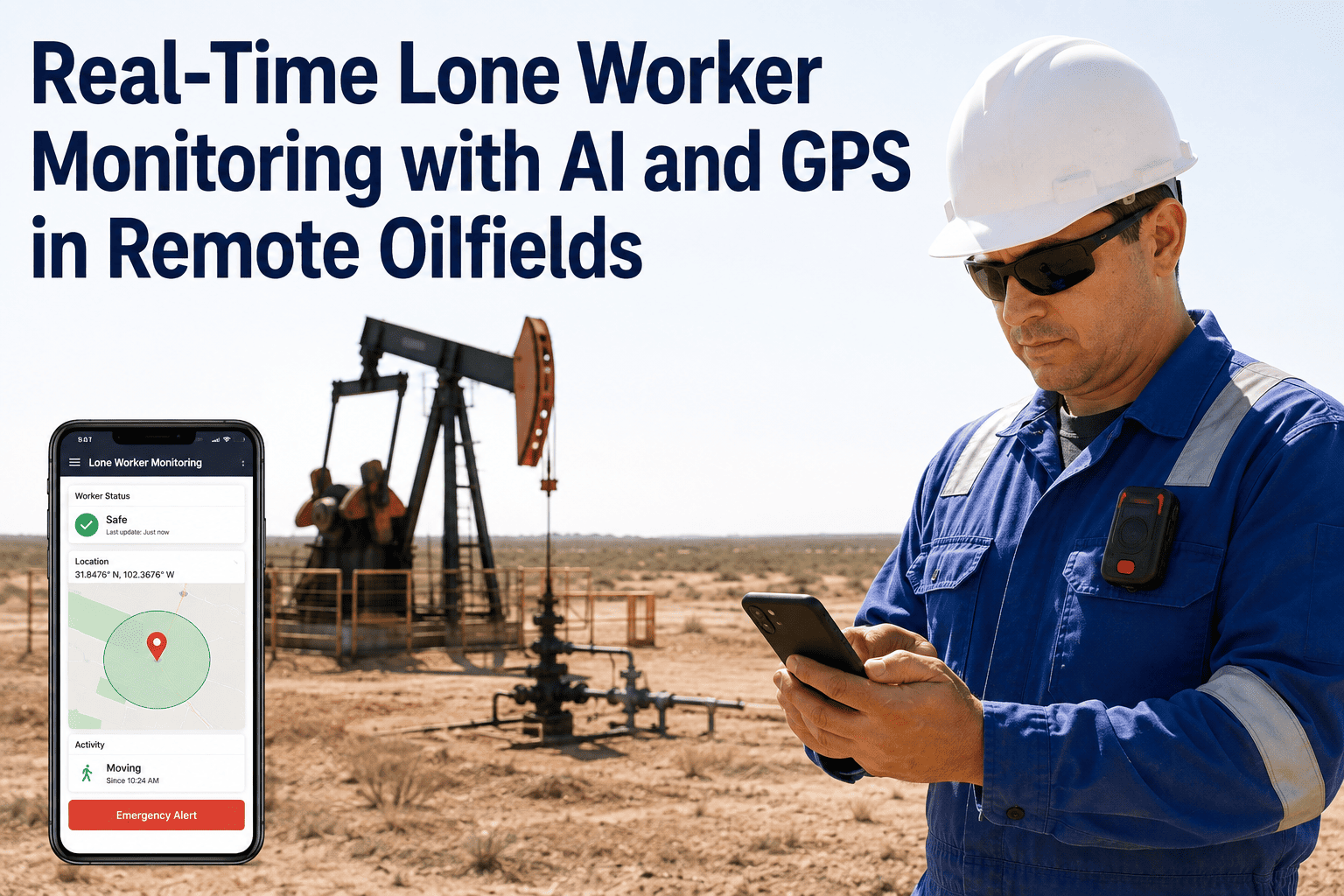
A wellsite forty miles from the nearest paved road does not care whether the pumper checking pressure gauges is having a cardiac event, has been struck by a swinging valve handle, or has simply gone quiet because the truck radio lost signal on schedule. The isolation that defines fieldwork in remote basins is also what turns a routine slip, a toxic gas exposure, or a medical emergency into a fatality, because nobody is close enough to see it happen and no phone in the cab has bars to call for help. Traditional lone worker programs lean on scheduled check-in calls and radio protocols that assume the worker is conscious, mobile, and within range of a tower, which is exactly the assumption that fails during the incidents that matter most. Satellite-connected wearables paired with AI-driven man-down detection close that gap by watching for the absence of normal movement instead of waiting for a missed phone call, and a field safety team can see how that detection layer fits over existing PPE and radio protocol at iFactory's support page.
Worker Safety · Remote Oil and Gas Operations
Real-Time Lone Worker Monitoring Built for Places Cell Towers Don't Reach
Satellite-connected wearables track location, movement, and vital signs across remote well pads, pipeline right-of-ways, and gathering stations. AI flags man-down events, no-motion states, and abnormal vitals, then routes an automated alert to dispatch even where there is no cellular coverage at all.
The Isolation Gap
What Happens To A Worker When Nobody Is Watching
Fieldwork in oil and gas has always carried more risk than most industries, but the numbers behind that risk tell a more specific story than "dangerous job." They point squarely at isolation itself as a multiplier — the same incident that a crew would recover from in a staffed facility becomes fatal in a remote setting simply because help does not arrive in time. The figures below are drawn from federal fatality surveillance and industry safety research, and they describe a pattern that repeats across basins, seasons, and company sizes.
20%
Of all workplace fatalities involve a worker who was alone
Across industries with lone or isolated work assignments
3 in 5
On-site oil and gas fatalities from struck-by or caught-between hazards
OSHA IMIS database, oil and gas extraction sites
66%
Of fatal cardiac events on oilfield sites went unwitnessed by any coworker
NIOSH Fatalities in Oil and Gas Extraction review
33%
Of reviewed fatal cardiac cases occurred while the worker was alone on site
Case review of oil and gas extraction workers, 2014-2019
470
Oil and gas extraction worker deaths tracked over a six-year window
NIOSH FOG surveillance database, 2014-2019
3x
Higher fatality rate in mining and oil and gas extraction than the private-sector average
Bureau of Labor Statistics, sector fatality comparison
Minute By Minute
The Response Gap That Traditional Check-Ins Cannot Close
A scheduled check-in call catches an emergency only if the emergency happens to fall inside the gap between calls, and even then only if the worker is conscious enough to answer. Everything that happens between calls is invisible to the safety program by design. The sequence below shows how a single incident plays out under a traditional hourly check-in protocol compared with continuous AI and GPS monitoring, and why the difference in response time is not a convenience — it is the entire margin between recovery and a fatality.
T+0
Incident Occurs
A fall from a catwalk, a hydrogen sulfide exposure, or a cardiac event drops the worker at a remote pad. Under a scheduled check-in system, the clock does not start until the next call is due — which could be minutes away or nearly an hour away, depending on when in the interval the event happens.
T+15s
Motion Sensors Register the Anomaly
A wearable device tracking orientation and motion detects the sudden impact pattern of a fall, or the absence of any motion where movement is expected. The AI model distinguishes this from normal working postures such as kneeling or bending, which is what keeps false alerts low enough for crews to trust the system.
T+60s
Automated Escalation Begins
The device attempts a local check-in prompt first, giving a conscious worker the chance to cancel a false alarm. If there is no response within the configured window, the system automatically escalates rather than waiting for a human to notice a missed call.
T+90s
Satellite Alert Transmits With Exact Location
Because the alert routes over satellite rather than cellular, coverage gaps that define most well pads and pipeline corridors do not delay the transmission. GPS coordinates, elevation, and last-known movement direction travel with the alert so responders know precisely where to go.
T+2min
Dispatch and Nearest Responder Notified
Supervisors, site safety leads, and the nearest available crew receive the alert simultaneously, along with the worker's vitals trend if the wearable includes physiological monitoring. This is roughly the point at which a traditional hourly check-in protocol has not yet even reached its next scheduled call.
Compare
The Traditional Path Over the Same Window
Under a manual check-in schedule, the same two minutes pass with no signal generated at all. Detection depends entirely on the worker being able to place a call, and the interval between checks — often thirty minutes to an hour on remote assignments — becomes the true response time whenever that assumption fails.
From Check-In To Continuous Coverage
Stop Measuring Worker Safety In Thirty-Minute Intervals
iFactory monitors lone workers continuously across remote sites, detecting man-down events, no-motion states, and abnormal vitals the instant they happen, then routing alerts over satellite the moment cellular coverage disappears.
Monitoring Layers
What The System Is Actually Watching, All Shift Long
Lone worker monitoring is frequently sold as a single check-in button, but a button only helps if the worker is conscious enough to press it. A useful system has to work without the worker doing anything at all, which is why the layers below stack passive sensing on top of active reporting rather than relying on either alone. Each layer targets a distinct way isolation turns an ordinary incident into an unwitnessed one.
01
Man-Down and Fall Detection
Accelerometer and orientation data feed an AI model trained to recognize the specific motion signature of a fall or sudden collapse, separating it from normal bending, kneeling, or climbing. Detection triggers an alert without any action from the worker.
02
No-Motion Timer
If a worker goes still for longer than expected for the task they are assigned — a strong indicator of unconsciousness or incapacitation — the system counts down a configurable window and escalates automatically if no movement resumes and no check-in is confirmed.
03
GPS Location and Geofencing
Continuous position tracking means every alert arrives with an exact coordinate, not a last-known site name. Geofences around hazardous zones such as tank batteries or wellheads can also trigger separate entry and dwell-time alerts.
04
Vital Sign Trending
On wearables equipped with heart rate and physiological sensors, sustained deviation from a worker's baseline is flagged as an early warning, supporting exactly the kind of unwitnessed cardiac event that oilfield fatality data identifies as a recurring, preventable pattern.
05
Satellite Failover Communication
Devices default to cellular where available and fail over to satellite automatically the moment signal drops, which is the majority of the time on remote pads, pipeline right-of-ways, and gathering stations far from any tower.
06
Two-Way Emergency Communication
Once an alert transmits, dispatch can send a message back to the device to confirm status, request an update, or advise the worker that help is inbound, closing the loop instead of leaving the worker unaware that anyone has been notified.
Old Method vs New Method
Scheduled Check-Ins Compared Against Continuous AI Monitoring
Most remote operations already have some version of a lone worker policy on paper. The question worth asking is whether that policy actually detects an incident, or whether it only confirms one after the fact. The comparison below lines up the two approaches against the same set of real failure scenarios pulled from oilfield fatality data.
| Failure Scenario | Scheduled Check-In Call | AI and GPS Wearable Monitoring |
| Worker collapses mid-interval |
Undetected until the next scheduled call, up to an hour later |
Detected within seconds by fall and motion sensors |
| Worker loses consciousness silently |
Appears identical to a missed call, delaying escalation |
No-motion timer escalates automatically without input |
| Site has no cell coverage |
Call cannot connect, incident goes unreported |
Alert fails over to satellite and still transmits |
| Cardiac or heat-stress event |
No physiological data available at all |
Vital trend deviation flagged before full collapse |
| Locating the worker for rescue |
Based on last reported site or radio call |
Exact GPS coordinate transmitted with the alert |
| Evidence for incident review |
Relies on worker recollection after the fact |
Full movement, location, and alert timeline logged |
The pattern across every row is the same — the traditional method depends on the worker being able to act, while continuous monitoring depends on nothing except the device staying powered and worn. That single difference is what separates a program that documents incidents from one that actually shortens the time to rescue.
Connectivity Reality
Built For The Coverage You Actually Have In The Field
Remote well pads rarely have a single, consistent connectivity type across a shift. A worker might start the day near a gathering station with full cellular bars, drive out to a pad with none, and spend the afternoon walking a pipeline right-of-way with intermittent signal at best. A monitoring system that only works on one network type is a system that goes dark exactly when the isolation risk is highest.
Cellular Zones
Near gathering stations, compressor sites, and roads close to town, the device uses standard cellular data for fast, low-latency alert transmission and live location updates.
Satellite Failover
The moment cellular signal drops — which is most of a typical remote basin — the device switches to satellite transmission automatically, with no action required from the worker and no gap in alert coverage.
Site Mesh Coverage
On larger pads or facilities with multiple workers, a local mesh network extends coverage between devices and a site gateway, reducing reliance on external connectivity entirely within the facility footprint.
Compliance Alignment
How Continuous Monitoring Maps To Lone Worker Safety Duties
OSHA does not maintain a single standalone lone worker standard, but the General Duty Clause and industry-specific oil and gas provisions place a clear obligation on employers to identify and control recognized hazards, and isolation itself is repeatedly cited in fatality reviews as an aggravating factor rather than a neutral condition of the job. Continuous monitoring turns that general obligation into a documented, auditable control rather than a policy statement on paper.
General Duty Clause
Section 5(a)(1) of the OSH Act
Requires employers to furnish a workplace free from recognized hazards likely to cause death or serious harm. Documented isolation risk with no active monitoring control is precisely the kind of recognized-and-uncontrolled hazard this clause targets.
Oil and Gas Extraction Standards
OSHA Oil and Gas Extraction Program
Covers hazards specific to drilling and servicing operations, including struck-by, caught-between, and toxic exposure risks that fatality data consistently links to remote, unsupervised work assignments.
NIOSH-OSHA Lone Worker Partnership
Joint Federal Research Initiative
A recent NIOSH-OSHA collaboration is specifically evaluating lone worker technologies and outcomes, signaling that monitoring evidence is becoming a more prominent part of how regulators expect isolation risk to be managed going forward.
Incident Documentation
OSHA Recordkeeping Requirements
Continuous location and alert logs give safety teams a verifiable timeline for any recordable incident, replacing reconstructed accounts with an actual record of movement, alert time, and response time.
Where This Risk Concentrates
Remote Roles Where Isolation Is The Job, Not An Exception To It
Some roles are only occasionally isolated. Others are isolated by design, for hours or entire shifts at a time, on sites where the nearest coworker could be a twenty-minute drive away. These are the assignments where continuous monitoring produces the clearest safety return, because the alternative — a scheduled call every thirty to sixty minutes — was never built to catch what actually happens between those calls.
Well Pad Pumpers
Solo rounds checking pressure, flow, and tank levels across multiple pads, often with hours between any human contact and long stretches with no cell signal at all.
Pipeline Right-of-Way Inspectors
Walking or driving long, linear corridors far from roads or facilities, checking for leaks and encroachment with no fixed base of operations nearby.
Wireline and Completions Crews
Operations at remote wellheads involving pressurized equipment and hazardous materials, frequently at sites reached only by unpaved lease roads.
Gas Plant and Compressor Station Technicians
Night-shift and weekend rounds at unmanned or minimally staffed facilities where a single technician may be the only person on site for an entire shift.
Environmental and Land Surveyors
Field assessments across undeveloped terrain ahead of drilling or pipeline construction, often in areas with no infrastructure and unpredictable wildlife or terrain hazards.
Water Transfer and Vacuum Truck Drivers
Solo drivers moving between remote sites on lease roads, combining the isolation risk of the destination with the transportation risk that leads oilfield fatality statistics nationally.
Common Questions
Frequently Asked Questions
How does the wearable distinguish a real fall from normal bending or crouching during fieldwork?
The AI model is trained on labeled motion data covering both genuine falls and the full range of ordinary field postures, including kneeling at a valve, climbing a ladder, and bending to check a gauge. It looks at acceleration profile, orientation change, and impact signature together rather than any single spike, which is what keeps false-positive alerts low enough that crews trust and actually wear the device instead of leaving it in the truck. Sites can also tune sensitivity thresholds during onboarding to match the specific tasks a given crew performs most often. Details on tuning for a specific job type are available through
iFactory support.
Does the device still work if a worker is completely out of cellular range for an entire shift?
Yes. The device is designed to fail over to satellite transmission automatically the moment cellular signal is unavailable, which covers the majority of well pads, pipeline corridors, and lease roads in most producing basins. Location updates and any triggered alert still transmit over satellite with only a modest increase in latency compared to cellular, and the switch between networks happens without any action from the worker. This is the specific gap that scheduled phone check-ins cannot close, since a call simply cannot connect with no signal at all.
What happens after an alert is sent — does dispatch just get a notification, or is there more context?
Dispatch and designated responders receive the worker's exact GPS coordinates, the type of alert triggered, and, on devices with physiological sensors, the vital sign trend leading up to the event. Two-way communication lets dispatch send a message back to the device to request a status update or confirm that help is on the way, so the worker is not left wondering whether the alert actually went through. The full timeline is logged automatically for post-incident review rather than depending on anyone's memory of what happened.
Will monitoring worker location and vitals raise privacy concerns among field crews?
This is a common and reasonable concern, and it is best addressed directly during rollout rather than left unaddressed. Most programs configure monitoring to be active during working hours and specific job assignments only, with clear communication to crews about exactly what is tracked, who can see it, and why. Framing the system as protection rather than surveillance, and showing workers the actual alert and response process, is consistently what determines whether a crew adopts the devices willingly or resists them.
How long does it take to get a fleet of field workers onto a monitoring program from a standing start?
A typical rollout for a first group of remote workers runs a few weeks from initial site assessment to live monitoring, covering device provisioning, connectivity testing across the actual sites the crew works, alert threshold configuration, and a short onboarding session so workers understand exactly what triggers an alert and what happens next. Expanding to additional crews after the first group is live moves faster since the configuration pattern is already established. A specific rollout timeline can be worked out by booking a walkthrough at
this scheduling link.
Close The Gap Between The Incident And The Alert
Your Next Solo Rounds Shouldn't Depend On A Phone Call Going Through
iFactory keeps every remote worker visible, continuously, from cellular zones through the dead spots that make up most of a producing field, with AI detection and satellite failover that report an incident the moment it happens.