A scaffold rated 50 psf medium-duty across a 200 square foot platform can carry 10,000 pounds of workers, tools, and material — until it can't. The failure envelope on any scaffold is a hard number, spelled out on the manufacturer's rated capacity, backed by the OSHA 4:1 safety factor, and completely invisible to the tradesman staging a pallet of masonry in the middle of the bay. Overloading is one of the leading causes of scaffold collapse in construction, and the failures rarely come with warning: a component buckles, a plank breaks, or the structure comes down with workers on it. The one thing standing between the rated capacity and a catastrophic collapse is knowing, in real time, how close the current load is to the limit — not from a piece of paper handed to the crew at toolbox talk, but from load cells built into the structure and an AI analytics layer watching every bay continuously. Sites building this capability work with iFactory's scaffold load engineering team to map load-cell placement, alarm thresholds, and CMMS-integrated escalation to each specific site's scaffold duty and material staging pattern.
IoT Load Monitoring · Collapse Prevention
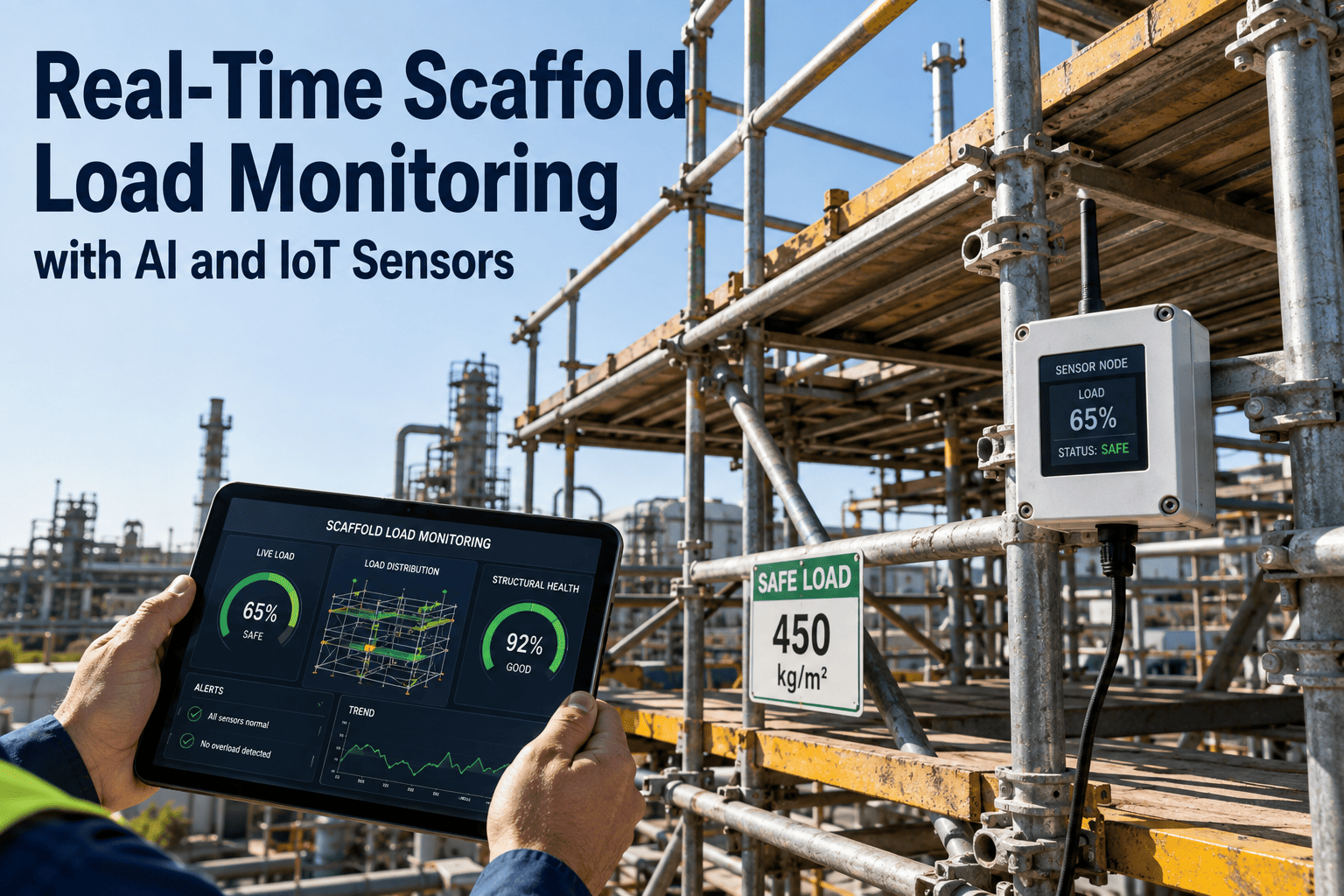
Real-Time Scaffold Load Monitoring with AI and IoT Sensors
Instrument every load-critical scaffold with IoT load cells. Track live load against manufacturer rated capacity and OSHA 4:1 safety factor. Alert workers, supervisors, and CMMS the moment material staging approaches the limit — long before the plank creaks, the frame buckles, or the structure comes down.
Live Platform Load %
0–60%
Safe · normal operation
60–80%
Caution · staging alert
80–95%
Warning · stop loading
> 95%
Critical · evacuate
Thresholds set against rated capacity per platform
Why Scaffold Load Is A Silent Failure Mode
The Structural Reason A Rated Capacity Isn't The Same As A Known Load
Every scaffold on a construction or industrial site carries a manufacturer-rated capacity that assumes ideal loading conditions: uniformly distributed weight, no dynamic surges, no eccentric material placement, no wind-induced live loading. The rated capacity is a starting number, and OSHA's requirement that the scaffold support at least four times the maximum intended load is the safety factor that absorbs the messy realities the rating didn't anticipate. But between the ideal and the actual sits a gap that nobody on the platform is measuring — until a load cell is telling them.
Consider the standard duty ratings. A light-duty scaffold is rated for 25 psf uniform load, medium-duty for 50 psf, heavy-duty for 75 psf, and special-duty for 100 psf. On a 50 square foot platform, medium duty means 2,500 pounds spread evenly. But construction rarely spreads loads evenly. A brick pallet weighing 3,000 pounds set in a single spot exceeds the local capacity even though the aggregate platform load looks fine on paper. A hoist lifting material adds dynamic load pulses the static rating didn't envision. Wind acting on netting or tarps adds live loading that competes for the same margin. The rated number and the actual applied load can drift far enough apart that a competent-person inspection at 7 AM says nothing about whether the scaffold is overloaded at 3 PM.
IoT load monitoring closes that gap by making the applied load measurable in real time. Load cells at the base of each leg, at critical planking spans, and at hoist attachment points continuously report the actual weight the structure is carrying. AI analytics layer the readings against the rated capacity, the OSHA safety factor, and the specific loading history of that platform to produce a live percentage — the number that tells everyone on and around the scaffold how much of the failure envelope has been consumed. When staging approaches the limit, alerts fire, work orders route, and access blocks trigger before the structure ever has to test its own margin.
The Duty Rating Framework
Matching Load Sensors To Scaffold Duty Class And Application
OSHA defines four scaffold duty categories, and each carries a different loading profile that drives different monitoring priorities. The four-tier framework below is how site safety and scaffold engineering leadership map load-cell density and alarm thresholds against the actual work each scaffold is doing.
Light Duty
25 psf · Inspections & Finishing
Painting, cleaning, inspection, light finish work. Load monitoring priority is worker count and tool load — overload risk is low but concentrated point loads still matter. Sparse sensor density, high alarm thresholds, catch dynamic events like tool drops.
Medium Duty
50 psf · General Construction
Bricklaying, plastering, general trades, moderate material staging. The most common duty class on site. Standard load-cell density at leg bases, alert on eccentric loading patterns, and continuous trend against the 4:1 safety envelope during active staging.
Heavy Duty
75 psf · Masonry & Stone Setting
Heavy material handling, stone setting, mechanical equipment. Higher load density means overload risk concentrates. Full leg-base instrumentation, dynamic load-pulse detection on hoist attachment points, and tight alarm thresholds — the failure margin is smaller in absolute terms.
Special Duty
100 psf+ · Engineered Applications
Custom-engineered structures, high-load industrial applications, shoring towers, and specialty configurations. Comprehensive sensor instrumentation across all critical points, engineer-specified thresholds, and integration with structural design monitoring.
The IoT Sensor Stack
What Actually Instruments A Load-Monitored Scaffold
"IoT scaffold monitoring" is shorthand for a coordinated sensor stack — each layer catches a different loading signature the others cannot see. The six sensor layers below are the standard instrumentation set on a comprehensively monitored load-critical scaffold, each feeding the AI analytics layer with a specific slice of the structural load picture.
S1
Leg-Base Load Cells
Compression load cells at every scaffold leg base measure the actual weight bearing on each foundation point. Reveals load distribution across the structure — eccentric loading shows up immediately as leg-to-leg imbalance.
S2
Platform Plank Strain Gauges
Strain gauges on critical planking spans measure deflection under load. Catches point-load concentrations that the aggregate platform reading would miss — a 3,000 lb pallet in a single bay lights up the strain trace even if total platform load looks fine.
S3
Tie & Anchor Force Sensors
Force sensors on wall ties and structural anchors monitor lateral load transfer to the tied structure. Wind loading, dynamic construction pulses, and lean progression all appear as anchor force trends before they escalate to structural instability.
S4
Inclinometers & Tilt Sensors
MEMS inclinometers at scaffold vertical members detect plumbness drift and settlement of base plates over time. Any tilt developing beyond design tolerance triggers an alert — often the earliest available signal that a leg is losing bearing.
S5
Environmental & Wind Sensors
Anemometers and environmental sensors measure wind speed and gust patterns at the scaffold. Wind loading acts as live load on tarped or netted structures — integrated with structural sensors to compute total dynamic loading in real time.
S6
Edge AI Gateway & Analytics
Edge compute at the scaffold gateway aggregates sensor streams, runs the load-vs-capacity analytics, and generates alarms locally when thresholds are crossed. Cloud connectivity syncs the trend, but alerts fire even if uplink is temporarily unavailable.
The Load-To-Alert Pipeline
From Sensor Reading To Blocked Access — The Real-Time Loop
The value of IoT load monitoring lives in the loop between sensor data and action. A load cell that reports every minute but never triggers an operational response is decoration. The five-stage pipeline below is what actually runs on a load-monitored scaffold once the system is deployed on site.
01
Scaffold Registration & Capacity Model
Each scaffold registered with its duty rating, platform area, rated capacity, and OSHA 4:1 safety factor stored in the platform. Capacity model tuned to the specific scaffold configuration and manufacturer specification.
02
Continuous Sensor Streaming
Load cells, strain gauges, tie sensors, inclinometers, and environmental sensors stream continuously to the edge gateway. Sub-minute cadence on load channels, faster on dynamic sensors, with local time-series storage on the gateway.
03
AI Analytics & Threshold Evaluation
Edge AI computes live platform load percentage against rated capacity, correlates strain patterns with expected load distribution, and evaluates every reading against the scaffold's specific threshold envelope. Anomaly detection flags eccentric loading and dynamic pulse events.
04
Escalation & Alert Distribution
Threshold breach triggers escalation matched to severity — caution alerts to the staging crew, warnings to the supervisor, critical alerts to the safety supervisor with automatic access-block flag on the scaffold register. Alerts fire in seconds, not shifts.
05
CMMS Work Order & Incident Archive
Critical events generate structured work orders into the CMMS with the sensor data, threshold breached, and recommended action attached. Full load history archived per scaffold for after-action review, contractor accountability, and insurance documentation.
See Live Load Trending On A Real Instrumented Scaffold
Watch AI Analytics Catch An Eccentric Pallet Load In Real Time
Book a walkthrough with iFactory's scaffold load engineering team and see live load percentage trending on a real instrumented scaffold — leg-base load distribution, strain-gauge point-load detection, dynamic hoist pulses, and automatic access-block escalation with CMMS routing.
Where Overload Actually Happens
The Five Loading Signatures Real-Time Monitoring Was Built To Catch
Scaffold overload rarely happens as a single dramatic event. It happens as one of five recurring signatures that human observation cannot reliably detect in real time. Each of the five below has a specific sensor pathway and a specific analytics response — and each one has appeared in the collapse-incident record often enough to justify continuous monitoring on load-critical structures.
Mode 1
Cumulative Material Staging Drift
The most common overload signature. Material staged incrementally across the shift — a few bricks, another pallet, a bundle of pipe — each addition looks minor but the cumulative total exceeds capacity. Continuous load cells catch the drift before the last addition tips it over.
Mode 2
Eccentric & Point-Load Concentration
A single heavy item — pallet, motor, precast segment — set on one bay while the rest of the platform is nearly empty. Aggregate platform load looks fine; local plank capacity is exceeded. Strain gauges on planking spans surface the concentration immediately.
Mode 3
Dynamic Hoist & Impact Loading
A material hoist lifting a load onto the scaffold introduces dynamic pulses that exceed the static rating momentarily. Impact loads from dropped materials do the same. High-cadence load channels capture the pulse events even when static readings sit inside spec.
Mode 4
Wind & Environmental Live Load
Wind acting on tarped or netted scaffolds transfers force into ties and anchors as live loading. Anemometers plus tie force sensors compute the environmental live-load contribution and combine it with the static structural load for a true total loading number.
Mode 5
Base Settlement & Plumbness Drift
Ground settlement under a leg base changes load distribution across the remaining legs and progressively tilts the structure. Inclinometers catch the plumbness drift, load cells surface the leg-to-leg imbalance, and combined they flag the settlement before it compounds into instability.
Where The Program Actually Pays Back
Six Categories Where Live Load Monitoring Moves The Numbers
IoT scaffold load monitoring delivers value across specific categories on site safety, project schedule, and insurance economics. The six categories below are the pattern that reliability and safety leaders consistently cite when they take the case for the program to project executive leadership.
01
Collapse Incident Prevention
Every prevented collapse is a fatality, a serious injury, a project shutdown, and an investigation avoided. On sites with load-critical scaffolds carrying stone, masonry, or mechanical equipment, this is the whole business case in a single line item.
02
OSHA Compliance & Citation Avoidance
Overloading violations sit high in the scaffold citation list. Continuous load data produces both the prevention layer and the compliance evidence chain — showing OSHA that the site actively monitored intended load against rated capacity across the work window.
03
Project Schedule Preservation
A scaffold collapse stops work across a wide area, triggers investigation, and cascades into schedule slip on critical-path activities. Preventing the incident preserves the project timeline that every day of overrun costs in liquidated damages or extended overhead.
04
Insurance & Bonding Position
Sureties and property insurers increasingly reward evidence-based safety programs on high-scaffold-density projects. Load-monitored scaffolds strengthen the risk position at bond renewal and premium negotiation — sometimes worth more than the monitoring cost itself.
05
Contractor & Trade Accountability
Overload signatures correlate to specific trades and shifts. The load data produces the objective record that supports contractor safety performance conversations, backcharge disputes, and future scope decisions on multi-contractor sites.
06
Design & Erection Feedback Loop
Long-term load data across a project's scaffold population reveals patterns — configurations that consistently see high loading, duty classes that get misapplied, staging behaviors that create risk. Feedback loops back into future scaffold planning and erection standards.
Field Perspective
"
The mental model I try to give project leadership on scaffold load is that the rated capacity is a specification, but the applied load is a variable. Every scaffold on site has a fixed rated capacity — 25, 50, 75 psf, whatever the duty class defines — but the actual load on that platform is changing every minute as workers move, material stages in, hoists lift, wind picks up. The 4:1 safety factor OSHA requires is designed to absorb the difference between the ideal loading the rating assumed and the messy loading the platform actually sees. But that safety factor is not infinite, and every incident I've investigated where a scaffold came down under load has the same pattern: the applied load crossed the capacity envelope some time before the failure, and nobody on site knew it. That's the specific gap that IoT load monitoring fills. Not a replacement for the competent-person inspection, not a replacement for the erection standard, not a replacement for the load rating — a live measurement of the variable that nobody was measuring before. Once a project sees the first eccentric-load alert catch a pallet placement that would have exceeded local plank capacity, or the first cumulative-drift alert catch a bay that had progressively staged past the rating, the argument for the program is over. The question stops being whether it's worth deploying and starts being how fast to expand it across the load-critical scaffold population.
Anastasia Kohl-Nakabayashi
Construction Safety Systems Lead · 21 years in scaffold engineering, IoT safety monitoring deployment, and collapse-incident investigation across commercial construction, industrial shutdowns, and infrastructure projects
Common Questions
Frequently Asked Questions
Does IoT load monitoring replace the OSHA-required competent-person scaffold inspection?
No, and any vendor suggesting otherwise is creating regulatory exposure for the customer. 29 CFR 1926.451 explicitly requires a competent person to inspect scaffolds before each work shift and after any occurrence that could affect structural integrity — that requirement is not delegable to a sensor network. What IoT load monitoring does is add a continuous measurement layer between the competent-person inspection walks, so the applied load stays inside the capacity envelope even when material staging or dynamic events happen outside the inspector's field of view. The competent person still signs the tag; the sensors ensure the load side of the equation stays honest between signings.
Talk to scaffold load engineering about how the two layers integrate on your site.
How are alarm thresholds set for a specific scaffold, and who is responsible for the numbers?
Alarm thresholds are set as percentages of the manufacturer's rated capacity, with the OSHA 4:1 safety factor providing the reference envelope. A typical configuration is caution at 60 percent of rated capacity, warning at 80 percent, and critical evacuation at 95 percent — but the specific numbers are tuned per scaffold configuration by the qualified engineer of record for the project. The load monitoring platform enforces the thresholds mechanically; the qualified engineer sets them. On special-duty or engineered scaffolds the threshold logic gets more nuanced, incorporating point-load limits, dynamic pulse ceilings, and combined static-plus-live-load envelopes for wind-exposed structures.
Can the load monitoring system handle temporary scaffolds that get erected and dismantled within days?
Yes, and this is one of the specific deployment patterns the platform is designed for. Short-life scaffolds on shutdowns and construction sites get instrumented with wireless load cells and battery-powered gateways at erection time, registered against their duty rating and rated capacity in the platform, and monitored continuously through their service window. At dismantle time the sensors are recovered, redeployed to the next scaffold, and the load history for that specific structure archives permanently in the incident-record and compliance-evidence trail. Modular wireless sensor systems typical of modern IoT deployments make the deploy-recover cycle fast enough to work on the erection cadences of large turnarounds.
What happens on sites with limited network connectivity — remote industrial locations or partially completed structures?
Edge processing is specifically designed for this scenario. The AI analytics run on the gateway at the scaffold, so threshold evaluation and local alarm triggering work even when cellular or Wi-Fi uplink is unavailable. Local visual and audible annunciators fire on critical thresholds regardless of connectivity, and the load history buffers locally for upload when connectivity returns. Sites with intermittent networks operate on the same safety envelope as connected sites — the only difference is the latency of central dashboard visibility, not the effectiveness of the local alarm response. Deployments on remote projects typically pair edge-first analytics with periodic satellite or cellular sync for portfolio-wide trending.
Book a demo to walk through connectivity architectures for your specific site conditions.
How does the load data integrate with the scaffold register, permit-to-work system, and CMMS?
The load monitoring platform is designed to write into the existing scaffold register and permit-to-work systems rather than replace them. Each instrumented scaffold's live load percentage is linked to its register entry, so the tag status displayed to workers reflects both the competent-person inspection state and the current load state. Critical threshold breaches automatically flip the register tag and notify the permit-to-work system to block access authorization until the load is reduced and the competent person re-inspects. CMMS work orders generate directly from critical events with sensor data, threshold breached, and recommended action attached. Integration uses standard REST APIs and completes during deployment engineering without requiring changes to the existing register, permit, or CMMS platforms.
Make Applied Load A Measured Variable
Stop Trusting That The Scaffold Isn't Overloaded And Start Measuring It Continuously
iFactory's IoT scaffold load monitoring platform is built for the specific realities of load-critical scaffold applications — masonry, mechanical erection, industrial turnarounds, and heavy-material trades. Load cells, strain gauges, tie force sensors, inclinometers, and environmental sensors feed into a single AI analytics layer that turns applied load from an unmeasured variable into a controlled metric — with alerts, access blocks, and CMMS routing that fire seconds after the capacity envelope is threatened.