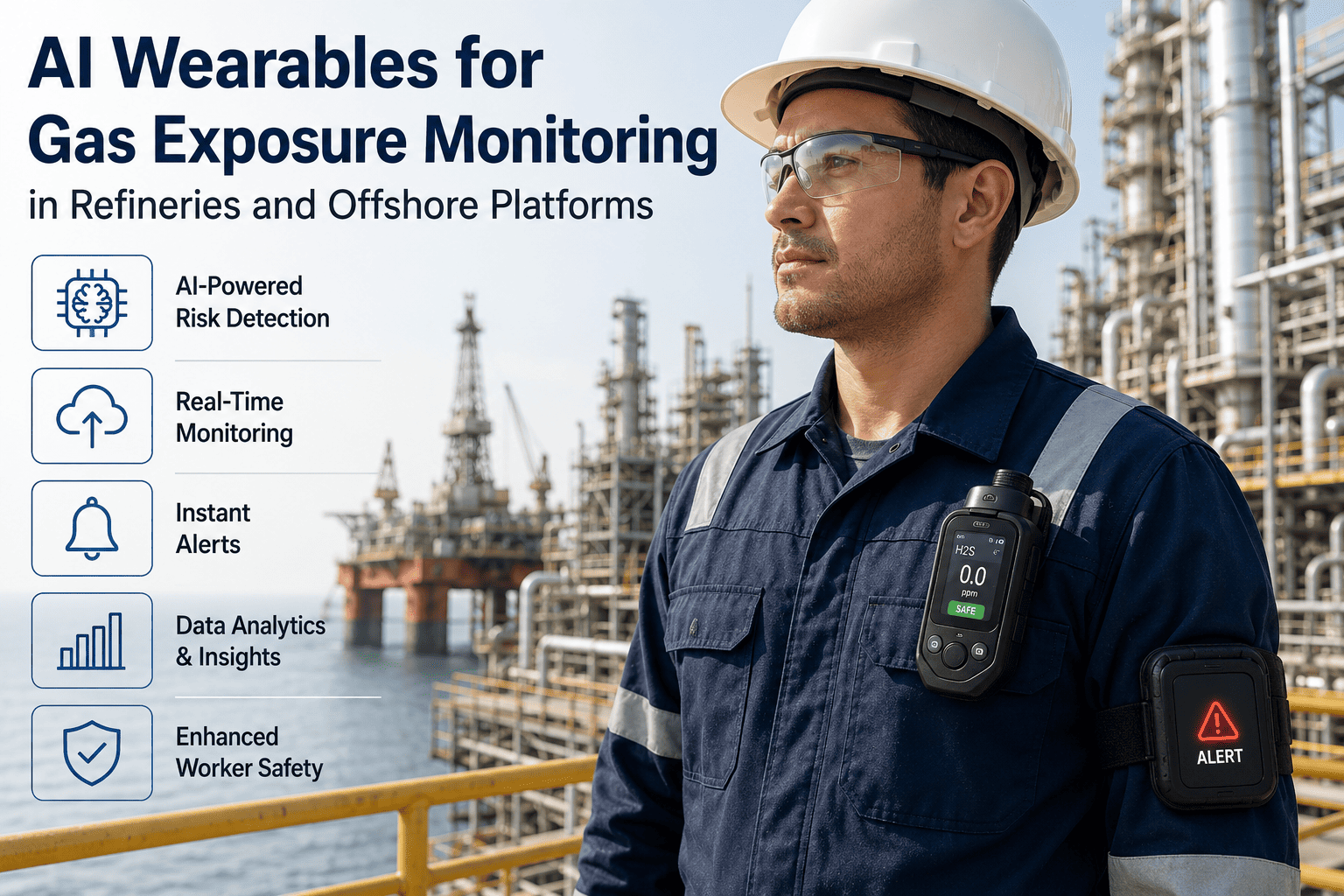
A worker's clip-on H2S monitor beeps once, briefly, during a shift change near a sour gas separator. Nobody logs it, the alarm resets itself, and the exposure never gets added to anything because the device only knows how to alarm, not to remember. Three shifts later a different worker gets a longer exposure in the same spot and the pattern connecting both events is invisible, because no system was tracking cumulative dose across people, time, or location. AI-connected wearables close that gap by turning every reading from every worker's personal monitor into a running record instead of a forgotten beep — book a gas monitoring demo to see cumulative dose tracking running on your own site's exposure data.
Every Breath Measured. Every Exposure Logged. Every Evacuation Automatic.
AI-connected personal gas monitors track H2S, LEL, CO, and O2 exposure in real time, calculate running TWA and cumulative dose per worker, and trigger evacuation alerts the instant a threshold is crossed.
The Four Gases Every Wearable Has to Watch
Refineries and offshore platforms don't have one gas hazard, they have four running at once, each with its own exposure limits and its own speed of onset. A wearable has to track all four simultaneously and know which threshold is closest to being crossed at any given second.
Why Human Senses Cannot Be the Backup Plan
H2S is famous for a rotten-egg smell at low concentrations, which creates a false sense of security. The smell is not a reliable warning system, and the numbers explain exactly why.
concentration at which olfactory fatigue starts paralyzing the sense of smell within minutes
concentration at which olfactory detection ceases almost immediately, right at the IDLH threshold
of H2S-related fatalities occurred in areas that were considered covered by monitoring
fatal U.S. occupational injuries from exposure to harmful substances in a single recent year, per BLS data
How Cumulative TWA Dose Tracking Actually Works
A single ppm reading tells you what is happening this second. TWA tells you what has happened all shift, and that running number is what actually determines whether a worker has to be pulled before a compliance limit is breached, not just an instantaneous alarm.
Continuous sampling
The wearable's sensors sample H2S, CO, LEL, and O2 concentrations continuously, timestamped and geotagged to the worker's location on site.
Running weighted average
Every reading is time-weighted against the elapsed shift duration, so a brief spike and a sustained low-level exposure contribute differently to the running total, exactly as the TWA formula requires.
Compare against per-gas limits
The AI checks the running TWA against the applicable PEL for each gas simultaneously, and separately tracks any ceiling or peak exposure rule that applies regardless of the average.
Project the trajectory
Rather than waiting for a limit to be crossed, the model projects whether the current trend will breach the TWA before the shift ends, giving supervisors lead time instead of a surprise.
Log the full exposure record
Every reading, alarm, and calculated dose is stored against the worker and the shift, building the exposure history that industrial hygiene and compliance teams need on demand.
See Live TWA Tracking Running on a Real Shift
Watch the platform calculate running dose for H2S, CO, LEL, and O2 in real time and trigger the evacuation logic exactly as it would on your floor.
The Automatic Response Ladder, From Watch to Evacuate
Not every reading above zero needs the same response. The AI applies a tiered response so a brief low-level reading gets logged quietly while a real threshold breach triggers an immediate, unmistakable evacuation signal.
Reading below alarm threshold. Recorded silently into the worker's running dose record, no alert generated.
Reading or projected TWA trend approaching threshold. Supervisor dashboard flags the worker for awareness, worker's device shows a low-level warning.
Alarm setpoint reached. Audible and vibrating alert on the wearable, real-time notification to supervisor and control room.
Ceiling, peak, or high alarm crossed. Automatic evacuation signal to the worker and everyone within the affected zone, muster count initiated instantly.
Standalone Detector Versus AI-Connected Wearable
A standalone clip-on gas monitor is not a bad device, it just cannot do anything with a reading beyond beeping in the moment. Connecting it to an AI platform changes what that same sensor data can do for the worker, the supervisor, and the compliance file.
What Lands in the Compliance Record Automatically
When an inspector or an incident investigation asks for the exposure history, having it generated automatically at the moment of the reading beats reconstructing it from memory and paper logs weeks later.
Per-worker dose history
Full TWA and peak exposure records for every worker, every shift, searchable by name, date, and location.
Alarm and response timeline
Timestamped record of every alarm tier reached, who was notified, and how long the response took.
Calibration and bump-test logs
Device calibration history stored alongside exposure data, so a reading's validity is never in question during an audit.
Zone and hotspot mapping
Aggregated readings by location reveal which areas of the site generate repeat alarms, informing engineering controls before the next exposure.
A Shift That Ended Before the TWA Was Breached
A maintenance technician working near a sulfur recovery unit picked up a series of short H2S readings across a shift, each one individually below the alarm setpoint and each one clearing before the next. On a standalone detector, none of those readings would have triggered anything, and the technician would have kept working through the afternoon unaware of how close the cumulative exposure was running to the shift limit. The connected wearable's running TWA calculation caught the trend two hours before shift end, flagged the projected breach to the supervisor, and the technician was reassigned to a lower-exposure task for the remainder of the day. No alarm ever sounded on the device itself, because the system caught the pattern the single-reading alarm was never designed to see.
What Changes When Gas Monitoring Goes Connected
Operators moving from standalone detectors to AI-connected wearables report the shift concentrated in three places: faster response, fewer undetected exposures, and a compliance file that builds itself.
Frequently Asked Questions
How does the system calculate TWA differently from what our current detectors already do?
Most standalone detectors show an instantaneous reading and a simple alarm threshold, but few calculate and display a continuously updated time-weighted average against the applicable PEL for each gas simultaneously. iFactory's platform time-weights every sample against elapsed shift duration for H2S, CO, LEL, and O2 in parallel, and separately tracks ceiling and peak exposure rules that apply regardless of the running average, since a single instantaneous spike can violate a limit even when the TWA stays low. The result is a running number that reflects actual cumulative regulatory exposure, not just the current second's reading. Talk to support about how the calculation maps to your site's specific exposure limits.
Does an automatic evacuation alert actually shut anything down, or just notify people?
The evacuation signal itself is a notification, not a physical shutdown, and it is designed that way deliberately, since the appropriate emergency response depends on your site's specific procedures and integration with existing safety systems. What the platform does automatically is push the alert simultaneously to the affected worker's wearable, every other wearable in the same geofenced zone, the supervisor, and the control room, and start a muster count the moment the evacuation tier is triggered. Where a site has automated shutdown valves or ESD systems already in place, those can be integrated as a downstream action rather than a replacement for the alert itself.
Can the platform work with the gas monitors we already have deployed, or do we need new hardware?
In most cases the existing personal gas monitors on your site can connect into the platform if they support cellular, Bluetooth, or wireless data output, since the AI layer sits on top of the sensor data rather than replacing the sensing hardware itself. Where a site's current devices are purely standalone with no connectivity, iFactory scopes a hardware refresh alongside the platform rollout during onboarding. Book a demo to review your current fleet against what's needed for connectivity.
How is worker location tracked for the evacuation zone and muster count features?
Wearables report location using a combination of GPS where available and site-specific positioning such as beacon or gateway triangulation indoors and in areas where satellite signal is unreliable, which is common inside process units and offshore topsides. That location data drives the geofenced evacuation alert, so only workers actually inside or near the affected zone receive the automatic signal rather than the entire site, and it feeds the muster count that confirms every worker in that zone has checked in safely.
What happens to the exposure data after a shift ends — where is it stored and who can access it?
Every reading, calculated TWA, alarm event, and response action is stored against the worker and shift in a searchable exposure record, available to safety and industrial hygiene teams for ongoing monitoring and to compliance teams during an audit or investigation. Access is role-based, so exposure history is visible to the people who need it for safety and compliance purposes without becoming a general surveillance record. Reach out to support to review data retention and access control options for your organization.
Turn Every Gas Reading Into a Protected Worker
Book a 30-minute walkthrough and see cumulative TWA tracking, tiered alerting, and automatic evacuation signaling running on a simulated shift from your own site profile.