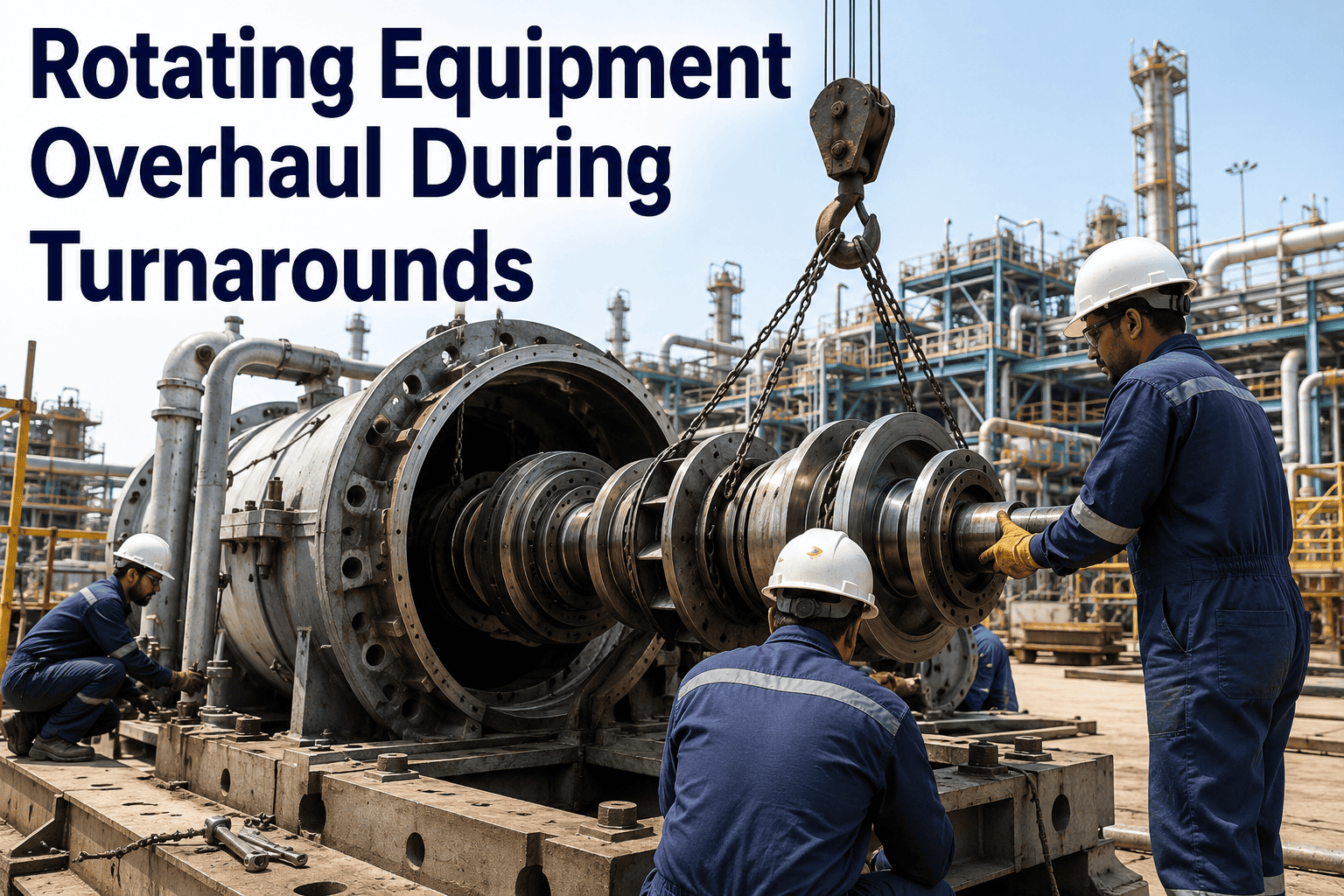
Rotating equipment overhauls represent the single largest driver of turnaround duration variability in oil and gas facilities, yet they are frequently planned using generic templates that fail to account for the specific condition, complexity, and vendor dependencies unique to each machine. A centrifugal compressor overhaul at one refinery might require 14 days with an OEM shop visit, while an identical machine at another facility with a well-managed spare rotor program could complete the same scope in 8 days using a local certified shop. The difference is not luck but planning discipline applied systematically to scope definition, vendor logistics, parts staging, and critical path management. Understanding how to structure rotating equipment overhaul planning as an integrated component of turnaround execution, rather than a standalone maintenance activity, determines whether your unit returns to service on schedule or faces weeks of delay driven by a single machine waiting on a vendor or a missing spare part. Book a demo to see how iFactory tracks rotating equipment overhaul progress within your turnaround command center.
Every Day Your Compressor Sits Disassembled Costs You a Million Dollars in Lost Production.
iFactory gives your turnaround team real-time visibility into every rotating equipment overhaul work stream, vendor status, and critical path dependency so you can compress schedules and eliminate waiting time.
Rotating Equipment Complexity Tiers Encountered During Turnarounds
Not all rotating equipment overhauls carry equal planning complexity or schedule risk. A large centrifugal compressor with a rotor that must leave site for OEM shop machining creates fundamentally different planning demands than a centrifugal pump that can be overhauled entirely in the field by site maintenance crews. The following classification groups the six most common rotating equipment types encountered in oil and gas turnarounds into complexity tiers based on the number of external dependencies, specialized vendor requirements, and critical path sensitivity they typically introduce. Understanding which tier each machine in your turnaround scope falls into determines the level of planning rigor, lead time, and contingency required.
The critical insight from this classification is that Tier 1 equipment should trigger a dedicated overhaul planning workstream that begins 12 to 18 months before the turnaround, with its own scope development timeline, vendor procurement process, and risk register. Tier 2 equipment requires focused planning attention starting 9 to 12 months out. Tier 3 equipment can be planned within the standard turnaround planning timeline but still needs specific parts verification and work package development rather than generic pump overhaul templates.
Seven-Phase Overhaul Planning and Execution Lifecycle
A major rotating equipment overhaul during a turnaround follows a distinct lifecycle that begins long before the unit shuts down and extends well past mechanical completion. Each phase has specific deliverables, decision gates, and dependencies that must be managed as an integrated sequence. Skipping or compressing any phase transfers risk to the execution window where the cost of resolving planning gaps increases by a factor of 10 to 50 for every day of schedule delay. The following lifecycle represents the HFE-validated planning sequence used by top-quartile turnaround performers for Tier 1 and Tier 2 rotating equipment overhauls.
Overhaul Scope Categories by Decision Trigger
Effective scope development for rotating equipment overhauls requires categorizing every work item by the type of decision trigger that determines whether it is included in the final scope. This categorization is critical because it determines when the scope item can be confirmed, which in turn determines procurement timing, work package readiness, and resource allocation. Scope items confirmed too late create the same execution delays as discovery work in other turnaround disciplines. The following matrix shows the three scope categories, their decision triggers, confirmation timing, and typical work items for a large centrifugal compressor overhaul as a reference example.
| Scope Category | Decision Trigger | Confirmation Timing | Procurement Lead Time | Typical Scope Items (Centrifugal Compressor Example) |
|---|---|---|---|---|
| Mandatory Scope | Regulatory requirement, manufacturer recommendation at current run hours, or known degradation from condition monitoring | Confirmed during P2 scope definition, T-12 to T-9 months | Long-lead items ordered in P4, standard items in P4-P5 | Bearing replacement, dry gas seal replacement, lube oil system flush, coupling inspection, alignment check, all clearance measurements, balance piston inspection |
| Conditional Scope | Findings at opening inspection including visual damage, dimensional measurements, NDE results, or unexpected degradation | Confirmed during P6 execution, typically within first 48-72 hours after machine opening | Pre-procured contingency items staged on-site, emergency procurement for items not anticipated | Impeller repair or replacement if erosion damage found, diaphragm re-machining if distortions exceed limits, casing joint re-facing if leakage detected, rotor replacement if shaft damage found |
| Discretionary Scope | Planning team judgment based on risk assessment, remaining useful life analysis, or opportunity to upgrade during a scheduled outage | Decided during P2 scope definition but can be added or removed during P4-P5 based on budget or schedule pressure | Same as mandatory if included, not procured if excluded | Impeller upgrade to newer aerodynamic design, control system modernization, bearing type upgrade from sleeve to magnetic, added instrumentation probes, casing modifications for future capacity increase |
The most common planning failure in rotating equipment overhauls is treating conditional scope items as if they are optional extras rather than highly probable scope items that happen to require opening inspection for final confirmation. Experienced planners estimate conditional scope probability for each item and pre-procure high-probability items to avoid the 4-to-8-week delay that emergency procurement would cause if the condition is confirmed at opening. A conditional item with a 70 percent probability of being required should be treated as mandatory for procurement purposes even though it remains technically conditional until opening inspection.
Parallel Work Stream Execution Map for a 21-Day Compressor Overhaul
The defining characteristic of a major rotating equipment overhaul is that it creates multiple parallel work streams that must converge at precise points in time for the overhaul to stay on the critical path. Unlike static equipment work where activities are largely sequential, a compressor overhaul simultaneously involves on-site mechanical disassembly and reassembly, off-site vendor shop work on the rotor, separate electrical motor overhaul, and instrumentation recalibration, all of which must synchronize for the machine to be reassembled and tested on schedule. The following execution map shows how these parallel streams overlap across a 21-day turnaround window, with the critical path highlighted by the sequence of dependencies between streams.
The critical path in this example runs through disassembly, vendor shop rotor overhaul, and reassembly, with the vendor shop segment being the longest single activity at 12 days. If the vendor shop delivers the rotor even one day late, the entire reassembly sequence shifts and the testing window compresses, creating risk that the machine will not be fully tested before the unit startup deadline. This is why vendor shop progress monitoring during execution is not an administrative task but a critical path management activity that should receive the same level of daily attention as on-site mechanical work. iFactory tracks vendor shop milestones alongside on-site progress in a single view, ensuring that off-site delays are visible to the entire turnaround team in real time.
Vendor Dependency Scorecards for Overhaul Execution
Vendor coordination during rotating equipment overhauls is fundamentally different from vendor management for static equipment work because the vendor is not just providing a service on your site but is actively performing work at their facility that directly controls your critical path. This creates a dependency relationship where your schedule is held hostage by the vendor's shop capacity, workforce availability, and parts supply chain. The following scorecards define the five critical vendor roles in a major rotating equipment overhaul, what each vendor needs from your facility to begin and complete their work, and the schedule risk they introduce if their dependencies are not managed proactively.
The critical coordination failure mode is not vendors failing to perform their technical work but vendors being unable to start their work because the facility has not delivered the components, data, or site access they need on the date specified in the contract. Every day a vendor waits for a rotor delivery or dimension confirmation is a day added to the critical path that cannot be recovered. Proactive vendor dependency management means treating the vendor's input requirements as internal work packages with the same priority and tracking rigor as any on-site activity.
Repair Versus Replace Decision Matrix for Overhaul Scope
One of the most consequential decisions during any rotating equipment overhaul is whether to repair a damaged component or replace it with a new or refurbished unit. This decision affects cost, schedule, and future reliability, and it is often made under time pressure during execution when the component is open and inspected for the first time. Having a pre-defined decision framework eliminates the ad-hoc deliberation that consumes valuable execution time and ensures that decisions are consistent with the organization's risk tolerance and long-term asset strategy. The following matrix provides the decision criteria and scoring guidance for the most common repair-versus-replace decisions encountered during centrifugal compressor overhauls.
| Component | Repair Option | Replace Option | Decision Criteria | Recommended Threshold |
|---|---|---|---|---|
| Rotor Shaft | Shop machining to remove scoring, plating of worn journals, re-balancing | New shaft from manufacturer or certified aftermarket supplier | Remaining dimensional margin after machining, number of previous repairs, criticality of shaft as single-point failure | Replace if machining removes more than 10% of original diameter or if this is the second repair on the same shaft |
| Impeller | Weld repair of erosion damage, re-machining of blade profiles, re-balancing | New impeller from OEM or reverse-engineered equivalent from certified foundry | Extent of erosion or corrosion damage, number of affected blades, impact on aerodynamic performance, material weldability | Replace if more than 15% of blade area is affected or if leading edge erosion exceeds 3mm depth on any blade |
| Dry Gas Seal | Refurbish with new sealing faces and secondary seals by certified seal shop | New seal assembly from OEM or approved alternative supplier | Seal face condition, spiral groove wear depth, secondary seal degradation, hours since last refurbishment | Replace if this is the third refurbishment cycle or if groove depth loss exceeds 25% of original specification |
| Thrust Bearing | Re-babbitting of worn pads, re-machining of thrust collar, re-tinning | New bearing assembly with pads and collar from OEM or certified bearing shop | Babbitt thickness remaining, pad temperature history, thrust collar surface condition, alignment of pad pivots | Replace if babbitt thickness is below 75% of original or if temperature history shows trending degradation over last two run cycles |
| Diaphragm | Re-machining of sealing edges, weld repair of cracks, re-staking of vanes | New diaphragm from OEM or certified fabrication shop | Crack extent and location, vane attachment integrity, sealing edge wear, material condition after extended service | Replace if cracks extend into vane attachment area or if re-machining would reduce wall thickness below minimum design allowance |
| Balance Drum | Re-machining of balance surface, new balance seal rings, re-balancing | New balance drum from OEM or certified machine shop | Surface wear depth, remaining dimensional margin, balance seal clearance increase since last overhaul | Replace if surface wear exceeds 2mm or if clearance increase suggests more than 50% of balance capacity has been lost |
The most important principle in applying this matrix is that the thresholds should be reviewed and approved by the engineering authority before the turnaround begins, not debated in the field while the machine is open and the clock is running. Pre-approved decision thresholds, documented in the work package and signed off by the turnaround manager and rotating equipment engineer, allow the field supervisor to make repair-or-replace decisions immediately at the point of inspection without waiting for engineering review that could take hours or days and consume critical path time.
Post-Overhaul Testing and Recommissioning Protocol
The recommissioning phase is where the value of the entire overhaul is either realized or lost. A machine that has been overhauled to the highest standards but is recommissioned improperly can sustain damage that negates the overhaul investment and potentially shortens the machine's remaining useful life. The following staged protocol defines the testing sequence from static verification through full-load operation, with each stage serving as a gate that must be passed before proceeding to the next. Skipping stages or combining stages to save time is the most common cause of post-overhaul failures in the first 30 days of operation.
Common Questions About Rotating Equipment Overhaul Planning
How do we decide whether to use the OEM or a third-party shop for a major compressor rotor overhaul?
The OEM versus third-party shop decision depends on four factors: the machine's criticality and consequence of failure, the availability of manufacturer drawings and material specifications, the third-party shop's certified experience on your specific machine model, and any warranty or service agreement obligations that may require OEM work. For Tier 1 machines where failure would cause a total unit shutdown and extended production loss, OEM overhaul is typically justified despite the 20 to 40 percent cost premium because the OEM has access to original manufacturing data, proprietary repair procedures, and can provide warranty coverage that third-party shops cannot match. For Tier 2 machines where a quality third-party shop has documented experience on the specific model and can provide equivalent quality assurance, the cost savings often justify the third-party route. The key requirement regardless of shop selection is that the facility must provide complete manufacturer drawings and specifications to the third-party shop, as machining to incorrect dimensions will invalidate the overhaul regardless of the shop's technical competence. Book a demo to see how iFactory tracks vendor shop selection criteria and performance history.
What is the value of maintaining a spare rotor program and how do we justify the capital investment?
A spare rotor program eliminates the single most critical path dependency in a compressor overhaul by allowing the machine to be reassembled with a pre-overhauled spare rotor while the in-service rotor is at the vendor shop. This typically compresses the critical path by 8 to 14 days depending on the rotor overhaul scope, which on a large refinery unit represents 2 to 5 million dollars in avoided production revenue per day of schedule reduction. The capital investment for a spare rotor ranges from 500,000 to 2,000,000 dollars depending on machine size and complexity, but the investment is recovered in a single turnaround cycle if the spare rotor enables even two days of schedule compression. The secondary benefit is that the spare rotor can be overhauled proactively in the vendor shop before the turnaround begins, transferring shop schedule risk from the execution window to the planning window where delays have no production impact. For any compressor that is on the critical path of a turnaround and requires rotor removal, a spare rotor is one of the highest-return capital investments available in turnaround planning. Contact support for spare rotor ROI modeling tools.
How do we manage the risk of scope expansion when opening inspection reveals unexpected damage?
Scope expansion risk is managed through three complementary strategies applied during the planning phase rather than reacted to during execution. First, pre-procure high-probability conditional scope items based on a formal probability assessment conducted during the P2 scope definition phase. Any component with greater than 60 percent probability of requiring replacement based on condition monitoring trends, age, and service history should be procured and staged on-site before the turnaround begins. Second, negotiate pre-priced change order provisions with all critical vendors so that if scope expansion requires additional shop work, the pricing and duration impact are already agreed and the vendor can begin immediately without contract renegotiation. Third, maintain a dedicated contingency budget of 15 to 25 percent of the planned overhaul cost that is specifically reserved for conditional scope confirmation, separate from the general turnaround contingency. The most important discipline is to never treat conditional scope as a surprise that requires emergency response. It is a predicted probability that should be pre-planned, pre-procured, and pre-budgeted to the maximum extent possible. Book a demo to explore conditional scope management tools.
What are the most common causes of schedule delay in rotating equipment overhauls and how can they be prevented?
Analysis of over 150 rotating equipment overhaul delays across refinery and petrochemical turnarounds identifies five recurring causes that collectively account for 80 percent of all schedule delays. Late rotor delivery from the vendor shop is the single largest cause at 28 percent, almost always driven by the facility failing to deliver the rotor to the shop on the contractually specified date, which cascades through the shop schedule. Missing or incorrect spare parts is the second cause at 22 percent, where parts staged on-site do not match the actual components found at opening due to drawing revision changes or incorrect bill of materials. Unexpected scope expansion from opening inspection findings that were not anticipated in the conditional scope assessment accounts for 15 percent of delays. Vendor specialist unavailability, where the seal vendor or alignment specialist cannot mobilize when needed because their schedule was not confirmed with a firm commitment, causes 10 percent of delays. The remaining 5 percent is attributed to crane and rigging conflicts where heavy lift scheduling conflicts with other turnaround activities. Every one of these causes is preventable through disciplined planning and proactive dependency management. Contact support for turnaround delay prevention strategies.
How does iFactory specifically support rotating equipment overhaul tracking during turnaround execution?
iFactory provides dedicated rotating equipment overhaul tracking within the turnaround command center that integrates on-site mechanical progress, off-site vendor shop milestones, electrical motor overhaul status, and instrumentation recalibration activities into a single real-time view. The platform maintains a digital twin of each machine's overhaul plan with the original baseline schedule, and automatically highlights deviations from the plan as they occur. Vendor shop progress is tracked through mandatory milestone reporting that the vendor submits through the platform, triggering alerts if any milestone is missed or at risk. Parts staging verification is tracked against the bill of materials with confirmed-on-site status for each component. The critical path impact of any delay in any work stream is automatically calculated and displayed, allowing the turnaround manager to see immediately whether a vendor delay or a parts shortage will affect the overall turnaround end date. Post-overhaul, all testing data from the recommissioning protocol is captured in the platform and linked to the machine's asset record for future condition monitoring reference. Book a demo to see the rotating equipment overhaul dashboard in action.
Your Most Expensive Machines Deserve More Than a Spreadsheet to Track Their Overhaul.
iFactory gives your turnaround team the real-time visibility into every rotating equipment work stream, vendor dependency, and testing stage needed to bring your compressors, turbines, and pumps back online on schedule and verified for reliable operation.