Undetected gas clouds are among the most consequential operational hazards in oil and gas — invisible to the naked eye, capable of propagating across a facility in minutes, and historically dependent on manual walk-down inspection protocols that cover a fraction of the asset area at intervals far too wide to catch fast-developing leaks before they become safety or regulatory events. AI-controlled drones have changed that calculus fundamentally. By combining optical gas imaging, laser absorption spectroscopy, and real-time AI classification into a single autonomous aerial platform, operators can now survey an entire refinery, offshore platform, or upstream production field in a fraction of the time it takes a manual inspection crew — and detect gas clouds at concentrations that handheld sensors carried by field personnel never reach. The global drone-based gas leak detection market in oil and gas was valued at over $5.5 billion in 2024 and is growing at nearly 9% annually, driven by operators who can no longer afford the gap between scheduled inspections and actual leak events. Book a Demo to see how iFactory AI's autonomous inspection platform deploys drone gas cloud detection across U.S. refinery, upstream, and midstream operations.
Why Manual Gas Detection Methods Are Structurally Insufficient
The limitations of manual gas detection in oil and gas are not failures of personnel quality or inspection frequency — they are structural constraints of the method itself. A field technician with a handheld photoionization detector or FID can inspect what is physically reachable, under wind conditions that allow safe field access, at intervals determined by permit schedules rather than by actual facility risk. A fast-developing methane release from a corroded flange at 20 meters elevation is invisible to a ground-level walk-down, undetectable by a fixed sensor array not positioned at the exact leak point, and unresponsive to a scheduled inspection that occurred six days prior.
The regulatory environment is also moving beyond what manual methods can document. EPA's updated Subpart W methane reporting requirements, the SEC's climate disclosure rules, and the expansion of LDAR (Leak Detection and Repair) programs to cover more asset classes all require a documentation density and inspection frequency that walk-down programs cannot physically produce. AI-controlled drones fill that gap by performing continuous, autonomous survey missions at a coverage rate and detection sensitivity that manual methods cannot approach — and generating the machine-recorded, timestamped detection records that regulatory audits require. Book a Demo to see how iFactory's platform maps to your facility's specific LDAR and EPA reporting obligations.
Coverage Ceiling
Manual inspection teams cover 1–3% of total asset area per shift. A refinery with 40,000 inspection points and a weekly walk-down cycle leaves each point uninspected for an average of 168 hours between visits — a window wide enough for any slow-developing leak to reach reportable concentration before detection.
Elevation & Access Constraints
Gas releases at height — from flare tip sections, overhead pipework, elevated heat exchangers — are inaccessible to ground-level sensors and require rope access or scaffold mobilization to inspect, creating inspection delays that allow leak events to propagate unchecked.
Documentation Gaps
Manual inspection records depend on technician transcription — introducing errors, inconsistencies, and traceability gaps that create regulatory exposure during EPA or OSHA audits requiring demonstration of systematic, documented inspection coverage across all LDAR-regulated equipment.
Personnel Hazard Exposure
Technicians conducting LDAR inspections in active process areas are exposed to the exact hazardous atmospheres they are attempting to detect — creating a compounding risk that autonomous drone inspection eliminates entirely by removing personnel from the detection work envelope.
How AI-Controlled Drones Detect Gas Clouds: The Technology Stack
An AI-controlled gas detection drone is not a single instrument — it is a layered technology stack in which sensor hardware, autonomous flight systems, and AI data processing operate in continuous coordination. Understanding each layer's function explains why the system achieves detection accuracy, coverage, and documentation standards that no single-technology approach can match.
Optical Gas Imaging (OGI) — Infrared Visualization
OGI cameras using mid-wave infrared (MWIR) imaging visualize gas plumes that are entirely invisible to conventional cameras. Current OGI payloads achieve less than 20 mK thermal sensitivity with 640x512 VGA resolution — detecting methane, propane, VOCs, and other hydrocarbon species as visible plume structures in the infrared spectrum at standoff distances exceeding 30 meters. The AI layer processes the OGI video stream in real time, classifying plume presence, estimating cloud boundary extent, and distinguishing gas plumes from thermal artifacts — reducing false positive rates that limit the operational utility of OGI-only systems.
TDLAS — Laser Concentration Quantification
Tunable Diode Laser Absorption Spectroscopy (TDLAS) adds quantification capability to the visual detection from OGI. The laser system measures gas concentration along the beam path by analyzing the absorption of laser light at wavelengths specific to the target species — providing a parts-per-million concentration figure that OGI cannot produce. The combination of OGI for spatial plume mapping and TDLAS for concentration measurement gives the AI system both location and magnitude data in a single drone pass, satisfying EPA quantification requirements for Subpart W reporting without a separate ground-level measurement crew.
AI Vision Processing — Real-Time Classification and Alerting
The AI model running on the drone's onboard edge processor or streamed to a cloud processing node classifies the sensor data in real time — distinguishing gas cloud events from thermal gradients, steam plumes, and sensor noise; estimating plume concentration and dispersion trajectory from wind data integrated with the sensor readings; and generating a structured detection event record within seconds of identification. Critical detections trigger an immediate alert to the operations center, with GPS coordinates, plume imagery, and concentration estimate attached — allowing maintenance dispatch before the drone mission is complete.
Autonomous Flight and Mission Management
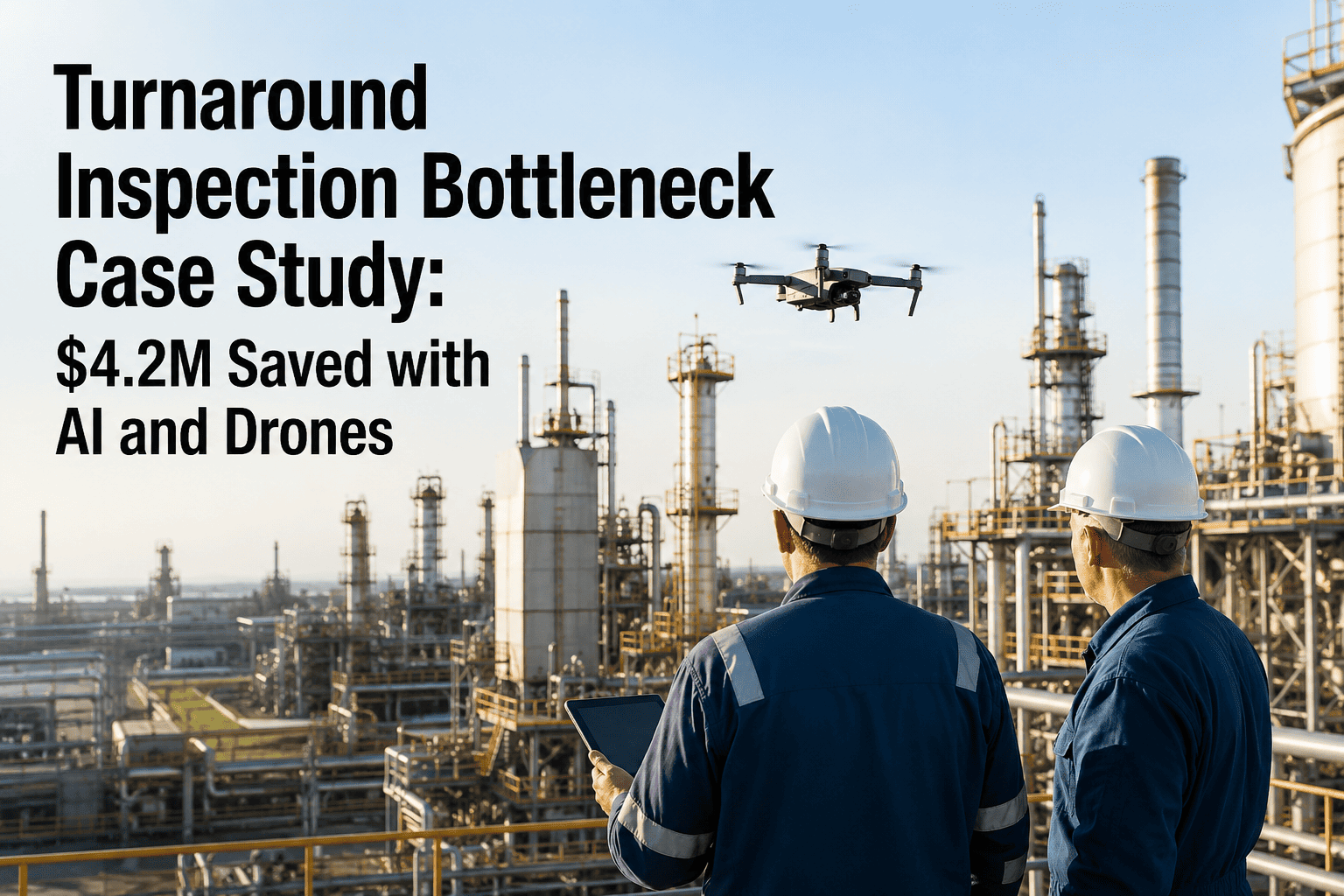
The autonomous flight system executes pre-planned survey missions against a facility digital twin — navigating the inspection route, managing obstacle avoidance, and adapting flight altitude and speed to maintain optimal sensor geometry for the current wind and atmospheric conditions. When a detection event occurs, the system autonomously repositions the drone for a close-approach confirmation pass before logging the finding and continuing the survey route. Mission data is automatically uploaded to the asset management platform on completion — including GPS-tagged detection locations, concentration logs, and OGI imagery — without manual data transfer or transcription.
AI Drone Gas Detection vs. Traditional LDAR Methods: A Direct Comparison
| Inspection Dimension | Traditional LDAR Walk-Down | Fixed Sensor Arrays | AI Drone Gas Detection |
|---|---|---|---|
| Coverage Per Mission | 1–3% of total asset area | Point coverage only at sensor locations | 100% of planned survey area |
| Elevation Access | Ground level only without scaffold | Fixed at installation height | Full 3D survey at any altitude |
| Detection Sensitivity | Requires close proximity (<1m) | Moderate at point location | Plume detection at 30m+ standoff |
| Concentration Quantification | Instrument-dependent, manual record | Continuous at fixed point | TDLAS ppm quantification per pass |
| Documentation | Manual transcription, variable quality | Automated but point-specific | Machine-generated, GPS-tagged, audit-ready |
| Inspection Frequency | Scheduled intervals (weekly/monthly) | Continuous at fixed points | Daily autonomous missions |
| Personnel Risk | Technicians in hazardous atmosphere | None (fixed installation) | Zero — fully remote operation |
Deploy AI Drone Gas Cloud Detection Across Your Oil & Gas Assets
iFactory AI's autonomous inspection platform integrates OGI, TDLAS, and real-time AI classification into a single managed gas detection system — delivering EPA-compliant LDAR documentation and zero-personnel hazardous atmosphere exposure from day one of deployment.
Operational Benefits Across Upstream, Midstream, and Downstream Applications
AI drone gas cloud detection delivers differentiated value at each segment of the oil and gas value chain, because the asset classes, regulatory frameworks, and operational constraints differ substantially between an upstream wellpad, a midstream compressor station, and a downstream refinery. iFactory AI's platform is configured to address each environment with inspection parameters, flight plan templates, and detection models tuned to the specific equipment and gas species present at each asset class.
Wellpad and Gathering System Methane Monitoring
Upstream wellpads span large surface areas with distributed equipment — wellheads, separator vessels, compressors, and flowlines — spread across terrain that makes walk-down inspection logistically intensive and weather-dependent. AI drone survey missions cover the full wellpad in a single flight, detecting methane at valve packing, separator dump valve, and compressor seal locations that manual inspectors reach only on quarterly LDAR schedules. For operators subject to EPA Subpart W methane quantification requirements, drone-generated concentration data satisfies reporting obligations without a separate ground measurement campaign.
Compressor Station and Pipeline Right-of-Way Survey
Midstream compressor stations combine high-pressure gas handling with rotating equipment — a combination that generates both fugitive emissions from sealing systems and potential release events from mechanical failure. AI drone missions provide weekly or daily survey coverage of the full station footprint, with OGI imaging capable of detecting compressor seal leaks at operating concentration levels far below those visible to fixed sensors. For pipeline right-of-way survey, Book a Demo to understand how BVLOS-capable drone operations extend survey coverage to remote pipeline segments without crew mobilization.
Refinery Fugitive Emission and Process Unit Monitoring
Downstream refineries operate thousands of LDAR-regulated components — flanges, valves, pump seals, compressor seals, pressure relief devices — across multiple process units at varying elevations. AI drone missions survey the full process unit area including elevated equipment that walk-down programs cannot access without scaffold mobilization, generating a spatial map of active emission sources that maintenance planners use to prioritize repair work orders by location, concentration, and proximity to ignition sources.
Expert Perspective: What AI Drone Gas Detection Changes About Facility Risk Management
Frequently Asked Questions: AI Drone Gas Cloud Detection in Oil & Gas
What gas species can AI-controlled drones detect in oil and gas environments?
OGI and TDLAS payloads detect methane, propane, butane, VOCs, H₂S, and other hydrocarbon species — with the specific detectable species determined by sensor wavelength selection and AI model calibration for each target compound.
Do AI drone gas detection records satisfy EPA LDAR and Subpart W documentation requirements?
Yes — iFactory's platform generates machine-recorded, GPS-tagged, timestamped detection logs with concentration data that satisfy EPA Method 21 alternative monitoring requirements and Subpart W quantification documentation standards.
Can drones detect gas clouds in ATEX-classified hazardous zones?
Drone platforms rated for ATEX Zone 2 and IECEx-certified configurations are available for operations in classified hazardous areas; Zone 1 operations require additional platform certification review against site-specific classification documentation.
How does the AI model reduce false positives from steam plumes and thermal gradients?
The iFactory AI model is trained on site-specific thermal signatures and calibrated during initial deployment to distinguish gas cloud spectral patterns from steam, heat shimmer, and ambient infrared sources common at refinery and upstream facilities.
What is the typical survey coverage rate for an AI drone gas detection mission?
A single drone mission covers a typical refinery process unit or upstream wellpad in 45 to 90 minutes — completing inspection that would require a manual walk-down team an entire shift, at full 100% component coverage rather than sample-based inspection.
AI Drone Gas Cloud Detection — Full Coverage, Real-Time Alerts, Audit-Ready Records
iFactory AI's gas detection platform deploys autonomous OGI and TDLAS drone missions across your upstream, midstream, or downstream assets — eliminating the coverage gaps, documentation risks, and personnel exposure of manual LDAR programs while satisfying EPA Subpart W, OSHA PSM, and ESG reporting requirements from a single integrated system.
Conclusion: From Scheduled Detection to Continuous Gas Cloud Intelligence
The transition from scheduled walk-down LDAR to AI drone gas cloud detection is not an incremental improvement to an existing inspection program — it is a structural change in what facility risk management can see and how fast it can respond. The coverage rate increases from single-digit percentages to 100% of the planned survey area. The detection latency drops from weeks to hours. The documentation quality moves from manual transcription to machine-generated audit records. And the personnel risk of conducting gas detection in active hazardous atmospheres is eliminated entirely.
The regulatory and ESG environment is moving in one direction — toward more frequent, more complete, and more defensibly documented gas emission monitoring across all facility types in U.S. oil and gas. The facilities that have deployed AI drone gas detection programs are already operating at the standard that regulations are approaching, rather than building toward it reactively. iFactory AI's platform is deployed across U.S. oil and gas assets today. Book a Demo to begin the infrastructure readiness assessment for your specific asset base — at no cost before any capital commitment is required.


-in-oil-&-gas-back-office.png)