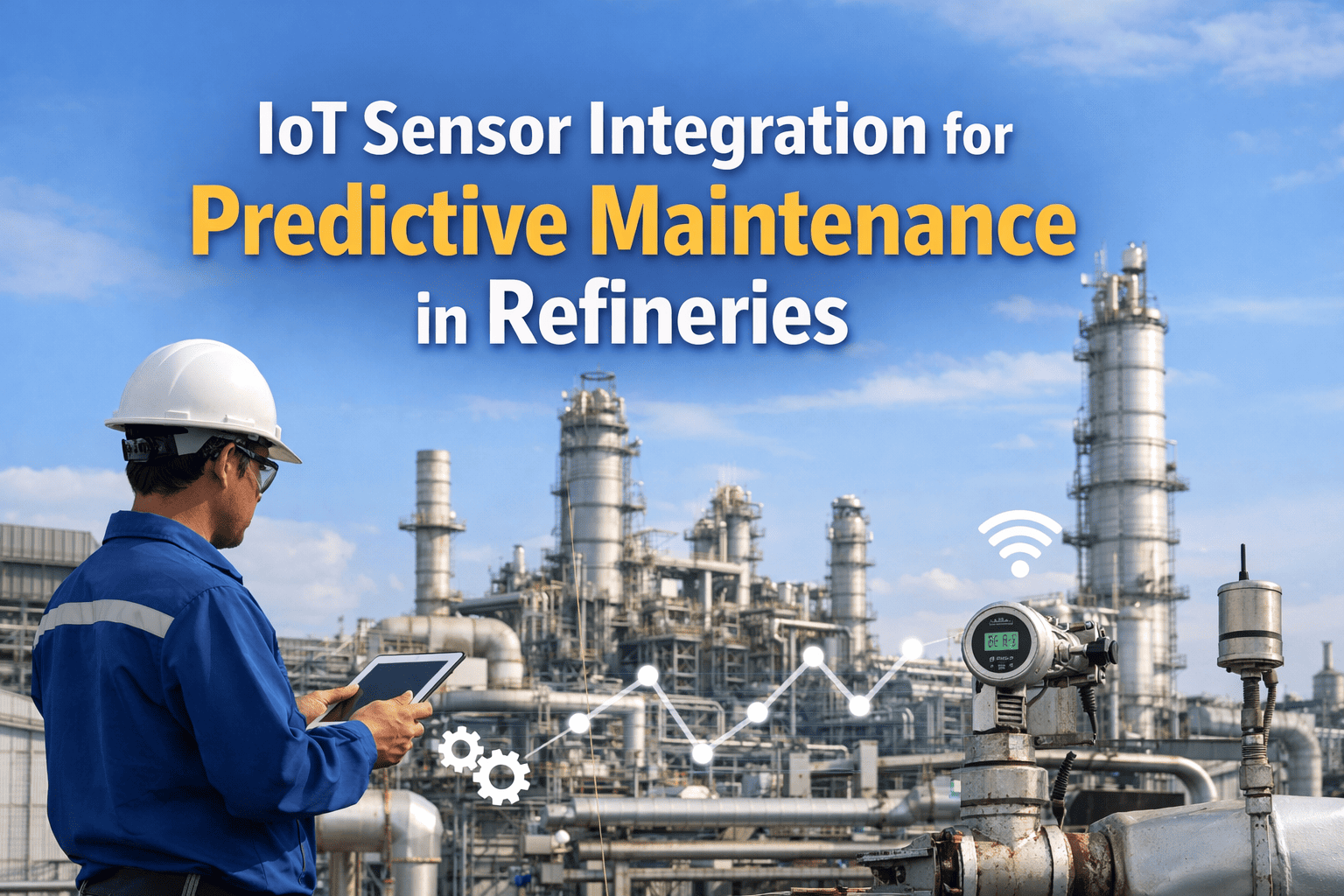
Every refinery and gas plant already has the data it needs sitting in SCADA tags, PLC registers, DCS archives, and a historian like PI System quietly compressing years of readings in the background. The problem was never a lack of data — it was that pressure readings live in one system, vibration lives in another, and maintenance records live in a CMMS that none of the others talk to. AI can only find a failure pattern across systems it can actually see. Bringing SCADA, PLC, DCS, and historian data into one connected layer is what turns that archive into a working prediction engine — talk to an integration expert about connecting yours.
OT Data Integration · SCADA & Historian AI
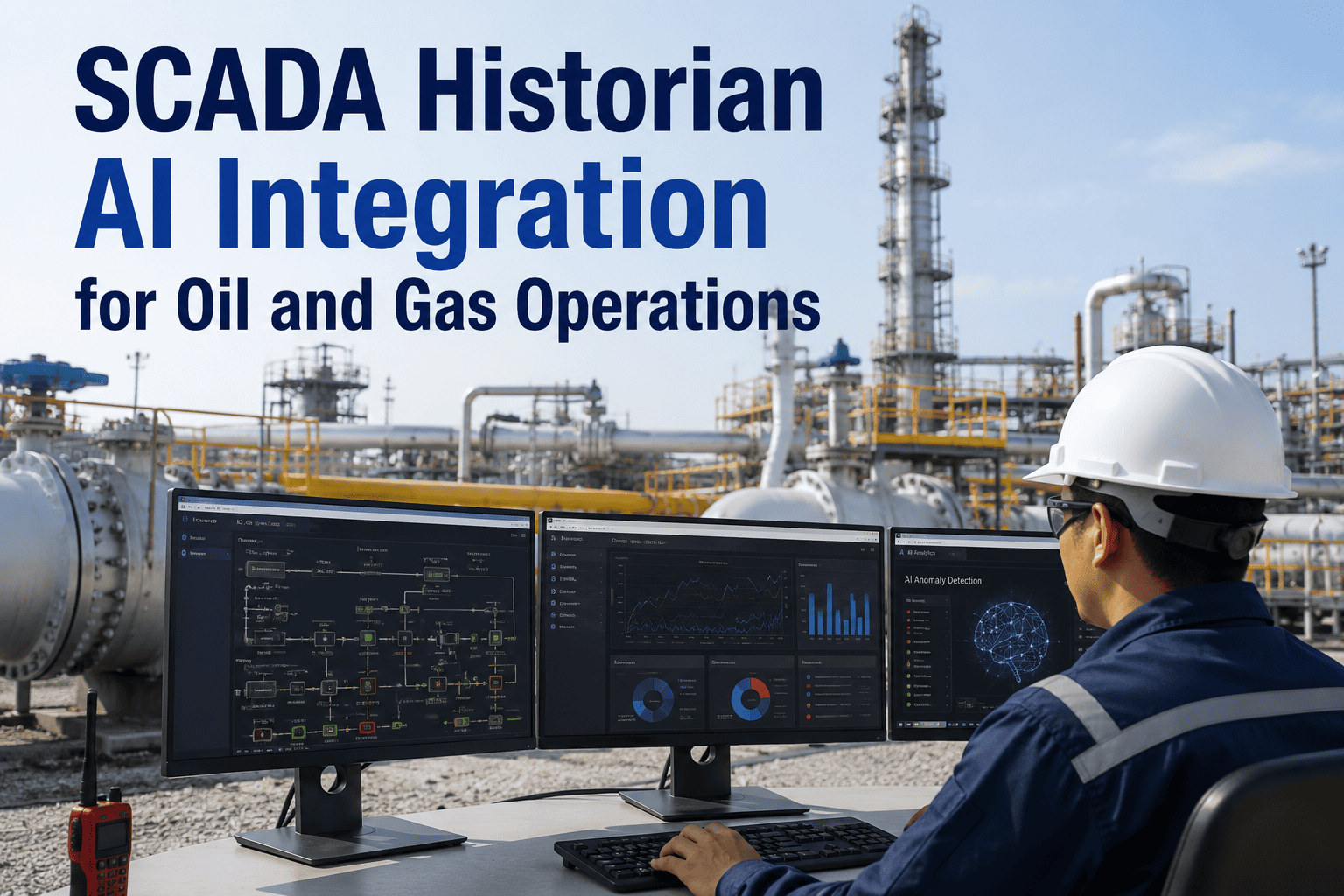
SCADA Historian AI Integration for Oil and Gas Operations
Connect SCADA, PLC, DCS, and historian archives into a single AI layer that turns disconnected time-series tags into predictive maintenance and production insight.
Four Systems, Four Different Languages
A typical refinery or gas plant runs SCADA for remote wells and pipelines, PLCs for local equipment control, a DCS for continuous process units, and a historian archiving all of it at high frequency. None of these were designed to explain a failure to each other.
SCADA
Remote well and pipeline monitoring, built for supervisory control across wide geography, not cross-system analysis.
PLC
Local equipment logic on pumps, compressors, and valves, generating raw signals with no historical context of their own.
DCS
Continuous process control across refinery units, holding real-time setpoints that rarely get compared against maintenance history.
Historian
Deep, compressed archives of every tag going back years — an enormous asset that most plants only query manually, after something already broke.
One Layer That Sits on Top of Everything You Already Run
Integration doesn't mean ripping out your historian or SCADA platform. It means adding an AI layer above them that reads every tag as one connected dataset instead of four separate ones.
AI Analytics & Alerting Layer
Unified Tag Model — Wells, Pumps, Compressors, Units
What Connected Data Actually Delivers
25%
Improvement in anomaly detection reported when historian data is paired with machine learning models
10%
Reduction in unplanned downtime documented in a large petrochemical case study using ML-enabled historian analytics
90%
Typical storage footprint reduction historians achieve through time-series compression, keeping years of data queryable
A historian full of data is not the same as a plant that acts on it. The value only shows up once SCADA, PLC, DCS, and historian tags are unified into one model an AI system can actually reason across.
What Gets Better Once the Data Is Connected
Cross-System Root Cause
A pump vibration spike in the PLC gets checked automatically against DCS process conditions and historian trend history before an alert ever reaches a technician.
Well and Pipeline Anomaly Detection
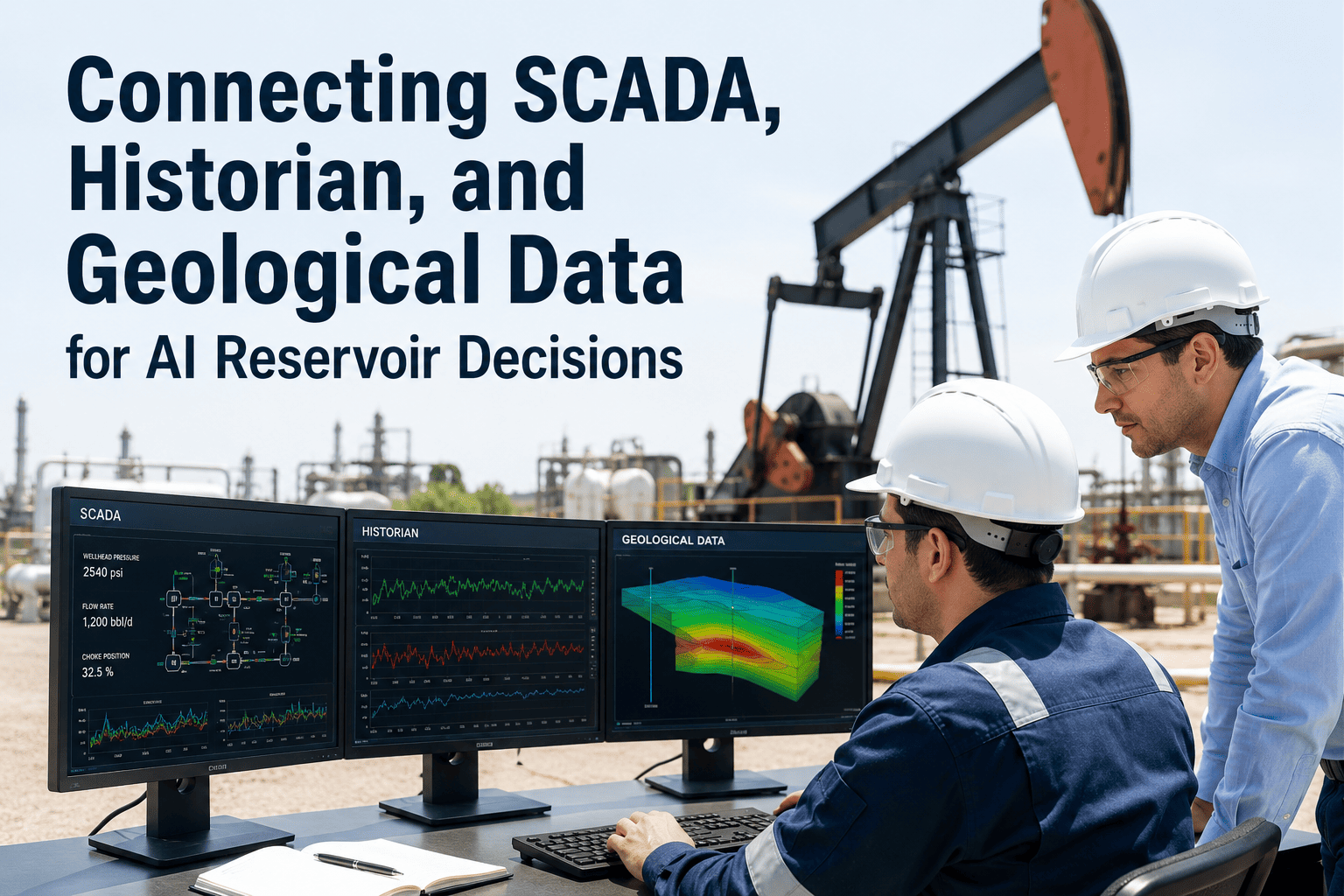
SCADA signals from remote wells are compared against historical baselines to catch subsurface blockages and pressure anomalies before they escalate into downtime.
Production Insight Across Units
Throughput, energy use, and quality data from every process unit roll up into one view instead of requiring a separate login and export for each system.
Faster Maintenance Decisions
Instead of a vibration analyst emailing a report to a planner who then opens a separate work order, the connected model routes the finding directly into a prioritized action.
Expert Insight
The most common integration mistake is treating this as a data migration project — move everything into one new database and call it done. That misses the point entirely. Your historian already holds years of valuable trend data; the job is building an AI layer that reads across your existing SCADA, PLC, and DCS tags without forcing a rip-and-replace. Sites that get this right start with one unit, prove the cross-system pattern detection works, then expand — not the other way around.
Renata Sousa — OT Data Architecture Consultant, 12+ years integrating historian and SCADA systems across refining and midstream sites
Siloed Systems vs. Unified AI Integration
| Capability |
Siloed SCADA/PLC/DCS/Historian |
Unified AI Integration |
Why It Matters |
| Root cause analysis |
Manually cross-referenced across systems, if at all |
Automatically correlated across every connected tag |
Failures get explained instead of just logged |
| Historian usage |
Queried manually after an incident |
Continuously scanned by AI models for developing patterns |
Years of archived data finally earns its keep |
| Maintenance workflow |
Findings emailed between separate tools |
Alerts route directly into a single prioritized action list |
Removes the manual handoff that delays repairs |
| Well and pipeline monitoring |
Reviewed within SCADA in isolation |
Compared against process and maintenance context together |
Anomalies get caught with fuller context, fewer false calls |
| Deployment effort |
New tools bolted on, adding another silo |
Layer added on top of existing SCADA, PLC, DCS, and historian |
No rip-and-replace of systems your teams already trust |
Frequently Asked Questions
Do we need to replace our existing historian or SCADA platform?
No. Integration is designed to sit on top of the SCADA, PLC, DCS, and historian systems you already operate, reading tag data through existing connectivity rather than requiring a platform swap. Most sites keep their current historian, such as a PI System, exactly as it is and add an AI layer above it.
Talk to an integration expert about your current OT stack.
How long does connecting these systems typically take?
Timelines depend heavily on how many tags and systems are involved, but most integrations start with a single unit or well cluster to validate cross-system pattern detection before expanding site-wide. This phased approach avoids the common trap of trying to connect everything at once and losing months to scope creep.
Contact support to scope a realistic first phase for your facility.
What happens to years of historical data already stored in our historian?
That archive is a major asset, not something to discard. Historians use compression techniques that preserve years of high-resolution readings in a manageable footprint, and integration is built to read directly from that archive so AI models can train on real historical failure patterns from day one.
Talk to an integration expert about how your existing archive gets put to work.
Can this work across remote wellheads as well as the main plant?
Yes. SCADA is typically the system covering remote wells and pipelines across wide geography, and its signals can be unified with plant-side PLC and DCS data in the same AI model. That means a pressure anomaly at a remote well can be checked against plant-side context automatically instead of being reviewed in isolation.
Contact support to discuss coverage across distributed assets.
Does unifying this data create new cybersecurity exposure?
Integration architecture matters here — a well-designed AI layer reads data through controlled, monitored connections rather than opening new direct paths into control systems. This is a deliberate design decision, not an afterthought, and should be part of any integration conversation from the start.
Talk to an integration expert about a security-conscious integration architecture.
Your Data Isn't Missing. It's Just Not Talking to Itself.
Connect SCADA, PLC, DCS, and historian tags into one AI layer and start finding the patterns that were always sitting in your own archives.