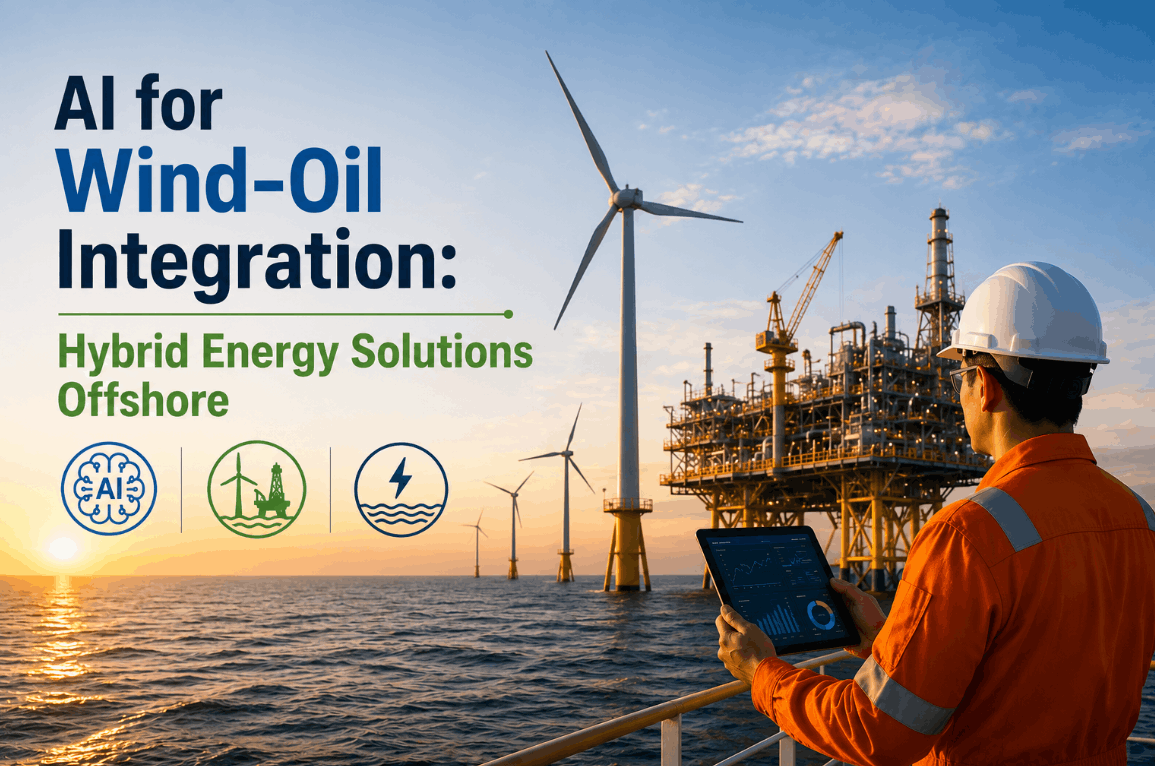
Offshore oil and gas platforms have powered the global economy for decades — but they have also been among the most carbon-intensive industrial facilities on earth, burning natural gas in turbines around the clock to sustain extraction, compression, and utility loads that can exceed 50 MW on a single complex. The intersection of rising carbon taxes, tightening emissions regulations, and rapidly maturing floating wind technology has created a structural inflection point for offshore operators: integrate renewable energy into the platform power supply now, or absorb compliance costs that will grow every year. AI wind oil hybrid offshore systems represent the most technically and commercially viable path to meaningful decarbonization on operating platforms — and AI is the operational intelligence layer that makes hybrid integration reliable, not just theoretically possible. This guide covers how AI-powered systems are transforming wind-oil integration across real offshore deployments, and how iFactory AI's platform gives operators the visibility and control to run hybrid energy systems at commercial performance standards.
Why Offshore Wind-Oil Integration Is Accelerating — and Why AI Is the Missing Link
The case for integrating wind power into offshore oil and gas platform operations has moved from theoretical to operational. Norway's Hywind Tampen project — an 88 MW floating wind farm supplying power to the Snorre and Gullfaks fields — is the most visible proof of concept, but it is not an isolated experiment. TotalEnergies has deployed a floating wind turbine at its Culzean platform in the UK North Sea, targeting a 20% reduction in platform power demand from renewable generation. Aker BP's Yggdrasil development is purpose-built for AI-managed electrification and hybrid operations from startup. The commercial logic is compelling: offshore gas turbines burning fuel gas to generate power represent both an operating cost and a direct emissions liability, with carbon taxes in Norway now exceeding €75 per tonne of CO₂ equivalents.
The engineering challenge, however, is significant. Wind is intermittent and variable. Platform power demand is continuous and non-negotiable — drilling loads, injection compressors, and living quarters cannot tolerate interruptions. The gap between what wind can deliver in any given hour and what the platform needs is filled by gas turbines, battery storage, or a combination of both. Coordinating those three sources in real time, across rapidly shifting weather conditions and production loads, is not a task that manual dispatch protocols can handle reliably. AI-driven energy management systems are what convert a hybrid installation from a demonstration project into a commercially reliable power supply. Book a Demo to see how iFactory AI manages hybrid offshore energy dispatch in real time.
- Gas turbines running at constant load regardless of available wind — maximum fuel burn, maximum emissions
- Wind curtailment during periods of low platform demand — renewable energy wasted rather than stored
- Battery cycling managed on fixed schedules, not optimized against wind forecast and demand patterns
- Hybrid system underperformance only identified after quarterly energy reviews, not in real time
- Carbon reporting based on estimated figures — not metered per-source actuals
- Gas turbine output dynamically adjusted every minute against real-time wind generation and storage state
- Excess wind routed to battery storage or green hydrogen production — zero curtailment at optimized storage sizing
- Battery charge-discharge cycles optimized against wind forecast, platform demand, and turbine maintenance schedule
- Hybrid system efficiency tracked at source level — deviations flagged before they affect platform power reliability
- Automated carbon intensity reporting per barrel produced — auditable, real-time, scope 1 compliant
How AI Manages the Hybrid Energy Dispatch Problem Offshore
The core operational challenge in any wind-oil hybrid system is dispatch: deciding, in real time, how much power each source should contribute at every moment. On a platform with 30 MW of gas turbine capacity, 15 MW of floating wind, and 8 MWh of battery storage, the number of possible dispatch combinations at any given moment is large — and the right answer changes continuously as wind speed fluctuates, platform loads shift between drilling phases, and battery state of charge evolves. AI energy management systems reduce this to a continuous optimization problem, solved in minutes or seconds rather than operator decisions made every hour.
Predictive Maintenance for Offshore Wind-Oil Hybrid Assets
In a conventional offshore platform, maintenance planning is straightforward in principle if not in practice: gas turbines and rotating equipment follow manufacturer-recommended intervals, and failures trigger emergency response. In a hybrid wind-oil system, the asset base expands significantly — floating wind turbines, battery storage systems, power conversion equipment, and subsea cable connections are added to the existing platform mechanical and electrical infrastructure. Each of these assets has its own failure modes, condition indicators, and maintenance requirements. Without AI-based condition monitoring, the maintenance burden of a hybrid system is significantly higher than the gas-turbine-only baseline — which erodes the economic case for integration. Book a Demo to see iFactory AI's predictive maintenance module for hybrid offshore assets.
| Hybrid Asset | iFactory Monitoring Parameters | Failure Mode Detected | Warning Lead Time | Avoided Cost / Event |
|---|---|---|---|---|
| Floating Wind Turbine Drivetrain | Vibration (main bearing, gearbox), nacelle motion, rotor imbalance index | Bearing spalling, gearbox wear, blade mass imbalance | 14–30 days | $800K–$2.1M |
| Battery Energy Storage System | Cell temperature, state-of-health, charge/discharge asymmetry, impedance rise | Thermal runaway precursor, cell degradation, BMS fault | 7–21 days | $250K–$600K |
| Offshore Gas Turbine (Hybrid Backup) | Exhaust temperature spread, combustion dynamics, compressor fouling index | Hot section degradation, compressor stall precursor, seal wear | 10–28 days | $400K–$1.3M |
| Dynamic Power Cable | Insulation resistance trend, partial discharge activity, connector temperature | Insulation degradation, fatigue cracking at touch-down zone | 5–15 days | $1.2M–$4.0M |
| Power Conversion & Inverter Systems | Harmonic distortion, thermal cycling index, switching loss trend | IGBT degradation, capacitor aging, cooling system fouling | 4–12 days | $90K–$280K |
| Mooring & Structural Monitoring (Floating Wind) | Mooring line tension asymmetry, platform tilt, fatigue accumulation model | Mooring line overload, anchor drag, structural fatigue exceedance | 3–10 days | $2.0M–$6.5M |
Green Hydrogen: The Next Layer of Offshore Wind-Oil Integration
For offshore operators targeting net-zero production targets, wind-powered green hydrogen production is the logical extension of hybrid energy systems — converting excess wind generation that would otherwise be curtailed into storable, exportable clean fuel. Research across multiple offshore platform configurations demonstrates that integrating wind turbines with alkaline water electrolysis and hydrogen storage creates a multi-energy system that can both power platform operations and produce exportable hydrogen, blended with natural gas for pipeline transport or shipped as compressed or liquefied hydrogen to onshore terminals. Book a Demo to explore how iFactory AI models hydrogen integration economics for your platform.
Digital Twin Integration: Simulating Hybrid System Performance Before Commitment
One of the most significant barriers to offshore wind-oil hybrid investment decisions is the uncertainty around actual performance in a specific operating environment. Floating wind resources vary substantially by field location, water depth, and prevailing weather patterns. Platform power demand profiles vary by production phase, drilling schedule, and seasonal load. The interaction between these variables and the proposed hybrid system configuration — turbine capacity, battery sizing, electrolyzer capacity if applicable — is too complex to evaluate reliably with spreadsheet models. Digital twins that simulate the hybrid system's full operating behavior across representative historical meteorological and operational data give engineering teams the performance confidence that unlocks capital approval.
Expert Perspective: What AI-Driven Hybrid Integration Actually Delivers
The assumption going into our hybrid integration project was that the main value would come from the fuel savings on our primary turbines. What we did not fully account for was the operational complexity of managing three power sources simultaneously — wind generation that changes every fifteen minutes, a battery that needed careful cycling to preserve its lifespan, and a gas turbine that has real startup and ramp constraints. Without the AI dispatch system, our operators would have been making continuous manual interventions, and the reality is that they would have defaulted to running the turbines at constant load rather than chasing the wind curve. The AI removed that cognitive burden entirely. We hit 94% of our projected fuel reduction in year one, our battery is cycling within its designed parameters for optimal longevity, and we have not had a single reliability event attributable to the hybrid system. The carbon reporting is automatic, the regulator submissions are clean, and our per-barrel emissions intensity is down 19% on the baseline. That combination — reliability, savings, and compliance — is what made the business case real.
Frequently Asked Questions: AI Wind-Oil Hybrid Offshore
iFactory connects to existing platform historians (OSIsoft PI, Siemens, ABB), SCADA systems, and metocean data feeds — no new sensors required in most installations. Integration is typically completed within 2 to 4 weeks without production disruption.
The AI dispatch model maintains a forward wind forecast horizon and pre-positions gas turbine spinning reserve and battery state-of-charge to guarantee platform power continuity through predicted low-wind periods — platform reliability is never compromised for renewable optimization.
Yes — iFactory's multi-energy dispatch model includes electrolyzer control, hydrogen storage management, and pipeline blending rate optimization as native modules, with hydrogen economics tracked alongside power generation costs in a unified dashboard.
iFactory generates per-source, per-interval carbon accounting with audit-ready output aligned to Scope 1 GHG reporting standards — exportable in formats accepted by NOGEPA, OGA, and other offshore regulatory bodies.
For platforms achieving 15–20% fuel displacement through hybrid wind integration, iFactory's AI management layer typically recovers its full cost within 6 to 12 months from improved dispatch efficiency, reduced maintenance costs, and avoided carbon tax exposure.
Conclusion: AI Is What Makes Offshore Hybrid Energy Systems Commercially Reliable
The offshore wind-oil integration opportunity is real, technically proven, and accelerating. Hywind Tampen, TotalEnergies Culzean, and the wave of hybrid projects entering engineering development across the North Sea, Gulf of Mexico, and Asia-Pacific demonstrate that floating wind can deliver meaningful, measurable decarbonization at operating platforms today. The constraint on scaling these deployments is not wind resource availability or turbine technology maturity — it is operational confidence. Operators need to know that a hybrid system will maintain platform power reliability through the full range of offshore weather conditions, production phases, and equipment states they will encounter over a 20-year project life.
AI-powered energy management is what converts that operational confidence from an aspiration into a demonstrated outcome. By integrating wind forecast data, real-time platform demand, battery state, and turbine condition into a continuously optimized dispatch model, iFactory AI closes the gap between a hybrid installation's theoretical performance and its actual day-to-day delivery. The result is a platform that runs cleaner, spends less on fuel, reduces its regulatory emissions liability, and provides the automated carbon reporting that capital markets, regulators, and corporate sustainability frameworks increasingly require — without adding operational complexity for the teams running the platform. The data infrastructure for this capability already exists on most modern offshore platforms. The AI management layer is what puts it to work.
-ai-s-critical-role.png)