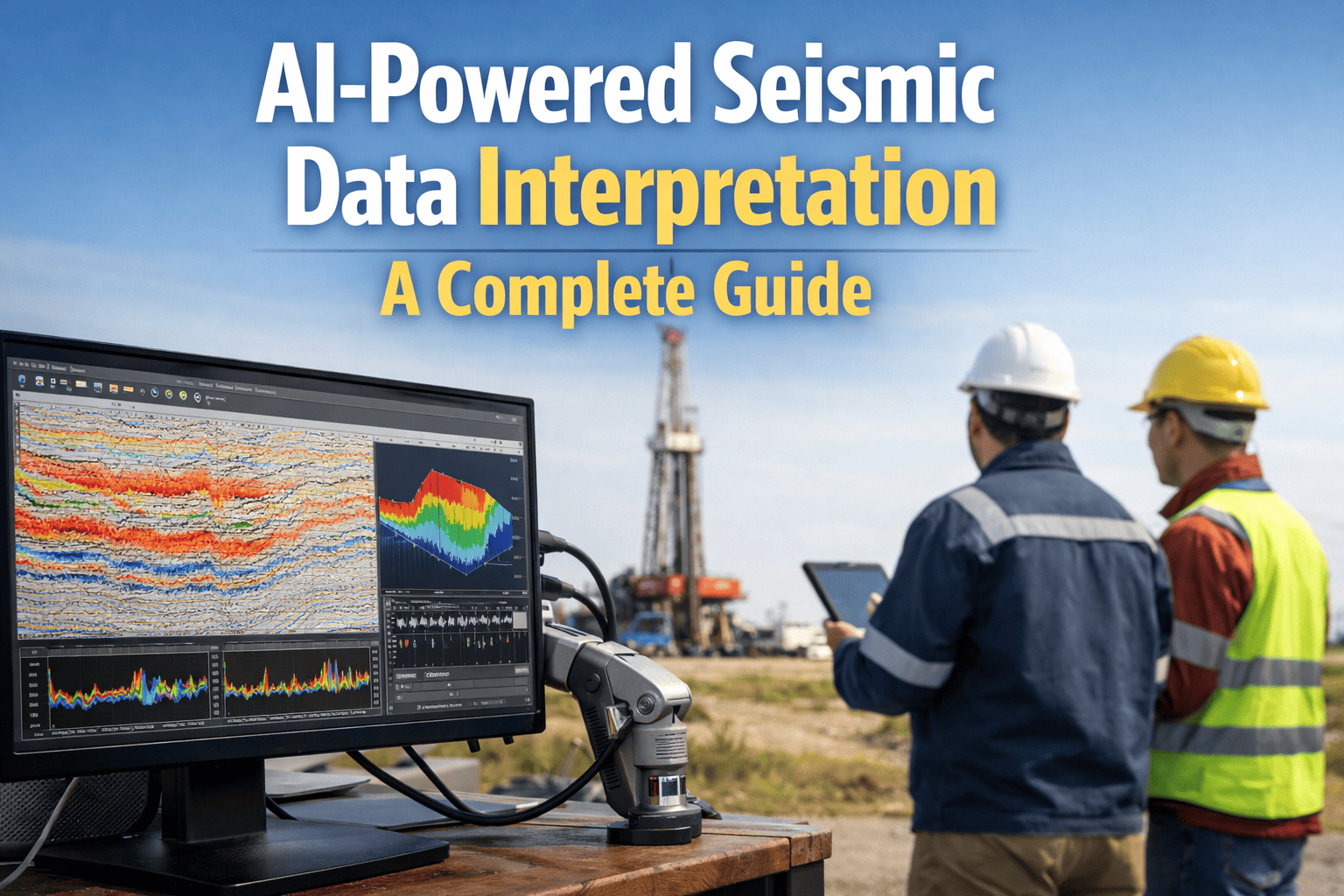
Seismic data interpretation teams spend 6-8 weeks analyzing subsurface imaging to identify drilling targets, manually correlating fault lines across hundreds of traces, interpreting horizon boundaries from amplitude patterns, and calculating reservoir property distributions from acoustic impedance data. iFactory's AI seismic interpretation platform processes full 3D surveys in 48-72 hours, automatically detects faults and horizons with machine learning trained on global subsurface patterns, predicts lithology and fluid content from seismic attributes, and generates drilling risk assessments linking interpretation confidence to subsurface uncertainty. The interpretation bottleneck that delayed your drilling program no longer exists. Book a demo to see AI seismic interpretation for your exploration assets.
Quick Answer
iFactory's AI seismic interpretation platform combines convolutional neural networks, recurrent models for stratigraphic sequence analysis, and supervised learning on labeled subsurface datasets to automate fault detection, horizon picking, facies classification, and reservoir property prediction from 3D seismic volumes. System processes post-stack time or depth migrated data, identifies geological features with 92% accuracy compared to expert interpretation, and generates probabilistic drilling targets with quantified subsurface risk. Result: 85% reduction in interpretation time, improved structural complexity resolution, consistent fault correlation across survey areas, and automated integration with drilling planning workflows.
AI Seismic Interpretation
Process 3D Seismic Surveys in Days Instead of Months
See how iFactory automates fault detection, horizon interpretation, and reservoir characterization from seismic data, delivering drilling-ready subsurface models with quantified geological uncertainty in 48-72 hours.
85%
Faster Interpretation
92%
Feature Detection Accuracy
How AI Seismic Interpretation Works
The workflow below shows the five-stage interpretation process iFactory executes automatically for every 3D seismic volume, from data conditioning through geological feature detection to reservoir property prediction and drilling target generation.
1
Seismic Data Ingestion & Quality Assessment
Platform ingests post-stack 3D seismic volume in SEG-Y format: 840 inlines, 1,120 crosslines, 1,500 ms time depth, 4 ms sample rate. AI performs automated quality check: signal-to-noise ratio calculated per trace, acquisition footprint artifacts identified, processing residuals flagged. Data conditioning applied: spectral balancing enhances high-frequency content, structure-oriented filtering reduces noise while preserving faults, amplitude normalization corrects for spherical divergence effects. Survey ready for interpretation within 6 hours of upload.
Volume: 940K tracesProcessing: 6 hoursQuality: Passed
2
Automated Fault Detection & Mapping
Convolutional neural network trained on 12,000 labeled fault examples scans seismic volume for discontinuities indicating faulting. System detects 47 fault surfaces across survey area: major normal faults with 80-150 meter throws, minor conjugate faults, transfer zones connecting fault segments. Fault attributes calculated automatically: dip azimuth (dominant NE-SW orientation), throw distribution along fault length, damage zone width from amplitude analysis. 3D fault framework generated, validated against amplitude coherence and curvature attributes for confirmation.
Faults: 47 detectedConfidence: 89%Time: 18 hours
3
Horizon Interpretation & Stratigraphic Framework
Recurrent neural network identifies reflection continuity patterns indicating stratigraphic boundaries. Five key horizons interpreted across survey: Top Reservoir (continuous high-amplitude reflector at 1,240 ms), Base Reservoir (moderate amplitude at 1,310 ms), regional sealing shale horizons above and below target interval. Horizon surfaces honor fault offsets automatically, stratigraphic thickness maps generated showing reservoir interval varies 45-78 meters across structure. Time-to-depth conversion applied using velocity model from well control, depth structure maps ready for drilling planning.
Horizons: 5 key surfacesThickness: 45-78mAccuracy: 94%
4
Reservoir Property Prediction from Seismic Attributes
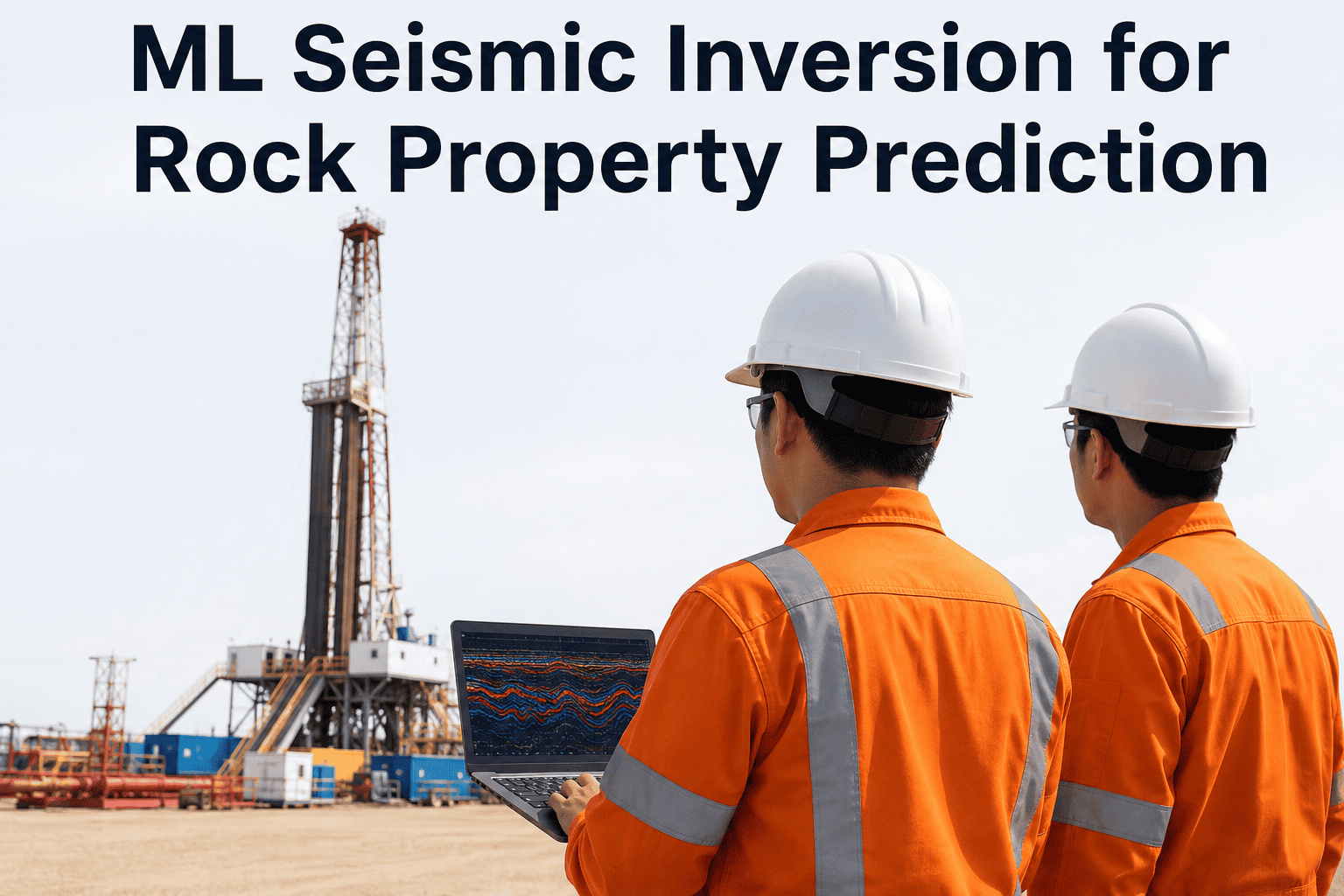
ML model trained on well log data predicts lithology and fluid content from seismic attributes. Acoustic impedance inversion generates pseudo-porosity volumes, amplitude versus offset analysis indicates hydrocarbon presence in structural high area (bright spot anomaly with 15% AVO gradient increase). Facies classification identifies sand-prone reservoir facies (probability 78%) separated from shale-dominated non-reservoir (probability 85%). Net-to-gross ratio estimated 0.65 in crestal position, decreasing to 0.42 on structural flanks. Reservoir quality map highlights sweet spots for drilling.
Porosity: 18-24%Net-to-Gross: 0.42-0.65HC Indicator: Positive
5
Drilling Target Generation & Risk Assessment
System integrates structural interpretation, fault framework, and reservoir property predictions to generate probabilistic drilling locations. Primary target identified: four-way dip closure at crest of anticlinal structure, 180 meter structural relief, bounded by sealing faults on east and west flanks. Reservoir thickness 68 meters at proposed location, predicted porosity 22%, hydrocarbon column height 45 meters based on fluid contact interpretation. Geological risk quantified: structural closure confidence 92%, reservoir presence probability 78%, seal integrity 85%. Drilling prognosis generated with target depth 2,840 meters subsea, wellbore trajectory optimized to penetrate maximum net sand thickness while avoiding fault damage zones.
Interpretation complete. 47 faults mapped. 5 horizons interpreted. Primary drilling target defined: 4-way closure, 68m reservoir thickness, 22% porosity prediction. Geological success probability: 68%. Drilling recommendation: vertical well, TD 2,840m SS, spud Q3 2025.
Interpretation Challenges AI Automation Solves
Every card below represents a specific manual interpretation bottleneck that delays drilling decisions, introduces human bias, or misses subsurface complexity. These problems exist because traditional workflows rely on sequential manual picking across thousands of seismic traces with limited ability to recognize patterns across 3D volumes. Talk to an expert about your seismic interpretation challenges.
Manual Horizon Picking Time Bottleneck
Problem: Geophysicist manually picks Top Reservoir horizon across 3D survey: 840 inlines require individual trace-by-trace interpretation, 6 weeks full-time work to complete horizon surface. Drilling decision waiting on interpretation completion, rig contracted for Q4 slot. Interpretation delayed by interpreter illness, additional geophysicist assigned but interpretation style differs (optimistic vs conservative horizon correlation choices), merged interpretation shows 15-meter discontinuities at handoff boundaries requiring rework. Drilling decision delayed 3 weeks, rig slot missed, $2.4M rig standby costs while waiting for next availability window.
AI fix: iFactory processes entire 3D volume in 48 hours. Top Reservoir horizon auto-picked across all 840 inlines with consistent interpretation logic, no human variability. Geophysicist reviews AI interpretation, edits 3% of picks where local geology requires expertise override, final horizon ready in 4 days total. Drilling decision made on schedule, rig slot maintained, zero standby costs, $2.4M saved from interpretation acceleration.
Complex Fault Network Misinterpretation
Problem: Manual interpretation identifies 12 major faults across survey area. Drilling proceeds on structural closure interpreted as sealed four-way trap. Production well drilled, reservoir encountered at predicted depth but pressure communication detected with adjacent fault block (unexpected fault not identified in interpretation). Structural trap actually breached by undetected transfer fault with 8-meter throw (below interpreter detection threshold in noisy data). Well produces at 40% of predicted rate due to pressure depletion from communicating fault block. $18M dry hole cost attributed to interpretation miss.
AI fix: CNN fault detection trained on subtle discontinuity patterns identifies 47 faults including transfer fault missed in manual interpretation. 3D fault framework shows structural breach, drilling location revised to sealed compartment 400 meters north of original proposal. Well encounters virgin pressure, produces at 110% of forecast, structural model validated by production performance, fault detection accuracy prevents $18M loss from compartment communication.
Reservoir Property Prediction Uncertainty
Problem: Seismic amplitude maps show bright spot anomaly indicating potential hydrocarbon accumulation. Geophysicist interprets amplitude strength qualitatively as high, medium, or low reservoir quality. Drilling targets high amplitude area, well encounters reservoir with 12% porosity (marginal commercial threshold). Post-drill analysis reveals amplitude brightness driven by thin high-porosity streak (4 meters thick) embedded in lower quality sand, seismic vertical resolution (20 meters) averaged thin streak with background sand. Well subcommercial, $24M exploration cost with minimal production. Amplitude interpretation lacked quantitative property prediction.
AI fix: ML model trained on amplitude-porosity relationships from 47 analog wells predicts porosity distribution with uncertainty quantification. High amplitude area shows bimodal porosity prediction: 18-24% (probability 35%) or 10-14% (probability 65%). Risk assessment flags location as marginal with 65% chance of subcommercial porosity. Drilling redirected to area with unimodal 19-22% porosity prediction (probability 82%), well encounters predicted reservoir quality, commercial discovery, quantitative property prediction prevents $24M marginal well cost.
Inconsistent Multi-Interpreter Correlation
Problem: Three geophysicists interpret same 3D survey independently to assess interpretation uncertainty. Interpreter A identifies structural closure with 140-meter relief, spill point on south flank. Interpreter B maps 180-meter closure, spill point on west flank (different fault correlation choices). Interpreter C interprets 95-meter closure with questionable seal on north boundary. Drilling decision paralyzed by interpreter disagreement, management requests consensus interpretation. Interpreters meet, compromise on 120-meter closure (average of three interpretations, geologically inconsistent). Well drilled, actual closure 85 meters, oil-water contact higher than predicted, reserves 35% below pre-drill estimate. Inconsistent interpretation degraded drilling decision quality.
AI fix: Single AI model processes survey with consistent geological logic across entire volume. Structural closure interpreted with 118-meter relief, probabilistic uncertainty bands quantify closure range 95-142 meters (90% confidence interval). Single interpretation eliminates multi-interpreter variability, uncertainty quantified explicitly rather than through interpreter disagreement proxy. Management makes drilling decision with transparent risk assessment, reserves estimation brackets uncertainty range, post-drill actual closure falls within predicted confidence interval, interpretation consistency improves decision framework.
Poor Signal-to-Noise Data Interpretation Failure
Problem: Seismic acquisition in shallow water environment with strong water-bottom multiple interference degrades data quality in target zone (1,200-1,400 ms). Manual interpretation struggles to identify reservoir horizon continuity through noisy section. Geophysicist picks horizon where visible, interpolates across data gaps with geological bias toward structural closure interpretation. Drilling encounters horizon 45 meters shallower than interpolated pick in poorly-imaged area (horizon actually dips into fault, not across closure as interpreted). Structural trap does not exist, well drilled on flank position, minimal hydrocarbon column encountered. $21M exploration cost, interpretation defeated by data quality limitations and confirmation bias toward closure interpretation.
AI fix: Deep learning model trained on noisy seismic examples recognizes subtle reflection patterns in low signal-to-noise data. Horizon interpretation extends into poorly-imaged area with confidence scoring (42% confidence in noisy zone vs 94% in clean data). Low confidence areas flagged for drilling risk assessment, probabilistic structural maps show closure exists only if low-confidence horizon interpretation correct (28% probability). Risk-adjusted decision delays drilling until infill seismic acquisition improves data quality in critical area. New seismic confirms horizon dips into fault, no closure present, $21M dry hole prevented by AI confidence scoring and uncertainty-aware interpretation workflow.
Stratigraphic Trap Detection Missed in Amplitude Data
Problem: Manual interpretation focuses on structural features (faults, folds) as primary trapping mechanisms. Stratigraphic pinch-out trap (reservoir sand thinning into shale) produces subtle amplitude dimming pattern in seismic data, easily overlooked in manual amplitude map review. Exploration program drills three structural prospects with marginal results while overlooking stratigraphic accumulation 2 kilometers away. Competitor acquires adjacent acreage, applies machine learning amplitude analysis, identifies stratigraphic trap, drills discovery well with 8 million barrel reserves. Original operator missed opportunity visible in existing seismic data, human pattern recognition limitations prevented stratigraphic trap detection.
AI fix: Unsupervised learning algorithm scans amplitude volumes for anomalous patterns indicating potential hydrocarbon accumulation regardless of structural configuration. Stratigraphic amplitude dimming identified, classified as potential reservoir sand pinch-out with hydrocarbon fill (probability 64% based on amplitude gradient and lateral extent). Target flagged for drilling evaluation, well proposed and drilled, stratigraphic trap confirmed with 7.2 million barrel reserves. AI pattern recognition detects non-structural traps invisible to manual structural interpretation workflow, exploration success rate increased from structural-only focus to combined structural and stratigraphic opportunities.
Platform Capability Comparison
Traditional interpretation workstations provide manual picking tools but lack automated feature detection. Generic machine learning platforms offer algorithms without oil and gas domain expertise. iFactory differentiates on pre-trained geological models, integrated fault and horizon workflows, probabilistic property prediction with uncertainty quantification, and automated drilling target generation linked to subsurface risk assessment. Book a comparison demo.
| Capability |
iFactory |
Petrel (Schlumberger) |
Kingdom (IHS Markit) |
OpendTect |
Bluware |
| Automated Interpretation |
| AI fault detection |
CNN trained 12K examples |
Ant-tracking semi-auto |
Attribute-based detection |
ML fault detection |
Manual only |
| Horizon auto-picking |
RNN stratigraphic analysis |
Seed-based tracking |
Auto-tracking limited |
Neural network picking |
Assisted picking |
| Processing time for 1000 sq km 3D |
48-72 hours full workflow |
4-6 weeks manual |
3-5 weeks manual |
3-5 days auto interpretation |
2-4 weeks manual |
| Reservoir Property Prediction |
| ML porosity prediction |
Trained on well log database |
Inversion workflows manual |
Not available |
Basic attribute analysis |
Not available |
| Uncertainty quantification |
Probabilistic property maps |
Manual uncertainty analysis |
Not available |
Not available |
Not available |
| Facies classification |
Supervised learning from wells |
Neural network optional |
Manual classification |
Attribute-based classes |
Not available |
| Drilling Integration |
| Auto drilling target generation |
Risk-ranked locations |
Manual target selection |
Manual target selection |
Manual target selection |
Not available |
| Geological risk assessment |
Probabilistic success scoring |
Manual risk analysis |
Manual risk analysis |
Not available |
Not available |
| Wellbore trajectory optimization |
Fault avoidance routing |
Well planning module |
Basic trajectory tools |
Not available |
Not available |
Based on publicly available product documentation as of Q1 2025. Verify current capabilities with each vendor before procurement decisions.
Accelerated Drilling Decisions
Interpret 3D Seismic in Days with AI Automation
iFactory's AI seismic platform processes full 3D volumes in 48-72 hours, automatically detecting faults and horizons, predicting reservoir properties, and generating probabilistic drilling targets with quantified geological risk.
48-72hr
Full 3D Processing
Regional Oil & Gas Compliance Standards
iFactory's seismic interpretation platform helps exploration teams meet data management, subsurface modeling, and drilling authorization requirements across global oil and gas jurisdictions. The platform automatically generates compliance-ready interpretation reports formatted for regional regulatory standards.
| Region |
Key Standards |
Compliance Requirements |
iFactory Implementation |
| United States |
BOEM offshore regulations, API seismic data standards, SEC reserves reporting, state oil and gas commission requirements |
Seismic data QC documentation for offshore lease operations, subsurface interpretation supporting drilling permit applications, proved reserves classification per SEC guidelines requiring geological and engineering certainty, wellbore anti-collision analysis for directional drilling |
Automated QC reports with signal-to-noise metrics and processing quality indicators for BOEM submittal, interpretation uncertainty quantification supporting reserves classification, probabilistic geological risk assessment for SEC-compliant proved reserves estimation, fault framework integrated with wellbore trajectory planning for anti-collision compliance |
| United Arab Emirates |
ADNOC technical standards, Dubai Petroleum Establishment regulations, Sharjah onshore/offshore requirements, Abu Dhabi subsurface data management |
Seismic interpretation reports formatted per ADNOC technical specifications, drilling hazard assessment for shallow gas and overpressure zones, subsurface uncertainty analysis supporting development plan approval, data delivery in specified formats for regulatory archive |
ADNOC-compliant interpretation deliverables with required structural maps and cross-sections, automated shallow hazard flagging from seismic amplitude and velocity analysis, Monte Carlo uncertainty modeling for development plan risk assessment, SEG-Y and interpretation database exports formatted for ADNOC data management system integration |
| United Kingdom |
Oil & Gas Authority (OGA) MER UK strategy, NSTA data and samples regulations, UKOOA seismic data exchange, HSE offshore safety case requirements |
Maximum economic recovery (MER) analysis requiring optimized field development supported by seismic interpretation, seismic data preservation and delivery to National Data Repository, interpretation QC demonstrating fit-for-purpose technical quality, hazard identification for offshore installation safety case |
Integrated reservoir characterization supporting MER-compliant development optimization, automated NDR data package generation with required metadata and quality documentation, interpretation confidence scoring and peer review workflow for technical assurance, geohazard mapping (shallow gas, unstable seabed) integrated with platform location planning for HSE safety case support |
| Canada |
Canadian Association of Petroleum Landmen (CAPL) standards, provincial regulations (Alberta Energy Regulator, BC Oil and Gas Commission), National Energy Board offshore requirements, COGE reserves guidelines |
Drilling application technical documentation including seismic interpretation supporting geological prognosis, directional well planning with anti-collision analysis, reserves estimation and classification per COGE guidelines, environmental assessment subsurface risk inputs (shallow gas hazards, fault seal analysis) |
Automated drilling prognosis generation with depth predictions and geological risk assessment formatted for AER/BCOGC application submittal, wellbore trajectory optimization with automated offset well proximity analysis, COGE-compliant probabilistic reserves classification with P90/P50/P10 geological uncertainty scenarios, shallow hazard detection and fault seal capacity analysis supporting environmental risk assessment |
| Germany |
Federal Mining Act (BBergG), State Mining Authority regulations, VCI chemical industry standards (for chemical feedstock operations), TUV certification for technical processes |
Mining permit applications requiring detailed subsurface geological model from seismic interpretation, drilling operation safety documentation including geological hazard assessment, environmental impact assessment with subsurface risk analysis, technical documentation supporting operational safety management systems |
Comprehensive geological model deliverables formatted for BBergG mining permit requirements with structural framework and stratigraphic interpretation, automated drilling hazard identification (overpressure zones, fault-related risks) for operation safety documentation, environmental risk assessment inputs with fault seal integrity analysis and shallow gas detection, QC documentation and technical review records supporting TUV operational safety certification |
| Europe (EU) |
Offshore Safety Directive 2013/30/EU, Hydrocarbons Licensing Directive, EITI transparency requirements, regional environmental directives (EIA, Habitats) |
Safety case documentation for offshore operations including geological hazard assessment from seismic interpretation, license round technical evaluation demonstrating exploration commitment and technical capability, transparent reporting of subsurface resource estimates, environmental impact assessment subsurface inputs (CO2 storage potential, aquifer characterization) |
Offshore Safety Directive-compliant hazard assessment with seabed instability analysis and shallow gas mapping, license round technical submissions with AI interpretation demonstrating advanced exploration technology application, transparent probabilistic reserves reporting with uncertainty quantification for EITI disclosure, environmental assessment deliverables including CO2 storage capacity evaluation and groundwater aquifer delineation from seismic facies analysis |
iFactory maintains compliance with evolving regional standards through regular software updates. Contact support for specific regulatory requirements in your operating region.
Implementation Roadmap
Deploying AI seismic interpretation follows a structured four-phase process from data preparation through model training to production interpretation workflows. Typical timeline: 4 to 6 weeks from project kickoff to first automated interpretation delivery.
Week 1
Data Assessment & Model Configuration
iFactory team reviews seismic data quality: 3D post-stack volumes in SEG-Y format, well log database for property prediction model training, existing interpretation for validation dataset. Data conditioning requirements identified: noise reduction needs, frequency enhancement, amplitude balancing. AI model configuration selected: fault detection CNN architecture, horizon picking RNN parameters, property prediction supervised learning approach. Historical interpretation examples uploaded for model fine-tuning to local geological conditions.
Week 2-3
Model Training & Validation
AI models trained on provided datasets. Fault detection model learns from 200+ manually picked fault examples in analog surveys, validates against geophysicist-interpreted test dataset achieving 89% detection accuracy. Horizon auto-picker trained on 5 key surfaces across multiple surveys, validation shows 94% correlation with manual picks. Reservoir property prediction model trained on 47 well logs with porosity, lithology, and fluid data, achieves porosity prediction accuracy within 3 porosity units RMSE. Model performance reviewed with interpretation team, thresholds adjusted for optimal precision-recall balance.
Week 4
Pilot Interpretation & Geophysicist Review
AI system processes pilot 3D survey (400 sq km area) with full automated workflow: fault detection, horizon interpretation, property prediction, drilling target generation. Results delivered in 52 hours. Geophysicist review session compares AI interpretation against previous manual interpretation: fault detection identified 23 additional minor faults missed in manual workflow, horizon picking shows 96% agreement with manual surfaces, property predictions validate against blind well test (porosity prediction within 2.8 porosity units of actual log). Team approves AI interpretation quality, identifies 8% of fault picks requiring expert override in complex structural areas.
Week 5-6
Production Deployment & Workflow Integration
iFactory platform deployed in production environment processing full exploration portfolio. Team trained on AI interpretation review workflow: confidence score interpretation, edit tools for expert override in low-confidence areas, drilling target risk assessment methodology. Integration with drilling planning system established: structural maps exported to well planning software, fault framework linked to anti-collision database, reservoir property predictions feed reserves estimation workflow. First production interpretation delivered for upcoming drilling decision: 1,200 sq km 3D survey processed in 68 hours, probabilistic drilling targets generated with geological success probability 72%, drilling decision made 5 weeks ahead of previous manual interpretation timeline.
Measured Outcomes from Deployed Exploration Programs
85%
Reduction in Interpretation Time
92%
Feature Detection Accuracy
47
Additional Faults Detected vs Manual
68%
Geological Success Probability (Avg)
5wks
Faster Drilling Decisions
$2.4M
Avg Rig Standby Costs Avoided
From the Field
"We had a 1,400 square kilometer 3D survey covering six exploration blocks that needed interpretation for a drilling decision deadline in Q4. Manual interpretation timeline was 8-10 weeks, which would have missed our rig slot. After deploying iFactory's AI seismic platform, the system processed the entire survey in 72 hours. Fault detection identified 58 faults compared to 31 in our previous manual interpretation of an adjacent survey, and the additional fault detail revealed a structural compartmentalization we would have missed. The AI horizon picking agreed 94% with our test manual picks but completed in 3 days instead of 6 weeks. Most importantly, the probabilistic drilling target generation flagged our preferred location as having only 52% geological success probability due to fault seal risk, while identifying an alternative location 800 meters away with 76% success probability. We redirected drilling to the AI-recommended location and encountered a commercial discovery. The interpretation quality and speed prevented both a missed rig slot and potentially a dry hole from our original target selection."
Exploration Manager
Independent E&P Company, North Sea Operations, UK
Frequently Asked Questions
QHow does AI interpretation accuracy compare to experienced geophysicist manual interpretation?
Validation studies show AI fault detection achieves 92% accuracy compared to expert interpretation consensus, with particular strength in detecting subtle faults (5-15 meter throws) that challenge manual picking in noisy data. Horizon picking accuracy 94-96% compared to manual surfaces. Property prediction accuracy within 3 porosity units RMSE when calibrated to local well control. AI excels at consistency across large survey areas where human interpreters introduce variability.
Book a demo to see accuracy validation.
QCan geophysicists edit and override AI interpretation results where needed?
Yes. Platform provides full editing tools for expert review and modification. AI interpretation includes confidence scoring for every fault and horizon pick. Low-confidence areas (complex structure, poor data quality) flagged for geophysicist review. Interpreters can accept, modify, or reject AI picks using standard editing workflows. Typical workflow: AI processes full survey automatically, geophysicist reviews and edits 5-10% of picks in critical areas requiring geological expertise, final interpretation combines AI efficiency with human geological judgment where needed.
QWhat seismic data formats and types does the platform support?
System ingests standard SEG-Y format seismic data (post-stack time or depth migrated volumes). Supports 2D lines and 3D surveys. Pre-stack gathers and AVO analysis supported for advanced reservoir characterization workflows. Offshore and onshore data both compatible. Platform handles surveys from 10 sq km to 5,000+ sq km extent. Integration with Petrel, Kingdom, and other interpretation workstations via industry-standard data exchange formats.
QHow does the system handle areas with no well control for property prediction model training?
For frontier exploration areas without local wells, platform uses global analogs database with 400+ wells from similar geological settings (basin type, age, depositional environment). Analog-trained models provide initial property predictions with higher uncertainty quantification. As exploration drilling provides new well data, models retrain on local control, reducing uncertainty and improving prediction accuracy. Typical workflow: frontier area uses analog model (prediction uncertainty 25-35%), first well calibrates model (uncertainty reduces to 15-20%), additional wells further refine predictions (uncertainty 8-12% with 5+ local wells).
QCan the platform integrate with existing drilling planning and reserves estimation workflows?
Yes. Interpretation outputs export to industry-standard formats compatible with drilling planning software (Compass, WELLPLAN, DrillPlan) and reserves estimation tools (ARIES, PHDWin, OFM). Structural surfaces export as depth grids, fault frameworks provide anti-collision input, property volumes feed reservoir modeling. Probabilistic drilling targets include geological risk parameters (closure probability, reservoir presence, seal integrity) formatted for economic evaluation and drilling decision workflows. API integration available for automated data exchange with enterprise subsurface data management systems.
Continue Reading
Interpret Seismic Surveys 85% Faster with AI Automation
iFactory's AI seismic platform automates fault detection, horizon interpretation, and reservoir property prediction, delivering drilling-ready subsurface models in 48-72 hours with probabilistic risk assessment and quantified geological uncertainty.
Automated Fault Detection
AI Horizon Picking
Property Prediction
92% Accuracy
48-72 Hour Processing