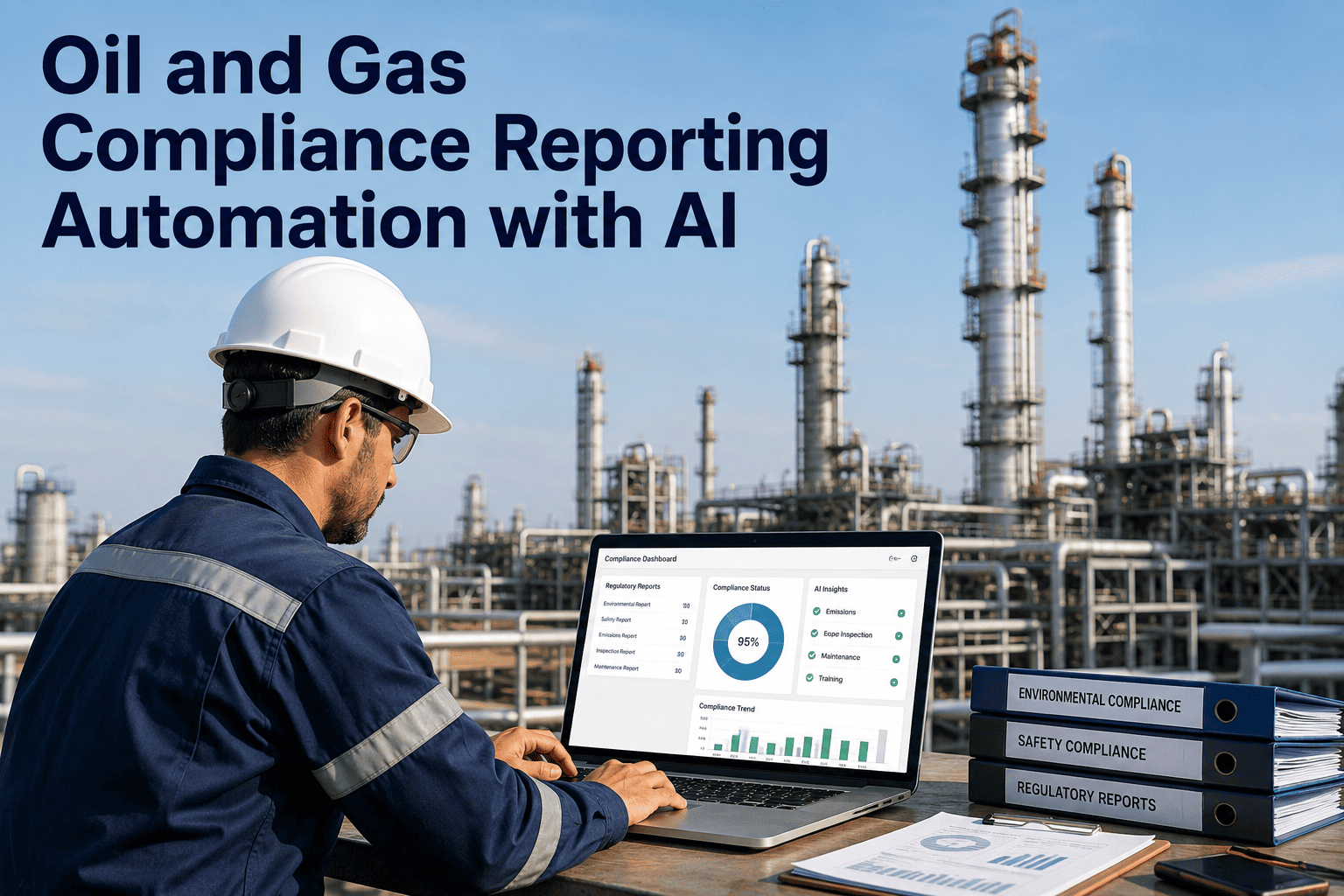
Regulatory reporting in oil and gas has never been simple — and in 2025, it is only getting more complex. U.S. operators face an expanding web of EPA emissions mandates, OSHA Process Safety Management requirements, DOT pipeline integrity reporting, SEC climate disclosure rules, and state-level environmental compliance deadlines, all demanding accurate data assembled from dozens of disconnected operational systems. The cost of getting it wrong ranges from six-figure penalties to operational shutdowns. Generative AI is changing this reality by automating the entire reporting lifecycle — from data collection across SCADA, MES, and IoT systems to structured, audit-ready document generation — compressing what once took compliance teams weeks into hours. Book a Demo to see how iFactory AI automates regulatory reporting across your oil and gas operations.
Automate Your Regulatory Reporting with Purpose-Built Gen AI
iFactory AI connects your SCADA, MES, ERP, and IoT data streams to an intelligent reporting engine that generates EPA, OSHA, DOT, and SEC-aligned compliance documents automatically — reducing manual effort by up to 85%.
Why Regulatory Reporting Is Breaking Traditional Oil & Gas Operations
The average upstream or midstream operator in the United States manages compliance obligations across more than a dozen overlapping federal and state regulatory frameworks simultaneously. EPA Subpart W greenhouse gas emissions reports, OSHA PSM incident logs, DOT PHMSA pipeline integrity management records, BSEE offshore production safety reports, and SEC climate-related financial disclosures each demand structured data assembled from sources that rarely speak to each other natively. The result is compliance teams spending 60 to 80 percent of their time on data collection and formatting rather than actual risk analysis.
Generative AI addresses this structural inefficiency by acting as an intelligent data aggregation and document generation layer — pulling production data, emissions measurements, incident records, and inspection logs from operational systems, normalizing them against regulatory schema, and drafting submission-ready reports with embedded audit trails. The technology does not replace compliance expertise; it eliminates the manual drudgework that prevents compliance professionals from focusing on the decisions that actually reduce organizational risk.
The Four-Stage Gen AI Regulatory Reporting Workflow
Effective gen AI regulatory reporting is not a single-step automation — it is an end-to-end workflow that spans data ingestion, contextualization, document generation, and submission management. iFactory AI implements this across all four stages through a unified industrial data fabric that connects SCADA, MES, ERP, and IoT layers. Understanding where Book a Demo conversations most often surface value helps operators prioritize their deployment sequence.
Stage 1: Automated Data Ingestion Across OT and IT Systems
Gen AI platforms connect to SCADA historians, DCS systems, emissions monitoring equipment, LIMS databases, and ERP records through OPC UA, Modbus, MQTT, and REST API connectors. Data is ingested continuously and normalized into a unified compliance data model — eliminating the manual export-and-paste workflows that introduce transcription errors into regulatory submissions.
Stage 2: Regulatory Schema Mapping and Threshold Monitoring
LLM-powered rule engines map ingested operational data against the specific schema requirements of each applicable regulation — whether that is EPA 40 CFR Part 98 emissions calculation methodology, OSHA 1910.119 process safety variables, or DOT 49 CFR Part 195 pipeline integrity metrics. Real-time threshold monitoring alerts compliance teams before deviation events become reportable incidents, enabling proactive corrective action.
Stage 3: Generative Document Drafting and Review
Generative AI models draft the compliance report narratives, populate structured data tables, calculate derived emissions factors, and format the output to match the required submission template for each regulator. Compliance officers receive a draft document with every data point traceable to its source record — ready for expert review rather than initial assembly. This stage alone typically eliminates 70 to 80 percent of manual preparation time.
Stage 4: Audit Trail Generation and Submission Management
Every AI-generated report carries an immutable audit trail — logging the source data record, the calculation methodology applied, the reviewer who approved each section, and the timestamp of submission. This documentation layer satisfies regulator demands for data lineage and provides defensible evidence in the event of an agency audit or enforcement inquiry.
Key Regulatory Reporting Areas Where Gen AI Delivers the Most Impact
Not all regulatory reporting workflows carry equal complexity or risk. The table below maps the highest-priority reporting obligations for U.S. oil and gas operators against the specific gen AI capabilities that address them — and the measurable impact observed across early deployments.
| Regulatory Framework | Key Reporting Requirement | Gen AI Automation Capability | Typical Time Savings |
|---|---|---|---|
| EPA Subpart W (GHG) | Annual GHG emissions from petroleum & natural gas systems | Automated emissions factor calculation from SCADA flow data | 75–85% reduction |
| OSHA PSM (1910.119) | Process hazard analysis, incident investigation, MOC records | NLP extraction from incident logs + auto-populated PHA templates | 60–70% reduction |
| EPA RMP (Risk Management) | 5-year RMP Plan updates, accident history, worst-case scenarios | Gen AI drafting of scenario narratives from historical event data | 65–80% reduction |
| DOT PHMSA (Pipelines) | Integrity management plans, incident reports, annual mileage reports | Automated ingestion from ILI tools and corrosion inspection records | 70–80% reduction |
| SEC Climate Disclosure | Scope 1, 2 & 3 emissions, climate risk narrative, financial impact | LLM-generated narratives tied to verified emissions data sources | 80–90% reduction |
| State Air Permits (Title V) | Facility-level emissions inventory, deviation reports, annual certifications | Continuous CEMS data ingestion and automated deviation flagging | 70–75% reduction |
What Distinguishes Industrial Gen AI from General-Purpose LLMs in Compliance Reporting
Deploying a general-purpose LLM like ChatGPT for regulatory reporting quickly surfaces a fundamental limitation: it has no connection to your operational data, no awareness of your specific permit conditions, and no ability to verify the numbers it generates. Industrial gen AI platforms like iFactory AI are purpose-built for this gap — combining LLM-powered document generation with live OT data integration and domain-specific regulatory knowledge. Book a Demo to see the difference between general-purpose AI and industrial compliance automation in a live environment.
Every number in an iFactory AI-generated compliance report is traceable to a source record in your SCADA historian, ERP system, or emissions monitoring equipment. No manual data entry, no copy-paste errors, no unverifiable LLM-generated figures.
The platform maintains a continuously updated library of federal and state regulatory templates — EPA, OSHA, DOT, SEC, and state equivalents — ensuring that generated documents match the current submission format requirements for each jurisdiction without manual template maintenance.
Continuous monitoring of emissions, process safety variables, and integrity metrics against regulatory thresholds means compliance teams receive early-warning alerts — not post-event incident reports. Addressing deviations before they cross reportable thresholds is where the highest compliance ROI is generated.
Every AI-generated report, data access event, calculation step, and reviewer approval is logged in a tamper-proof audit trail. This documentation satisfies agency information requests and provides defensible evidence of good-faith compliance in enforcement proceedings — a requirement that general-purpose LLMs cannot fulfill.
Deploying Gen AI for Regulatory Reporting: A Practical Three-Phase Rollout
Deploying gen AI for regulatory reporting does not require a multi-year transformation program. A focused phased rollout — starting with the highest-volume, highest-risk reporting obligations — delivers measurable compliance efficiency within the first 90 days. The sequence below reflects best practices observed across North American oil and gas deployments.
Compliance Obligation Inventory and Data Source Mapping
Catalog every active federal and state reporting obligation, its submission frequency, data requirements, and the operational systems that currently hold the relevant records. This audit invariably surfaces data gaps, manual handoffs, and inconsistent data formats that gen AI integration must address. The output is a prioritized integration roadmap ranked by compliance risk and report volume.
OT/IT Data Integration and Regulatory Template Configuration
Connect iFactory AI to priority data sources — SCADA historians, CEMS, LIMS, and ERP systems — through OPC UA, Modbus, REST API, and MQTT connectors. Configure the regulatory template library for your specific permit conditions, emissions factors, and jurisdictional requirements. Most operators complete this phase in four to eight weeks for the top three or four reporting obligations.
Parallel Run, Validation, and Full Deployment
Run the gen AI reporting system in parallel with existing manual workflows for one full reporting cycle. Compliance officers review AI-generated drafts against manually prepared reports to validate calculation accuracy and narrative quality. After parallel validation, the AI workflow becomes the primary reporting mechanism with human review as the final approval step — not the assembly step.
Ready to Eliminate Manual Compliance Reporting?
iFactory AI connects your SCADA, MES, ERP, and IoT data to a purpose-built regulatory reporting engine — generating audit-ready EPA, OSHA, DOT, and SEC reports automatically, with full data lineage and immutable audit trails.
What Compliance and Operations Leaders Are Saying About Gen AI Reporting
Reviewed by environmental compliance engineers and HSE directors with deployment experience across upstream, midstream, and downstream operations in North America. The following observations reflect active gen AI compliance implementations in the U.S. energy sector.
Our EPA Subpart W annual report used to consume six weeks of two senior engineers' time — most of it pulling data from our SCADA historian, LIMS, and production accounting system and reconciling discrepancies. After deploying an integrated gen AI reporting platform, the same report takes less than three days, with engineers spending their time reviewing results rather than assembling them. The error rate on our last submission was zero, compared to the three correction requests we averaged in prior years.
The real value of gen AI in compliance is not just speed — it is the early-warning capability. When our emissions monitoring system detected a CEMS deviation that would have triggered a reportable exceedance, the AI flagged it 11 hours before the threshold was crossed. We corrected the burner tuning issue during the same shift. The incident never became a regulatory event. That kind of proactive compliance is impossible with the manual review processes we had before.
These outcomes are consistent with published research showing AI-assisted compliance monitoring improving regulatory adherence rates from 95% to 99.8% in midstream operations — and with the broader industry trend of Book a Demo conversations that consistently identify regulatory reporting as the highest near-term ROI use case for gen AI in oil and gas.
Generative AI Is the Compliance Infrastructure That Oil & Gas Operations Need Now
The regulatory reporting burden on U.S. oil and gas operators is not decreasing — SEC climate disclosure requirements, tightening EPA methane rules, and expanding state-level environmental mandates are all adding complexity to compliance programs that were already resource-constrained. The traditional model of spreadsheet-driven, manually assembled compliance reports is structurally incompatible with the scale and frequency of modern reporting obligations.
Generative AI closes this gap by automating the data collection, calculation, drafting, and audit trail generation that consume the majority of compliance team bandwidth — freeing engineers and HSE professionals to focus on risk analysis, process improvement, and strategic compliance positioning rather than document assembly. The technology is not experimental: early deployments across midstream, upstream, and downstream operations are reporting 75 to 85 percent reductions in report preparation time, near-zero submission error rates, and proactive deviation detection that prevents reportable incidents rather than just documenting them. The operators building gen AI compliance infrastructure today are positioning themselves for a regulatory environment that will only grow more demanding — and doing so with a platform that pays for itself on the first avoided penalty or agency enforcement action.
Generative AI Regulatory Reporting — Frequently Asked Questions
Yes — industrial gen AI platforms like iFactory AI connect directly to SCADA historians, CEMS, DCS, and LIMS via OPC UA, Modbus, and REST API, pulling live operational data for real-time compliance monitoring and automated report generation.
Purpose-built platforms maintain a continuously updated library of federal and state regulatory templates, automatically mapping ingested operational data to the correct schema and format for each jurisdiction without manual template management by the compliance team.
Every AI-generated figure is traceable to its source data record through an immutable audit trail; human compliance officers review and certify each submission, meaning final regulatory responsibility remains with the qualified professional who signs the report.
Yes — industrial platforms support per-facility permit condition configuration, allowing the reporting engine to apply the correct emissions factors, threshold limits, and submission formats for each location within a unified multi-site compliance dashboard.
Most operators complete the first reporting automation cycle within 90 days of deployment, with measurable time savings on the very first AI-assisted report submission — typically 70 to 85 percent reduction in preparation hours compared to the prior manual process.
Connect Your Operations to Intelligent Regulatory Reporting
iFactory AI is enabling oil and gas operators across North America to automate their most burdensome regulatory reporting workflows — from EPA GHG submissions to OSHA PSM records — with full data lineage and zero manual assembly.