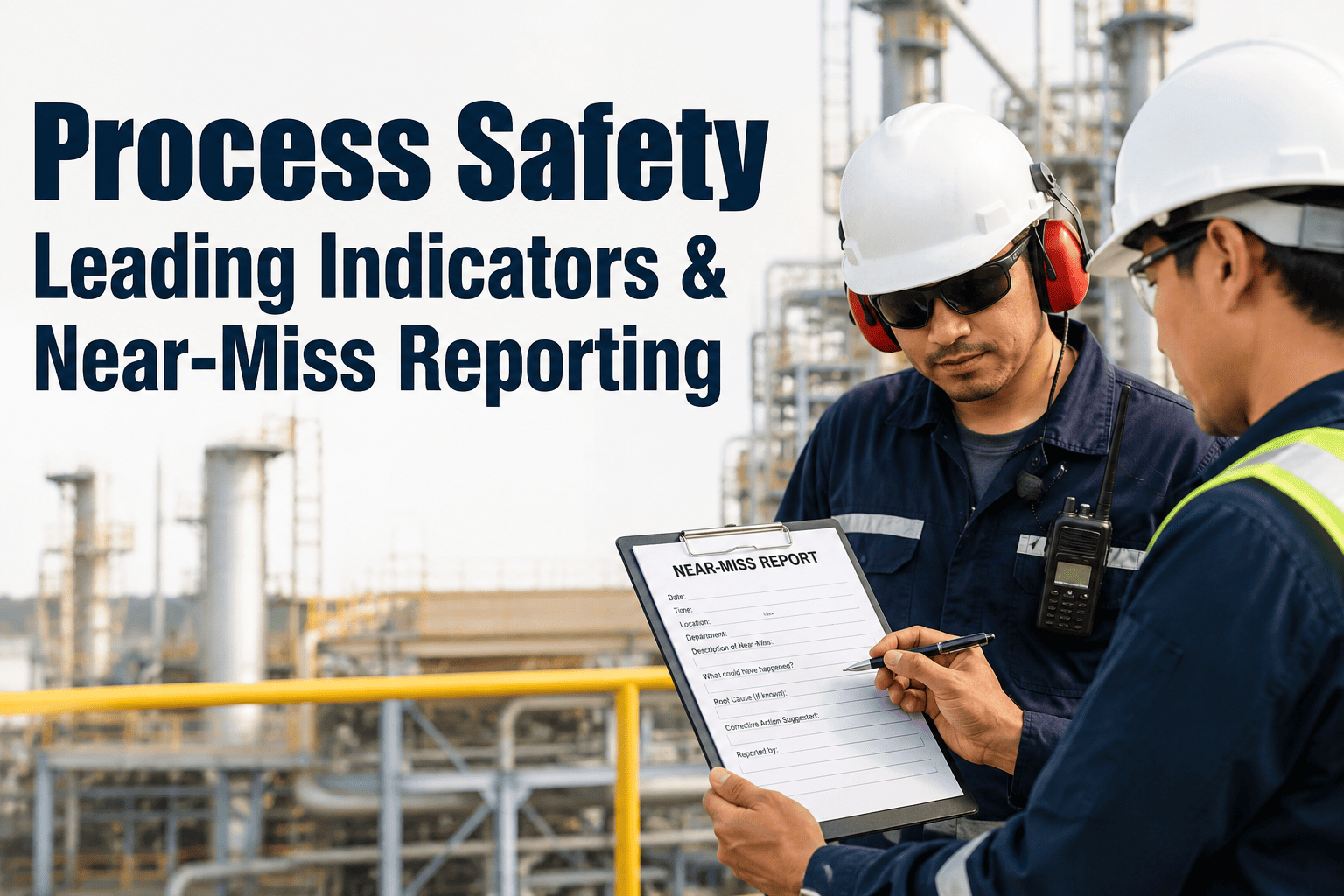
Most safety programs still talk about near misses using a number that was never actually true. Herbert William Heinrich's 1931 study proposed that for every fatality or major injury, there are 29 minor injuries and 300 incidents with no injury at all — a tidy 300:29:1 pyramid that became the foundation for decades of near-miss tracking programs. The problem is that Heinrich's ratio was derived from a narrow dataset and treated severity as if it were a random draw from the same pool of unsafe acts, when in reality a slip on a wet floor and a fall from an unguarded platform are governed by almost entirely different causal pathways. Safety researchers have spent the years since dismantling the literal ratio while reaching a more useful conclusion: near-miss reports remain one of the strongest leading indicators an organization has, not because they predict a fixed countdown to the next serious injury, but because they surface the weak signals — the workarounds, the close calls, the "that's just how we do it here" moments — that a lagging injury statistic will never show you in time to act. Building a reporting culture that actually captures those signals is a psychological safety problem and a system design problem before it is an analytics problem, and getting both right is what separates a near-miss program that generates real learning from one that generates a drawer full of unread forms. Book a Demo to see how a digitized near-miss program surfaces signals your current system is most likely missing.
Turn Near-Miss Reports Into a Real Leading Indicator
iFactory makes reporting frictionless, triages every submission automatically, and surfaces the patterns across reports that point to where your next incident is most likely to happen.
Near-Miss Reporting Analytics: Turning Weak Signals Into Organizational Learning
A practical framework for building a near-miss program that captures real signal — covering psychological safety, reporting friction, AI-assisted triage, and the closed-loop learning teams that keep employees submitting reports instead of giving up on them.
Why Near-Misses Go Unreported: Six Failure Modes
Most organizations don't have a near-miss reporting problem because employees fail to notice hazards. They have one because the system surrounding the report actively discourages submitting it — through fear, friction, or silence after the fact. Fixing reporting volume starts with naming the specific failure mode at play, because each one requires a different fix. Book a Demo to see how iFactory's reporting workflow is designed against each of these six patterns.
Fear of Blame or Disciplinary Action
When a near-miss report has ever been used to discipline the person who filed it, that channel closes permanently — not just for that worker, but for everyone who hears the story. Reporting rate collapses long before management notices it happened.
Reporting Friction: Paper Forms & Multi-Step Logins
A near miss noticed in the field and forgotten by the time someone reaches a computer terminal was never really captured. Every extra step between noticing a hazard and submitting it costs reporting volume.
The "Report Black Hole": No Visible Follow-Up
An employee who files a report and never hears what happened to it learns one lesson: reporting doesn't change anything. That lesson spreads through a crew faster than any safety meeting can counter it.
Unclear Definition of What Counts as a Near Miss
Without a shared, concrete definition, employees default to only reporting events that were obviously close calls — missing the much larger set of minor deviations and workarounds that carry the same systemic root causes.
Production Pressure & the Time Cost of Reporting
When stopping to file a report visibly costs schedule time during a busy shift, the calculation an employee makes — consciously or not — favors finishing the task over documenting the near miss.
Normalization of Deviance: "That's Just How It Works Here"
A workaround repeated often enough without consequence stops registering as a hazard at all. The near miss that should be reported has quietly become standard practice in the eyes of the crew performing it.
The Incident Pyramid Myth: What Heinrich's Ratio Got Wrong
Heinrich's pyramid was never built from a controlled causal study — it was a retrospective count of insurance claim files, generalized into a fixed ratio that got repeated in safety training for nearly a century. Later researchers, including longtime safety-science contributor Fred Manuele, revisited the underlying logic and found the ratio couldn't be replicated consistently across industries or hazard types, because severity and frequency are driven by largely separate causal factors — a falling object and a tripping hazard don't share the same probability of becoming a fatality just because both are technically "unsafe conditions." Book a Demo to see how iFactory frames near-miss data without relying on a ratio that doesn't hold up.
| Model | Ratio Claimed | Era | What Modern Research Says |
|---|---|---|---|
| Heinrich's Triangle | 300 no-injury incidents : 29 minor injuries : 1 major injury | 1931 | Based on insurance claim files, not a controlled causal study; the ratio has not replicated consistently across industries. |
| Bird's Triangle | 600 near misses : 30 minor injuries : 10 serious injuries : 1 fatality | 1969 | Added a property-damage tier from a larger claims dataset, but still treated severity as a fixed probability draw rather than its own causal pathway. |
| Industry-Specific Variants | Reported ratios ranging from roughly 20:1 to 600:1 depending on the study | 1970s–2000s | The wide variance across studies suggests the ratio reflects reporting culture as much as it reflects underlying risk. |
| Modern Safety Science Consensus | No single fixed ratio; frequency and severity follow largely independent causal pathways | 2000s–Present | Near misses remain a valuable leading indicator of system weakness, not a literal countdown toward the next serious injury. |
Stop Tracking a Ratio. Start Tracking the Signal.
See how iFactory's near-miss analytics frame reporting data as a learning signal instead of a debunked prediction formula — and what that means for how your team prioritizes corrective action.
A Four-Tier Maturity Model for Digitizing Near-Miss Reporting
Sites rarely jump straight from a paper near-miss form to a fully closed-loop learning organization, and they don't need to. iFactory's deployment framework moves a site through four tiers, each one building on the trust established by the last, so reporting volume grows because employees see real follow-through rather than because they were told to report more. Safety leaders ready to map their current program against these tiers can Book a Demo and bring their existing reporting data into the conversation.
A QR-code or mobile reporting channel lets any employee submit a near miss in under sixty seconds, with an optional anonymous path for reports where naming the observer matters less than capturing the hazard.
Incoming reports are automatically categorized by hazard type, location, and potential severity, and routed to the right reviewer — removing the manual dispatcher step that delays response on straightforward reports.
Clustering analysis looks across hundreds of reports for a repeated root cause showing up on different shifts, in different areas, or under different supervisors — a pattern no single report, or single supervisor, would surface alone.
Every report tracks to a documented corrective action with a named owner and a due date, and recurring themes feed directly into the next safety meeting agenda instead of staying buried in a spreadsheet.
From Report to Insight: Reporting Rate & Closure Time Benchmarks
A near-miss program's health shows up in two numbers more than any other: how many reports actually come in, and how quickly each one closes with a visible action. Both numbers move together — closure speed is usually what determines whether reporting volume holds or quietly declines after the first few months. Book a Demo to benchmark your current program against these figures.
"The hardest conversation I have with new safety managers is convincing them that a rising near-miss report count is good news, not bad news. They've spent their career being told fewer incidents means a safer site, so when reporting volume goes up after we remove the friction and start closing the loop, their instinct is to worry. What actually happened is that the hazards were always there — we just couldn't see them. The sites that get this right stop chasing a ratio and start treating every report as a data point about where their system is weakest. That shift in framing did more for our injury rate over two years than any single engineering control we installed."
A Near-Miss Program Is a Learning System, Not a Ratio to Hit
Heinrich's pyramid earned its century-long shelf life because it gave safety managers a simple story to tell leadership: report more, prevent the big one. The story was too simple, but the instinct underneath it wasn't wrong — organizations that surface their weak signals do learn faster than organizations that wait for a lagging statistic to tell them something went badly. The work that actually moves the needle isn't chasing a fixed ratio; it's removing the friction that keeps reports from being filed, building enough psychological safety that people believe filing one won't backfire on them, and closing the loop visibly enough that the next report feels worth the effort.
iFactory's role in that system is structural rather than cultural — it can't manufacture trust on its own, but it can remove the excuses that erode trust before it has a chance to build: the report that took ten minutes to file, the submission that vanished with no response, the pattern that three different supervisors each half-noticed but never connected. Sites that close those structural gaps consistently see reporting culture follow.
Near-Miss Reporting & the Incident Pyramid — Frequently Asked Questions
Q: Is Heinrich's 300:29:1 ratio still considered accurate?
No — modern research shows the ratio isn't fixed across organizations or hazard types. Near misses remain valuable as a learning signal, not as a literal countdown to a major injury.
Q: What is psychological safety and why does it matter for near-miss reporting?
It's the belief that reporting a hazard or mistake won't lead to punishment or embarrassment. Without it, reporting rates collapse no matter how easy the reporting system is to use.
Q: How does iFactory increase reporting volume without changing site culture overnight?
By removing reporting friction with mobile or QR submission and an optional anonymous path, then visibly closing the loop on every report so employees see action instead of silence.
Q: Can AI actually find patterns across reports that supervisors would miss?
Yes — clustering analysis can surface a repeated root cause appearing across different shifts or areas that no individual supervisor would otherwise connect.
Q: How long until we see a measurable change in reporting culture?
Reporting volume typically rises within the first 90 days; sustained psychological safety improvement usually develops over 6–12 months alongside visible follow-through.
Ready to Build a Reporting Culture People Actually Trust?
Speak with an iFactory safety analytics specialist about digitizing near-miss reporting, closing the loop on corrective actions, and surfacing the weak signals your current system is missing.