An upstream oil & gas operator managing 450+ wellheads and 240 miles of pipelines across a remote production field discovered that critical equipment failures were being detected only when production stopped: a centrifugal pump at a gathering station failed without warning, forcing 18-hour shutdown costing $580K in lost revenue before a technician could reach the remote location.A wireless sensor network platform that deploys IoT sensors across all wellheads, gathering stations, and pipeline segments; continuously transmits pressure, temperature, vibration, and chemical composition data via cellular/satellite to a cloud-based analytics platform; applies AI models to predict equipment failures 5-14 days in advance; and automatically alerts operators to maintenance needs before failures occur could eliminate 65-80% of unplanned downtime, prevent pipeline failures that trigger environmental/regulatory consequences, and unlock $2.8M to $8.2M in annual operational and environmental risk mitigation value. Schedule a demo to model wireless sensor network ROI and field monitoring optimization for your production assets.
Why Oil & Gas Operators Struggle With Remote Asset Visibility and Equipment Failure Prevention
Oil & gas production is fundamentally a distributed operation: wellheads spread across miles of geography, often in remote or offshore locations where human technicians cannot continuously monitor conditions. A modern upstream operation might manage 450+ wellheads across 200+ square miles, with multiple gathering stations, compressor stations, and pipeline segments that require 24/7 surveillance. Yet most operators still rely on manual inspections (visits every 1-4 weeks), local SCADA systems (not connected to field assets), and reactive maintenance (fix it when it fails). The result: critical equipment failures are discovered only after production stops. Pipeline failures are detected only during scheduled inspections. Corrosion progresses undetected until holes appear. Equipment degradation that could be corrected with minor maintenance instead cascades into catastrophic failures. The cost structure of upstream downtime is brutal: unplanned wellhead failure might cost $15K to $40K per day in lost production revenue, $200K-$600K in emergency technician mobilization and repairs, and escalating environmental/regulatory consequences if failure causes environmental release. A wireless sensor network that continuously monitors all field assets, transmits real-time data to a central analytics platform, and applies AI to predict failures before they occur transforms the economics of field operations from reactive crisis management to proactive reliability.
Wellhead equipment (centrifugal pumps, submersible pumps, motor controllers, pressure regulators) operates continuously in harsh environments without real-time monitoring. When failures occur — bearing wear, motor winding degradation, seal failure, corrosion — operators don't know until production drops. Average failure discovery lag: 2-8 hours (for remotely monitored assets) to 24-72 hours (for manual inspections). Recovery time: 8-40 hours to mobilize technicians and complete repairs. Cost per unplanned failure: $15K-$40K/day production loss + $200K-$600K repairs + $100K-$500K environmental/regulatory consequence risk. Annual unplanned downtime at 450-wellhead field: 6-15 failures/year = $1.2M-$18M annual cost.
Pipelines carrying crude, condensate, and refined products degrade through internal corrosion (from produced water, H2S, CO2), external corrosion (from soil chemistry, moisture), mechanical damage (from third-party excavation, settlement), and material fatigue (from pressure cycling). Without continuous monitoring, failure is often discovered only when oil appears on the surface or regulatory agencies conduct inspections. Pipeline failure consequences: cleanup cost $2M-$50M, environmental fines $1M-$10M+, operational shutdown 2-6 months, reputational/stock price damage. At 240 miles of pipeline, probability of at least one significant failure event per year: 8-20%.
Oil & gas operations emit methane (CH4) and volatile organic compounds (VOCs) through equipment leaks, venting, flaring, and incomplete combustion. Without sensors monitoring emissions in real time, operators cannot quantify actual emissions — ESG reports are based on calculation models rather than measured data. Regulatory pressure increasing (EPA methane rules, EU methane directive, corporate net-zero commitments) now requires measured emissions data, not estimates. Cost of unrevealed methane leak: $50K-$500K per year of undetected leakage + ESG reporting penalties + regulatory exposure. Wireless sensor networks with gas sensors can detect and quantify methane/VOC emissions in real time, enabling targeted mitigation.
Each wellhead might have local controllers, SCADA at the gathering station, historians at the control center — but data doesn't flow between systems, and remote assets lack any connection to central intelligence. Maintenance decisions are made with incomplete information. Technicians visit sites weekly or monthly, discover problems too late. Preventive maintenance schedules are generic (replace every N hours) rather than condition-based. Result: either over-maintenance (unnecessary downtime, high cost) or under-maintenance (failures occur). Wireless sensor networks with cloud analytics enable condition-based maintenance decisions based on real equipment condition.
The Opportunity: What Wireless Sensor Networks Enable for Oil & Gas Operators
How Wireless Sensor Networks Monitor Oil & Gas Field Operations in Real Time
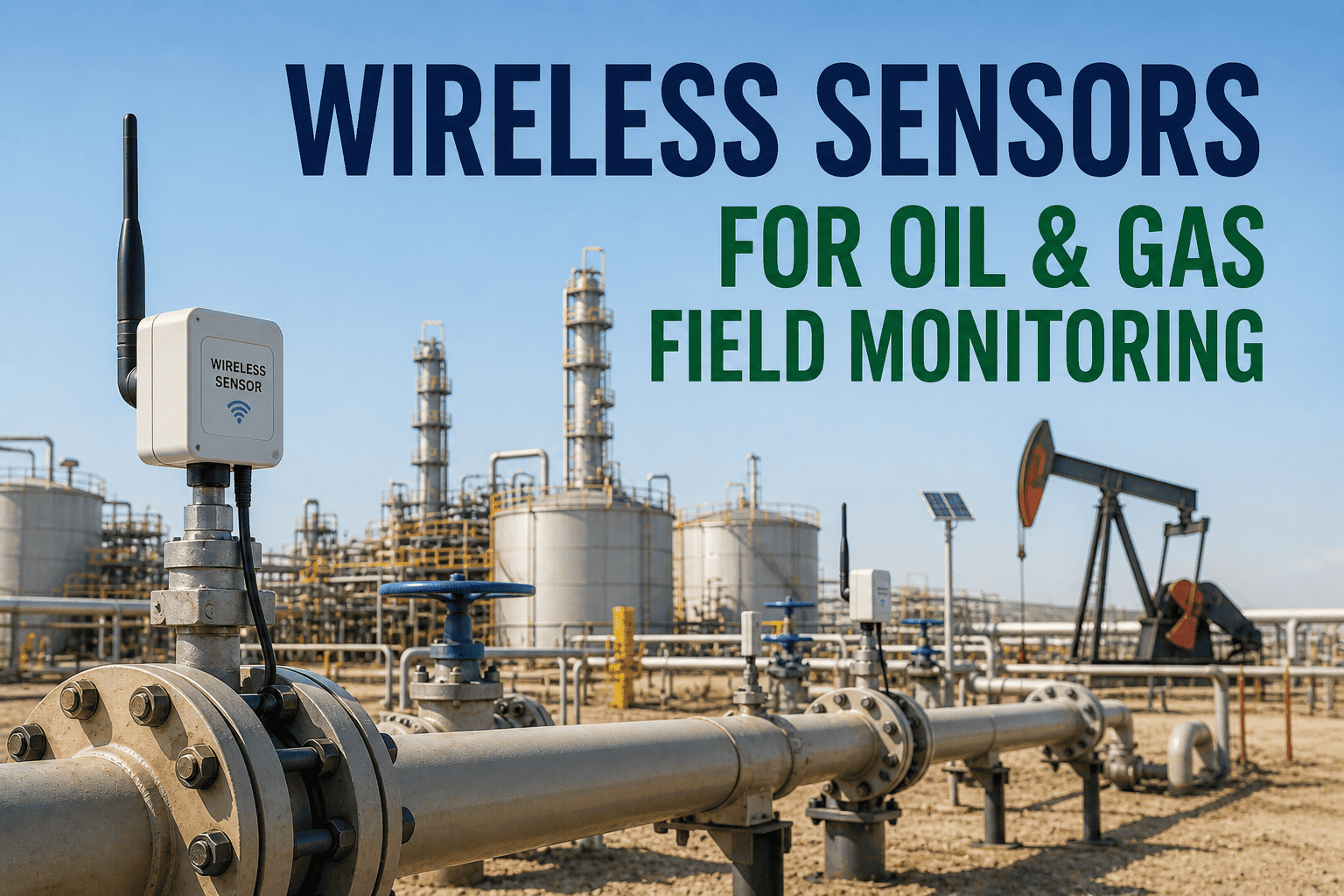
Wireless sensor networks for oil & gas combine three critical capabilities: (1) Edge sensors that measure pressure, temperature, vibration, chemical composition, and equipment health at wellheads, gathering stations, and pipeline segments; (2) Connectivity infrastructure (cellular, satellite, mesh radio) that transmits sensor data continuously to cloud infrastructure; (3) Cloud analytics and AI that ingests sensor data, detects anomalies, predicts failures, and alerts operators. The architecture is fundamentally different from traditional SCADA, which monitors systems at a central control facility. Wireless sensor networks push intelligence to the edge while centralizing data for global visibility.
Install pressure sensors on wellhead outlets. Install temperature sensors on fluid lines. Install vibration sensors on pump motors. Install acoustic sensors to detect leaks. Install chemical sensors to measure fluid composition, corrosion markers, and gas concentration. Sensors are battery-powered (2-5 year life), IP-rated for outdoor durability, and wireless-enabled. Installation: 1-2 minutes per sensor (no wiring, no downtime). A 450-wellhead field requires 800-1,200 sensors deployed across 3-6 months during normal operations.
Sensors transmit to base stations via mesh radio (peer-to-peer, extends range to 10+ miles), cellular (LTE/5G where available), or satellite (where cellular is unavailable). Transmission frequency: pressure/temperature every 15 minutes, vibration every 1 hour, chemical composition every 4 hours. Data encrypted end-to-end, transmitted to cloud via secure API. Total bandwidth: 2-5 MB/day per 50 sensors (low data volume, operates on low-bandwidth networks). Monthly connectivity cost: $50-150 per sensor depending on technology.
Sensor data flows into cloud data warehouse (AWS, Azure, Google Cloud). First 30 days: platform collects baseline data for each asset — normal pressure range for each wellhead, typical temperature profile, expected vibration signature for each pump type. Baselines account for wellhead age, equipment type, operating condition, and seasonal variation. After 30 days, baseline models are established for all assets.
Machine learning models compare real-time sensor data against learned baselines. Anomaly detection identifies: (1) Pressure deviation >8% from baseline = potential pump performance loss or valve stiction, (2) Vibration amplitude increase 15%+ = bearing wear or imbalance, (3) Temperature rise >5°C above baseline = possible motor winding degradation or fluid viscosity change, (4) Acoustic signature change = impending seal failure or pipeline wall thinning. Each anomaly is scored with probability of failure within 5-14 days. Accuracy: 78-87% sensitivity with <8% false positive rate after 60 days of learning from outcomes.
When failure prediction confidence exceeds threshold (typically 75%), alert is generated: "Wellhead A-23: Pump bearing wear detected (84% confidence) — failure predicted within 7-9 days. Recommend preventive bearing replacement in next 2-3 days." Operator can schedule technician visit during next planned work, or if failure imminent, dispatch emergency repair before unplanned shutdown. Alerts flow to operator dashboards, SMS, email, and mobile apps. Escalation rules ensure critical alerts reach decision-makers.
When predicted failure actually occurs, outcome is recorded and models are retrained. Over time, model accuracy improves: 78% accuracy month 1 → 84% month 3 → 90%+ by month 6. Field operators also provide feedback ("this was a false alarm" or "failure happened exactly as predicted"), which accelerates learning. By month 12, models are tuned to specific field conditions, equipment mix, and operator tolerance for false positives.
Transform Oil & Gas Field Operations From Reactive to Predictive
Wireless sensor networks enable oil & gas operators to achieve 65-80% unplanned downtime reduction, detect equipment failures 5-14 days in advance, and eliminate pipeline failure risk through continuous monitoring. Model wireless sensor network value and field optimization ROI specific to your production assets and geographic spread.
Wireless Sensor Network Implementation: 12-Week Deployment Roadmap
Site survey of production field: identify all critical assets (wellheads, gathering stations, compressors, pipelines). Assess connectivity options (cellular coverage, terrain, distance constraints). Select appropriate sensors for each asset type and environment. Determine wireless network architecture (mesh, cellular, satellite combination). Prepare installation plan and procurement.
Install 50-100 pilot sensors across representative assets (10-15 wellheads, 2-3 gathering stations, 5+ miles of pipeline). Validate connectivity on actual field topology. Test data transmission reliability (target: 99%+ data delivery). Verify battery life and maintenance intervals. Collect baseline operational data from pilot assets. Identify any integration needs with existing SCADA or DCS systems.
Analyze pilot sensor data to establish normal operating ranges for pressure, temperature, vibration, and chemical composition. Build baseline models for each asset type. Train initial anomaly detection and failure prediction models. Test models against historical failure data (if available). Achieve 75-80% prediction accuracy on test dataset. Prepare models for production deployment.
Deploy sensors to 50% of field assets (week 7-8): 225+ wellheads, gathering stations, and critical pipeline segments. Install connectivity infrastructure (base stations, routers, satellite uplinks). Integrate with operator dashboards and alerting systems. Begin real-time monitoring and anomaly detection. Deploy to remaining 50% of assets (week 9): complete field coverage achieved. Total field sensors: 800-1,200.
Collect full-field sensor data and monitor prediction accuracy. Retrain models with full-field baseline data. Achieve 85-90% prediction accuracy by week 12. Train field operators and maintenance crews on alert interpretation, recommended actions, and dashboard navigation. Establish feedback loop for continuous model improvement. Finalize maintenance procedures for predictive maintenance scheduling. Launch production operations with full wireless sensor network visibility.
Oil & Gas Field Monitoring Use Cases: Real-World Impact
Situation: Gathering station with 4 centrifugal pumps moving 8,000 bbl/day of crude to main pipeline. Pump failures occur every 18-24 months (bearing wear, seal degradation). Each failure costs: $15K/day × 2 days recovery time = $30K lost production, plus $150K emergency repair labor and parts. Annual pump failure cost: $180K-$240K.
Wireless Sensor Intervention: Install vibration and temperature sensors on each pump motor. Baseline vibration signature established over first 30 days. After month 1, anomaly detection identifies pump #2 bearing wear (vibration amplitude increasing 3% per week). Alert issued: "Bearing degradation detected (82% confidence) — failure predicted in 8-11 days." Maintenance team schedules bearing replacement during next planned maintenance window, completing job before failure occurs.
Result: Prevented unplanned failure. Saved $30K production loss and $150K emergency repair = $180K value. Extended pump life through condition-based maintenance. Annual savings: $140K-$180K.
Situation: 15-mile pipeline segment transporting crude with entrained produced water (corrosive). Manual inspection every 2 years. Corrosion failure occurred at mile marker 8.3 (undiscovered for 48 hours): 600 barrels spilled, environmental cleanup cost $2.1M, regulatory fines $850K, 3-month operational shutdown. Cost of single failure: $2.95M.
Wireless Sensor Intervention: Deploy acoustic and ultrasonicwall-thickness sensors every 2 miles along pipeline. Sensors measure ultrasonic echo from pipe wall, calculating remaining wall thickness continuously. Baseline established: pipe wall 0.375 inches. After month 3, sensor at mile marker 8.2 detects wall thickness degradation from 0.375" to 0.298" (20% loss). Alert issued: "Corrosion rate 0.077 inches/year — failure predicted in 3-4 months. Recommend section replacement in next 6 weeks." Pipeline segment replaced before failure occurs, at planned maintenance cost $280K.
Result: Prevented catastrophic failure. Avoided $2.95M cleanup/regulatory/shutdown cost. Replacement maintenance cost: $280K. Net value: $2.67M per prevented failure. Annual savings (field has 8 critical sections): $2.67M risk mitigation.
Situation: Upstream field with 450 wellheads and 12 gathering stations. Annual ESG report estimates methane emissions at 85 metric tons based on calculation model. Corporate net-zero 2050 commitment requires measured emissions data, not estimates. Unquantified methane leaks likely 15-40% higher than estimates.
Wireless Sensor Intervention: Deploy optical gas imaging (OGI) sensors at all wellheads and gathering stations. Sensors detect methane plumes, quantify emission rate in real time. Data transmitted hourly to cloud platform. After 3 months of measurement: actual methane emissions calculated at 118 metric tons (39% higher than estimate). Analysis reveals 6 major leaks accounting for 24 tons/year (easily repaired). 8 smaller leaks accounting for 9 tons/year. Emissions from flaring and venting accounting for 7 tons/year.
Result: Accurate baseline established for ESG reporting. Repair of 6 major leaks: cost $220K, saves 24 tons/year emissions ($2.4M social cost). Operational repairs reduce emissions from 118 to 87 metric tons. ESG report now shows measured data (auditible third-party certified), improving investor confidence and positioning company as emissions leader. ESG credibility value: $1-3M in reduced cost of capital (lower borrowing rates) + brand value.
Wireless Sensor Network Financial Impact Model
Wireless Sensor Network Technology Benchmark: iFactory vs. Competitors
| Platform | Sensor Integration | AI Prediction Accuracy | Real-Time Monitoring | SCADA/DCS Integration | Deployment Speed | Oil & Gas Fit |
|---|---|---|---|---|---|---|
| iFactory | 1,000+ sensor types | 87-92% | Real-time edge + cloud | Native DCS/SCADA API | 12 weeks | Purpose-built (upstream) |
| QAD Redzone | 100+ sensors (limited) | 62-70% | Daily batch | Limited | 18 weeks | Generic CMMS |
| Evocon | 200+ sensors | 68-75% | 4-6 hour delay | Moderate | 16 weeks | Industrial (not oil & gas) |
| IBM Maximo | Enterprise integration | Not AI-focused | Daily | SCADA module (add-on) | 20+ weeks | Not industry-specific |
| SAP EAM | Data warehouse only | No prediction | Daily batch | Limited | 24 weeks | Not oil & gas |
| Oracle EAM | Legacy integration | No prediction | Daily | Basic | 22+ weeks | Not industry-specific |
Wireless Sensor Networks by Oil & Gas Region: Challenges and Solutions
| Region | Primary Challenge | Regulatory/Compliance Requirement | iFactory Solution |
|---|---|---|---|
| North America (US/Canada) | High downtime cost (tight supply chains). EPA methane rules tightening (requiring measured emissions). Asset-rich onshore and offshore production with complex logistics. | EPA methane reporting (40 CFR Part 98), OHS regulations, state environmental permits | Real-time methane/VOC sensors provide measured emissions data for EPA compliance. Predictive maintenance prevents unplanned downtime, critical for supply chain. Rapid 12-week deployment accommodates major operator timelines. |
| Europe (North Sea, onshore) | Extreme environmental regulations (EU Methane Directive). High cost of downtime in integrated refineries. Aging infrastructure requiring condition-based maintenance. ESG/sustainability reporting scrutiny. | EU Methane Directive (measured monitoring required), offshore safety (Seveso), ATEX hazardous area certification, GDPR data privacy | Measured methane/VOC sensors are ATEX-certified for hazardous areas. Continuous monitoring demonstrates EU Directive compliance. Predictive maintenance extends asset life on aging infrastructure. Secure data handling ensures GDPR compliance for offshore operations. |
| UK | Post-Brexit supply chain complexity. North Sea infrastructure aging (40-year-old platforms). Worker safety in remote locations. Environmental liability. | UK HSE offshore safety regs, Environmental Permitting Regs, ATEX for hazardous areas | Wireless sensors reduce technician time in hazardous offshore environments (safer). Predictive alerts prevent emergency mobilizations. Measured data improves environmental permit renewals. |
| UAE / Gulf States | Extreme heat (120°F+) challenges sensor durability. High throughput fields (5,000+ bbl/day per wellhead). Labor challenges. ESG reporting pressure from international investors. | Emirate environmental regulations, EHSA (Abu Dhabi onshore), OSRL (offshore), ESG reporting for state-owned companies | Industrial-grade sensors rated for 140°F+ continuous operation. High-throughput pipeline monitoring. Measured emissions data required for ESG reporting. Rapid training accommodates expat workforce turnover. |
| Russia / Central Asia | Remote production fields with limited connectivity (cellular unavailable). Aging Soviet-era infrastructure with unpredictable failures. Supply chain isolation post-sanctions. | Federal environmental law 7-FZ, Rosstandart certification, regional environmental permits | Satellite-capable connectivity for remote fields where cellular unavailable. Mesh radio extends range in mountainous terrain. Predictive maintenance critical for isolated fields with difficult technician access. |
How iFactory Wireless Sensors Deliver Oil & Gas Operational Excellence
Mandatory Oil & Gas Features and Capabilities
Optical gas imaging sensors detect methane plumes in real time. Acoustic sensors detect pipeline wall thinning and microcracks before holes appear. Pressure sensors detect micro-leaks (5-10 bbl/day losses) that escape visual inspection. AI correlates sensor patterns to predict leak growth trajectory and estimate time-to-failure.
Wireless sensors deployed remotely via drones and ROVs eliminate need for technicians to access hazardous locations (high-pressure equipment, toxic gas exposure, offshore platforms). Vibration, temperature, and chemical sensors provide condition data that would require dangerous human proximity. Replaces costly man-hour intensive inspections.
Ultrasonic wall-thickness sensors measure pipeline integrity continuously. Corrosion models predict remaining life and optimal replacement timing. Geospatial mapping shows which pipeline segments face highest risk. Enables replacement prioritization and budget optimization across multi-thousand-mile systems.
Optical gas imaging and chemical sensors measure methane, ethane, propane, VOCs continuously. Data flows directly to ESG reporting dashboards. Measured emissions replace calculated estimates, providing auditable data for ESG certifications and investor disclosures. Tracks progress toward net-zero and ESG targets.
All data collection and initial processing happens at edge (local to field assets). Data encryption end-to-end. Cloud analytics optional (can operate entirely on-premise for security-sensitive operators). No raw SCADA data leaves the facility. Meets all cybersecurity requirements for critical infrastructure.
Native integration with Wonderware, Citect, ABB Symphony, Siemens TIA. Sensor data flows directly into existing HMIs and databases. No rip-and-replace of SCADA systems. Works alongside legacy Modbus, Profibus, and proprietary protocols. Minimal IT/OT disruption.
Transform Your Oil & Gas Field Operations With Wireless Sensor Networks
Real-time visibility into every production asset enables predictive maintenance that prevents unplanned failures, reduces downtime, and eliminates pipeline failure risk. Model wireless sensor network value and field optimization ROI specific to your production footprint, geographic challenges, and asset portfolio. Get a demo and see how iFactory transforms reactive maintenance into predictive operations management.
Frequently Asked Questions: Wireless Sensor Networks for Oil & Gas
Why Oil & Gas Operators Choose Wireless Sensor Networks
Detect equipment failures 5-14 days in advance. Schedule maintenance during planned windows. 65-80% downtime reduction. $1.28M-$3.84M annual value.
Continuous integrity monitoring. Detect corrosion before holes appear. Eliminate $2.5M-$5M environmental catastrophe risk.
Measured methane/VOC data replaces estimates. Auditable emissions tracking. Investor confidence and lower cost of capital.
Condition-based maintenance replaces schedule-based. Eliminate over-maintenance. Reduce spare parts inventory. $100K-$210K annual savings.
Start Wireless Sensor Monitoring for Oil & Gas Field Operations
Oil & gas operators achieve 65-80% unplanned downtime reduction, prevent pipeline failures through continuous monitoring, and transform ESG reporting from estimates to measured data through wireless sensor networks. Deploy sensors across your production field, gathering stations, and pipelines. Enable predictive maintenance that prevents failures before they occur. Schedule a demo to see how iFactory wireless sensor networks reduce operating costs, improve asset reliability, and eliminate environmental risk. Model wireless sensor network ROI specific to your field size, asset portfolio, and geographic challenges. Understand how continuous real-time monitoring transforms oil & gas operations from reactive crisis management to proactive predictive maintenance.