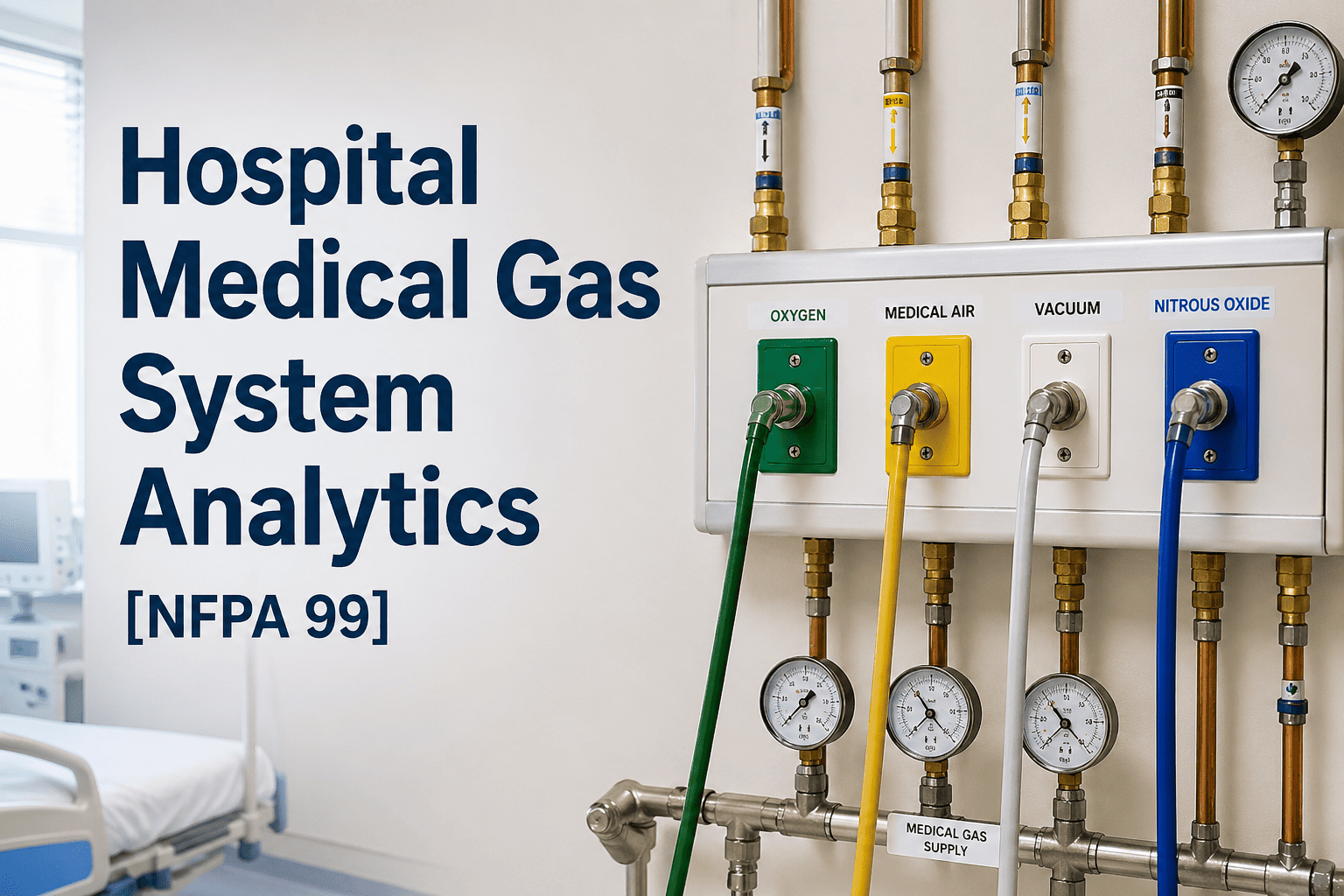
Every hour a hospital's medical gas system operates without a verified Analytics protocol, it silently accumulates regulatory exposure, Joint Commission liability, and — at its worst — a preventable patient safety event that no compliance officer can retroactively fix. The question is not whether your NFPA 99 gaps will surface. It is whether they surface during a scheduled audit — or during a Code Blue.
Is Your Medical Gas Infrastructure Audit-Ready — or a Liability Waiting to Happen?
iFactory's Medical Gas Analytics Platform transforms reactive compliance into a proactive revenue-protecting, patient-safe operational standard for healthcare systems at any scale.
The Financial and Clinical Cost of Fragmented Medical Gas Oversight
Hospital CFOs and CNOs face a compounding risk: medical gas system failures are simultaneously a patient safety catastrophe, a CMS reimbursement threat, and a multi-million dollar litigation exposure. Manual inspection logs, disconnected alarm systems, and paper-based NFPA 99 compliance trails are no longer operationally viable in a facility managing oxygen, medical air, vacuum, and nitrous oxide across dozens of zones. iFactory's integrated Analytics platform closes this gap — giving your clinical engineering and compliance teams a single, audit-defensible command layer before the next Joint Commission survey cycle begins.
Oxygen Systems
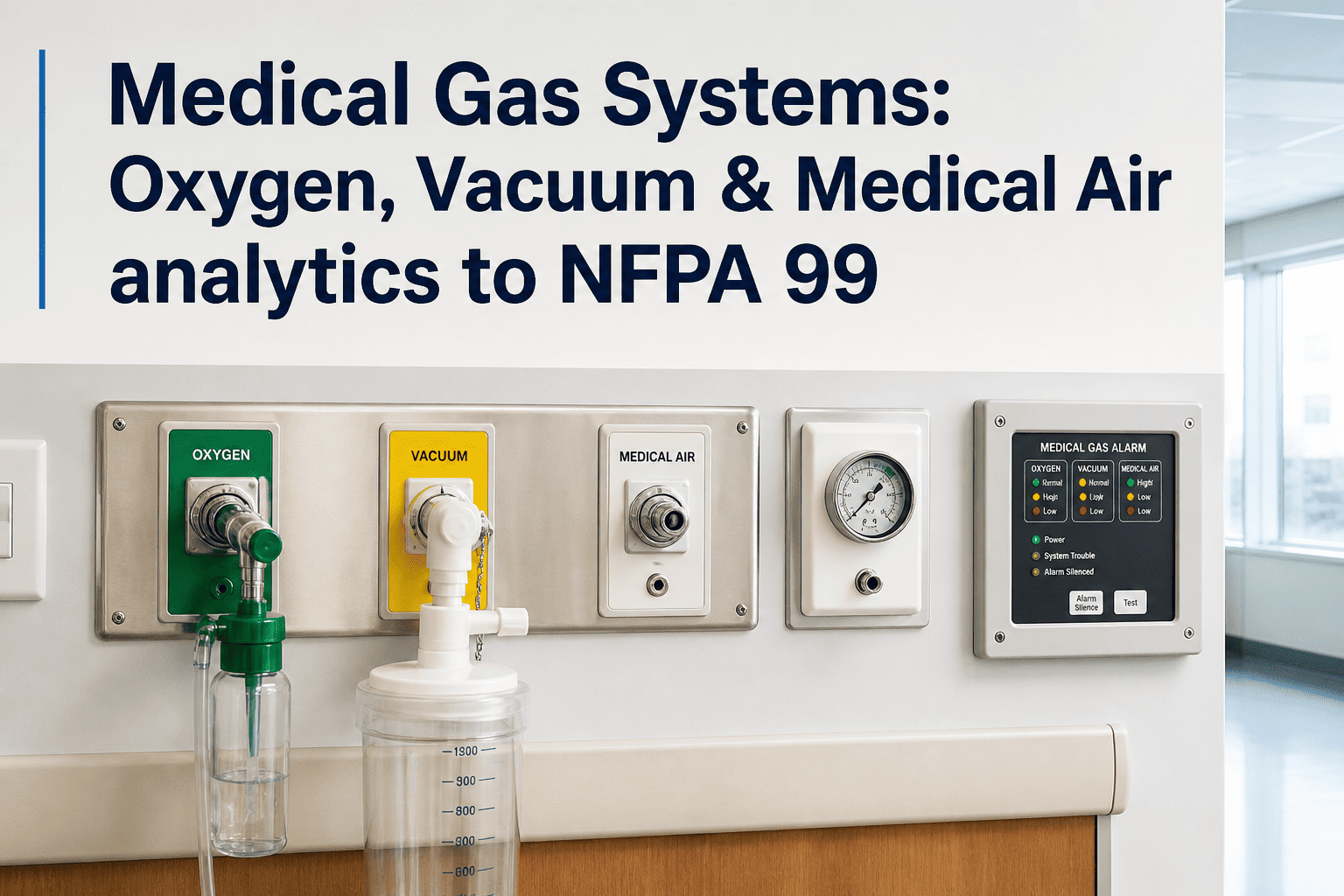
Continuous pressure monitoring, automated zone alarm verification, and predictive supply chain analytics for bulk liquid oxygen and cylinder backup systems per NFPA 99 Chapter 5.
Medical Air Systems
Dew point tracking, compressor performance logging, and automated flagging of air quality deviations before they reach ventilator-dependent patient zones in ICU or surgical suites.
Vacuum & WAGD
Real-time vacuum system throughput Analytics with cross-referenced alarm panel auditing and Waste Anesthetic Gas Disposal circuit validation mapped to OR scheduling data.
Nitrous Oxide
Automated manifold switchover logging, cylinder weight telemetry, and usage anomaly detection that prevents both clinical shortages and regulatory exposure from untracked gas consumption.
Legacy Friction vs. iFactory Optimized Excellence
Healthcare operations leaders can quantify the operational delta between fragmented manual workflows and an integrated iFactory Analytics deployment. The table below translates each gap into its direct financial, clinical, and regulatory consequence — the language that moves capital budget approvals.
| Operational Domain | Legacy Friction | iFactory Optimized Excellence | Clinical Risk Eliminated | Financial Impact |
|---|---|---|---|---|
| NFPA 99 Documentation | Paper logs, manual sign-off | Immutable digital audit trail, auto-generated | Joint Commission citation risk | $180K+ avg deficiency fine |
| Alarm Panel Testing | Quarterly manual tests, undocumented gaps | Continuous automated verification with timestamp export | Silent alarm failure in code situations | Litigation & CMS penalty exposure |
| Oxygen Pressure Monitoring | Visual gauge checks, reactive response | 24/7 sensor telemetry with predictive low-supply alerts | Ventilator & surgical gas disruption | Avoided emergency procurement costs |
| Medical Air Quality | Periodic dew point testing, manual log | Continuous dew point and CO monitoring with threshold alerts | Contaminated air delivery to patients | ICU adverse event cost avoidance |
| Inspection Scheduling | Calendar-based, staff-dependent | AI-driven risk-prioritized inspection dispatch | Missed inspections on high-risk zones | 30–40% labor efficiency gain |
| Regulatory Reporting | Manual compilation, weeks per audit cycle | One-click NFPA 99 compliance export, survey-ready | Undetected compliance drift between surveys | 80% reduction in audit prep hours |
How iFactory Addresses Burnout, Throughput, and Patient Safety Simultaneously
Healthcare VPs consistently cite three interlocked crises: clinical engineering staff burnout from manual compliance workloads, operational bottlenecks that constrain patient throughput, and escalating patient safety risk from aging infrastructure. iFactory's platform resolves all three through a single integrated workflow — not three separate point solutions.
Clinical engineering technicians currently spend an estimated 35–50% of their available hours on documentation, log reconciliation, and reactive alarm investigation. iFactory automates the full documentation layer — freeing staff for high-value inspection work, reducing turnover risk, and improving departmental retention KPIs that directly affect Joint Commission workforce standards scores.
Unplanned medical gas disruptions — pressure drops, vacuum failures, alarm ambiguities — cause surgical case delays averaging 23 minutes per incident and ICU diversion events that suppress revenue by tens of thousands per day. iFactory's predictive alert layer surfaces anomalies hours before clinical disruption, protecting case volume and downstream DRG reimbursement integrity.
The leading driver of medical gas adverse events is not equipment failure — it is undocumented alarm silencing, missed verification intervals, and cross-zone labeling errors that paper systems cannot catch in real time. iFactory's continuous monitoring engine creates a 360-degree safety envelope around every gas zone, generating defensible evidence that your hospital exercised appropriate clinical diligence.
The Five-Stage iFactory Medical Gas Analytics Deployment
Every iFactory deployment follows a structured implementation roadmap designed to deliver measurable compliance wins within the first 90 days while building the long-term predictive infrastructure that reduces capital replacement costs over a five-year horizon.
Operational Gap Audit
iFactory architects conduct a facility-wide NFPA 99 compliance gap assessment, mapping every medical gas zone, alarm panel, and inspection interval against current documentation to establish your baseline risk exposure score and ROI projection.
Sensor Integration & Digital Twin Build
IoT pressure, vacuum, and air quality sensors are deployed across all NFPA 99-governed zones. A high-fidelity digital twin of the facility's medical gas infrastructure is constructed to enable spatial visualization of system health and zone-level risk scoring.
Alarm Verification Automation
The platform integrates with existing master alarm panels and zone valve boxes to automate verification testing cycles. Every test result, timestamp, and technician signature is captured in an immutable log formatted for direct Joint Commission submission.
Predictive Analytics Activation
AI models trained on hospital medical gas failure signatures begin scoring your system for pressure degradation trends, compressor performance decline, and cylinder depletion trajectories — converting raw telemetry into prioritized maintenance work orders delivered directly to clinical engineering workflows.
Lifecycle & CapEx Optimization
Historical performance data aggregates into a structured capital planning model. Facilities leaders gain a 5-year rolling replacement forecast for compressors, manifolds, and distribution infrastructure — shifting from reactive capital requests to proactive board-level CapEx justification with documented asset condition evidence.
Schedule Your Medical Gas Operational Gap Audit Today
Healthcare systems that engage iFactory before their next Joint Commission survey cycle reduce citation risk by an average of 87% and recover full platform ROI within 14 months through avoided penalties, labor efficiency, and prevented case delays.
Medical Gas Analytics — Questions from Healthcare VPs and C-Suite Leaders
Does iFactory integrate with existing CMMS and HTM platforms like TMS or Accruent?
Yes. iFactory provides vendor-neutral API connectors for major healthcare CMMS platforms including TMS, Accruent, and IBM Maximo. Medical gas inspection records, work orders, and alarm verification logs are pushed directly into your existing asset management workflows — no parallel data entry, no duplicate documentation burden on clinical engineering staff.
How does the platform support Joint Commission and DNV survey preparation?
The platform maintains a continuously updated NFPA 99 compliance dashboard with one-click export of all required EC.02.05.07 and EC.02.05.09 documentation packages. Survey coordinators can generate a fully formatted evidence binder — including alarm test records, inspection intervals, and corrective action logs — in under four hours rather than the three to five weeks typical of manual compilation processes.
What is the deployment timeline for a multi-campus health system?
A single-campus deployment achieves full sensor integration and dashboard activation within 60 to 90 days. Multi-campus health systems follow a phased rollout prioritized by Joint Commission survey schedule and assessed risk density. Most enterprise clients reach system-wide deployment within 12 months with dedicated iFactory implementation support at each facility. Book a Demo to review a detailed implementation timeline for your system.
How does iFactory address HIPAA and healthcare data sovereignty requirements?
iFactory deploys on HIPAA-eligible cloud infrastructure with AES-256 encryption at rest and in transit. All medical gas telemetry and inspection data remains within your designated sovereign cloud environment. A Business Associate Agreement is executed as a standard contract component, and our security architecture documentation is available for direct review during the clinical informatics evaluation process.
Can the platform be scoped to a single high-risk department before enterprise rollout?
Absolutely. Many health systems begin with a targeted deployment in the surgical suite, ICU, or cardiac catheterization lab — environments where medical gas failure carries the highest patient safety and revenue risk. This pilot model delivers measurable ROI within the first quarter and builds the institutional evidence base needed to justify system-wide capital approval. Book a Demo to design your pilot scope.
Every Day Without Analytics Is a Day of Unquantified Risk
Healthcare leaders who act before a survey cycle — not after a citation — protect patient safety, preserve reimbursement revenue, and build the operational infrastructure for sustainable growth. The audit is the easy part. Surviving it with zero deficiencies requires iFactory.



.png)