Every hour your hospital runs on legacy emergency power protocols, you are accepting a liability that your board, your patients, and your insurers cannot afford. Generator failures during critical care windows cost facilities an average of $690,000 per incident—and NFPA 110 non-compliance exposes you to regulatory shutdown risk that no risk officer can defend.
Is Your Emergency Power Infrastructure One Failure Away From a Patient Safety Crisis?
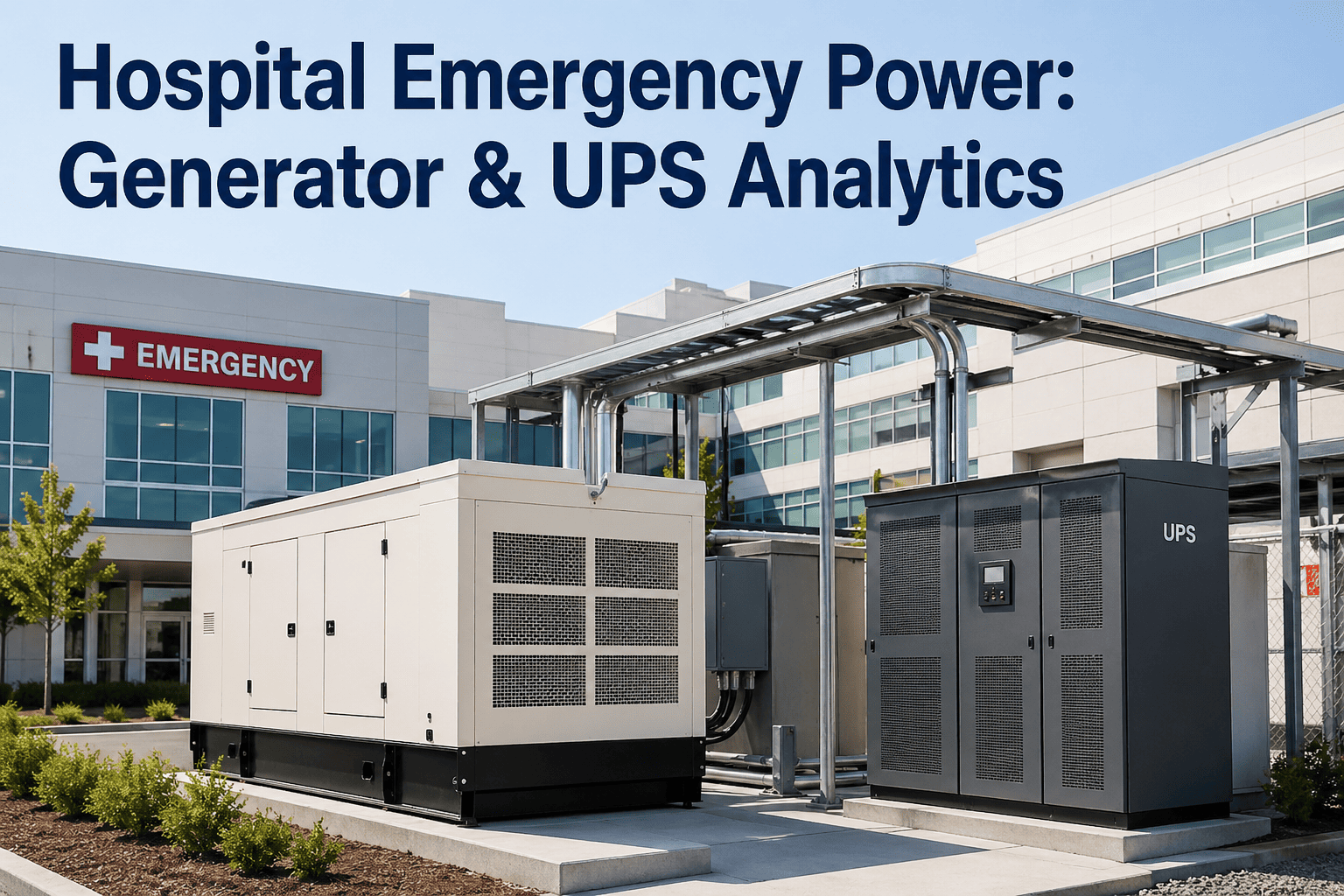
iFactory Healthcare unifies generator telemetry, UPS health, transfer switch logic, and NFPA 110/99 compliance into a single predictive intelligence dashboard designed for healthcare operations at scale.
The Financial & Clinical Case for Predictive Emergency Power Analytics
Healthcare executives managing multi-site campuses face an invisible operational risk: emergency power systems that pass annual load tests but fail silently between inspection cycles. The problem is not hardware—it is the absence of continuous intelligence. iFactory Healthcare transforms your generator fleet, transfer switches, and UPS banks from inspected assets into monitored, self-reporting infrastructure that surfaces degradation weeks before it becomes a code-red event. The ROI is immediate: reduced testing labor, avoided catastrophic repair costs, and defensible NFPA 110/99 audit trails that eliminate regulatory exposure.
Generator Fleet Analytics
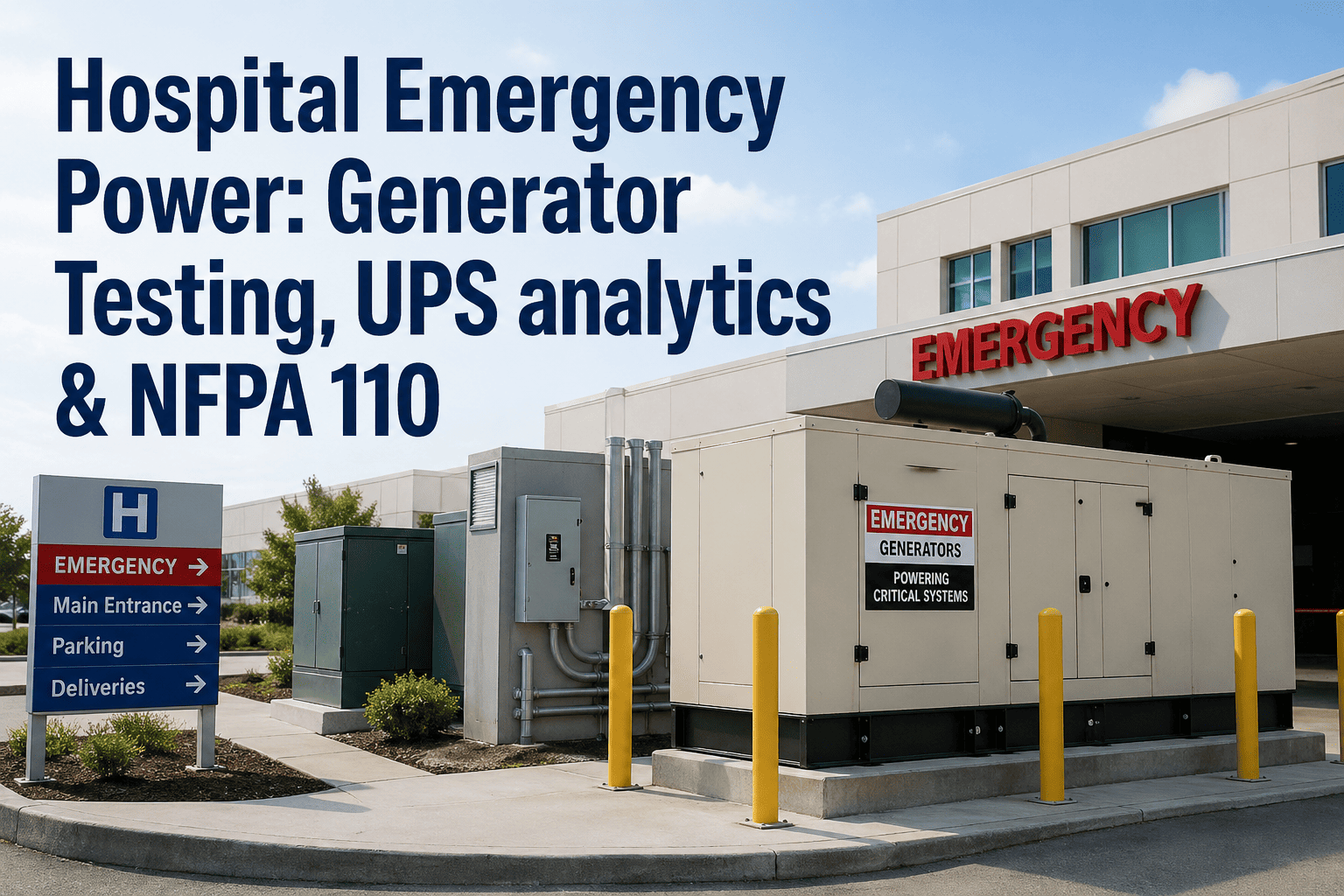
Continuous runtime monitoring, fuel consumption trending, coolant and oil temperature baselines, and automated NFPA 110 load test scheduling with digital pass/fail documentation.
UPS Health Monitoring
Real-time battery state-of-health scoring, capacitor degradation alerts, bypass event logging, and predictive replacement scheduling that eliminates surprise battery failures in surgical suites and ICUs.
Transfer Switch Intelligence
Automated transfer time benchmarking, contact wear analysis, and switching sequence validation ensure that every essential branch circuit energizes within the 10-second NFPA 99 life-safety window.
NFPA Compliance Engine
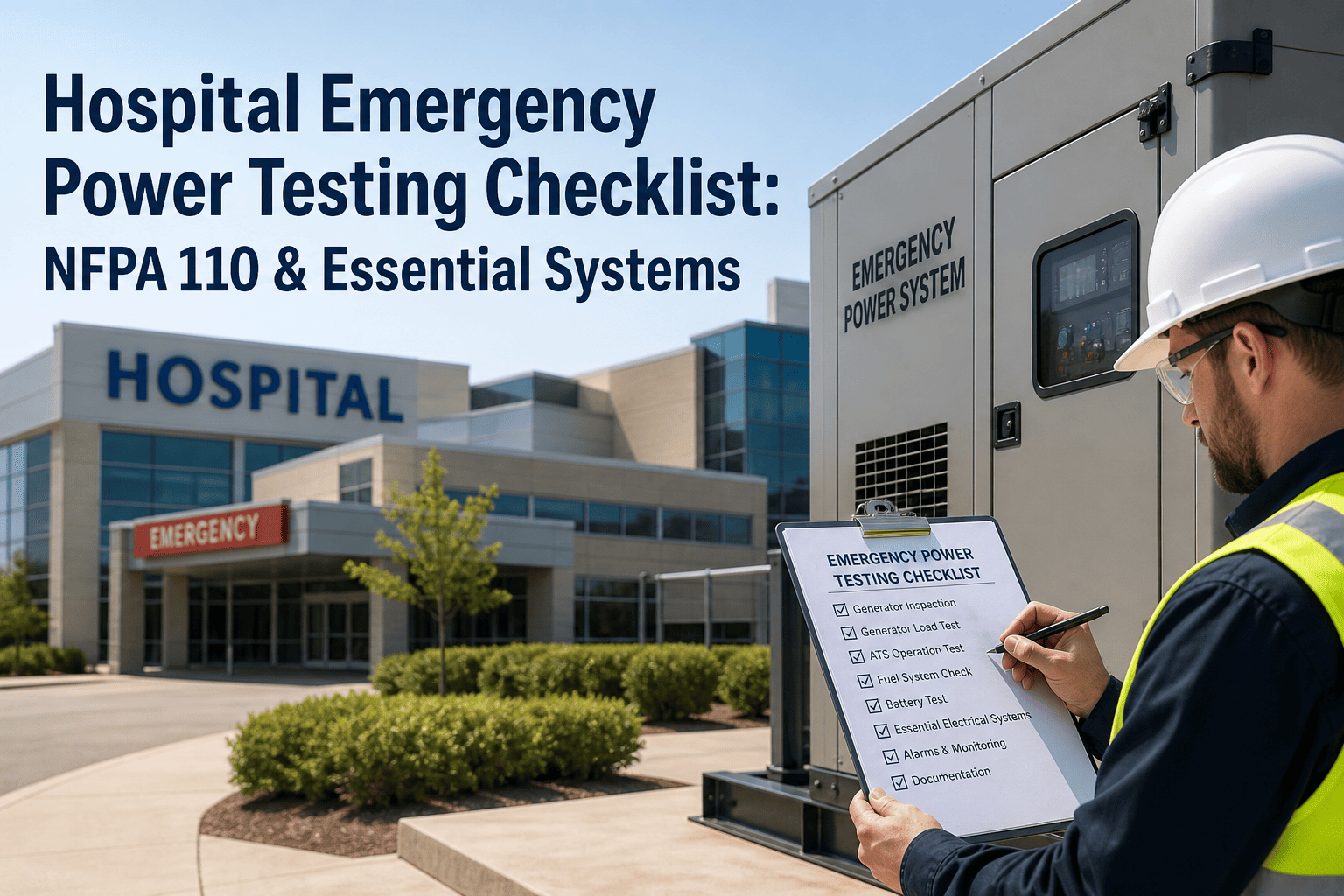
Automated generation of NFPA 110 and NFPA 99 inspection records, exception reports, and corrective action logs. Produces a legally defensible audit trail for every test cycle and anomaly event.
Legacy Friction vs. iFactory Optimized Excellence
The gap between how most health systems manage emergency power today and what is operationally possible is not incremental—it is transformational. The comparison below is the conversation your VP of Facilities, CNO, and CFO need to have before the next inspection cycle.
| Operational Domain | Legacy Friction | iFactory Optimized Excellence | Financial Impact |
|---|---|---|---|
| Generator Monitoring | Annual load tests only. Failures discovered during events. | Continuous telemetry with predictive degradation scoring 6–8 weeks out. | Avoid $690K average incident cost |
| UPS Battery Lifecycle | Fixed replacement schedules regardless of actual health. | AI-driven state-of-health index replaces on condition, not on calendar. | 35% reduction in battery CapEx |
| Transfer Switch Testing | Manual log sheets. Human error in transfer time recording. | Automated transfer time capture, variance trending, and code-ready reports. | 80% labor reduction per test cycle |
| NFPA 110/99 Compliance | Paper binders. Audit prep takes weeks. Gaps discovered during surveys. | Real-time compliance dashboard. Audit package generated in under 4 hours. | Eliminate regulatory penalty exposure |
| Multi-Site Visibility | Siloed facility reports. No cross-campus risk aggregation. | Unified executive dashboard showing fleet health index across all campuses. | Single FTE manages 12+ facilities |
| Incident Response | Reactive. Staff alerted after failure begins. | Predictive alerts dispatched 48–72 hours before threshold breach. | Zero unplanned clinical downtime |
How Emergency Power Analytics Solves Your Three Biggest Clinical Risks
Power infrastructure failure is not an engineering problem in isolation—it is a patient safety event, a staff burnout accelerator, and a throughput killer. iFactory Healthcare is built for healthcare operations leaders who understand that every minute of emergency power uncertainty has a clinical cost measured in outcomes, not just dollars.
Ventilators, perfusion pumps, and anesthesia workstations require uninterrupted power with zero tolerance for transfer delays. iFactory validates every ATS transfer event against the 10-second NFPA 99 window and alerts clinical engineering the moment variance is detected—before a patient is ever in the room.
Facilities teams at health systems spend an estimated 1,200 hours per campus per year on manual NFPA documentation and emergency power testing coordination. iFactory automates data capture, exception flagging, and report generation—freeing your engineers to focus on resolution rather than recordkeeping.
Unplanned power events in OR suites trigger mandatory downtime protocols that cascade into case cancellations and revenue loss averaging $15,000 per delayed surgical hour. Predictive generator and UPS analytics eliminate the unplanned component of this equation entirely.
From Pilot to Full-Campus Deployment in 90 Days
iFactory Healthcare is engineered for rapid deployment inside existing CMMS and BMS environments. Our implementation methodology requires no rip-and-replace of current infrastructure—we layer predictive intelligence on top of what you already own, delivering measurable ROI before your next NFPA inspection cycle. Book a Strategic Demo to receive a campus-specific deployment timeline built around your current generator and UPS inventory.
Operational Gap Audit
Our clinical engineering consultants map your existing emergency power assets, review your last three NFPA inspection cycles, and quantify the compliance and financial risk in your current state. Delivered as a board-ready executive brief within 5 business days.
Sensor Integration & Baseline Establishment
IoT telemetry nodes are deployed on your generator fleet, UPS systems, and transfer switches. AI models establish operational baselines for each asset within 30 days of live data ingestion, calibrated against your facility's demand patterns and clinical schedules.
NFPA Compliance Dashboard Activation
Your compliance team receives access to a real-time NFPA 110/99 dashboard pre-loaded with your asset inventory, inspection schedules, and exception queues. The first automated audit package is generated and reviewed with your team before the 60-day mark.
Predictive Alert Calibration
Alert thresholds are tuned to your clinical priority tiers—OR suites, ICUs, and ED receive the highest sensitivity profiles. Your facilities team begins receiving actionable predictive work orders 48–72 hours ahead of potential threshold breaches.
Executive Reporting & Multi-Site Rollout
C-suite and VP-level stakeholders receive a unified fleet health index, financial risk dashboard, and CapEx forecasting tool. Deployment scales to additional campuses using the same integration framework with no additional implementation overhead per site.
Your Next Regulatory Survey Is Either a Risk or a Showcase. You Choose.
Healthcare VPs and C-Suite leaders who have completed the iFactory Operational Gap Audit report an average 42% reduction in emergency power-related risk exposure within the first quarter. The audit is complimentary. The risk of declining it is not.
Emergency Power Analytics for Hospitals — Executive Questions Answered
Does iFactory replace our existing CMMS or integrate with it?
iFactory is designed as a complementary intelligence layer, not a replacement. We integrate bidirectionally with leading healthcare CMMS platforms including TMS, Accruent, and IBM Maximo, pushing predictive work orders directly into your existing workflow queues so adoption requires zero retraining of your facilities team.
How does the platform document NFPA 110 compliance for Joint Commission surveys?
Every load test, transfer time event, fuel level check, and battery health reading is timestamped, geo-tagged to the asset, and stored in an immutable log that meets Joint Commission Environment of Care documentation standards. Surveyors can review a complete 36-month history in a single digital package. Book a Demo to see a live audit export.
What is the typical ROI timeline for a mid-size health system?
Mid-size health systems with 3–8 campuses typically recover full platform cost within 14 months through avoided emergency repairs, reduced manual testing labor, and eliminated regulatory penalty exposure. Systems with aging generator fleets (10+ years) frequently see ROI within the first 6 months due to a single avoided catastrophic failure event identified through predictive scoring. Book a Demo to run your specific ROI model.
Can the platform monitor both utility-grade generators and smaller branch-circuit UPS units?
Yes. iFactory's sensor architecture scales from 2MW campus generators down to 3kVA pharmacy UPS units. Every asset in your essential electrical system hierarchy is monitored under a single platform, giving you a complete essential branch, critical branch, and equipment branch view across your entire facility footprint.
How is clinical data protected given that the platform connects to hospital infrastructure networks?
iFactory operates on a dedicated, isolated OT network segment that never intersects with your EHR or clinical data networks. All telemetry is transmitted over encrypted channels to a HITRUST-certified cloud environment with no PHI exposure by design. Our security architecture is available for review during your Strategic Demo.
Schedule Your Hospital Emergency Power Intelligence Briefing Today
Join the health systems already operating with predictive emergency power intelligence. Every week of delay is a week of unquantified risk exposure your board cannot see and your patients cannot afford.