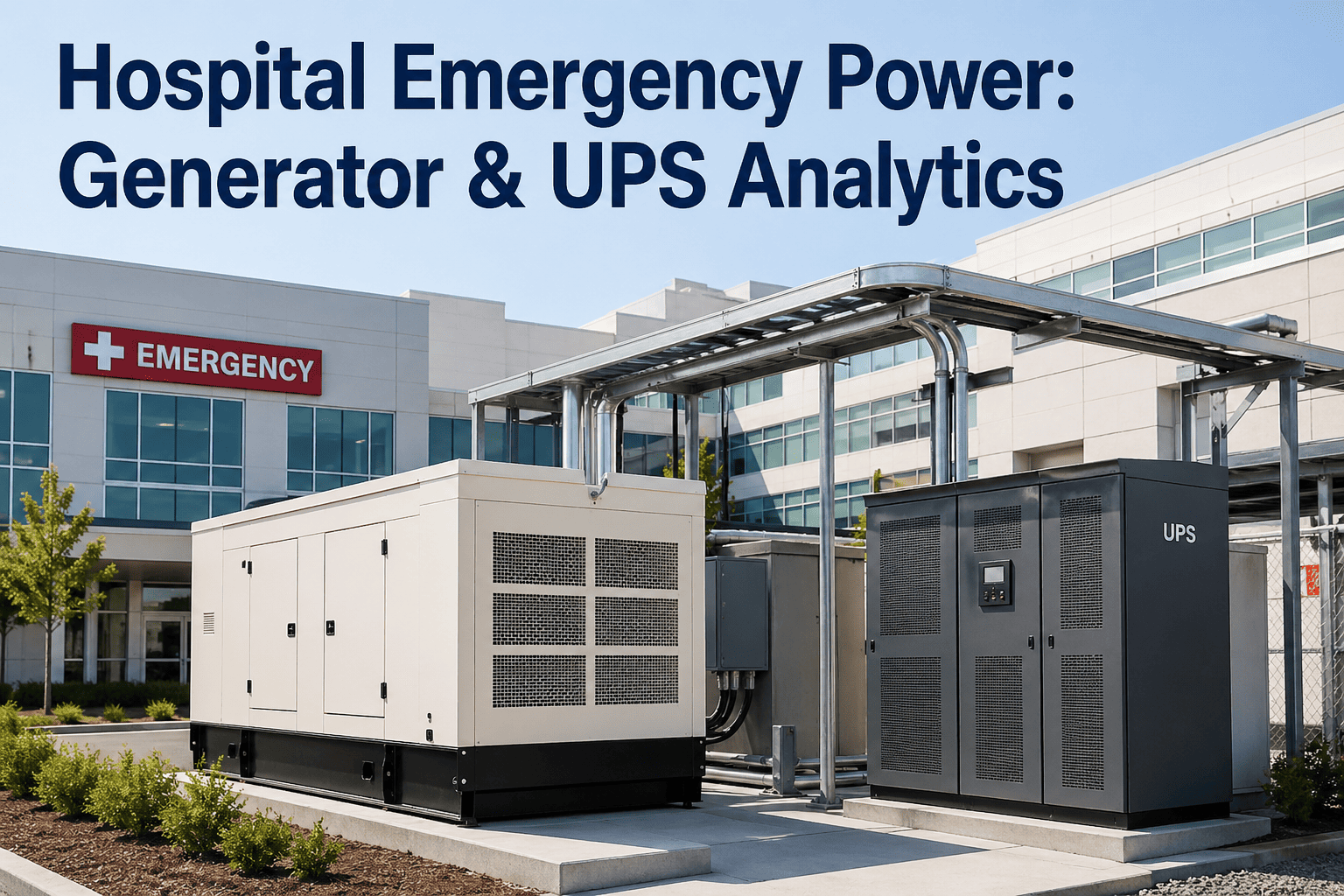
Every hour a hospital generator fails a load test without a documented corrective action plan, clinical leadership absorbs compounding liability exposure—undetected fuel degradation, unverified ATS transfer timing, and silent NFPA 110 gaps that become CMS survey findings, accreditation losses, and, in the worst scenario, preventable patient harm during the next grid outage.
Is Your EPSS Audit-Ready for the Next Unannounced Survey?
iFactory Compliance Management centralises generator logs, ATS records, and fuel data into a single defensible audit trail—eliminating manual spreadsheet risk overnight.
Why Emergency Power Testing Is a Revenue and Safety Event—Not Just Maintenance
NFPA 110 and CMS Condition of Participation 482.41(c) mandate rigorous testing of every Essential Electrical System component. Non-compliance triggers:
Revenue Risk
- CMS Immediate Jeopardy citations average $50K–$100K per occurrence
- Joint Commission findings halt elective procedure revenue streams
- Repeat deficiencies trigger mandatory third-party oversight costs
Patient Safety
- Unverified ATS transfer time leaves ICU on unprotected power for 4–10 seconds
- Failed generator load tests indicate equipment that will fail in real emergencies
- Undetected fuel contamination causes mid-outage generator shutdown
Operational Exposure
- Paper-based logs cannot produce real-time compliance dashboards for surveyors
- Manual scheduling misses monthly, quarterly, and annual test cadences
- Incomplete deficiency tracking leaves corrective actions unverified
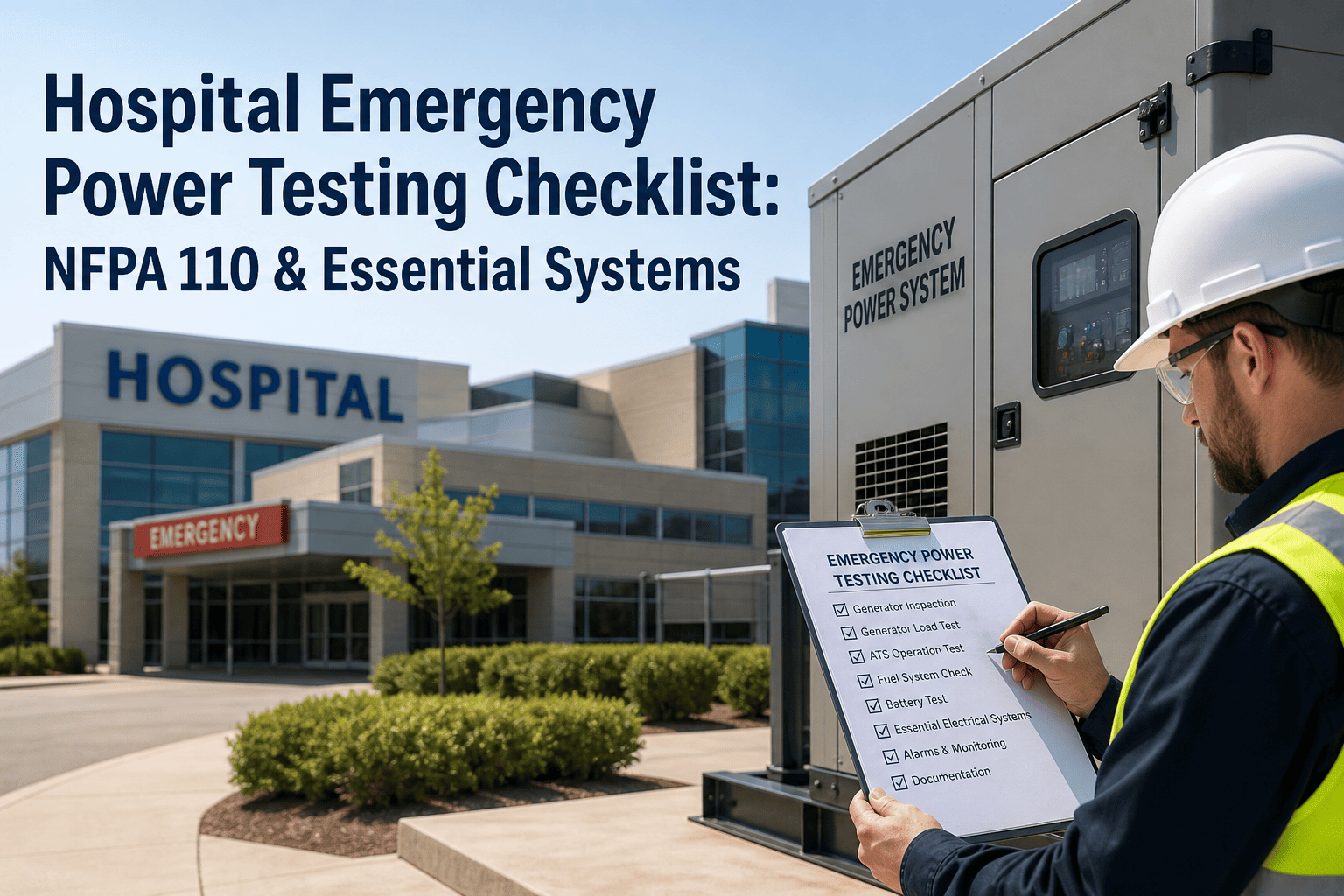
Hospital Emergency Power Testing Checklist: NFPA 110 & Essential Systems
Use this structured checklist across monthly, quarterly, and annual cycles. Each item maps directly to NFPA 110 Chapter 8 and CMS interpretive guidelines.
- ✓ Run generator under load for minimum 30 minutes at ≥30% nameplate rating
- ✓ Verify automatic transfer switch (ATS) picks up within 10 seconds of simulated utility failure
- ✓ Inspect fuel level — confirm ≥ 96-hour on-site supply per NFPA 110 §8.3.7
- ✓ Check coolant level, oil pressure, battery voltage, and block heater operation
- ✓ Document all alarm panel indicators — low fuel, high coolant temp, overcrank
- ✓ Verify annunciator panel functionality at generator and remote location
- ✓ Confirm load test log is signed by licensed facility engineer or designee
- ✓ Test all automatic transfer switches under load — record transfer and retransfer times
- ✓ Verify Life Safety Branch (LSB) illuminates within 10 seconds of normal power loss
- ✓ Test Critical Branch (CB) restoration — OR lighting, nurse call, receptacles
- ✓ Verify Equipment System (ES) branch loads transfer within 10 seconds
- ✓ Inspect UPS systems serving life-critical equipment — runtime verification required
- ✓ Document any voltage or frequency deviations during transfer sequence
- ✓ Conduct 4-hour full-load test per NFPA 110 §8.4.2 — all connected loads, no artificial load banks unless justified
- ✓ Submit diesel fuel sample for ASTM D975 analysis — water content, microbial, cetane rating
- ✓ Perform infrared thermography on all switchgear, bus bars, and ATS contacts
- ✓ Test governor response — verify frequency stabilises within 2 Hz within 10 seconds
- ✓ Verify all EPSS documentation is current: single-line diagrams, equipment inventory, maintenance logs
- ✓ Validate written EPSS testing plan is reviewed and approved by AHJ or designated engineer
- ✓ Confirm corrective action register is closed for all prior year deficiencies
The Compliance Gap: Legacy Friction vs. iFactory Optimised Excellence
| Compliance Area | Legacy Friction | iFactory Optimised Excellence | Clinical Outcome |
|---|---|---|---|
| Test Scheduling | Manual calendar reminders, frequent misses | Automated cadence engine — monthly, quarterly, annual auto-triggered | Zero Missed Tests |
| Log Documentation | Paper binders, illegible entries, missing signatures | Digital logs with timestamped technician sign-off and photo attachments | Surveyor-Ready in Seconds |
| ATS Transfer Timing | Manual stopwatch, often unrecorded | Automated timing capture integrated with CMMS data stream | Verified Every Cycle |
| Fuel Management | Visual gauge checks, no trend history | IoT sensor integration with low-fuel predictive alert at 7-day threshold | No Supply Surprises |
| Deficiency Tracking | Sticky notes, email chains, unverified closure | Corrective Action module with owner assignment, due date, and closure proof | Auditable Closure Trail |
| Regulatory Reporting | 48-hour scramble before surveys | One-click NFPA 110 compliance report — exportable to PDF or GRC platform | Survey Confidence |
How Digitised EPSS Compliance Reduces Burnout and Increases Throughput
Facilities Engineer Relief
- Eliminates 6–10 hrs/month of manual log compilation
- Auto-notifies technicians of upcoming test windows
- Reduces overtime tied to last-minute survey preparation
- Mobile-first interface — complete tests from the generator room floor
Risk & Compliance Leadership
- Real-time EPSS compliance dashboard visible to CNO and CFO
- Proactive gap identification before regulatory contact
- Links every deficiency to a work order with financial impact estimate
- Supports enterprise-wide roll-up across multi-campus health systems
Patient Throughput Protection
- Verified ATS performance keeps ORs and ICUs protected during transfers
- Proven generator reliability prevents unplanned procedure interruptions
- Maintains elective surgery scheduling confidence — protects revenue
- Supports Magnet® and DNV certification documentation requirements
Stop Managing Emergency Power on Spreadsheets
iFactory Compliance Management transforms your EPSS testing programme into an always-on, audit-ready digital system — reducing survey risk and protecting patient safety at every campus.
NFPA 110 & Hospital EPSS Testing — Frequently Asked Questions
What does NFPA 110 require for monthly generator tests?
NFPA 110 §8.4.1 mandates monthly load tests of at least 30 minutes at ≥30% of nameplate kW rating. If the facility cannot achieve this under connected load, a supplemental load bank test must be documented with engineering justification on file.
How does iFactory handle multi-campus health system EPSS tracking?
The platform supports enterprise-level hierarchy — each campus maintains its own generator and ATS inventory while system leadership views a consolidated compliance dashboard. Gaps at any site trigger escalation workflows to the appropriate facilities director automatically.
Can iFactory produce the documentation required during a CMS survey?
Yes. The Compliance Management module generates a timestamped, technician-signed EPSS test history report on demand. Surveyors receive a PDF covering the full look-back period — typically 12–36 months — within seconds of the request. Book a Demo to see the report builder.
What is the ROI timeline for digitising our EPSS compliance programme?
Most health systems recover implementation costs within the first survey cycle avoided. A single CMS Immediate Jeopardy citation for EPSS non-compliance can cost $50K–$250K in fines, consulting fees, and lost elective revenue — far exceeding annual platform cost. Request an Operational Gap Audit for a facility-specific estimate.
Does the platform integrate with existing CMMS and BMS systems?
iFactory connects via REST API to major CMMS platforms including IBM Maximo, TMA, and Accruent. Building management system data feeds can be ingested to auto-populate generator runtime hours, fuel sensor readings, and alarm events directly into the compliance log.
Launch Your EPSS Digital Compliance Programme Today
Join health systems that have eliminated paper-based generator logs and achieved continuous NFPA 110 readiness with iFactory Compliance Management.


.png)