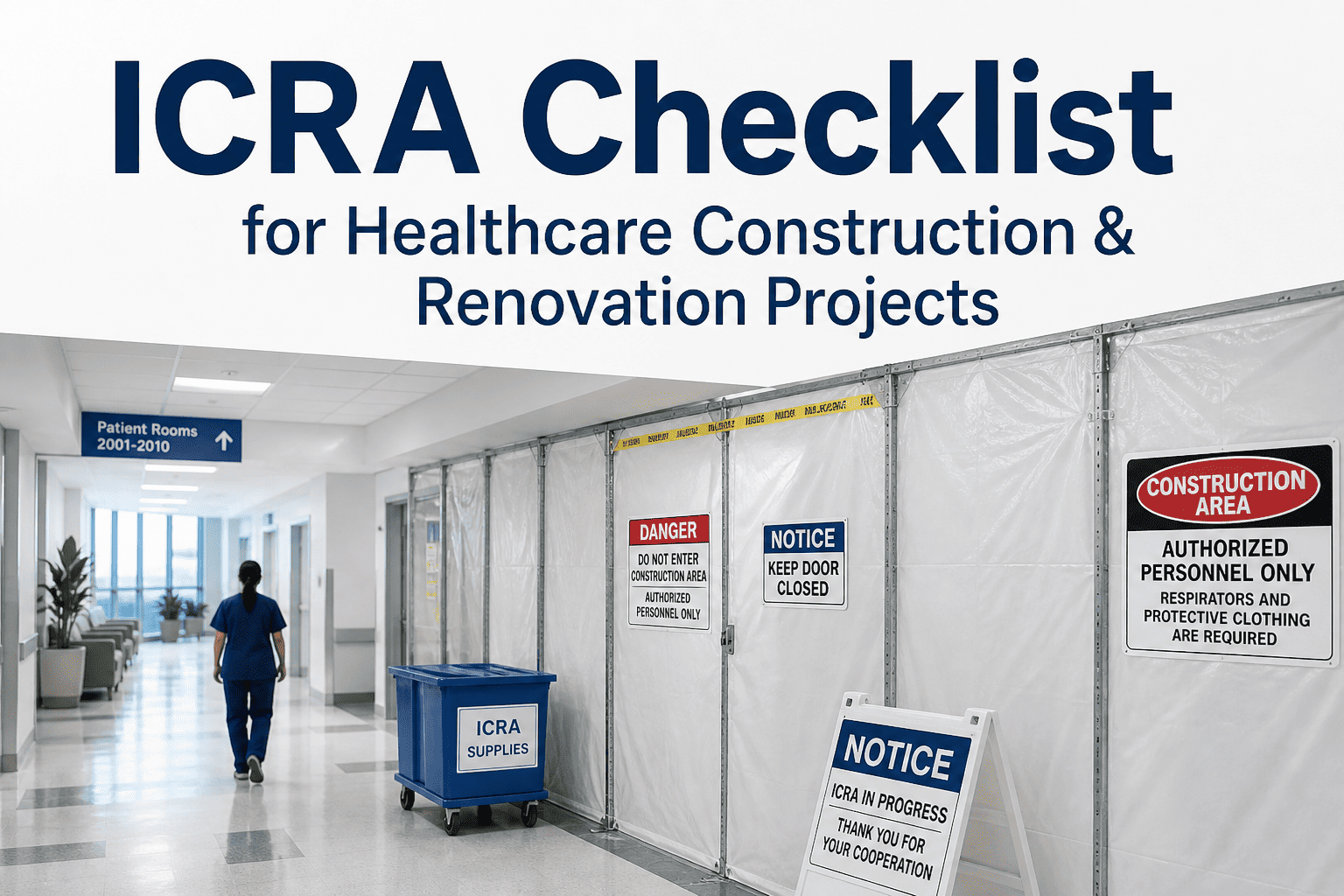
Every hour a healthcare facility operates under unmanaged construction risk, it exposes immunocompromised patients to airborne pathogens, invites costly regulatory violations, and quietly hemorrhages revenue through avoidable infection-related readmissions. Without a structured ICRA checklist embedded in your compliance workflow, your team is one inspection away from a Joint Commission citation — and one outbreak away from a reputational crisis that no marketing budget can repair.
Is Your ICRA Process Fully Documented & Audit-Ready?
iFactory digitizes your Infection Control Risk Assessment workflow — from Class I to Class IV — with automated documentation, real-time barrier tracking, and compliance audit trails.
What Is an ICRA Checklist — and Why It Is a Financial Imperative
An Infection Control Risk Assessment (ICRA) checklist is a structured pre-construction protocol mandated by the Joint Commission, CDC, and CMS for all healthcare renovation and construction projects. It classifies risk by patient vulnerability and project type, then enforces physical, procedural, and air-quality controls. Facilities without a digital, trackable ICRA process face compounding losses:
ICRA Risk Class Matrix — Know Your Exposure Before Breaking Ground
Every ICRA begins with a dual-axis classification: Construction Activity Type (A through D) crossed with Patient Risk Group (Low to Highest). The resulting class — I through IV — determines the full scope of required controls. Use this matrix as your first checklist gate.
| ICRA Class | Activity Type | Patient Risk Group | Required Controls | iFactory Status |
|---|---|---|---|---|
| Class I | Type A — Inspection only | Low Risk | Standard work practices | Automated |
| Class II | Type B — Small scale, short duration | Medium Risk | Dust control, HEPA vacuuming | Tracked |
| Class III | Type C — Work generating dust | High Risk | Sealed barriers, negative air pressure | Enforced |
| Class IV | Type D — Major demolition | Highest Risk | Anteroom, HEPA, 24/7 air monitoring | Audited |
Complete ICRA Checklist for Healthcare Construction & Renovation
The following checklist is organized by phase. Each item must be documented with date, responsible party, and verification signature to meet Joint Commission standards. iFactory digitizes every line item with timestamped accountability.
Pre-Construction Assessment
Barrier & Containment Setup
Active Construction Monitoring
Post-Construction & Closeout
Legacy ICRA Friction vs. iFactory Optimized Excellence
The gap between manual ICRA management and a digitized compliance platform is measured in audit failures, HAI events, and staff hours. This comparison translates that gap into operational and financial reality.
| ICRA Dimension | Legacy Friction | iFactory Optimized Excellence | Outcome |
|---|---|---|---|
| Documentation | Paper forms, manual filing, illegible signatures | Digital timestamped checklists with e-signatures | 100% audit-ready records |
| Risk Classification | Subjective, inconsistent across departments | Standardized matrix with guided decision logic | Zero classification errors |
| Barrier Monitoring | Sporadic manual walkthroughs, no log | Scheduled digital inspections with photo evidence | Breach detection in real time |
| Air Quality Tracking | Separate spreadsheets, manual data entry | Integrated sampling log with threshold alerts | Proactive HAI prevention |
| Regulatory Audit | Hours of document retrieval and compilation | One-click compliance report export | Audit preparation in minutes |
| Staff Accountability | Unclear ownership, reactive escalation | Role-assigned tasks with completion tracking | Full chain of custody documented |
How Digital ICRA Management Resolves the Three Clinical Crises
Staff Burnout Reduction
Patient Throughput & Safety
Regulatory & Financial Risk Mitigation
Replace Paper ICRA Processes with an Audit-Ready Digital Platform
iFactory's Compliance Management module digitizes every phase of your ICRA workflow — from pre-construction risk classification to post-construction sign-off — with full documentation, mobile access, and one-click regulatory reporting.
ICRA Checklist — Frequently Asked Questions
Who is responsible for completing the ICRA checklist in a hospital?
The Infection Control practitioner or designated IC liaison owns the ICRA permit. However, completion requires sign-off from the project manager, facilities director, and department head. iFactory assigns role-based tasks to each stakeholder with deadline enforcement and escalation alerts.
Is an ICRA checklist required for minor repairs, not just major renovations?
Yes. Even Type A activities — such as cutting ceiling tiles for inspection — require a Class I ICRA assessment if performed in or adjacent to patient care areas. iFactory's guided intake form automatically determines the required class based on activity type and patient proximity.
How does iFactory ensure ICRA documentation is Joint Commission compliant?
Every checklist item in iFactory is mapped to Joint Commission EC.02.06.05 standards. Completed checklists are timestamped, e-signed, and stored in an immutable record that can be exported instantly during a tracer audit. Book a Demo to review our compliance architecture.
Can iFactory support multi-site health systems running concurrent ICRA projects?
Absolutely. iFactory's enterprise architecture supports unlimited concurrent ICRA projects across multiple campuses in a single dashboard. System-level administrators gain portfolio visibility while site-level teams manage their individual project workflows independently. Book a Demo to see the multi-site control panel.
Launch Your Digital ICRA Compliance Workflow Today
Join healthcare facilities already protecting patients and passing audits with iFactory's automated ICRA management platform.


.png)