Every hour a hospital construction project runs without a compliant ICRA protocol, immunocompromised patients are breathing unfiltered air carrying Aspergillus spores — a pathogen responsible for mortality rates exceeding 50% in vulnerable populations. The cost of a single healthcare-acquired infection (HAI) attributable to construction can exceed $45,000 in direct treatment costs, not counting regulatory fines, litigation exposure, and irreversible reputational damage. Yet most facilities still manage ICRA through paper checklists, disconnected spreadsheets, and reactive monitoring. The question is not whether your next renovation project carries infection risk — it does. The question is whether your compliance infrastructure is engineered to contain it.
Is Your ICRA Process Audit-Ready and Digitally Enforced?
iFactory centralizes your ICRA classification, barrier checklists, and monitoring logs into a single compliance dashboard — protecting patients and passing every regulatory inspection.
Infection Control Risk Assessment: The Regulatory Foundation of Safe Healthcare Construction
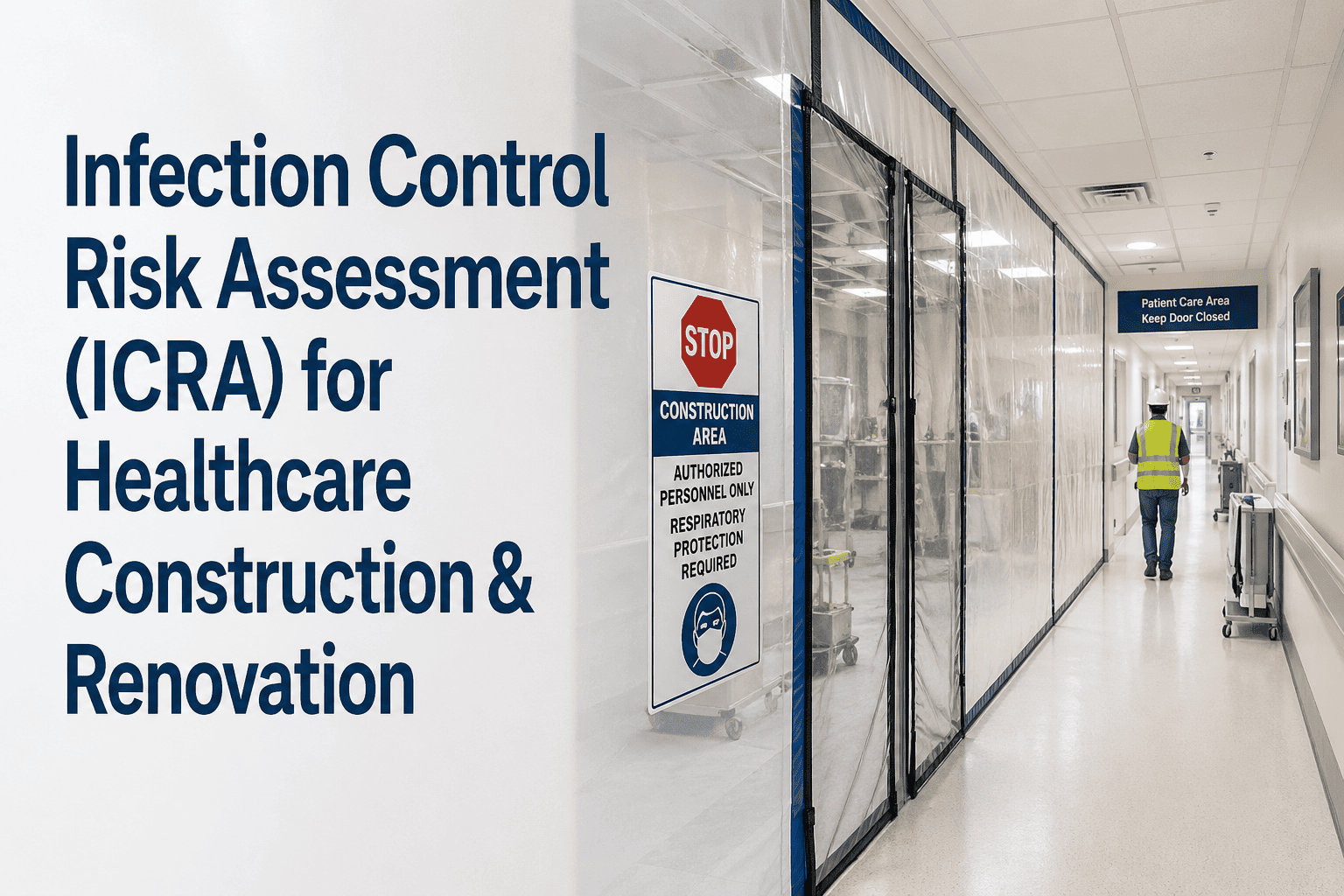
ICRA is a structured, pre-construction protocol mandated by The Joint Commission, ASHRAE 170, and FGI Guidelines. It classifies renovation risk by project type and patient population proximity — producing a legally binding action plan that governs dust containment, airflow direction, barrier integrity, and worker compliance throughout every phase of construction.
Risk Classification
Projects are scored from Class I (low dust, minor work) to Class IV (high-risk demolition near immunocompromised units), each triggering escalating containment requirements.
Barrier Engineering
Physical containment walls, negative pressure units, HEPA filtration, and sticky mats must be specified, installed, and verified before a single tool touches the construction zone.
Permit & Sign-Off
An ICRA permit must be issued, signed by Infection Control and Facilities, posted at the work site, and maintained in an auditable record for the duration of the project.
Active Monitoring
Daily environmental rounds, air pressure verification, and barrier inspection must be logged with timestamped records. Deviations require immediate corrective action documentation.
Understanding the Four ICRA Risk Classes and Required Interventions
The ICRA matrix intersects Construction Activity Type (A through D) with Patient Risk Group (Low, Medium, High, Highest) to produce a Class I–IV designation. Each class carries mandatory controls that cannot be negotiated or deferred — only documented and enforced.
| ICRA Class | Activity Type | Patient Risk Zone | Required Controls | Compliance Priority |
|---|---|---|---|---|
| Class I | Type A — Inspection only | Low Risk | Dust mask, work area cleanup | Standard |
| Class II | Type B — Small scale, short duration | Medium Risk | Portable containment, HEPA vacuum | Elevated |
| Class III | Type C — Any demolition or dust-generating work | High Risk | Anterooms, negative air pressure, daily log | High |
| Class IV | Type D — Major demolition near patient care | Highest Risk | Full isolation barriers, 24/7 monitoring, director sign-off | Critical |
Legacy ICRA Friction vs. iFactory Optimized Compliance Excellence
Most healthcare facilities are managing Class III and IV projects using tools that were never designed for real-time compliance enforcement. The operational and financial gap between legacy workflows and a digitally integrated ICRA platform is not incremental — it is categorical.
| Compliance Area | Legacy Friction | iFactory Optimized Excellence | Operational Impact |
|---|---|---|---|
| Risk Classification | Manual matrix review, prone to misclassification | Guided digital wizard auto-assigns ICRA class | Zero misclassification incidents |
| Permit Issuance | Paper forms, 48–72 hr turnaround | Digital permit generated and countersigned in minutes | Projects launch faster, compliantly |
| Barrier Verification | Verbal walkthroughs, no photo evidence | Timestamped photo checklists with geo-tags | Auditable, defensible documentation chain |
| Daily Monitoring | Paper rounds log, often incomplete | Mobile-first digital rounds with real-time escalation | 100% round completion enforcement |
| Regulatory Reporting | Manual extraction, 10–15 hr report prep | One-click audit package with full chain of custody | Survey-ready in under 30 minutes |
| Corrective Actions | Verbal notifications, no tracking | Automated task assignment with resolution SLA | Closed-loop accountability on every finding |
How Digital ICRA Management Solves the Three Biggest Clinical Operational Failures
Infection preventionists spend 6–10 hours per project week on ICRA paperwork coordination. iFactory automates permit routing, checklist distribution, and reminder escalations — reclaiming clinical capacity for patient-facing surveillance.
Unverified barrier failures trigger emergency unit evacuations. Digital real-time barrier monitoring detects pressure differentials and seal breaches before they escalate — keeping beds operational and revenue streams intact.
A single Joint Commission citation for ICRA deficiency can result in a Condition-Level finding requiring a 45-day corrective plan. iFactory's continuous digital audit trail transforms surveyor visits from threats into demonstrations of operational maturity.
Five Phases to a Fully Digitized ICRA Compliance Program
Baseline Assessment
Audit all active and pipeline construction projects. Map current ICRA classification accuracy, permit completeness, and monitoring log compliance rates to establish the gap baseline.
Platform Configuration
Configure iFactory's ICRA module with your facility's unit risk profiles, construction contractor roster, and approval authority hierarchy for digital permit countersignature workflows.
Barrier & Monitoring Digitization
Deploy mobile-first daily monitoring rounds with mandatory photo capture for all Class III and IV projects. Activate automated escalation rules for any missed inspection window.
Corrective Action Integration
Connect ICRA findings directly to your work order system. Every barrier deficiency generates a timestamped corrective task with assignee accountability and resolution verification requirement.
Regulatory Reporting Automation
Activate one-click audit package generation. All permits, monitoring logs, corrective actions, and sign-off records are compiled into a survey-ready compliance dossier on demand.
Eliminate ICRA Compliance Risk Across Every Active Construction Project
iFactory's Compliance Management module gives infection preventionists and facilities directors a single platform to classify, permit, monitor, and audit every construction project — from minor renovations to Class IV demolition adjacent to your ICU.
Infection Control Risk Assessment — Frequently Asked Questions
Who is responsible for completing the ICRA before construction begins?
The ICRA must be completed jointly by the Infection Preventionist and the Facilities/Project Manager before any work order is issued. Both parties must countersign the permit, establishing shared accountability for patient protection throughout the project lifecycle.
How often must ICRA monitoring rounds be conducted for Class III and IV projects?
Joint Commission and CMS standards require daily environmental rounds for Class III and IV projects, with documentation of barrier integrity, negative pressure differential, HEPA filter status, and worker compliance with PPE and decontamination protocols at every entry and exit point.
What happens if an ICRA barrier failure is identified mid-project?
An immediate corrective action must be initiated, documented with photographic evidence, and assigned to a responsible party with a resolution timeline. If the breach poses an active patient risk, an incident report must be filed and environmental cultures may be required by your infection control program.
Can iFactory manage ICRA for simultaneous multi-site construction projects?
Yes. iFactory's Compliance Management module supports concurrent project tracking across multiple buildings, floors, and campuses. Each project maintains its own permit chain, monitoring log, and corrective action register while leadership gains a consolidated compliance dashboard view. Book a Demo to see the multi-site dashboard.
Does digital ICRA documentation satisfy Joint Commission survey requirements?
Absolutely. Joint Commission surveyors accept and increasingly prefer digital compliance records, provided they contain timestamped entries, identifiable responsible parties, and an unbroken chain of custody. iFactory's audit export meets all EC.02.06.05 and IC standards for construction-related infection control documentation.
Digitize Your ICRA Program Before Your Next Survey Window
iFactory gives infection control and facilities teams a single platform to manage every ICRA permit, barrier inspection, and corrective action — with full audit-ready documentation generated automatically.