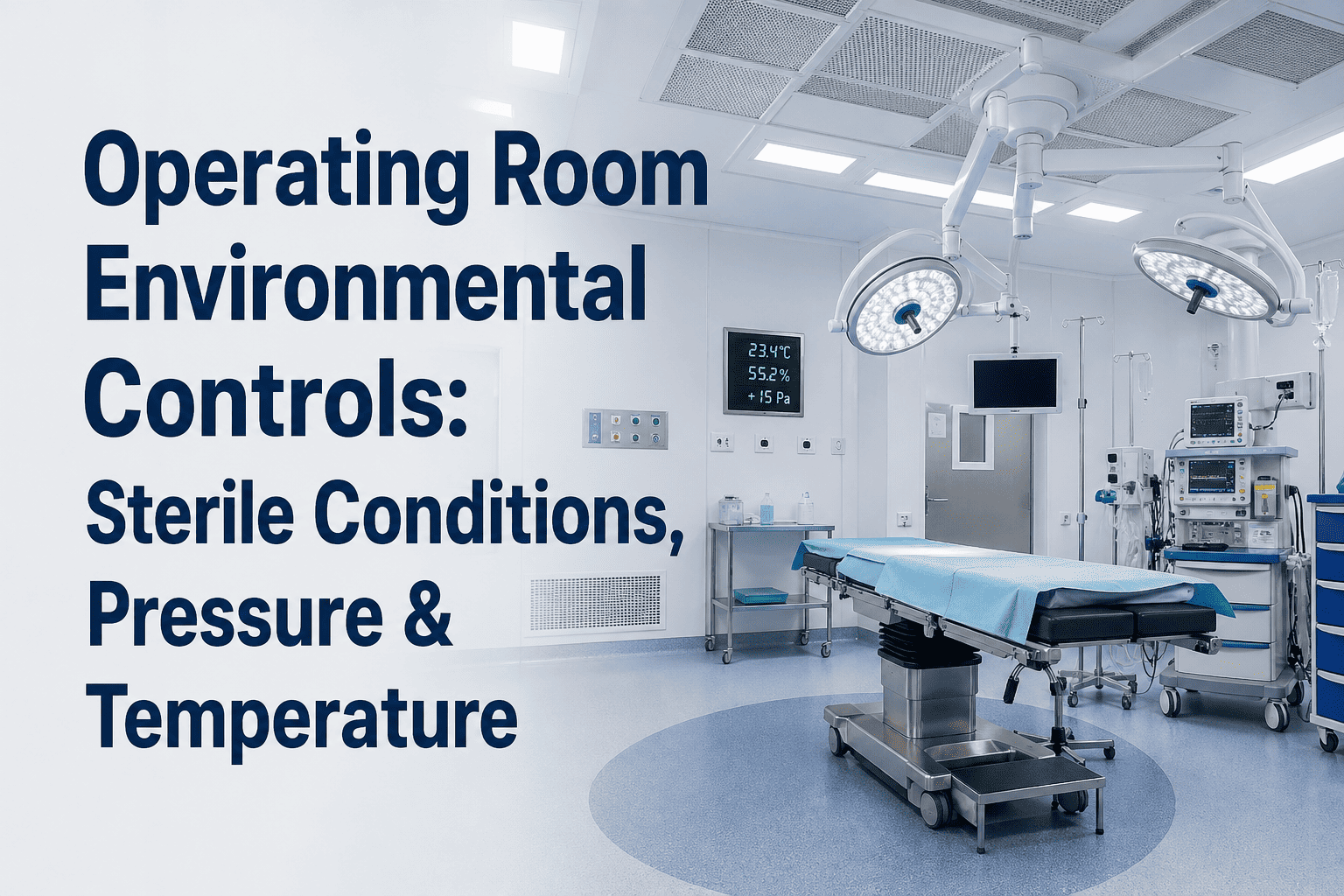
Every hour a surgical suite operates outside its mandated environmental parameters, your hospital absorbs compounding liability—infection risk, regulatory exposure, and the kind of sentinel event that ends careers. OR environmental controls are not an operational luxury; they are the invisible architecture that separates safe surgery from catastrophe. When positive pressure fails, when laminar airflow is compromised, when particulate counts silently exceed thresholds, your clinical team cannot see it happening—but the patient outcome data will.
Are Your Surgical Suites Continuously Monitored for Sterile Compliance?
iFactory's IoT integration platform delivers live pressure, temperature, humidity, and particulate dashboards—eliminating blind spots before they become adverse events.
The Financial & Clinical Cost of Unmonitored OR Environments
Surgical site infections (SSIs) linked to environmental control failures cost U.S. hospitals an average of $29,000 per case in extended care, readmissions, and litigation. For a facility running 15 ORs, a single undetected positive-pressure failure during peak scheduling is not an engineering incident—it is a balance sheet event. iFactory's IoT integration layer transforms passive OR infrastructure into an active compliance engine.
Revenue Leakage Risk
- SSI readmissions not reimbursed under CMS value-based programs
- OR downtime during manual compliance checks averages 45 min/suite/week
- Reactive HVAC repairs cost 4× planned maintenance budgets
Regulatory Exposure
- ASHRAE 170, Joint Commission, and CMS require documented environmental logs
- Manual paper logs fail audit integrity tests in 38% of surveyed facilities
- Non-compliance citations trigger immediate corrective action plans
iFactory IoT ROI
- Continuous sensor streams replace manual rounding entirely
- Automated alerts escalate threshold breaches in under 90 seconds
- Immutable digital audit trail satisfies Joint Commission evidence requirements
Critical OR Environmental Controls: Standards & Failure Consequences
ASHRAE 170-2021 and The Joint Commission define specific environmental thresholds for Class B and Class C surgical suites. Each parameter below represents both a clinical safety requirement and a monitored IoT data point within iFactory's platform.
| Parameter | Required Standard | Failure Consequence | iFactory Monitoring | Alert Priority |
|---|---|---|---|---|
| Positive Pressure Differential | ≥2.5 Pa above corridor | Airborne pathogen ingress | Continuous differential sensors | Critical |
| Laminar Airflow | Unidirectional, 0.25–0.50 m/s | Particulate settling on sterile field | Velocity & directional probes | Critical |
| Air Changes per Hour | ≥20 ACH (min. 4 outside air) | Anesthetic gas accumulation | HVAC integration feed | Critical |
| Temperature | 18°C–24°C (64°F–75°F) | Hypothermia risk, microbial growth | Multi-zone thermocouples | High |
| Relative Humidity | 20%–60% RH | Electrostatic discharge, fungal risk | Capacitive humidity sensors | High |
| Particulate Count (ISO 7) | ≤352,000 particles ≥0.5μm/m³ | SSI causation pathway activation | Real-time particle counters | Critical |
| HEPA Filtration Integrity | 99.97% at 0.3μm (ULPA optional) | Unfiltered recirculation during cases | Pressure drop monitoring | High |
Legacy Friction vs. iFactory Optimized Excellence
The operational gap between manual environmental monitoring and iFactory's continuous IoT integration is not incremental—it is categorical. The comparison below quantifies the clinical, financial, and compliance difference your leadership team needs to evaluate.
| Operational Dimension | Legacy Friction | iFactory Optimized Excellence |
|---|---|---|
| Pressure Monitoring | Manual gauge checks, 2× daily | Continuous 24/7 sensor streaming with auto-alerts |
| Compliance Documentation | Paper logs, prone to gaps & falsification | Immutable digital record, audit-ready in real time |
| Breach Response Time | Hours to days after manual discovery | 90-second escalation to facilities & clinical lead |
| HEPA Filter Management | Calendar-based replacement schedules | Condition-based replacement via pressure-drop AI |
| Multi-Suite Visibility | Suite-by-suite manual rounds | Single dashboard across entire surgical floor |
| Regulatory Audit Readiness | Retroactive data assembly (days of staff time) | On-demand report generation in under 60 seconds |
| SSI Attribution & Root Cause | No environmental correlation available | Timestamped sensor data mapped to case schedules |
How Continuous OR Monitoring Resolves Your Three Biggest Clinical Pressures
Staff Burnout Reduction
- Eliminates manual environmental rounding tasks for nursing and facilities staff
- Automated shift-change compliance reports replace paper handoffs
- Reduces unplanned OR holds that escalate team stress during peak scheduling
- Staff confidence increases when environmental safety is verifiably continuous
Patient Throughput Optimization
- Pre-case environmental certification completed automatically before first incision
- Predictive HVAC maintenance prevents mid-schedule suite shutdowns
- Faster turnover validation—no manual sign-off delays between cases
- SSI reduction directly decreases readmission volume and bed occupancy pressure
Patient Safety Elevation
- Real-time particulate alerts halt cases before sterile field is compromised
- Temperature and humidity deviations flagged before patient transport to suite
- HEPA integrity data creates a defensible chain of custody for infection control
- Joint Commission survey readiness maintained as a continuous operational state
How iFactory's IoT Integration Layer Works in Surgical Environments
Sensor Deployment & Calibration
- Wireless IoT sensors installed at ASHRAE-mandated measurement points
- Factory-calibrated to NIST standards with documented baseline certification
- Zero disruption to active OR scheduling during phased installation
Real-Time Data Ingestion
- All sensor streams unified into iFactory's secure cloud via encrypted MQTT protocol
- Edge processing handles local alerting even during network interruptions
- Data refreshed at configurable intervals down to 30-second cycles
Threshold Management & Escalation
- Custom alert thresholds per suite type (Class B vs. Class C vs. hybrid)
- Multi-tier escalation: facilities team → charge nurse → OR director within 90 seconds
- All breach events timestamped and logged to immutable audit record automatically
Compliance Reporting & EHR Integration
- On-demand Joint Commission and CMS environmental compliance reports
- Case-level data correlation: link environmental conditions to surgical schedule timestamps
- HL7 FHIR-compatible export for integration with Epic, Cerner, and Meditech
Predictive Maintenance & Lifecycle Optimization
- AI models predict HEPA filter end-of-life 14 days before critical pressure drop
- HVAC performance trending identifies degradation before clinical impact occurs
- CapEx planning reports generated from accumulated asset health data annually
Eliminate OR Environmental Risk Across Every Surgical Suite
iFactory's IoT integration platform delivers the continuous monitoring, automated compliance, and predictive intelligence your surgical program requires.
OR Environmental Controls & iFactory IoT — Frequently Asked Questions
Does iFactory integrate with existing hospital BMS and HVAC control systems?
Yes. iFactory uses vendor-neutral API and BACnet/Modbus protocols to integrate with existing Building Management Systems, pulling HVAC performance data directly into the unified OR dashboard without replacing your current infrastructure investments.
How does the platform handle Joint Commission environmental surveys?
iFactory generates pre-formatted compliance reports covering all ASHRAE 170 and Joint Commission EC.02.05.01 requirements on demand. Surveyors receive a complete, timestamped environmental history for any date range in under 60 seconds. Book a Demo to see the report interface live.
Can the system differentiate alert thresholds between Class B and Class C surgical suites?
Absolutely. Each suite is configured individually with its designated classification parameters. iFactory supports mixed-class surgical floors where Class B orthopedic ORs and Class C procedure rooms operate under different threshold profiles within the same dashboard.
What is the implementation timeline for a 10-suite surgical floor?
A standard 10-suite deployment reaches full operational monitoring within 6–8 weeks, including sensor installation, calibration certification, staff training, and EHR integration. No OR downtime is required during the phased installation process. Request an Operational Gap Audit for a facility-specific timeline.
How is OR environmental data secured and who has access?
All sensor data is transmitted via AES-256 encrypted channels and stored in HIPAA-compliant, SOC 2 Type II certified cloud infrastructure. Role-based access controls ensure facilities staff, infection control, and executive leadership each have appropriately scoped visibility dashboards.
Start Continuous OR Monitoring Across Your Entire Surgical Program
iFactory's healthcare IoT platform gives your infection control, facilities, and clinical teams a single source of truth for every sterile environment parameter.



.png)
.png)