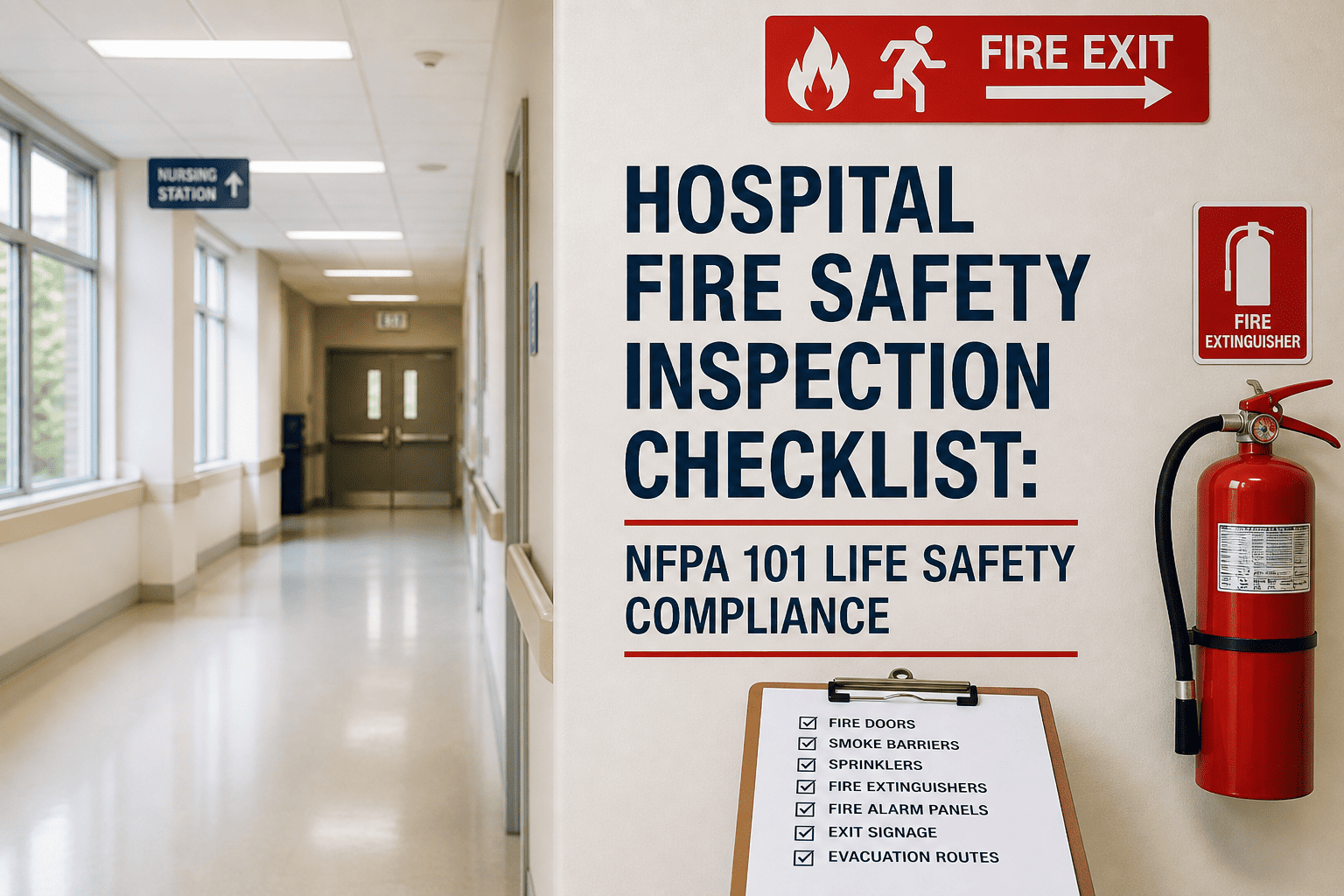
Every 119 minutes, a hospital fire event disrupts patient care in the United States — and facilities without a structured NFPA 101 compliance framework face CMS citation, litigation exposure, and irreversible reputational damage. The question is not whether your hospital will face a fire safety audit — it is whether your compliance data will be ready when it does.
Is Your Hospital Inspection Data Audit-Ready?
Centralize fire safety inspections, automate compliance tracking, and eliminate documentation gaps — all from one enterprise dashboard built for healthcare.
What NFPA 101 Non-Compliance Actually Costs Your Facility
Hospital leadership consistently underestimates the financial and operational exposure buried inside fire safety gaps. NFPA 101 Life Safety Code compliance is not a checkbox — it is a living operational requirement that directly impacts Joint Commission accreditation, CMS Conditions of Participation, and civil liability posture. The cost of a single cited deficiency far exceeds the annual cost of a compliant inspection management system.
CMS Immediate Jeopardy
- Citations can halt Medicare & Medicaid reimbursements
- Remediation plans require documented corrective evidence
- Average resolution cost: $250,000–$1.2M per event
Joint Commission Deficiency
- EC.02.03.05 fire protection system failures trigger RFIs
- Unresolved findings escalate to Accreditation-at-Risk status
- Public disclosure damages patient acquisition pipeline
Litigation Exposure
- Missing inspection records become plaintiff evidence
- Staff injury claims spike post-incident without audit trails
- Insurance premium increases average 18–34% after citations
Operational Disruption
- Emergency evacuations disrupt ICU and surgical suites
- Manual re-inspection cycles consume 200+ staff hours annually
- Patient transfers during incidents cost $8,000–$22,000 per event
Hospital Fire Safety Inspection Checklist — NFPA 101 Life Safety Code
The following checklist maps directly to NFPA 101 Chapter 18/19 requirements for existing and new healthcare occupancies. Each domain must be inspected, documented, and archived with timestamps for CMS and Joint Commission survey readiness.
| Inspection Domain | Key Inspection Points | NFPA 101 Reference | Frequency | Compliance Priority |
|---|---|---|---|---|
| Fire Doors & Assemblies | Self-closing function, latch operation, gap tolerances, label integrity | §18/19.2.2.2 | Annual | Critical |
| Smoke Barriers & Compartments | Penetration seals, corridor width, signage, wall continuity | §18/19.3.7 | Annual | Critical |
| Automatic Sprinkler Systems | Head clearance, water flow tests, control valve position, FDC access | §18/19.3.5.7 | Quarterly/Annual | Critical |
| Fire Alarm & Detection | Pull station testing, smoke detector sensitivity, annunciator panel, voice evacuation | §18/19.3.4 | Semi-Annual | Critical |
| Exit Signage & Emergency Lighting | Illumination levels, battery backup duration, sign visibility at 100ft | §18/19.2.10 | Monthly/Annual | High |
| Portable Fire Extinguishers | Pressure gauge, pin & seal, mounting height, travel distance compliance | §18/19.3.5.3 | Monthly/Annual | High |
| Hazardous Area Enclosures | Soiled linen rooms, storage rooms, mechanical spaces — door & sprinkler compliance | §18/19.3.2 | Annual | High |
| Evacuation Routes & Drills | Corridor obstruction, drill frequency logs, HICS activation records, staff competency | §18/19.7.1–7.2 | Quarterly Drills | Moderate |
Legacy Friction vs. iFactory Optimized Excellence
Most hospital compliance teams are managing fire safety with a combination of paper forms, shared drives, and spreadsheet trackers — a fragmented system that creates systematic blind spots. The comparison below illustrates the operational and financial gap between legacy approaches and a purpose-built compliance management platform.
| Compliance Dimension | ❌ Legacy Friction | ✅ iFactory Optimized Excellence |
|---|---|---|
| Inspection Scheduling | Manual calendars, missed deadlines, reactive scrambles before surveys | Automated recurring schedules with escalation alerts 30/60/90 days out |
| Documentation Storage | Paper binders, scattered PDFs, no version control, retrieval takes hours | Centralized cloud repository with instant audit-ready export in <60 seconds |
| Deficiency Tracking | Verbal handoffs, sticky notes, no formal corrective action workflow | Structured CAP (Corrective Action Plan) with owner assignment and due-date enforcement |
| Survey Readiness | 2–3 week emergency prep before each Joint Commission survey | Perpetual readiness dashboard with real-time compliance score by department |
| Multi-Site Visibility | No consolidated view — each facility operates as a compliance island | Enterprise-wide compliance heatmap across all campuses and off-site locations |
| Staff Accountability | No audit trail — impossible to verify who inspected what and when | Timestamped digital signatures with photo evidence attached to every inspection record |
| Regulatory Updates | Compliance teams manually track NFPA, CMS, and TJC code changes | Platform-level regulatory intelligence with automatic checklist versioning |
Clinical & Operational Impact of a Compliant Fire Safety Program
Staff Burnout Reduction
- Eliminate repetitive manual documentation cycles
- Reduce pre-survey preparation time by up to 70%
- Route findings automatically — no coordinator bottleneck
- Mobile-first inspection forms completed in the field
Patient Safety & Throughput
- Proactive deficiency closure prevents code-triggered evacuations
- Smoke barrier integrity supports infection control compartmentalization
- Reliable suppression systems protect vulnerable ICU & NICU populations
- Faster fire door remediation keeps surgical suites operational
Financial & ROI Outcomes
- Avoid CMS citation remediation costs averaging $400K per finding
- Reduce compliance FTE overhead by 30–45% through automation
- Lower insurance premiums via defensible inspection audit trails
- Protect $2–18M annual Medicare reimbursement from accreditation risk
5-Step Path to NFPA 101 Perpetual Readiness with iFactory
Operational Gap Audit
Map your current inspection workflows against NFPA 101 Chapter 18/19 requirements to identify documentation gaps, missed frequencies, and untracked deficiencies across all campuses.
Digital Checklist Deployment
Deploy NFPA 101-aligned digital inspection forms to mobile devices used by environment of care teams — capturing photo evidence, timestamps, and inspector signatures in real time.
Automated Schedule & Alert Engine
Configure inspection recurrence for each domain — monthly extinguisher checks, quarterly sprinkler tests, annual door assemblies — with automated escalation to department heads on overdue items.
Corrective Action & Closure Workflow
Route deficiencies directly to assigned owners with structured CAP templates, deadline enforcement, and re-inspection triggers — creating a closed-loop compliance cycle with full traceability.
Survey-Ready Reporting Dashboard
Generate instant compliance summaries, deficiency trend reports, and department-level scorecards formatted for Joint Commission EC tracers, CMS surveys, and state health department audits.
Hospital Fire Safety Compliance — Frequently Asked Questions
What is the inspection frequency for fire doors under NFPA 101?
NFPA 80 (referenced by NFPA 101) requires annual fire door assembly inspections performed by qualified individuals. Results must be documented and corrective actions tracked to closure within a defined remediation timeline.
How does iFactory handle multi-campus hospital networks?
The platform provides a unified enterprise dashboard where compliance officers can view real-time inspection status, deficiency counts, and compliance scores across all campuses simultaneously — eliminating the siloed reporting model of legacy systems.
Can inspection records be exported for Joint Commission surveyors?
Yes. iFactory generates audit-ready compliance packages in PDF and structured data formats within 60 seconds — including timestamped inspection logs, photo evidence, corrective action histories, and staff signature records. Book a Demo to see the export workflow live.
What is the ROI timeline for implementing a digital compliance platform?
Most hospital systems report measurable ROI within 90 days — primarily through reduced FTE hours on documentation, faster deficiency closure cycles, and avoidance of a single CMS citation. Long-term value is realized through sustained accreditation protection and lower insurance premiums. Book a Demo to review our ROI model for your facility size.
Protect Your Accreditation. Automate Your NFPA 101 Compliance.
Join healthcare systems already eliminating inspection gaps with iFactory's compliance management platform — built for Joint Commission, CMS, and state survey readiness.

.png)
.png)