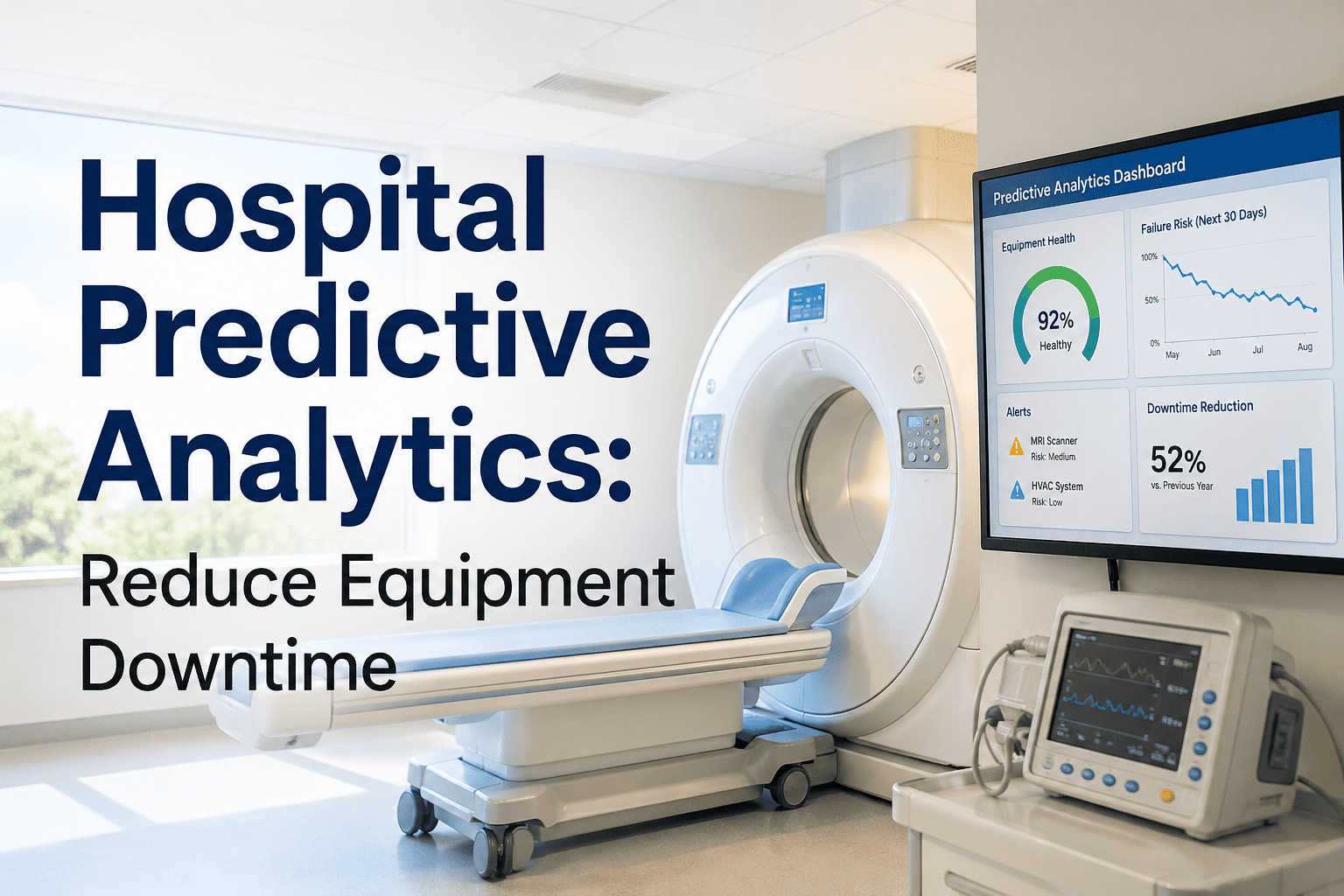
Every hour a critical piece of medical equipment sits idle, your hospital hemorrhages thousands in lost revenue, delayed procedures, and mounting patient safety risk — yet most 500-bed facilities still rely on reactive maintenance cycles designed for a 1990s world.
40% Equipment Downtime Reduction in 12 Months
See how a 500-bed hospital eliminated reactive maintenance, automated work orders, and achieved Joint Commission-ready documentation with iFactory's Predictive Analytics Console.
The Financial & Clinical Cost of Equipment Downtime
Unplanned equipment failures are not maintenance problems — they are revenue and patient safety crises. Before iFactory, this 500-bed hospital faced compounding operational debt driven by legacy PM schedules, siloed work order systems, and zero predictive visibility.
Revenue at Risk
- $2.4M+ annual revenue leakage from unscheduled downtime
- 14 avg. hours per critical equipment failure resolution
- 23% OR scheduling disruptions tied to equipment unavailability
Patient Safety Exposure
- Delayed diagnostics linked to imaging equipment gaps
- Manual logs creating compliance blind spots pre-audit
- Reactive-only protocols increasing adverse event risk
Operational Friction
- Biomedical team spending 60% of time on emergency calls
- Paper-based PM logs failing Joint Commission standards
- No real-time asset location or utilization visibility
Legacy Friction vs. iFactory Optimized Excellence
The operational gap between a reactive maintenance model and an AI-driven predictive platform is not incremental — it is transformational. This matrix defines the delta your leadership team must quantify.
| Operational Category | Legacy Friction State | iFactory Optimized State | Outcome Delta |
|---|---|---|---|
| Maintenance Scheduling | Static calendar-based PM cycles | AI-predicted condition-based alerts | 40% Downtime Reduction |
| Work Order Generation | Manual technician entry, 2–4 hr lag | Automated trigger on anomaly detection | Real-Time Dispatch |
| Compliance Documentation | Paper logs, retroactive filing | Immutable digital audit trail, auto-generated | Joint Commission Ready |
| Asset Utilization Visibility | No real-time location or usage data | Live dashboard with RTLS integration | Full Fleet Visibility |
| Biomedical Team Allocation | 60% reactive emergency response | 80% planned, scheduled, optimized | Staff Burnout Reduced |
| Capital Planning | Gut-instinct CapEx decisions | AI-driven lifecycle forecasting | Predictive CapEx ROI |
How iFactory Solves the Three Core Clinical Operations Challenges
Staff Burnout & Allocation
- Predictive alerts replace emergency dispatch cycles
- Automated work orders eliminate manual triage
- Technician workloads balanced via intelligent scheduling
- Biomed staff redirected to high-value preventive work
Patient Throughput & Safety
- Critical imaging & OR equipment uptime maximized
- Procedure delays from equipment failure reduced significantly
- Real-time asset availability integrated into OR scheduling
- Fewer adverse events from equipment performance gaps
Regulatory & Compliance Risk
- Joint Commission documentation generated automatically
- Every maintenance action timestamped and immutable
- Audit preparation time reduced from weeks to hours
- Zero compliance gaps identified in post-iFactory survey
How This Hospital Achieved Results in 12 Months
Operational Gap Audit (Weeks 1–2)
- Full equipment inventory digitized into iFactory asset registry
- Existing PM schedules benchmarked against failure history data
- Compliance documentation gaps identified and prioritized
Predictive Analytics Console Deployment (Month 1–2)
- IoT sensor integration across 1,200+ medical devices
- AI baseline models trained on 36 months of historical failure data
- Automated work order triggers configured per equipment class
Staff Enablement & Workflow Integration (Month 2–4)
- Biomed team trained on real-time dashboard and alert protocols
- Work order system integrated with existing CMMS and EHR platforms
- Role-based dashboards deployed for clinical, operations, and C-suite
Continuous Optimization & ROI Measurement (Month 6–12)
- AI models continuously refined with new failure and resolution data
- Quarterly CapEx lifecycle reports delivered to CFO and COO
- 40% downtime reduction validated against 12-month baseline KPIs
Quantified Outcomes at 12 Months Post-Deployment
Is Your Hospital Losing Revenue to Equipment Downtime Right Now?
Book a 30-minute demo or request a complimentary Operational Gap Audit to benchmark your current state against iFactory's proven healthcare framework.

.png)
.png)