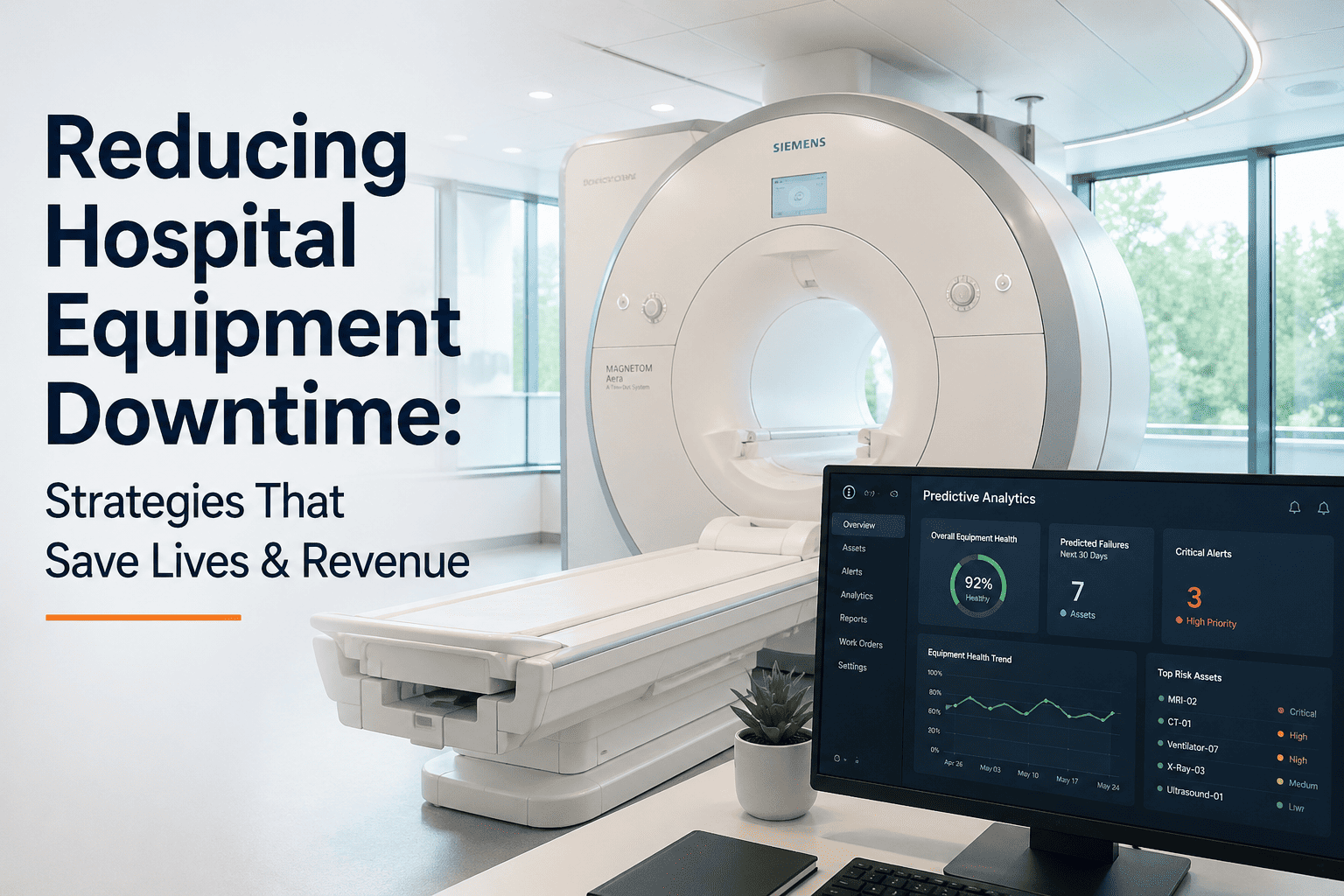
Every hour a critical MRI scanner sits offline costs your hospital an estimated $150,000 in lost revenue — and that figure does not include emergency rescheduling, patient diversion costs, or the silent damage to clinical trust your staff absorbs in silence. For Operations Directors managing 500 to 5,000+ assets across multi-site health systems, reactive maintenance is no longer a budget problem — it is a patient safety liability.
Is Your Equipment Downtime Costing You Millions Annually?
iFactory's AI analytics platform identifies failure patterns before they occur — protecting revenue, staff capacity, and patient outcomes across your entire asset portfolio.
The True Cost of Unplanned Equipment Downtime in Hospital Operations
Unplanned downtime is not an IT issue — it is a revenue and risk event that cascades through every department. AI-driven analytics transforms raw sensor data into financial certainty for Operations Directors.
Revenue Leakage
- MRI/CT downtime averages $1.4M in lost procedures annually per machine
- Emergency equipment rental inflates OPEX by 18–35% per incident
- Insurance claim delays trigger secondary cash flow disruptions
Patient Safety Risk
- Defibrillator or ventilator failure is a reportable sentinel event
- Unplanned downtime increases adverse outcome probability by 22%
- JCAHO audit exposure rises with every undocumented failure cycle
Staff Burnout Signal
- Clinical staff re-routing adds 40+ minutes of non-care labor per incident
- Repeated equipment failures are a top-5 nursing resignation driver
- Biomed teams spend 61% of time on reactive, non-value work
Operational Drift
- Legacy CMMS data lags real-time conditions by 48–72 hours
- PM schedules built on age — not condition — waste 30% of biomed budget
- Multi-site visibility gaps prevent portfolio-level risk correlation
How AI Analytics Eliminates Failure Patterns Before They Become Downtime Events
iFactory's condition-based intelligence layer replaces static PM calendars with dynamic, risk-ranked maintenance queues — cutting unplanned failures by up to 70% in year one deployments.
| Analytics Capability | Legacy Approach | iFactory AI Outcome | Financial Result | Priority |
|---|---|---|---|---|
| Failure Pattern Detection | Post-failure incident log | 48–72hr predictive alert window | Prevent $150K+ per avoided downtime event | Critical |
| Automated PM Scheduling | Fixed calendar intervals | Condition-triggered work orders | 30% biomed labor cost reduction | Critical |
| Asset Utilization Scoring | Manual census counts | Real-time utilization heatmaps | Defer $2M+ in unnecessary CapEx | High |
| Multi-Site Risk Correlation | Siloed site reports | Portfolio-wide failure risk index | System-level budget optimization | High |
| Compliance Audit Trail | Manual documentation | Immutable AI-generated records | Zero JCAHO citation exposure | Sustained |
Legacy Friction vs. iFactory Optimized Excellence
The operational gap between reactive maintenance and AI-driven reliability is not incremental — it is transformational. This matrix quantifies the shift Operations Directors achieve within 90 days of deployment.
Legacy Friction
- Failures discovered at point of breakdown — zero advance warning
- PM schedules tied to manufacturer age guidelines, not actual wear data
- Biomed technicians dispatch reactively across floors with no routing logic
- Equipment downtime reported manually — 24–48hr reporting lag
- CapEx replacement driven by age assumptions, not utilization evidence
- Audit documentation assembled retroactively from paper logs
- Multi-site operations managed through disconnected CMMS dashboards
- Staff re-routing logged informally — no systemic pattern recognition
Optimized Excellence
- AI detects anomalous sensor signatures 48–72 hours before failure onset
- Dynamic PM queues ranked by real-time condition score and clinical priority
- Automated work orders route biomed to highest-risk assets first
- Live dashboards surface downtime events within seconds of trigger
- Utilization heatmaps identify underused assets — defer or redeploy capital
- Immutable AI-generated audit logs satisfy JCAHO and DNV requirements
- Unified portfolio view across all campuses — single pane of glass
- Staff diversion events tracked and correlated to upstream equipment signals
Three Dimensions of Clinical and Operational Transformation
AI-driven hospital equipment analytics delivers measurable outcomes across the three highest-stakes domains for Operations Directors: workforce stability, patient throughput, and regulatory posture.
Staff Burnout Reduction
- Eliminate reactive equipment crises that consume clinical staff bandwidth
- Biomed teams shift from firefighting to planned, skilled maintenance work
- Nursing satisfaction scores improve when equipment reliability is predictable
- Reduced overtime tied directly to emergency equipment failure response
Patient Throughput Gains
- Zero-downtime imaging suites increase daily procedure capacity by 12–18%
- Surgical suite equipment readiness eliminates case delays and cancellations
- ED equipment uptime directly correlates to lower diversion hours logged
- Scheduled maintenance windows preserve peak-hour operational capacity
Regulatory & Risk Posture
- Automated PM documentation eliminates manual compliance gaps
- AI failure logs serve as defensible records in adverse event investigations
- Condition-based evidence supports denied insurance claim appeals
- JCAHO, DNV, and CMS survey readiness maintained continuously
90-Day Path from Reactive Maintenance to Predictive Excellence
iFactory's phased deployment model is engineered for zero operational disruption — integrating with your existing CMMS, EHR, and BAS infrastructure from day one.
Asset Inventory & Sensor Baseline (Days 1–14)
- Full asset registry digitization across all campuses and modalities
- IoT sensor deployment on Tier-1 critical assets — imaging, life support, OR
- Historical failure data ingestion from existing CMMS for AI model training
AI Model Calibration & Alert Threshold Setting (Days 15–30)
- Condition-based failure signatures calibrated per equipment class and age
- Clinical priority weighting applied — life support assets ranked highest
- Biomed and Operations Director dashboards configured for role-based visibility
Live Predictive Operations Launch (Days 31–60)
- Automated work orders generated and routed without dispatcher intervention
- Real-time downtime alerts pushed to mobile, dashboard, and email channels
- Utilization scoring activates for CapEx deferral and asset redeployment decisions
Portfolio Optimization & ROI Reporting (Days 61–90)
- Quarterly ROI report quantifies avoided downtime costs and biomed savings
- Multi-site risk index identifies system-wide capital replacement priorities
- Compliance audit package generated automatically for regulatory submissions
Stop Losing Revenue to Unplanned Equipment Failures
Book a personalized demo or request an Operational Gap Audit to see exactly where AI analytics can recover millions in suppressed hospital capacity within your first fiscal year.
Hospital Equipment Downtime Reduction — Frequently Asked Questions
Does iFactory integrate with our existing CMMS and EHR systems?
Yes. iFactory uses vendor-neutral APIs to integrate with leading CMMS platforms including IBM Maximo, ServiceMax, and HealthStream, as well as Epic and Cerner EHR environments. No rip-and-replace required — your existing data becomes the AI training foundation.
How quickly can we expect measurable downtime reduction results?
Most health systems report a 40–60% reduction in unplanned downtime events within the first 60 days of live AI monitoring. Full predictive model maturity — with failure pattern recognition across all asset classes — typically occurs within 90 days of deployment.
Does the platform meet HIPAA and healthcare data sovereignty requirements?
Absolutely. iFactory deploys on HIPAA-compliant cloud infrastructure with AES-256 encryption at rest and in transit. All equipment telemetry and maintenance records are stored in sovereign healthcare cloud environments. Book a Demo to review our security architecture.
Can the platform manage assets across multiple hospital campuses simultaneously?
Yes. iFactory's multi-site architecture provides a unified portfolio view across unlimited campuses — with site-level drill-down, system-wide risk scoring, and centralized biomed dispatch for health systems managing 10 to 300+ facilities.
What is the typical ROI timeline for an Operations Director to present to the CFO?
Most deployments achieve full cost recovery within 6–9 months. Year-one ROI cases typically combine: avoided downtime revenue recovery ($500K–$2M), biomed labor reallocation savings (20–30%), and CapEx deferral from utilization evidence. Book a Demo to generate your custom ROI model.
Launch Your AI-Driven Equipment Reliability Program Today
Join health systems already recovering millions in suppressed revenue through predictive analytics, condition-based maintenance, and unified asset intelligence.