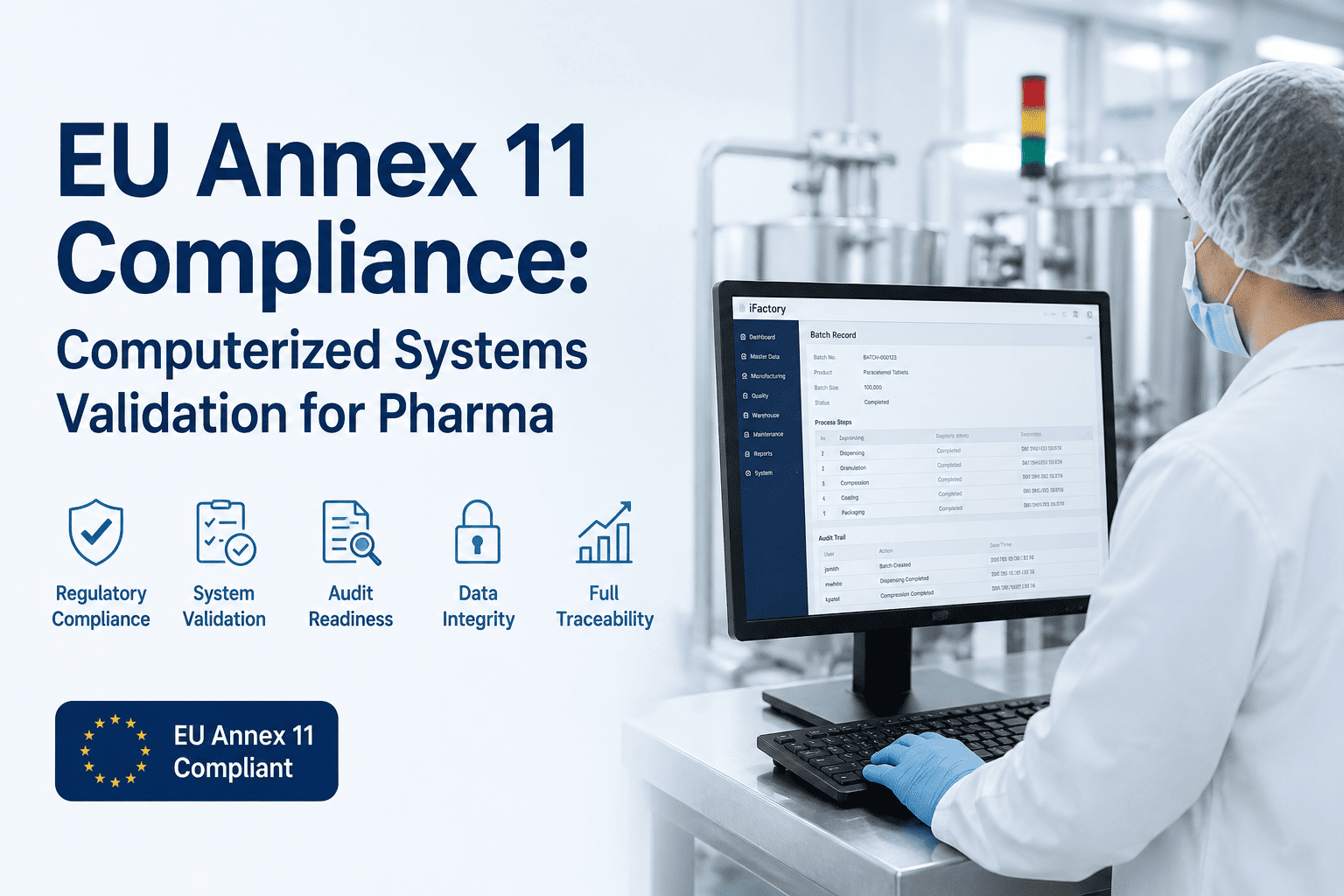
Every unvalidated software action in your pharma manufacturing environment is a potential GMP deviation — and in the EU market, that deviation carries a single outcome: regulatory action, product recall, or market suspension. EU Annex 11 is not a checkbox exercise. It is a binding framework that governs every computerized system touching your product lifecycle, and non-compliance is costing manufacturers an average of €4.2M per audit failure event — before legal exposure is calculated.
Is Your Computerized System Validation Audit-Ready?
iFactory delivers a pre-validated, GAMP 5-aligned MES platform with full traceability, risk-based validation documentation, and data integrity controls built for EMA scrutiny.
What EU Annex 11 Actually Demands — and Where Teams Fail
EU Annex 11 to the EU GMP Guide governs all computerized systems used in regulated pharmaceutical manufacturing, quality, and distribution. Unlike 21 CFR Part 11, Annex 11 is scope-inclusive and risk-based — it applies to legacy systems, cloud platforms, and AI-driven MES environments equally. Most audit failures trace to the same five gaps:
No documented URS, FRS, or risk assessment aligned to GAMP 5 category. Systems go live without formal validation evidence packages.
Audit trails disabled, tamper-accessible, or not reviewed at defined intervals — a direct Annex 11 Clause 9 violation.
ALCOA+ principles not enforced at system level. Raw data overwritten, timestamps manipulated, or backup integrity unverified.
Clause 3 requires supplier qualification. Most teams lack a current audit of their MES or LIMS vendor's quality system and SDL.
Software updates, configuration changes, and patch deployments executed without impact assessment or re-validation review.
Business continuity and backup restoration procedures untested, undocumented, or failing to meet defined RPO/RTO targets.
Legacy Friction vs. iFactory Optimized Compliance
The operational and financial cost of legacy CSV approaches is measurable. This matrix maps the transition from manual validation friction to iFactory's pre-validated, audit-ready architecture.
| Annex 11 Clause | Legacy Friction | iFactory Optimized Excellence | Compliance Impact |
|---|---|---|---|
| Clause 4 — Validation | Manual IQ/OQ/PQ binders, months of effort per system | Pre-built GAMP 5 validation packages, category 4/5 ready | Critical |
| Clause 7 — Data Storage | Local drives, ad hoc backup schedules, no integrity checks | Encrypted sovereign cloud, automated integrity verification | Critical |
| Clause 9 — Audit Trail | Disabled by default, not reviewed, easily manipulated | Immutable, timestamped, role-reviewed at configurable intervals | Critical |
| Clause 10 — Change & Config | Undocumented patches, no impact assessment workflow | Integrated change control with auto-triggered re-validation flags | High |
| Clause 11 — Periodic Eval | Missed review cycles, no system health dashboards | Automated compliance dashboards with scheduled review alerts | High |
| Clause 3 — Supplier QA | Vendor qualification absent or outdated SDLs on file | iFactory provides current SDL, audit access, and QA agreements | Moderate |
Three Dimensions of Value: Quality, Throughput, and Team Capacity
Annex 11 compliance is not an overhead cost — it is an operational multiplier. iFactory's validated platform removes the manual burden that consumes your QA and IT teams, redirecting capacity toward production efficiency and patient-critical quality outcomes.
Regulatory Risk Elimination
- Inspection-ready documentation at all times
- EMA and MHRA audit support included
- Zero data integrity findings in client audits
- Clause-mapped evidence packages pre-built
Manufacturing Throughput
- Automated batch record review cuts cycle time by 60%
- Electronic signatures replace paper sign-off queues
- Real-time deviation flagging prevents batch rejection
- Validated workflows reduce OOS investigation volume
Staff Capacity Recovery
- QA teams reclaim 12+ hours/week from manual CSV tasks
- IT freed from manual backup verification and patch logging
- Automated periodic reviews replace scheduled audit sprints
- Single platform replaces 4–6 disconnected validation tools
iFactory's Validation-First MES Architecture
iFactory is engineered from the ground up for regulated pharma environments. Every module ships with corresponding validation evidence, making CSV a platform feature rather than a post-implementation project.
GAMP 5 Category Classification
Every system component is pre-classified as Category 3, 4, or 5 with corresponding validation strategy, reducing scoping effort by over 70% versus build-your-own approaches.
Risk-Based Validation Repository
URS, FRS, risk assessments, IQ/OQ/PQ protocols, and summary reports maintained in a living, version-controlled validation master file — updated automatically on each platform release.
Immutable Audit Trail Engine
All user actions, system events, and data modifications captured in a tamper-evident, time-stamped log. Configurable review workflows and exception reports fulfill Clause 9 requirements natively.
Integrated Change Control
Change requests linked directly to impact assessment templates. Triggered re-validation tasks assigned automatically when configuration or software changes affect validated functions.
Sovereign Data & Disaster Recovery
EU-hosted GovCloud deployment with AES-256 encryption, defined RPO/RTO targets, and quarterly DR test reports provided as part of the compliance package.
EU Annex 11 & iFactory — Frequently Asked Questions
Does iFactory ship with a ready-to-use Validation Master File?
Yes. iFactory provides a complete, template-driven Validation Master File aligned to Annex 11 and GAMP 5 guidance. Clients receive pre-authored URS, risk assessments, and test protocols that are customizable to their site-specific configuration — eliminating blank-page validation starts.
How does iFactory handle software updates without invalidating the system?
Each platform release includes an Impact Assessment Summary and delta validation package. Change control workflows are embedded in the platform — every update triggers a scoped re-validation review, keeping your system in a continuously validated state.
Can iFactory support hybrid on-premise and cloud deployments for EU data sovereignty?
Yes. iFactory supports EU-region sovereign cloud, on-premise, and hybrid deployment models. All configurations are covered by our standard validation package, with data residency documentation available for regulatory filing purposes.
What is included in the Operational Gap Audit?
Our architects perform a structured review of your current CSV approach against all 20 Annex 11 clauses, identifying critical gaps, priority remediation actions, and a phased compliance roadmap with associated effort estimates. Book a Gap Audit to begin your assessment.
Close Your Annex 11 Compliance Gaps Before Your Next Inspection
iFactory's pre-validated MES platform eliminates CSV overhead, enforces ALCOA+ data integrity, and delivers inspection-ready evidence at every audit touchpoint.