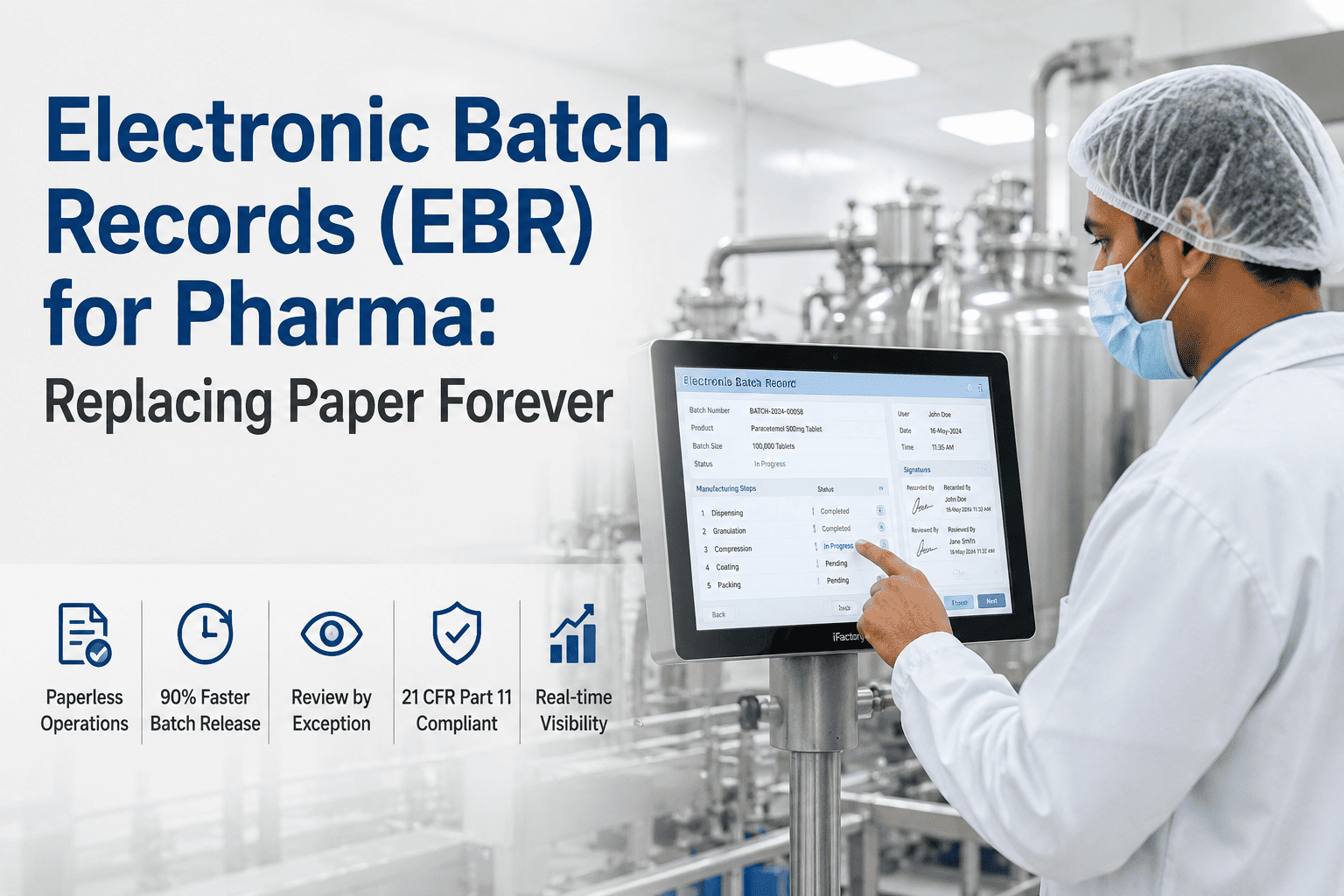
Every day your pharma manufacturing operation runs without validated 21 CFR Part 11 compliance, you are not simply risking an FDA warning letter — you are hemorrhaging revenue through batch rejections, facing potential consent decrees, and exposing your organization to criminal liability. The average FDA enforcement action costs manufacturers between $8M and $50M in remediation, legal fees, and lost production. The question is not whether to achieve compliance — it is how much longer you can afford to delay.
Is Your Electronic Records Infrastructure FDA-Ready?
Deploy iFactory's audit trail and electronic records system to achieve 21 CFR Part 11 compliance across every manufacturing line.
What 21 CFR Part 11 Non-Compliance Actually Costs You
FDA's 21 CFR Part 11 governs the use of electronic records and electronic signatures in regulated pharmaceutical manufacturing. Non-compliance is not a procedural technicality — it is a direct threat to your product approvals, clinical trial data integrity, and market authorization. The financial and operational consequences are irreversible without a validated software platform.
Revenue Leakage
- Batch rejection rates increase 3–5× without validated records
- Manual audit preparation consumes 400–800 labor hours per inspection
- Product release delays cost $250K–$2M per day in lost revenue
Operational Risk
- Paper-based records cannot satisfy 21 CFR 11.10 system controls
- Lack of audit trail exposes CAPA processes to data integrity findings
- Cross-site data inconsistency triggers Form 483 observations
Patient Safety Exposure
- Falsified or incomplete batch records create recall liability
- Unvalidated e-signatures invalidate GMP documentation
- Real-time deviation tracking failures delay safety escalations
Core Requirements of 21 CFR Part 11 — and How iFactory Addresses Each
Part 11 compliance requires a validated system that controls record creation, modification, deletion, and access. iFactory's Audit Trail and Electronic Records module is purpose-built to satisfy every technical and procedural control mandated under Subparts B and C.
| 21 CFR Part 11 Requirement | Regulatory Reference | iFactory Solution | Clinical Outcome | Priority |
|---|---|---|---|---|
| Audit Trail — Secure, computer-generated | §11.10(e) | Immutable timestamped log per user action | Zero data integrity findings | Critical |
| Electronic Signature Binding | §11.50, §11.70 | Role-based biometric + token 2FA | Full document traceability | Critical |
| System Access Controls | §11.10(d) | Granular role and permission matrix | Unauthorized access eliminated | Critical |
| Record Retrieval & Archival | §11.10(c) | Indexed cloud storage, 21-year retention | Inspection-ready in under 4 hours | High |
| Operational System Checks | §11.10(f) | Automated sequence validation engine | Process deviation rate −62% | High |
| Training Documentation | §11.10(i) | Integrated LMS with competency sign-offs | Audit-ready training records | Standard |
Legacy Friction vs. iFactory Optimized Excellence
The operational gap between manual compliance processes and a validated electronic records platform is not incremental — it is transformational. The matrix below maps the exact cost of inaction across your most critical compliance workflows.
Paper logs, spreadsheets, and disconnected ERP modules with no tamper-evident controls — flagged on every FDA inspection
Wet signatures scanned to PDF; no binding link between signature and record content — not Part 11 compliant
Manual archive searches requiring 48–72 hours during inspections; records frequently incomplete or missing
Siloed corrective actions with no automated escalation, leading to repeat deviations and repeat Form 483s
CSV projects lasting 12–18 months with external consultants consuming 20–30% of IT budget annually
Auto-generated, immutable, computer-timestamped audit trail on every record event — inspection-ready at all times
Cryptographically bound e-signatures with 2FA, non-repudiation enforcement, and full §11.70 linkage compliance
Full-text indexed retrieval returns any record in under 90 seconds; pre-configured inspection export packages
Closed-loop CAPA with automated escalation thresholds, effectiveness checks, and cross-site trending analytics
Pre-validated IQ/OQ/PQ documentation package delivered at deployment — reduce validation cycle to under 8 weeks
How iFactory Transforms Compliance Into Clinical & Operational Performance
Staff Burnout Reduction
- Eliminate manual documentation tasks consuming 6–10 hrs/week per operator
- Automated batch record generation reduces transcription errors by 94%
- Role-based dashboards surface only relevant compliance tasks per shift
- Electronic workflow routing replaces 200+ paper handoffs per production batch
Patient Throughput Increase
- Batch release cycle time reduced from 14 days to under 72 hours
- Real-time deviation detection prevents hold escalations during production
- Automated QA sign-off workflows eliminate 3–5 day review bottlenecks
- Parallel review capability increases throughput by 40% without adding headcount
Regulatory Readiness ROI
- Inspection preparation time drops from 800 hours to under 20 hours
- Pre-built FDA, EMA, and PMDA response packages generated on demand
- Zero repeat observations on Part 11 controls across all validated sites
- Average ROI of 340% realized within 18 months of full platform deployment
Your Path to Full 21 CFR Part 11 Compliance in 5 Phases
Operational Gap Audit
- Identify all electronic records and signature processes in scope
- Map current controls against §11.10 and §11.300 requirements
- Quantify risk exposure and remediation cost baseline
System Validation (CSV)
- Deploy iFactory with pre-authored IQ, OQ, and PQ protocols
- Execute validation testing against your specific manufacturing SOPs
- Generate complete validation master plan documentation for FDA submission
Audit Trail Activation
- Configure immutable audit trail parameters for all record types
- Activate user access controls with role-permission matrix sign-off
- Enable real-time anomaly detection for record tampering events
E-Signature Binding
- Implement 2FA-based electronic signatures across all GMP workflows
- Configure §11.50 manifestation requirements on all signed records
- Train operators and QA personnel with competency sign-off documentation
Continuous Compliance Monitoring
- Activate automated periodic review scheduler for system access logs
- Deploy executive compliance dashboard for real-time risk visibility
- Schedule annual revalidation cycles with automated change control tracking
Top 6 Part 11 Gaps That Trigger FDA Enforcement Actions
Systems that log only creation events — not modifications or deletions — fail §11.10(e) and are the single most-cited Part 11 deficiency in FDA 483s.
Off-the-shelf ERP or LIMS systems deployed without formal Computer System Validation are not Part 11 compliant regardless of their feature set.
Group accounts or shared passwords violate §11.300 unique identification requirements and invalidate every electronic signature executed under that credential.
Failure to define and enforce retention schedules for electronic records violates §11.10(c) and can result in data destruction during active inspections.
Mixing paper and electronic records without a validated hybrid procedure creates irreconcilable discrepancies that regulators treat as falsification risk.
System changes made without formal change control revalidation invalidate the entire validation status of the platform, nullifying your compliance posture.
Close Your Compliance Gap Before the Next FDA Inspection
iFactory delivers a pre-validated, inspection-ready 21 CFR Part 11 platform with full audit trail, bound electronic signatures, and sovereign data storage for pharmaceutical manufacturers.
21 CFR Part 11 Compliance — Frequently Asked Questions
Does 21 CFR Part 11 apply to our cloud-hosted manufacturing system?
Yes. Part 11 applies to any electronic records that are created, modified, maintained, archived, or transmitted in connection with FDA-regulated activities — regardless of whether the system is on-premise or cloud-hosted. iFactory deploys on GovCloud-equivalent sovereign infrastructure with full AES-256 encryption and compliant data residency controls.
How long does Computer System Validation take with iFactory?
iFactory provides a pre-authored validation documentation package including User Requirements Specification, Functional Specification, and IQ/OQ/PQ protocols. Most clients complete validation in 6–8 weeks compared to the 12–18 month industry average for custom CSV projects. Book a Demo to review our validation accelerator toolkit.
Can iFactory integrate with our existing MES or ERP platform?
Yes. iFactory uses validated, bi-directional API connectors for SAP, Oracle, Veeva, and all major pharma MES platforms. Data flows are mapped and validated as part of the implementation, ensuring audit trail continuity across every integrated system. No data silos, no reconciliation gaps.
What is the difference between Part 11 and data integrity (ALCOA+)?
Part 11 is the FDA regulatory framework for electronic records and signatures. ALCOA+ (Attributable, Legible, Contemporaneous, Original, Accurate) is the data integrity standard that defines what good records look like. iFactory satisfies both simultaneously — the audit trail and e-signature modules are specifically designed to meet ALCOA+ principles within a Part 11-validated environment.
What happens to our compliance status when we update the system?
All system changes are managed through iFactory's built-in change control module, which automatically triggers impact assessments and revalidation workflows. This ensures your validation status is continuously maintained without manual tracking. Every change event is logged in the audit trail with full approval chain documentation. Book a Demo to see change control in action.
Deploy a Validated 21 CFR Part 11 Platform Across Your Manufacturing Sites
Join pharmaceutical manufacturers already operating with zero data integrity findings using iFactory's audit trail, electronic records, and validated e-signature platform.