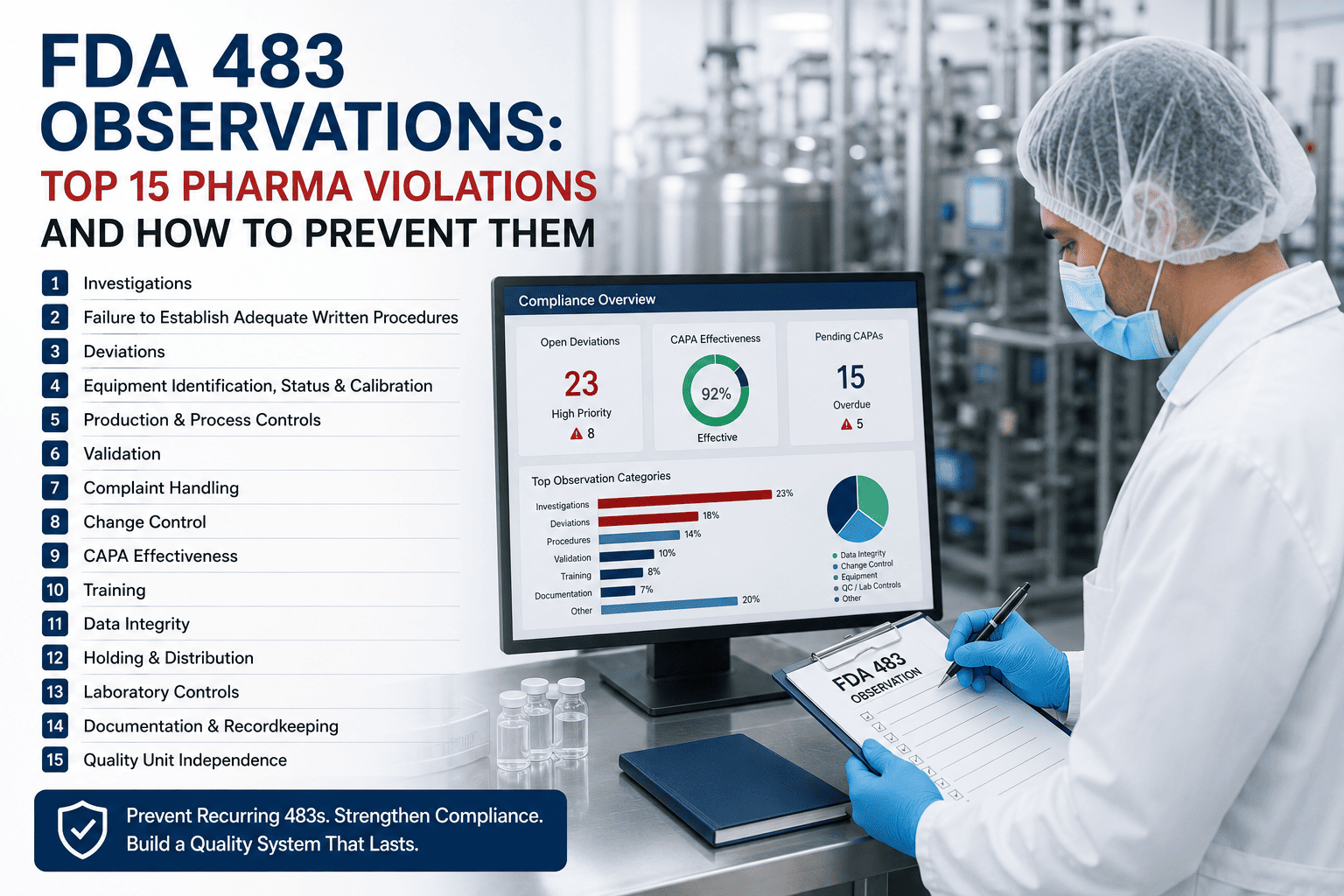
Every FDA 483 observation handed to your quality team is a ticking clock — one that counts down to a Warning Letter, consent decree, or worse: a product recall that wipes out years of market trust overnight. Yet most pharma quality systems are still running on fragmented SOPs, manual CAPA logs, and deviation trackers that were never designed to scale. The result is a compliance debt that compounds silently until a Form 483 arrives and exposes every gap in black and white.
Is Your CAPA System Built to Survive FDA Scrutiny?
iFactory's validated deviation and CAPA workflows eliminate the root causes behind the most cited 483 observations — before inspectors arrive.
The Financial Reality Behind FDA 483 Observations
A single Warning Letter costs an average of $50M–$600M in remediation, lost production, and shareholder value erosion. Form 483 observations are not administrative inconveniences — they are early-stage revenue hemorrhage signals your QMS should be preventing, not reacting to.
Revenue at Risk
- Import alerts freeze product shipments
- Consent decrees halt manufacturing lines
- Repeat 483s escalate to Warning Letters
- Market cap erosion follows public disclosures
Patient Safety Liability
- OOS results missed due to poor CAPA closure
- Batch release errors from unvalidated processes
- Inadequate complaint investigation trails
- Recall risk from unresolved deviations
Operational Drain
- QA teams consumed by manual audit prep
- Duplicate data entry across disconnected systems
- Slow CAPA cycles extending regulatory exposure
- Staff burnout from reactive compliance culture
Top 15 FDA 483 Observations in Pharma Manufacturing
These are the observations that appear most frequently across FDA inspection records, directly mapped to the quality system failures that trigger them — and how iFactory's CAPA and Deviation Management module addresses each one.
Inadequate CAPA System
- Root cause not formally documented
- Effectiveness checks missing or undated
- Actions not verified as complete
OOS Investigation Failures
- Phase I investigation not completed
- Invalidation without documented scientific basis
- Retesting without hypothesis
Laboratory Controls Deficiencies
- Equipment calibration gaps
- Reagent logs incomplete
- Analyst training not current
Process Validation Gaps
- CPPs not defined or monitored
- Process ranges not statistically justified
- Revalidation triggers not defined
Data Integrity Violations
- Audit trails disabled or altered
- Raw data not retained
- Shared login credentials in use
Deviation Management Failures
- Deviations not classified by risk
- No trending across product lines
- Recurring deviations with no systemic CAPA
Change Control Breakdowns
- Unplanned changes not documented
- Impact assessments missing
- Post-change verification not performed
Training Program Deficiencies
- SOPs updated without retraining
- Training effectiveness not assessed
- Records not linked to job roles
Complaint Handling Gaps
- Complaints not reviewed for MDR reportability
- Investigations closed without root cause
- No trending or signal detection system
Environmental Monitoring Failures
- EM excursions not investigated
- Sampling plans not risk-stratified
- Alert and action limits not updated
Supplier Qualification Gaps
- Unapproved suppliers used in production
- Qualification audits overdue
- No risk-based requalification schedule
Batch Record Deficiencies
- Incomplete or illegible entries
- Electronic records not 21 CFR Part 11 compliant
- Review signatures missing or undated
Stability Program Weaknesses
- Stability failures not investigated
- Annual product review data gaps
- Shelf-life extensions lacking supporting data
Equipment Qualification Failures
- IQ/OQ/PQ documentation incomplete
- Equipment used outside qualified parameters
- Preventive maintenance records missing
Periodic Review Failures
- Annual product reviews not completed on time
- Signal trending absent from review scope
- Management review not documented formally
Legacy Friction vs. iFactory Optimized Excellence
| Quality Process | Legacy Friction | iFactory Optimized | Compliance Outcome |
|---|---|---|---|
| CAPA Management | Manual spreadsheets, missed deadlines | Automated workflows with escalation alerts | 483-Proof Closure |
| Deviation Logging | Paper-based, inconsistent risk classification | Risk-tiered digital intake with trending engine | Systemic Prevention |
| OOS Investigations | Ad-hoc email chains, no phase tracking | Structured phase-gated investigation module | Audit-Ready Trail |
| Data Integrity | Shared logins, editable logs | 21 CFR Part 11 compliant immutable audit trail | Inspector Confidence |
| Training Linkage | SOP updates not tied to retraining | Auto-triggered retraining on document change | Zero Training Gaps |
| Complaint Handling | Disconnected intake, no signal detection | Integrated MDR screening and trend dashboard | Proactive Risk Signal |
How iFactory Solves the Three Pillars of QA Failure
Staff Burnout Prevention
- Automated CAPA routing removes manual follow-up burden
- Dashboard visibility replaces status-check meetings
- Templated investigation forms cut documentation time by 60%
- Role-based task queues eliminate duplicate effort
Manufacturing Throughput
- Faster deviation closure unblocks batch release cycles
- Validated change control prevents production halts
- Real-time OOS alerts reduce investigational delays
- Predictive trending flags repeat issues before they recur
Inspection Readiness
- Single-click audit trail export for FDA, EMA, and PMDA
- CAPA effectiveness metrics available in real time
- Pre-built 483 response templates aligned to CFR citations
- Cross-functional visibility reduces front-room prep time
iFactory's 5-Step Framework for 483-Free Operations
Unified Quality Data Model
Centralize deviations, CAPAs, complaints, and change controls into a single validated platform — eliminating the data silos that cause cross-system blind spots during inspections.
Risk-Based Prioritization Engine
Automatically classify deviations and OOS events by risk tier. High-risk findings trigger immediate escalation paths with defined SLA timelines enforced by the system.
Automated Effectiveness Verification
Schedule and enforce CAPA effectiveness checks at defined intervals. The platform closes the loop automatically — producing the evidence trail FDA inspectors require.
Cross-Module Trend Intelligence
Surface repeat deviation patterns, supplier-linked failures, and process drift signals before they become systemic — converting reactive quality into predictive quality control.
Continuous Inspection Readiness
Maintain a living audit-ready state 365 days a year. Pre-formatted inspection dashboards, immutable logs, and role-based access controls satisfy 21 CFR Part 11 at every layer.
Stop Reacting to 483 Observations. Start Preventing Them.
iFactory's validated CAPA and Deviation Management platform is purpose-built for pharma quality teams that cannot afford another inspection finding.
FDA 483 & iFactory — Frequently Asked Questions
How quickly can iFactory be deployed in a regulated pharma environment?
iFactory's validated platform deploys with a pre-configured pharma template in 8–12 weeks, including IQ/OQ documentation, role setup, and SOP alignment — minimizing validation overhead and accelerating time-to-compliance.
Does iFactory support 21 CFR Part 11 and Annex 11 compliance?
Yes. The platform is built on an immutable audit trail architecture with electronic signature controls, access-based permissions, and time-stamped records that satisfy both FDA and EMA electronic record requirements out of the box.
Can iFactory integrate with our existing ERP and LIMS systems?
iFactory provides validated API connectors for major pharma ERP and LIMS platforms, enabling bidirectional data exchange for batch records, OOS events, and equipment status — eliminating manual data bridging between systems.
What is the ROI for implementing iFactory's CAPA module?
Most pharma quality teams recover implementation costs within 6 months through reduced manual investigation hours, faster CAPA closure rates, and elimination of repeat deviations that previously required extensive management review cycles. Book a Demo to access our pharma-specific ROI calculator.
Schedule Your iFactory Operational Gap Audit Today
Our pharma compliance architects will map your current QMS against the top 15 FDA 483 triggers and deliver a prioritized remediation roadmap within 5 business days.


.png)