Every year, pharmaceutical manufacturers lose millions in operational value not during an FDA inspection — but in the chaotic weeks before one. Scrambled documentation, fragmented CAPA trails, and data integrity gaps don't just trigger 483 observations — they signal systemic leadership failure. In 2026, inspection readiness is no longer a compliance task. It is a financial imperative.
Is Your Facility Audit-Ready Before the Investigator Arrives?
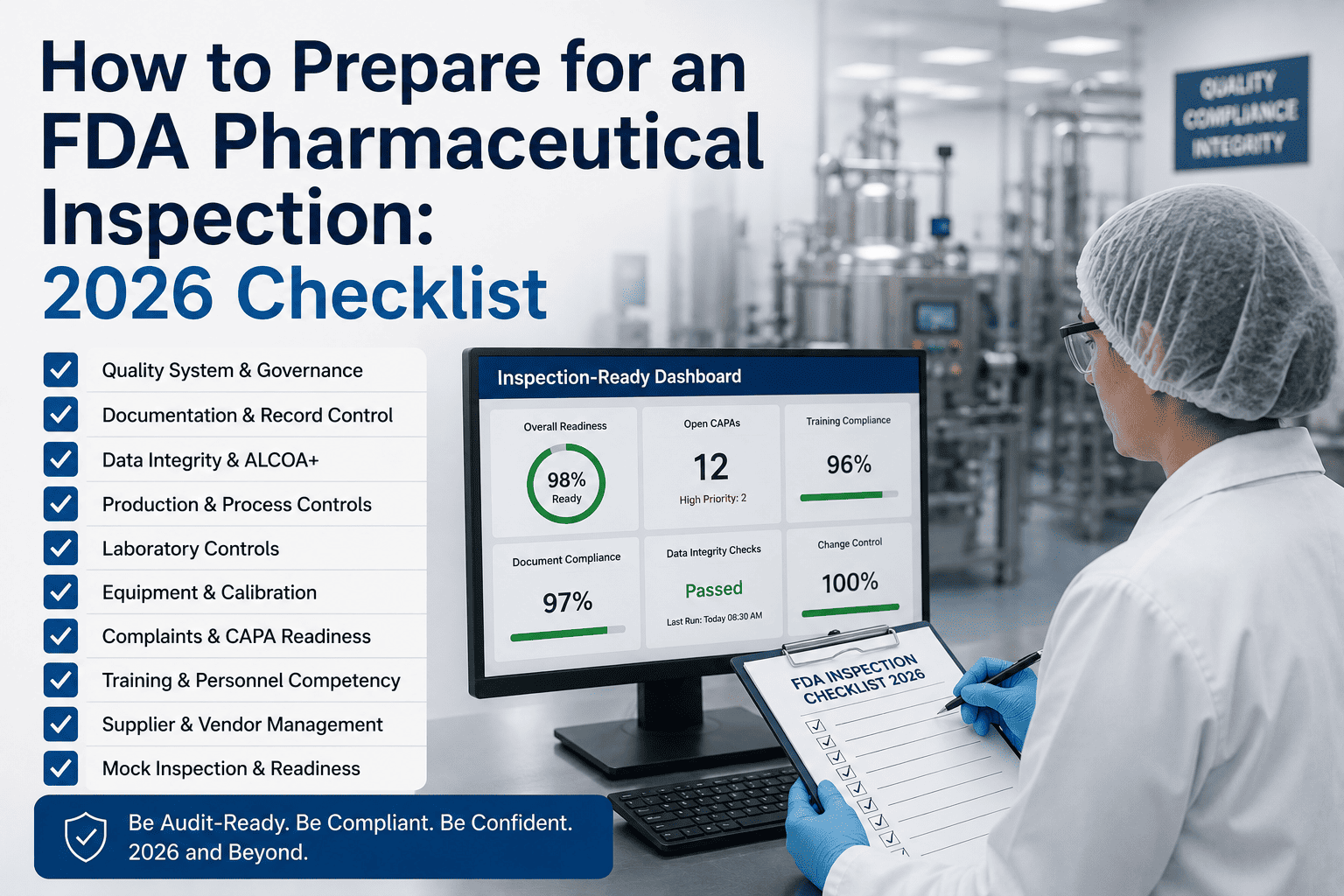
iFactory's Inspection-Ready Dashboards centralize documentation, CAPA status, and data integrity flags into a single compliance command center for pharmaceutical operations.
The Financial & Clinical Cost of Being Unprepared
A single FDA Warning Letter can freeze product releases, trigger consent decrees, and destroy shareholder value overnight. The 2026 inspection landscape is more demanding than ever — with data integrity now cited in over 60% of all 483 observations. The cost of reactive compliance is exponentially higher than proactive readiness.
Revenue at Risk
Import alerts and Warning Letters can halt shipments worth tens of millions within 72 hours of issuance — with no defined recovery timeline.
483 Observation Rate
Facilities without unified CAPA documentation receive 2.4× more repeat observations, compounding regulatory scrutiny over each inspection cycle.
Staff Burnout Cost
Manual inspection prep consumes 600–900 staff-hours per site. iFactory's dashboards reduce this to under 40 hours through automated evidence aggregation.
Scalable Readiness
Enterprise pharmaceutical networks operating 10+ sites require centralized oversight. Decentralized audit prep creates fatal blind spots across the portfolio.
FDA Pharmaceutical Inspection Preparation: 2026 Checklist
Use this checklist as a structured readiness framework. Each domain maps directly to FDA investigator focus areas and common 483 citation categories observed in recent inspection cycles.
Data Integrity Audit Trail
· Verify all electronic records comply with 21 CFR Part 11
· Confirm audit logs are uneditable and timestamped
· Eliminate spreadsheet-based record-keeping for GMP-critical data
· Validate that backup and recovery procedures are tested and documented
CAPA System Readiness
· Confirm all open CAPAs have defined owners and due dates
· Verify root cause analysis documentation is complete for all Class II+ deviations
· Ensure effectiveness checks are scheduled and tracked
· Review CAPA closure rates — target greater than 85% on-time
Batch Record & Documentation Control
· Confirm Master Batch Records are version-controlled and approved
· Verify that no obsolete SOPs are accessible on the production floor
· Audit document retrieval times — FDA investigators expect records within minutes
· Validate electronic signatures on all critical quality records
Laboratory Controls & OOS Investigations
· Review all open Out-of-Specification investigations for completeness
· Verify that invalidated OOS results have full scientific justification
· Confirm laboratory equipment qualification records are current
· Audit analyst training logs against active test methods
Training Records & Personnel Qualification
· Verify 100% SOP training completion for all GMP-role personnel
· Confirm training effectiveness assessments are documented
· Review contractor and temporary staff qualification records
· Ensure training records are accessible within 5 minutes of request
Supplier & Vendor Qualification Files
· Audit Approved Supplier List for expired qualification dates
· Confirm all critical material suppliers have current Quality Agreements
· Verify incoming material testing records against Certificate of Analysis
· Review audit history for Tier 1 API and excipient suppliers
Inspection-Ready Dashboard Configuration
· Configure iFactory dashboards for real-time CAPA, deviation, and complaint visibility
· Set escalation alerts for overdue quality events 30 days before inspection window
· Enable one-click evidence packaging for common investigator request categories
· Assign site inspection coordinator role with dashboard admin access
Legacy Friction vs. iFactory Optimized Excellence
The gap between inspection-ready and inspection-reactive facilities is not a matter of effort — it is a matter of infrastructure. This matrix maps the operational reality of legacy compliance workflows against the iFactory standard.
| Compliance Domain | Legacy Friction | iFactory Optimized Excellence | Risk Eliminated |
|---|---|---|---|
| CAPA Management | Spreadsheets, email threads, missed deadlines | Automated owner assignment, real-time status dashboard | 483 Repeat Observations |
| Data Integrity | Disconnected systems, manual audit logs | Unified audit trail, 21 CFR Part 11 native compliance | Warning Letter Trigger |
| Document Retrieval | 30–90 minutes to locate records on-demand | Sub-3-minute evidence packages, role-based instant access | Investigator Confidence Loss |
| Training Compliance | Siloed LMS with no quality system integration | Live training-gap alerts linked to active deviations | Personnel Qualification Gap |
| Pre-Inspection Prep | 600–900 staff-hours of manual evidence gathering | Automated inspection readiness score updated daily | Operational Burnout |
How Inspection Readiness Drives Clinical & Operational Outcomes
Inspection readiness is not a back-office function. When quality systems are optimized, the downstream effects reach patient safety, release velocity, and operational capacity across the entire manufacturing network.
· Integrated deviation and complaint data
· Automated risk scoring before batch release
· Full traceability from raw material to finished product
· Eliminates manual reconciliation errors pre-release
· Automated evidence aggregation replaces manual prep
· Real-time quality dashboards remove reactive fire-fighting
· Clear ownership workflows reduce cross-team confusion
· Inspection simulation mode for staff confidence building
· Reduced batch record review cycle from days to hours
· Parallel QA workflows enabled by real-time data access
· Automated OOS triage reduces lab investigation delays
· PAI-ready documentation packages generated on demand
Know Your Inspection Readiness Score Before the FDA Does
iFactory's Inspection-Ready Dashboards give pharmaceutical QA leaders a real-time compliance command center — so every audit begins from a position of operational strength, not reactive chaos.
FDA Inspection Preparation — Frequently Asked Questions
What are the most common causes of FDA 483 observations in 2026?
Data integrity failures, incomplete CAPA documentation, and inadequate laboratory controls are the leading citation categories. Facilities relying on hybrid paper-electronic systems face the highest 483 frequency due to inconsistent audit trail management.
How far in advance should pharmaceutical facilities begin inspection preparation?
Best-practice facilities maintain a perpetual state of readiness — not a sprint. iFactory dashboards support a rolling 90-day readiness window with automated gap flagging so there is no inspection sprint, only continuous compliance. Book a Demo to configure your readiness cadence.
Can iFactory support both domestic and international FDA inspections?
Yes. iFactory's platform is designed for multi-site, multi-jurisdiction pharmaceutical operations. It supports domestic PAIs, surveillance inspections, and foreign facility inspections with region-specific compliance mapping and evidence packaging.
How does iFactory address data integrity requirements under 21 CFR Part 11?
The platform provides native Part 11 compliance with immutable audit logs, electronic signature workflows, access controls, and validated system status. All records meet ALCOA+ principles — Attributable, Legible, Contemporaneous, Original, Accurate, and more. Book a Demo to review our validation documentation package.
What is a Pre-Approval Inspection (PAI) and how does iFactory support it?
A PAI is conducted by FDA prior to approving a new drug application, verifying that manufacturing processes match the submitted data. iFactory's PAI mode automatically compiles process validation records, batch history, and equipment qualification evidence into structured submission-ready packages.
Transform Your Quality System into an Inspection Asset
Join pharmaceutical operations teams using iFactory to convert compliance complexity into competitive advantage — one inspection-ready dashboard at a time.