Every hour your facility operates under vague GMP interpretation—rather than enforced cGMP standards—you are absorbing FDA warning letter risk, silent batch failures, and the compounding cost of a recall that averages $10 million before litigation. The distinction between GMP and cGMP is not semantic. It is the difference between a compliant facility and a shutdown notice.
Is Your Shop Floor Enforcing cGMP in Real Time?
iFactory's Compliance Enforcement Engine closes the gap between written SOPs and actual manufacturing execution—automatically, at every station.
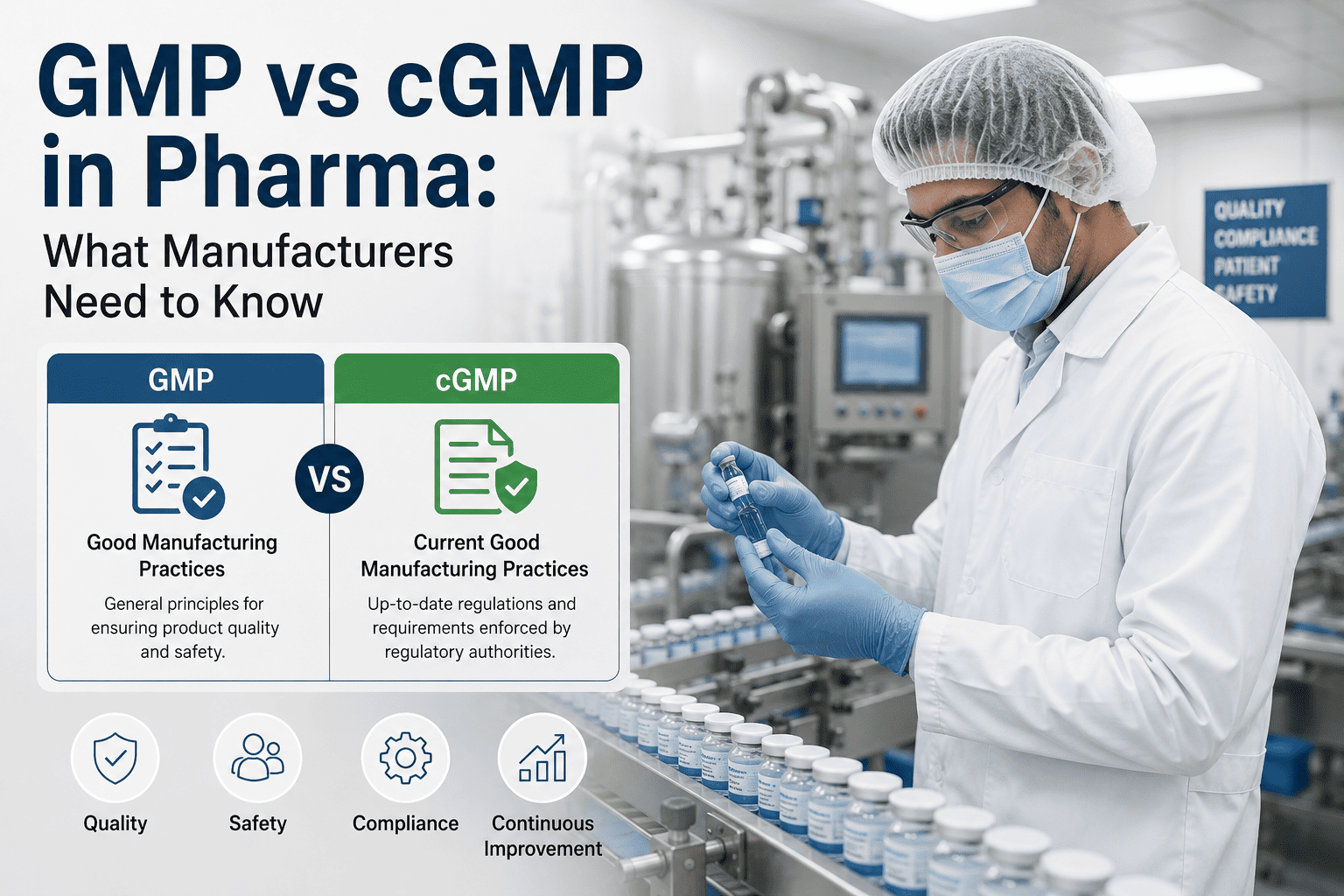
GMP vs. cGMP: The Definition That Defines Your Risk Profile
The FDA does not use GMP and cGMP interchangeably. Understanding the regulatory intent behind each term is the first layer of compliance literacy every Quality Director must own.
Good Manufacturing Practice
- Foundational regulatory framework
- Defined by WHO and ICH guidelines
- Static standards, periodically revised
- Minimum threshold for market authorization
- Applies broadly across all drug manufacturers
Current Good Manufacturing Practice
- FDA's living, evolving standard (21 CFR Parts 210–211)
- Demands adoption of current best technologies
- Enforced via inspections, 483 observations, warning letters
- Requires real-time documentation and traceability
- Non-compliance triggers import alerts and consent decrees
The Compliance Gap
- GMP-compliant does not equal cGMP-compliant
- Paper-based SOPs fail cGMP real-time requirements
- Manual deviation logs create 483 exposure
- Outdated equipment qualifications trigger findings
- Uncontrolled change management voids batch records
Who Enforces cGMP and What Triggers an Inspection
cGMP is not self-certified. These agencies inspect, issue findings, and shut facilities down. Know your regulators before they know your gaps.
| Regulatory Body | Jurisdiction | Primary Regulation | Enforcement Tool | Risk Level |
|---|---|---|---|---|
| FDA (CDER/CBER) | United States | 21 CFR 210 & 211 | Form 483 / Warning Letter | Critical |
| EMA | European Union | EudraLex Vol. 4 | Non-Compliance Report | Critical |
| WHO | Global / PIC/S | WHO TRS 986 Annex 2 | Prequalification Suspension | High |
| MHRA | United Kingdom | UK GMP (post-Brexit) | Improvement Notice | High |
| CDSCO | India | Schedule M (revised 2023) | Manufacturing Suspension | Moderate |
Legacy Friction vs. iFactory Optimized Excellence
The cost of staying with legacy systems is not a future risk—it is a present-day operational tax your P&L absorbs every quarter.
| cGMP Requirement | Legacy Friction | iFactory Optimized Excellence | Financial Impact |
|---|---|---|---|
| Real-time batch records | Paper logs, transcription errors, 48-hr lag | Electronic batch records auto-generated at each station | -$240K/yr rework |
| Deviation management | Email chains, missed CAPA deadlines | Automated deviation capture, routed CAPA with SLA timers | -483 observation risk |
| Change control | Manual approval matrices, version drift | Locked digital change workflow with audit-ready signatures | Batch release speed +40% |
| Equipment qualification | Spreadsheet-tracked, often overdue | AI-triggered qualification reminders, calibration logs | Zero missed PMs |
| Training verification | Binder sign-offs, no real-time enforcement | Station access locked until training currency confirmed | Staff error rate -60% |
| Audit readiness | 2–3 week pre-inspection data compilation | One-click inspection package, cross-system traceability | Audit prep cost -80% |
How iFactory Resolves the Three Failure Modes of cGMP Non-Compliance
- Root cause: paper and hybrid record systems
- FDA finding rate: number one category in 483 observations
- iFactory fix: real-time eBR with e-signature at point of execution
- Outcome: zero transcription events, 100% traceability
- Root cause: manual compliance tasks consuming QA bandwidth
- Industry stat: QA staff spend 35% of time on non-value admin
- iFactory fix: automated routing, guided workflows, smart alerts
- Outcome: QA capacity freed for strategic oversight
- Root cause: manual batch release approval queues
- Cost: each delayed batch day equals $50K–$200K revenue deferral
- iFactory fix: parallel digital review, pre-approved release criteria
- Outcome: batch release cycle reduced by up to 3 days
Five Steps to Enforced cGMP Compliance with iFactory
Operational Gap Audit
Map every current documentation process against 21 CFR 211 requirements. Identify the specific clauses creating your 483 exposure before an FDA investigator does.
Electronic Batch Record Deployment
Replace paper and hybrid records with iFactory eBR. Every manufacturing step is captured at the point of execution with a 21 CFR Part 11 compliant e-signature.
CAPA & Deviation Automation
Activate the Compliance Enforcement Engine to capture deviations in real time, auto-route CAPAs to responsible owners, and enforce SLA closures before they become repeat findings.
Training & Access Control Integration
Link operator training currency to station access permissions. Unqualified personnel cannot execute cGMP-controlled steps—enforced by the platform, not by supervisory memory.
Inspection-Ready Dashboard Activation
Turn on the one-click audit package generator. Every inspection request—FDA, EMA, or internal—is answered with a complete, cross-referenced data package in minutes, not weeks.
GMP vs. cGMP — Questions Quality Leaders Ask
Is a facility that meets WHO GMP automatically cGMP-compliant for FDA purposes?
No. WHO GMP and FDA cGMP share a common foundation but diverge on documentation depth, equipment validation specificity, and process analytical technology expectations. A WHO-compliant facility may still receive FDA 483 observations on documentation or laboratory controls.
What is the most commonly cited cGMP deficiency in FDA 483 observations?
Failure to establish and follow written procedures (21 CFR 211.68 and 211.192) consistently ranks in the top three. This directly implicates facilities running hybrid paper-digital systems where SOPs exist but shop-floor enforcement is not electronically verified.
Does cGMP require electronic records, or is paper still acceptable?
Paper is technically permissible, but the FDA's emphasis on data integrity—reinforced through guidance documents since 2016—creates significant practical risk for paper-based systems. The inability to demonstrate contemporaneous, unaltered records in paper environments consistently generates 483 findings in modern inspections.
How does iFactory's Compliance Enforcement Engine differ from a standard QMS?
A standard QMS stores compliance records. iFactory's Compliance Enforcement Engine enforces compliance at the point of manufacturing execution—blocking non-conforming steps, locking unqualified access, and generating an immutable audit trail in real time. It is the difference between documentation after the fact and prevention at the source.
What is the ROI timeline for deploying iFactory in a mid-size pharma facility?
Most facilities recover implementation costs within 14–18 months through three streams: reduced batch release cycle time (revenue acceleration), eliminated pre-inspection data compilation labor (direct cost reduction), and avoided 483 remediation costs (risk mitigation). A single avoided warning letter response typically exceeds the full platform cost.
Close Your cGMP Gap Before the Next Inspection
iFactory's Compliance Enforcement Engine enforces current Good Manufacturing Practices at every station, every shift—automatically.
Schedule Your Pharma Compliance Architecture Review
Our pharma compliance architects will map your current documentation system against 21 CFR requirements and identify your highest-risk gaps before your next inspection window.