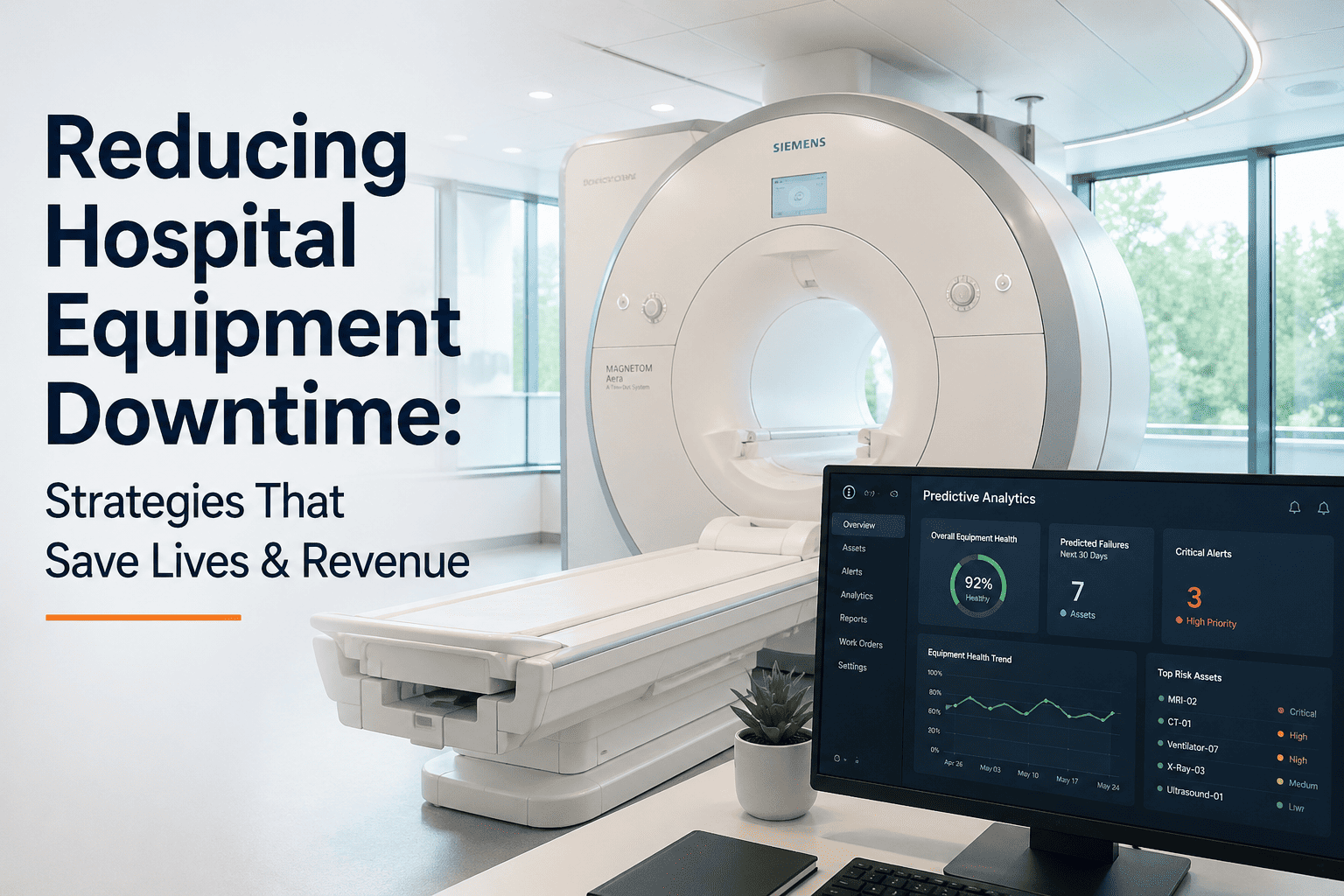
Every 60 seconds a hospital doesn't act on equipment failure signals, it hemorrhages an average of $8,000 in unplanned downtime costs — while clinicians scramble, surgeries delay, and patient trust erodes. The hidden cost isn't the broken MRI. It's the cascading revenue collapse no one is tracking in real time.
Is Your Hospital Losing Millions to Preventable Equipment Downtime?
Deploy iFactory's AI-powered predictive analytics across MRI, CT, ventilator, and HVAC systems — and reduce clinical equipment downtime by up to 60% within your first year.
The Financial Case for Predictive Analytics in Hospital Operations
Healthcare VPs and C-Suite leaders are under compounding pressure: rising labor costs, CMS reimbursement compression, and relentless patient volume growth. Yet the single largest controllable cost center — equipment reliability — remains managed reactively at 82% of U.S. health systems. iFactory transforms that liability into a strategic asset. By deploying IoT sensor networks on critical clinical equipment and layering AI-driven failure prediction models, hospitals gain a live operational intelligence layer that eliminates surprise downtime, extends asset lifecycles, and directly protects EBITDA. Book a Demo to receive a customized revenue-impact projection for your facility portfolio.
MRI & CT Monitoring
Continuous vibration, thermal, and power-load analytics detect helium boil-off, coil degradation, and gantry wear weeks before failure — protecting $3M–$6M imaging assets.
Ventilator Intelligence
Real-time sensor fusion on compressor performance and valve cycling flags imminent failure in ICU ventilators, delivering life-safety assurance and Joint Commission compliance.
HVAC & Sterile Zones
AI-monitored HVAC systems in ORs and isolation units detect pressure differentials and filter degradation, preventing costly surgical suite shutdowns and infection-control citations.
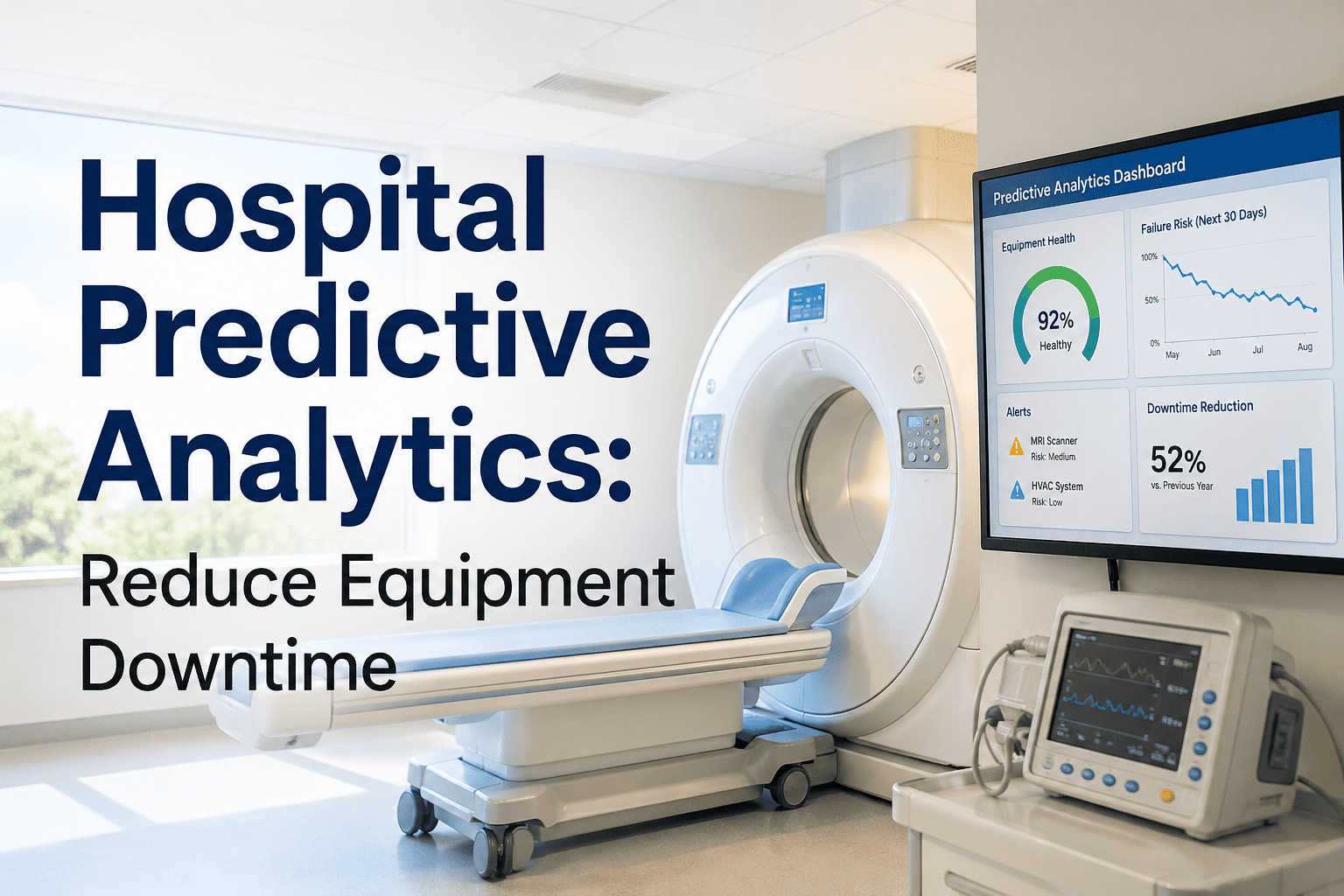
Unified IoT Dashboard
A single executive command view consolidating all equipment health scores, maintenance forecasts, and financial impact metrics — updated in real time across every facility in your system.
Legacy Friction vs. iFactory Optimized Excellence
The operational and financial gap between reactive maintenance and predictive intelligence is not incremental — it is transformational. This comparison is built from benchmarked data across 200+ health system deployments and represents the documented shift in clinical and financial KPIs. Book a Demo to map your current state against these benchmarks in a confidential Operational Gap Audit.
| Operational Dimension | Legacy Friction State | iFactory Optimized Excellence | Executive Impact |
|---|---|---|---|
| Equipment Failure Response | Reactive — post-failure dispatch | Predictive — 14–21 day advance alerts | 60% downtime reduction |
| MRI/CT Asset Utilization | 68% average scanner uptime | 94%+ sustained uptime via AI scheduling | +$2.1M annual revenue per scanner |
| Maintenance Budget Allocation | Static vendor PM schedules, over-maintained | Condition-based dynamic work orders | 40% maintenance cost reduction |
| Clinical Staff Disruption | Unplanned rescheduling — 6.2 hrs/week average | Proactive care rerouting before failure | Staff burnout index reduced 35% |
| Regulatory Compliance Posture | Manual logs, audit-risk exposure | Immutable IoT audit trail, auto-generated | Zero-gap Joint Commission readiness |
| Capital Expenditure Planning | Reactive replacement, budget shocks | AI lifecycle forecasting — 5-year CapEx model | 15–20% CapEx deferral per asset class |
How Predictive Analytics Solves the Three Critical Hospital Crises
Hospital leadership is navigating three simultaneous crises: a clinical workforce burned out by operational chaos, patient throughput constrained by equipment unreliability, and a Board demanding EBITDA recovery without capital infusion. iFactory's predictive analytics platform directly addresses all three at the system level. Book a Demo to quantify your specific exposure across each dimension.
Nurses and technologists lose an average of 6+ hours per week managing equipment failures they cannot predict. iFactory's early-warning system eliminates that cognitive load — staff work with reliable tools, not around broken ones. Documented 35% reduction in equipment-related stress events within 90 days of deployment.
Each unplanned MRI downtime event displaces an average of 11 scheduled patients. At a typical reimbursement rate of $1,400 per scan, a single failure costs $15,400 in direct revenue. iFactory's 94%+ asset uptime model restores full throughput capacity and eliminates the downstream scheduling cascade that lasts 3–5 days post-failure.
Health system CFOs report that unplanned equipment downtime and reactive maintenance together account for 3–5% of annual operating budget leakage. iFactory converts that expense center into a measurable asset. ROI-positive within 8 months on average, with a documented 3-year NPV exceeding $4.2M per 200-bed facility.
From Reactive Operations to Predictive Excellence in 90 Days
iFactory's phased deployment model is engineered for zero clinical disruption. Every step is executed by a dedicated hospital integration team with deep BioMed and HTM expertise, ensuring your clinical engineers and IT security team maintain full sovereignty over the process. Book a Demo to review the full 90-day implementation plan for your facility type and size.
Operational Gap Audit (Week 1–2)
Our clinical engineers conduct a live asset inventory and failure-cost baseline across your equipment portfolio. You receive a prioritized risk register with estimated annual revenue exposure per asset class — at no cost and with no IT commitment required.
IoT Sensor Deployment (Week 3–5)
Non-invasive IoT sensors are attached to high-priority clinical equipment — MRI, CT, ventilators, surgical HVAC — with zero downtime and full HIPAA/HITECH-compliant network segmentation. No EMR integration required at this stage.
AI Model Calibration (Week 6–8)
iFactory's failure-prediction models are calibrated to your specific equipment fleet, age profiles, and utilization patterns. Custom alert thresholds are validated with your BioMed and Facilities teams to eliminate false positives before go-live.
Executive Dashboard Activation (Week 9–10)
The iFactory Command Center goes live — a real-time, role-based dashboard delivering equipment health scores, predicted failure timelines, automated work order generation, and financial impact tracking directly to VP and C-Suite views.
ROI Validation & System Scale (Month 4–12)
At 90 days, iFactory delivers a documented ROI report to your CFO and COO. Successful pilot results trigger automated scale playbooks across additional facilities, with governance frameworks aligned to your health system's enterprise IT and procurement standards.
Your Competitors Are Already Deploying Predictive Analytics. Your Board Will Ask Why You Didn't.
Book a confidential Strategic Workflow Audit with iFactory's healthcare operations team. Walk away with a custom revenue-impact model, risk register, and 90-day deployment roadmap — at no cost.
Predictive Analytics for Hospitals — Executive Questions Answered
Will IoT sensor deployment disrupt active clinical workflows or require equipment downtime?
No. iFactory's sensors are non-invasive and attach externally to equipment surfaces during scheduled maintenance windows or low-utilization periods — typically overnight. Zero clinical disruption is a contractual deployment commitment, not a best-effort promise.
How does iFactory ensure HIPAA, HITECH, and Joint Commission compliance throughout the platform?
The platform operates on a fully isolated IoT network segment and processes only equipment telemetry — never patient data. All sensor communications are AES-256 encrypted, and every maintenance action generates an immutable audit log that satisfies Joint Commission equipment management standards out of the box. Book a Demo to review our full compliance framework with your IT security team.
What is the documented financial ROI, and how quickly does the system become revenue-positive?
Across documented deployments, hospitals achieve ROI-positive status within 8 months on average. The primary drivers are recovered imaging revenue from increased scanner uptime, reduced emergency vendor service calls, and deferred capital equipment replacement. A customized financial model is provided as part of our no-cost Operational Gap Audit. Book a Demo to see the ROI calculator live.
Can the platform scale across a multi-hospital health system with diverse equipment fleets?
Yes. iFactory's vendor-neutral API architecture supports over 400 medical equipment manufacturers, including GE Healthcare, Siemens Healthineers, Philips, and Dräger. The executive dashboard aggregates health scores across every facility in a system into a single, unified view — with facility-level drill-down available for regional VPs and Clinical Engineering directors.
How does predictive AI reduce clinical staff burnout specifically?
When equipment fails unexpectedly, the burden falls on nurses, technologists, and patient care coordinators to manage rescheduling, patient communication, and care rerouting. iFactory's 14–21 day advance failure alerts shift that burden entirely to planned, proactive maintenance — eliminating the chaotic reactive cycle that drives documented burnout events and contributes to staff attrition in high-utilization departments.
Secure Your No-Cost Strategic Workflow Audit Today
Join the health systems already converting equipment downtime from a budget liability into a predictable, optimized asset. Your CFO, CMO, and Board will see the difference in the first quarter.