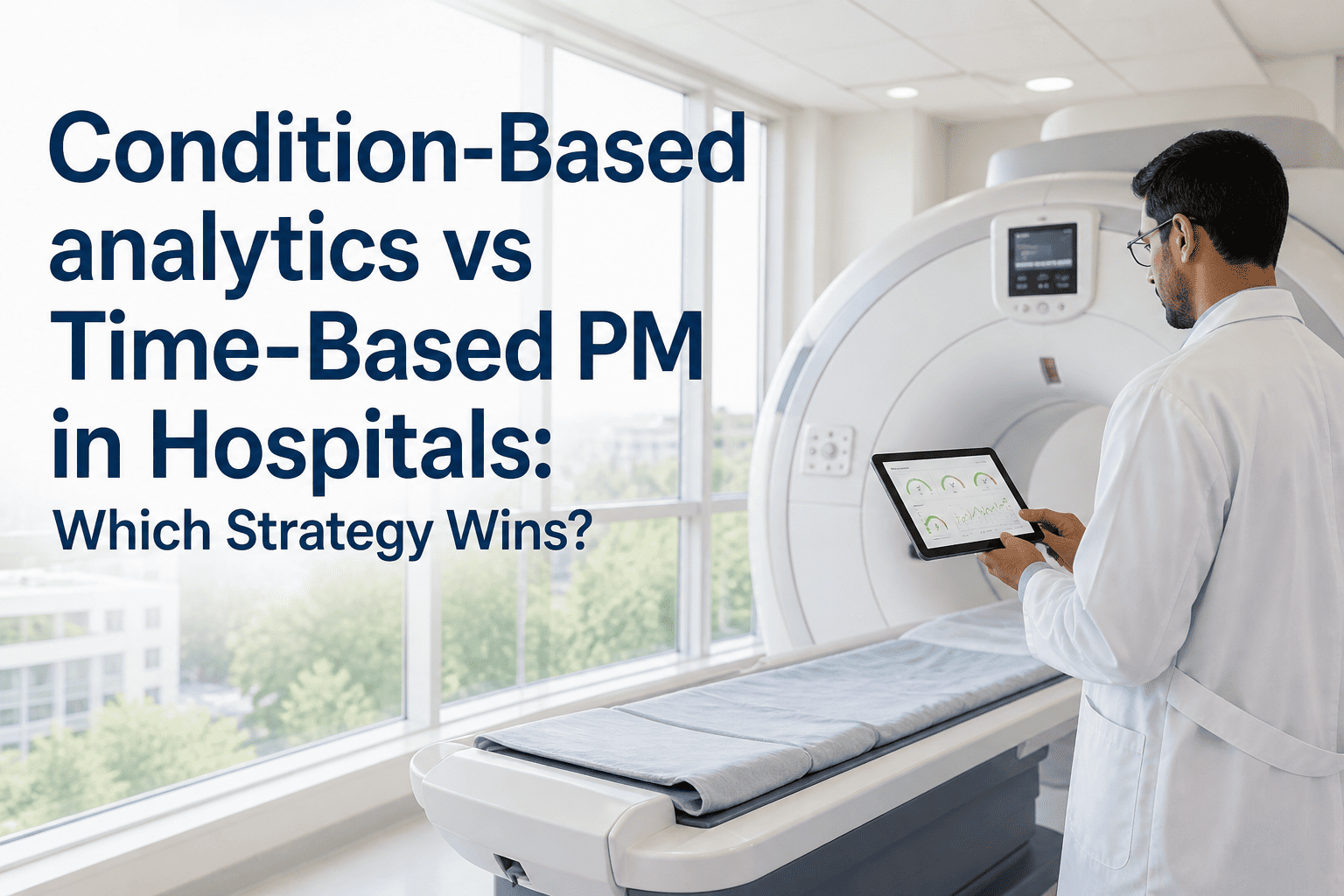
Every year, hospitals silently hemorrhage millions through equipment failures that were entirely predictable — not from lack of technology, but from a maintenance philosophy stuck in 1980. Your Facility Manager is scheduling PM rounds on a calendar. Your CFO is watching unplanned downtime erode margins. And your clinical staff are absorbing the friction of degraded assets that nobody flagged in time. The choice between Condition-Based Maintenance (CBM) and Time-Based Preventive Maintenance (PM) is no longer a facilities question — it is a financial, clinical, and competitive one.
Is Your Hospital Maintaining Assets — or Just Managing Schedules?
iFactory's AI-driven analytics platform shifts hospitals from reactive cycles to predictive precision — protecting revenue, staff, and patients simultaneously.
The Financial Stakes of Your Maintenance Strategy
Hospital maintenance strategy is a direct driver of EBITDA, patient outcomes, and regulatory standing. Analytics Directors navigating this decision must weigh three core dimensions: cost predictability, failure prevention accuracy, and compliance exposure.
Time-Based PM vs. Condition-Based Analytics: Core Differences
- Scheduled on fixed calendar intervals regardless of asset health
- Generates unnecessary work orders — up to 30% redundant PM tasks
- Cannot predict failures occurring between scheduled intervals
- Labor-intensive documentation with high manual error rates
- Over-maintenance accelerates wear on healthy components
- Static compliance — reactive to audits rather than proactive
- Budget based on historical averages, not real-time asset risk
- AI monitors real-time sensor data — vibration, temperature, pressure, runtime
- Triggers maintenance only when thresholds indicate actual degradation
- Predicts failures 2–8 weeks before occurrence with ML pattern recognition
- Auto-generates compliant work orders with timestamp audit trails
- Extends asset lifespan by eliminating unnecessary intervention cycles
- Continuous compliance — every action logged and regulation-ready
- Dynamic CapEx forecasting based on live asset health scores
Legacy Friction vs. iFactory Optimized Excellence
| Dimension | Legacy Time-Based PM | iFactory CBM Platform | Financial Impact |
|---|---|---|---|
| Failure Detection | Post-failure or scheduled check | AI detects anomaly 2–8 weeks early | –60% Emergency Repair Cost |
| Work Order Volume | Fixed schedule — 30% redundant | Need-based — zero redundancy | –40% Labor Hours |
| Compliance Audit | Manual logs, high error rate | Auto-generated, immutable records | 92% Pass Rate |
| Asset Lifespan | Shortened by over-maintenance | Extended via precision intervention | +20% Asset Life |
| Budget Forecasting | Historical averages, static | Live health scores, dynamic CapEx | Predictable CapEx |
| Downtime Risk | High — failures occur between PMs | Low — continuous monitoring | –75% Unplanned Downtime |
| Staff Burden | Manual rounds, paper trails | Automated alerts, digital workflow | Reduced Burnout |
How CBM Solves the Three Biggest Clinical Operations Challenges
Staff Burnout Reduction
- Eliminates repetitive manual inspection rounds
- Automated alerts replace reactive emergency calls
- Digital work orders remove paperwork burden
- Engineers focus on high-value interventions only
Patient Throughput Protection
- Critical imaging and OR equipment stays online
- Zero procedure cancellations due to equipment failure
- Predictive scheduling prevents peak-hour downtime
- CMMS integration keeps clinical coordinators informed
Regulatory Risk Elimination
- Joint Commission-ready audit trails generated automatically
- CMS documentation requirements met in real time
- Zero manual log falsification risk
- Deficiency reports auto-escalated to compliance officers
Which Strategy Fits Which Medical Equipment Category?
Not every asset benefits equally from CBM. iFactory's platform applies a hybrid intelligence model — applying condition-based monitoring where sensor ROI is highest and optimizing PM intervals everywhere else.
- MRI & CT Scanners
- HVAC & Chiller Systems
- OR Tables & Surgical Robots
- Medical Air Compressors
- Sterilization Autoclaves
- Infusion Pumps & Ventilators
- Patient Monitoring Systems
- Elevator & Patient Transport
- Laboratory Analyzers
- Nurse Call Systems
- Fire Suppression Systems
- Emergency Generator Testing
- Defibrillators (AHA Protocol)
- Radiation Safety Checks
- Water Quality Testing
Book Your Operational Gap Audit with iFactory
Our clinical analytics architects will map your current PM strategy against a CBM-optimized model and show you exactly where revenue is leaking and patient risk is hiding.
How iFactory Deploys CBM Without Disrupting Clinical Operations
Asset Inventory & Risk Tiering
Classify all assets by criticality, replacement cost, and failure consequence. Defines CBM vs. PM priority for every equipment category in your facility.
Sensor Integration & Baseline Calibration
Deploy IoT sensors on high-priority assets. AI establishes performance baselines for each unit within 30 days of live monitoring without clinical disruption.
CMMS & EHR Workflow Integration
iFactory connects to your existing CMMS, EHR, and procurement systems. Zero dual-entry — all maintenance data flows to one unified dashboard automatically.
Predictive Model Training & Alert Tuning
ML models learn your specific equipment behavior. Alert thresholds are tuned to minimize false positives while maximizing true failure prediction accuracy.
Continuous Optimization & Compliance Reporting
Monthly performance reports quantify ROI and identify the next tier of assets ready for CBM migration. Compliance packages generated automatically for every audit cycle.
Analytics Directors Ask — iFactory Answers
Does CBM require replacing our existing CMMS platform?
No. iFactory integrates with leading CMMS platforms including IBM Maximo, ServiceNow, and Infor EAM. Your existing workflows are enhanced, not replaced.
How long before we see measurable ROI after deployment?
Most analytics teams report measurable cost reduction within 90 days of full sensor integration. Full ROI payback typically occurs between 8–14 months depending on portfolio complexity.
Is condition-based analytics compliant with Joint Commission standards?
Yes. iFactory's auto-generated maintenance logs, digital signatures, and timestamped records are architected to meet Joint Commission, CMS, and NFPA 99 documentation requirements. Book a Demo to review our compliance framework.
What happens to equipment not yet sensor-ready?
iFactory's hybrid model optimizes time-based PM intervals for non-sensor assets using historical failure data and manufacturer guidelines, reducing redundant PMs by up to 25% even before CBM is deployed.
How do we justify the CBM investment to our CFO?
Our ROI calculator maps your current downtime costs, emergency repair spend, and PM labor hours against projected CBM savings. Book a Demo to generate a custom financial case for your board.
Stop Guessing. Start Predicting. Book Your iFactory Demo Today.
Analytics Directors who switch to CBM don't just cut costs — they transform maintenance from a liability into a clinical operations advantage.

.png)