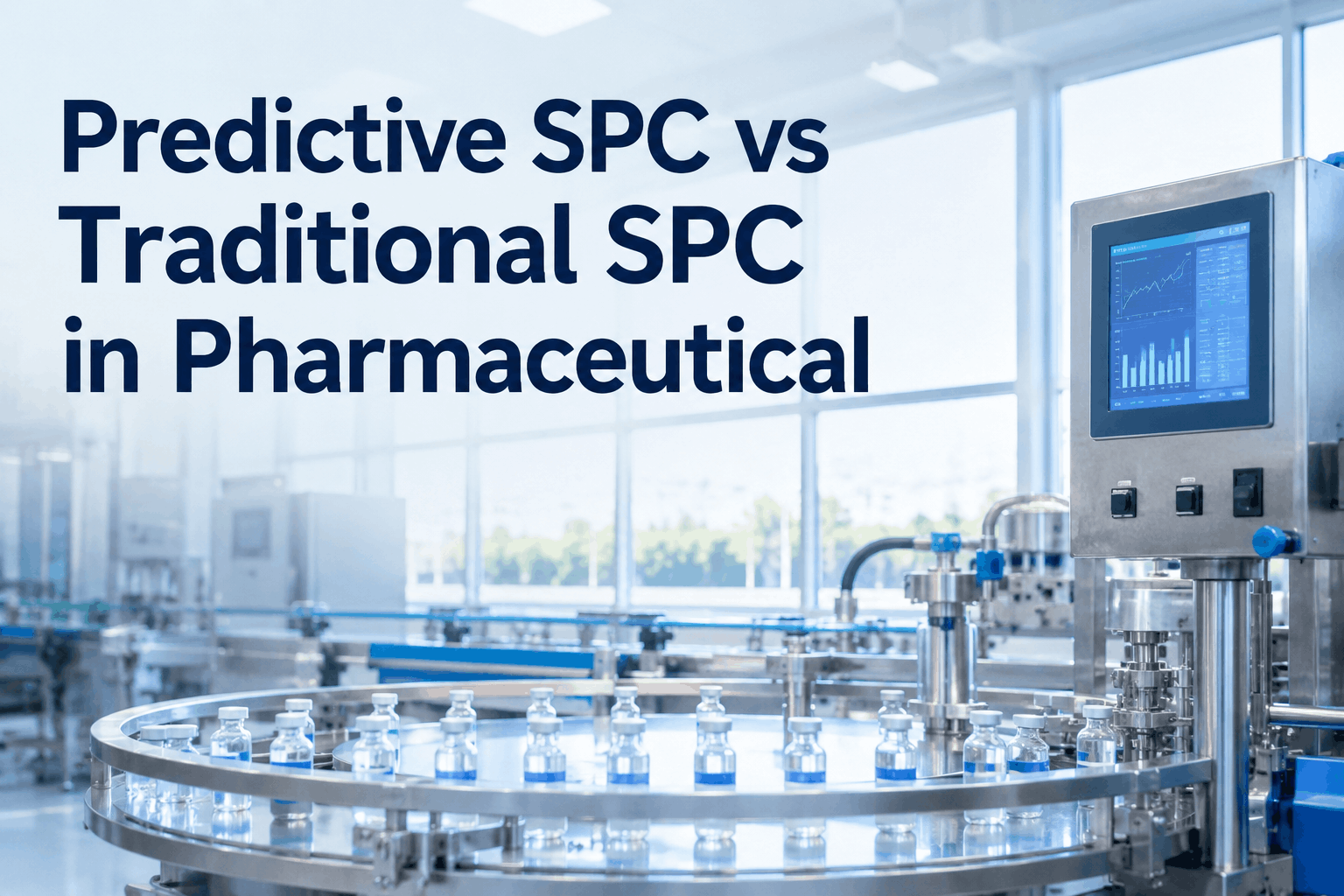
Pharmaceutical Supervisors operating on SAP MII / xMII rule-based SQC live with a predictable frustration — the platform faithfully reports what already happened, but consistently fails to anticipate what's about to happen. A batch deviates, the rule fires, the deviation paperwork starts; the next batch deviates, the rule fires again. The platform treats every parameter independently, ignores the multivariate signature that linked the three previous excursions, and applies the same static control limits regardless of product family, batch size, shift, raw material lot, or ambient conditions. Predictive SPC is the paradigm shift that replaces these limitations — multivariate models trained on historical batch profiles, adaptive control limits that tune automatically to current conditions, and excursion anticipation that gives Supervisors a 4–24 hour window to intervene before a deviation becomes a batch loss event. For pharmaceutical operations specifically, the impact on batch consistency is dramatic — Cpk improvements of 0.3–0.8 points are typical within 12 months, deviation rates drop 50–70%, and Supervisor time shifts from reactive investigation paperwork to proactive process oversight and improvement. iFactory AI delivers this on a pre-configured NVIDIA appliance running on-premise inside the GAMP 5-validated boundary, deploys in 6–12 weeks, and represents the AI-native alternative to SAP MII / xMII / DMC for pharmaceutical SPC operations. This page is the Supervisor's strategic guide to the SQC-to-SPC paradigm shift, what adaptive SPC models actually do for batch consistency, and how the daily Supervisor experience changes after migration.
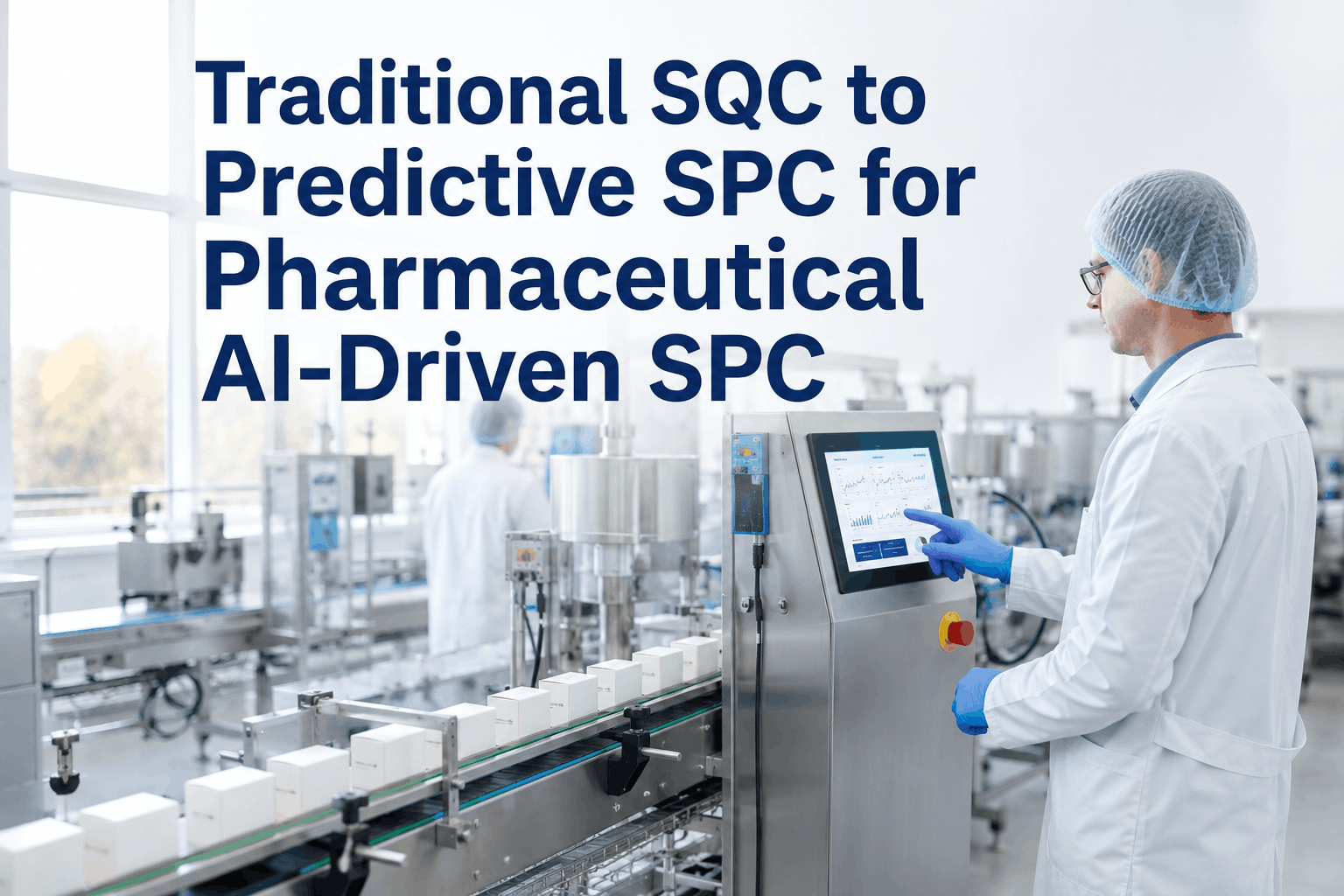
Traditional SQC to Predictive SPC for Pharmaceutical AI-Driven SPC
The pharma Supervisor's guide to the paradigm shift from rule-based SAP xMII SQC to AI-native predictive SPC — adaptive control limits tuning per product family, shift, and material lot · multivariate excursion anticipation hours ahead of breach · batch consistency Cpk improvements of 0.3–0.8 typical. Pre-configured NVIDIA appliance, GAMP 5 pre-validated, live in 6–12 weeks.
Traditional SQC vs Predictive SPC — The Paradigm Shift in Detail
The difference between rule-based SQC (SAP xMII style) and AI-native predictive SPC isn't a feature improvement — it's a different operational paradigm. The capability comparison below shows where the legacy paradigm reaches its inherent limits and where the AI-native paradigm starts. For pharmaceutical operations with regulatory compliance pressure, multi-product complexity, and batch consistency demands, the paradigm difference shows up in every operational decision Supervisors make.
What rule-based SQC actually does
What AI-native SPC actually does
Every row in the comparison represents a specific operational decision Supervisors make daily. Where the legacy SQC paradigm forces reactive workflow, the predictive SPC paradigm enables proactive oversight. The transition isn't about replacing dashboards or training operators — it's about giving Supervisors the foresight to make in-process decisions before excursions force deviations.
Want a paradigm-shift assessment for your specific pharma operation? Book the AI SPC Migration Workshop — iFactory's pharma team will assess your current rule-based SQC limitations and project the predictive SPC outcomes specific to your dosage forms, product portfolio, and Supervisor workflows. Sessions available this week.
Adaptive SPC Models — How Control Limits Actually Adapt
Adaptive control limits is the most important AI capability for pharma batch consistency, and the one that legacy SQC simply cannot replicate. Static control limits assume the process is statistically stationary — same conditions, same expected variability — which is rarely true for pharmaceutical operations running multiple product families across different shifts, raw material lots, and seasons. Adaptive limits tune automatically to the actual current conditions of the batch being processed.
The model continuously tunes control limits across five categories of variation — product family, shift, raw material lot, ambient conditions, and equipment state. Each adjustment reflects what the model has learned about normal variability under that specific condition combination. Supervisors see the right control envelope at every moment, with false alarms minimized and real drift signatures highlighted clearly.
Want to see adaptive SPC models running on representative scenarios from your dosage forms? Book the AI SPC Migration Workshop — sessions include live demonstration tuned to your product families, dosage forms, and current variability patterns. Sessions available this week.
The Supervisor Role — How Daily Workflow Transforms
What Supervisors actually do differently after migration
The Supervisor's daily workflow shifts substantially after the SQC-to-SPC paradigm change. Reactive paperwork drops; proactive process oversight rises. The work feels less constantly interrupted by deviation triage and more focused on the supervisory decisions that benefit from human judgment. Year-over-year Supervisor retention typically improves measurably after AI-native SPC deployment.
Before · Rule-Based SQC Era
- Pull xMII reports for shift review meeting
- Triage deviation reports as they open
- Lead manual root-cause investigations (30–60 min each)
- Sign deviation paperwork and CAPA documentation
- Respond to QA escalation queries reactively
- Manually correlate quality data across systems
- Maintain spreadsheet trackers for cross-batch trends
- Spend 50–60% of shift on reactive admin work
After · AI-Native SPC Era
- Review AI predictions in shift handover (5 min)
- Approve agent RCAs rather than building from scratch
- Make proactive decisions on flagged batches
- Lead process improvement initiatives
- Engage with QA on strategic quality programs
- Mentor operators on new AI-augmented workflow
- Review cross-product consistency dashboards
- Spend 60–70% of shift on substantive supervisory work
For pharmaceutical Supervisors specifically, the workflow transformation also affects regulatory engagement. Audit prep time drops from days to hours. Inspection responses become evidence-based rather than narrative-based. The Supervisor's perceived value to the organization shifts from administrative competence to operational judgment — a meaningful career trajectory improvement that often correlates with retention and internal promotion.
Six Pharma Operations Where Predictive SPC Pays Back Fastest
Granulation & Compression
Adaptive SPC on granulation moisture, blend uniformity, tablet weight, hardness. Limits tune per product family and material lot. Multivariate signature catches drift.
Coating & Film Quality
Adaptive limits on coating weight gain, color delta-E, disintegration time. Multi-product coating lines benefit dramatically from auto-tuning per formulation.
Sterile Manufacturing
Adaptive limits on environmental monitoring (particulates, microbials), fill weight variance, container closure integrity. Excursion anticipation critical for sterility.
API Synthesis
Predictive SPC on reactor conditions, intermediate purity, yield drift across multi-step API processes. Catches batch problems hours before crystallization step.
Biologic Fill/Finish
Adaptive limits on fill weight, lyophilization profile, environmental conditions. Excursion anticipation prevents loss of high-value biologic batches.
Continuous Manufacturing
Adaptive limits ideal for continuous manufacturing where real-time SPC drives in-process adjustments. Cpk maintained across long runs without manual recalibration.
Want application-specific Cpk projections for your pharma operation? Send your dosage forms, product portfolio, and current Cpk baseline to iFactory support and the pharma team will return a customised projection with 12-month roadmap — typically within 3 business days, no obligation.
21 CFR Part 11, EU Annex 11, GAMP 5 & ALCOA+ — Built In
Pre-validated workflows for pharma SPC regulatory frameworks
- 21 CFR Part 11 — electronic records and signatures
- EU Annex 11 — computerized systems validation
- EU Annex 1 — sterile medicinal products requirements
- GAMP 5 Category 4 — pre-validated with IQ/OQ/PQ artifacts
- ICH Q7/Q9/Q10 — quality risk management framework
- ICH Q14 — analytical procedure development
- ALCOA+ — all 9 attributes enforced at record creation
- USP <1010> — analytical data interpretation guidance
Adaptive SPC model decisions are captured as 21 CFR Part 11 records — attributable to the specific model version, contemporaneous with the underlying data, with full audit trail and tamper-evident storage. Model changes follow GAMP 5 change-control procedures with re-validation evidence. Supervisors retain full authority to accept, modify, or override AI predictions; every decision is logged with full audit trail.
Two Real Pharma Supervisor Outcomes
Multi-product OSD facility with 28 SKUs and chronic Cpk variability across portfolio
A mid-size oral solid dosage manufacturer producing 28 SKUs across 4 production lines. Cpk averaged 1.15 across the product portfolio — meeting minimum customer requirements but consistently flagged in supplier audits as borderline. Supervisors spent 55% of shift on deviation investigation paperwork. SAP MII handled SPC but couldn't adapt limits per product family, driving false alarms on some products and missed signals on others.
Sterile injectable operation with elevated environmental excursion rate and batch loss risk
A sterile injectable manufacturer running 4 filling lines for parenteral products. Environmental excursions during filling drove 8–11 batch rejections annually with average batch value of $4.2M. SAP xMII captured environmental monitoring data but excursions were typically detected at fail rather than anticipated in time for intervention. Supervisor responsibility for excursion response created chronic stress on the team.
Neither scenario matches your operation? Send your dosage forms, product portfolio, and current SAP xMII state to iFactory support and the pharma team will return a customised Supervisor-focused migration analysis with 12-month roadmap — typically within 3 business days, no obligation.
iFactory's Pharma Deployment — On-Premise or Cloud
Same AI-native platform on either deployment model. Same adaptive SPC models, multivariate detection, autonomous RCA, GAMP 5 pre-validation. For pharmaceutical operations specifically, on-prem is the strongly recommended default because of validated GxP boundary preservation requirements.
iFactory On-Premise Appliance Strong default for pharma operations preserving GxP validated state
- Pre-configured NVIDIA AI server — racked, software-loaded, ready to plug in.
- Validated GxP boundary preserved — minimizes CSV effort.
- <50ms edge inference — keeps up with high-speed pharma operations.
- Works during WAN outages — SPC monitoring continues uninterrupted.
iFactory Cloud For multi-site pharma operations with central QA oversight
- Fully managed — no rack, no facility requirements.
- Same adaptive SPC stack — multivariate, autonomous RCA, GAMP 5 frameworks.
- Cross-site Cpk benchmarking across all pharma plants.
- Fastest deployment — first site live in 2–4 weeks.
The paradigm shift is from reactive paperwork to proactive oversight.
Traditional SQC keeps Supervisors triaging deviations after they've fired. Predictive SPC with adaptive control limits gives Supervisors 4–24 hours of foresight to intervene before excursions develop. Batch consistency Cpk improves 0.3–0.8 points, deviation rates drop 50–70%, and Supervisor workload shifts toward substantive process work. The AI SPC Migration Workshop sizes the paradigm shift specifically for your operation.
Frequently Asked Questions
How are adaptive control limits actually validated under GAMP 5?
iFactory's adaptive limit models ship pre-validated as GAMP 5 Category 4 with IQ, OQ, and PQ artifacts. During deployment, the models are tuned to plant-specific data, and the validation is extended to cover the plant configuration. Limit changes follow change-control procedures — every model update is captured with audit trail, re-validation evidence, and Supervisor approval where needed. Inspections receive full transparency into how limits were established and how they evolve.
What's the difference between predictive SPC and SAP DMC's analytics?
SAP DMC offers descriptive analytics and improved dashboarding compared to xMII, but it doesn't include the adaptive limit models, multivariate signature recognition, LSTM trajectory prediction, or autonomous RCA that constitute predictive SPC. DMC is a cloud-resident upgrade of the same fundamental paradigm — descriptive, threshold-based, after-the-fact. Predictive SPC is the paradigm shift to anticipation and proactive intervention.
How long do the adaptive models need to learn the plant?
For mature deployments, the models reach steady-state accuracy after 8–14 weeks of operation on plant-specific data — covering typical product mix, shift patterns, material lot variation, and ambient seasons. Initial deployment activates with industry-pretrained models that are immediately useful, then continuously improve as plant-specific data accumulates. Cpk gains typically show in months 3–6 and continue improving into year 2.
Does AI replace the Supervisor's authority over batch decisions?
No. Supervisors retain full authority over all in-process decisions, deviation determinations, and batch release approvals. The AI provides predictions, recommendations, and pre-computed root-cause analyses as inputs to the Supervisor's decision — not as autonomous decisions themselves. Every Supervisor action, override, or approval is captured with audit trail per 21 CFR Part 11. The shift is in workflow content (proactive vs reactive) not authority.
Do I have to buy NVIDIA servers separately?
No. iFactory's on-premise appliance ships fully loaded — pre-configured NVIDIA AI server, software pre-installed, network gear, cabling, edge devices for line-side inference. You provide rack space, line power, Ethernet, and PLC/SCADA integration points. The deployment team handles installation, GAMP 5 validation, and configuration. For cloud, no hardware investment at all.
Can we migrate one product family or production area first?
Yes — and it's the recommended approach. Start with the product family or production area where batch consistency issues are most acute (typically multi-product OSD lines or sterile manufacturing). Validate the adaptive limit performance and Cpk gain on a single area. Then expand product-by-product or area-by-area in 2–4 week waves. Full multi-product deployment typically completes in 4–6 months.
What does the AI SPC Migration Workshop cover?
The half-day workshop covers — current-state SAP xMII assessment with focus on rule-based SQC limitations, adaptive SPC paradigm demonstration on your representative dosage forms and CQAs, batch consistency Cpk projection, three-path migration comparison, GAMP 5 validation timeline, Supervisor workflow transformation walkthrough, deployment roadmap with milestone dates. Outcome is a concrete migration plan. Suitable for Supervisors, Quality Leaders, IT, QA, and finance representatives.
Rule-based SQC was the right tool for a previous era of pharma operations. Adaptive predictive SPC is what comes next.
Multivariate models trained on historical batch profiles, adaptive control limits that tune automatically across product family / shift / material lot / ambient conditions, autonomous RCA pre-computed before excursions fire — running on a pre-configured NVIDIA appliance inside your GAMP 5-validated boundary. Batch consistency Cpk improvements of 0.3–0.8 are typical within 12 months. The AI SPC Migration Workshop is the fastest way to size the paradigm shift for your specific operation.