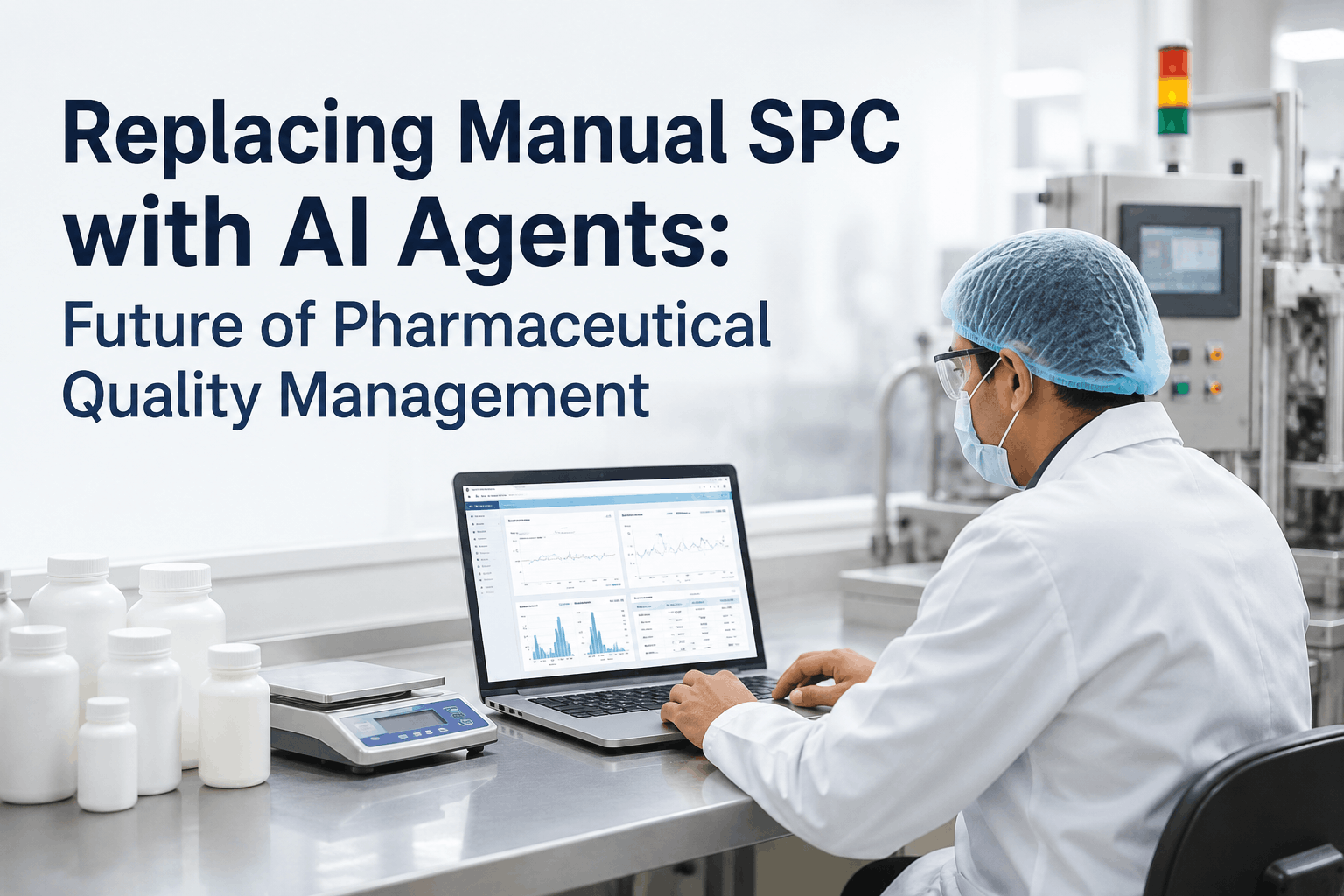
The pharma operator's day on SAP xMII or any traditional SPC platform breaks down predictably. Pull up the control chart from xMII. Walk to the line. Check the parameter manually against the chart. Document in the batch record by hand. Walk back. Repeat for the next CQA, next batch, next shift. Pharmaceutical operators on legacy SPC platforms typically spend 4–6 hours per 12-hour shift on documentation, chart review, manual quality checks, deviation paperwork, and SOP lookup — work that produces compliance evidence but doesn't move quality outcomes. That time is the largest hidden cost in pharma SPC operations and the one most invisible to financial reporting. AI-native predictive SPC handles operator productivity differently. The platform itself watches every parameter continuously, documents in the batch record automatically, surfaces predictions and recommendations through the operator dashboard, and assembles compliance evidence as activities occur. Operators get back 2–4 hours per shift for high-value work — process optimization, training, troubleshooting, cross-functional projects. This is the side-by-side: Traditional SPC, Cloud SPC, and AI-Native Predictive SPC compared across the four dimensions that actually determine pharma operator productivity and the platform's real cost — latency, data sovereignty, operator productivity, and 3-year TCO.
Predictive SPC vs Traditional SPC in Pharmaceutical
Traditional SPC, Cloud SPC, AI-Native Predictive SPC compared side-by-side for pharmaceutical batch quality control — latency, data sovereignty, operator productivity, and total cost of ownership. The migration choice that determines whether operators get back 2–4 hours per shift for high-value work.
Three Pharma SPC Platforms Side-by-Side
Pharma batch quality control platforms divide into three categories today. Traditional on-prem SPC like SAP MII and SAP xMII; cloud-only SPC like SAP DMC; and AI-native predictive SPC like iFactory AI. They differ across the dimensions that determine actual operator productivity outcomes — and the validated state of GxP compliance that pharma operations depend on.
SAP MII / xMII style
SAP DMC / SaaS vendors
iFactory AI
The Four Dimensions That Determine Real Pharma Operator Productivity
Most pharma SPC platform comparisons get lost in feature checklists. For pharma batch quality control operator productivity specifically, the dimensions that determine actual outcomes reduce to four. Each is independent; each can disqualify a platform on its own.
1. Latency
For pharma batch quality control, the AI inference loop must complete inside the operator's decision window. Cloud-only platforms add 500–2000ms WAN round-trip on every signal; on-prem edge inference completes under 50ms. The difference determines whether operators see drift signals in time to adjust the batch.
2. Data Sovereignty
The validated state of pharma batch records, process data, and audit trail exists inside the plant boundary today. Cloud-only platforms require moving that data and re-validating the supplier under Annex 11. On-prem AI preserves the existing validated boundary, dramatically simplifying CSV effort and inspection responses.
3. Operator Productivity
Pharma operators on traditional SPC spend 4–6 hours per shift on chart review, manual documentation, deviation paperwork, and SOP lookup. AI-native predictive SPC handles documentation and monitoring automatically; operators get back 2–4 hours per shift for process optimization, training, and troubleshooting.
4. Total Cost of Ownership
Traditional SPC carries ongoing maintenance license, on-prem infrastructure, and accumulating customization costs. Cloud SPC adds full GxP re-validation effort and per-tag subscription scaling. AI-native predictive SPC includes appliance, software, deployment, GAMP 5 pre-validation, and 3 years of model retraining in a single turnkey package.
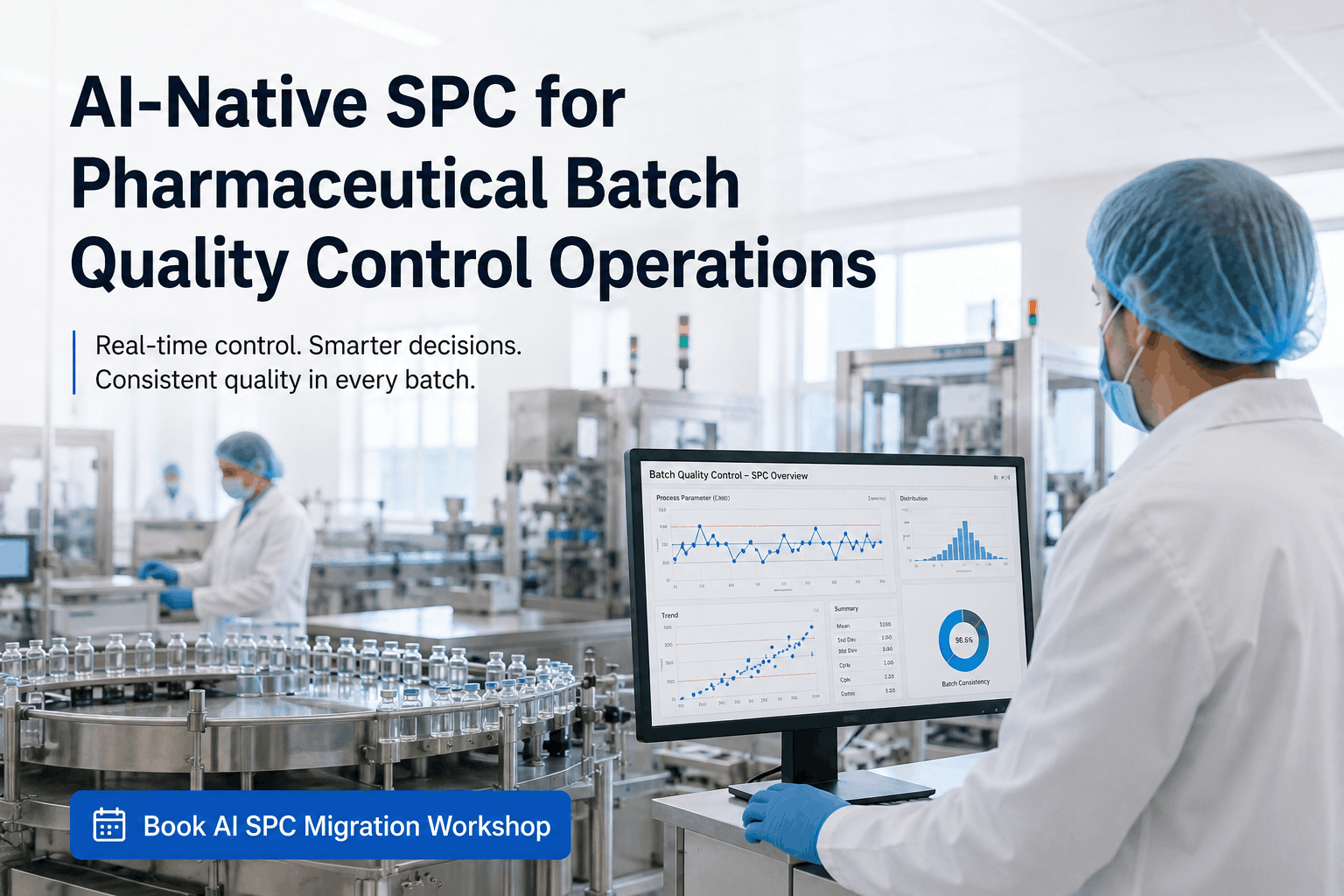
Want a sized comparison across the four dimensions for your specific pharma operation? Book the AI SPC Migration Workshop — iFactory's team will model your latency, sovereignty, operator productivity gain, and TCO across all three platform categories using your plant size, current SPC footprint, and CQA portfolio. Sessions available this week.
Operator Productivity — Where the Hours Actually Go
The single strongest argument for AI-native predictive SPC in pharma is what happens to the operator's shift workload. The visualization below breaks down a typical 12-hour pharma operator shift on traditional SPC versus AI-native — what changes is which tasks consume time, not whether the work gets done.
Want to see the operator productivity breakdown applied to your specific pharma operation? Book the AI SPC Migration Workshop — iFactory's team will analyze your current operator workflow and project the hours-per-shift recovery specific to your CQAs, dosage forms, and current SPC footprint. Sessions available this week.
Latency Where It Matters — The 50ms vs 1500ms Gap
Latency is the most overlooked dimension in pharma cloud SPC discussions. The vendor's marketing says "real-time"; the actual round-trip from process signal to actionable operator alert tells a different story. In pharma batch operations with high-speed filling, blistering, or packaging, the difference between in-flight intervention and after-the-fact diagnosis often determines whether a batch deviates or stays in spec.
Six Pharma Operator Productivity Applications
Automatic Batch Records
Compliance Agent captures process data, AI-derived predictions, operator actions, and verification into the electronic batch record — automatically, contemporaneously, ALCOA+ compliant.
Automatic SPC Monitoring
AI continuously monitors every parameter against adaptive limits. Operator gets surfaced anomalies and predictions — not 200 charts to review manually each shift.
Deviation Documentation Acceleration
Investigation Agent produces complete root-cause analysis with supporting evidence; operator reviews and approves rather than building from scratch with historian queries.
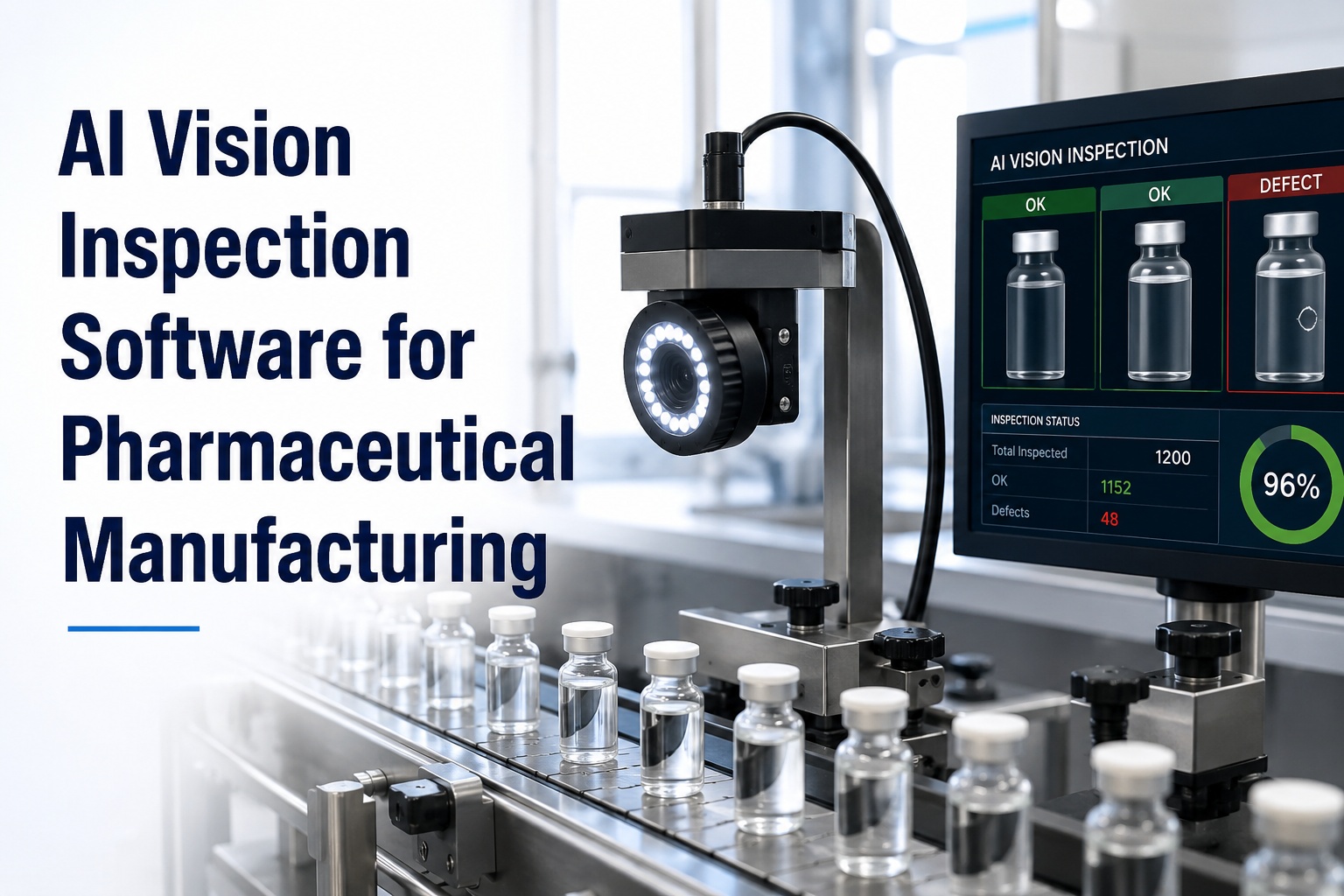
AI Vision Auto-Inspection
Tablets, capsules, vials, ampoules, blister packs inspected 100% inline by AI Vision. Operators handle exception review only — typically 1–3% of units flagged for confirmation.
SOP Lookup & Recipe Reference
Operator asks natural-language questions — SOPs, MOC procedures, recipe parameters, USP/EP monograph specs. Copilot returns plant-specific answers with linked documents.
Shift Handover Automation
AI automatically generates shift handover package — current batch status, AI predictions of imminent attention items, deviations in progress, operator actions pending.
Want an application-specific operator productivity projection for your top pharma batch operations? Send your current operator shift workflow and SAP xMII footprint to iFactory support and the pharma team will return a projected hours-per-shift recovery map with 12-month deployment roadmap — typically within 3 business days, no obligation.
Two Real Pharma Operator Productivity Outcomes
Mid-size CDMO with 22 SKUs across 5 production lines and operator workload challenges
A mid-size contract development and manufacturing organization (CDMO) producing 22 pharma SKUs across 5 production lines. Operators consumed 5.5–6 hours per shift on SPC chart review, batch documentation, SOP lookup across multiple product recipes, and deviation paperwork. Operator overtime ran 12–18% above target. SAP xMII handled SPC but couldn't address the documentation burden or product-switching complexity.
Specialty pharma manufacturer with chronic batch record completion delays
A specialty pharma manufacturer producing complex parenteral products across 3 filling lines. Manual batch record completion consumed 90–120 minutes per batch of operator and supervisor time. Batch release frequently delayed because of pending documentation completion. SAP xMII captured the process data but operators still completed batch records manually.
Neither scenario matches your operation? Send your operator workflow assessment and SAP xMII footprint to iFactory support and the pharma team will return a customised productivity analysis with hours-saved projection per shift and 12-month roadmap — typically within 3 business days, no obligation.
iFactory's Pharma SPC Deployment — On-Premise or Cloud
Same AI-native predictive SPC platform on either deployment model. Same operator productivity recovery, same documentation automation, same GAMP 5 pre-validation. The choice depends on validation strategy and multi-site approach.
iFactory On-Premise Appliance Default for pharma plants preserving existing validated state
- Pre-configured NVIDIA AI server — racked, software-loaded, ready to plug in.
- Validated GxP boundary stays in plant — minimizes CSV effort.
- <50ms edge inference — keeps up with high-speed filling and packaging.
- Works during WAN outages — operator productivity continues uninterrupted.
iFactory Cloud For multi-site pharma operations with central QA oversight
- Fully managed — no rack, no facility requirements.
- Same productivity automation — auto eBR, AI Vision, RCA, Copilot.
- Cross-site benchmarking on operator productivity across all plants.
- Fastest deployment — first site live in 2–4 weeks.
Operator hours are the hidden cost. The platform decides whether you recover them.
Traditional pharma SPC consumes 4–6 operator hours per 12-hour shift on manual documentation, chart review, and deviation paperwork. Cloud SPC adds latency and GxP re-validation without meaningfully changing the operator workload. AI-native predictive SPC recovers 2–4 hours per shift by automating documentation and surfacing only exceptions. The AI SPC Migration Workshop sizes the recovery for your operation across all three platform categories.
Frequently Asked Questions
Why does latency matter for pharma batch quality control?
For pharma operators, the in-process window between drift detection and the last chance to adjust a batch is measured in seconds to minutes for high-speed lines (filling, blistering, packaging) and minutes to tens of minutes for batch reactors. Cloud SPC platforms with 500–2000ms round-trip latency consume a measurable share of that adjustment window before the operator can act. On-prem edge inference at <50ms preserves the full adjustment window.
How does AI-native SPC actually free up operator time?
Three mechanisms. First — automatic batch record completion eliminates 60–90 minutes per shift of manual documentation. Second — AI-driven SPC monitoring replaces manual chart review of 100–300 parameters per shift. Third — autonomous RCA produces complete deviation investigations that operators approve rather than build, saving 80% on deviation paperwork. Combined, 2–4 hours per shift typically returned for high-value work.
Is data sovereignty really a concern for pharma cloud migration?
Yes, for pharma specifically. The validated state of GxP records exists inside the plant boundary today. Cloud SPC requires re-validating the supplier under EU Annex 11, establishing tenant isolation evidence, and demonstrating ALCOA+ data integrity across the cloud boundary. Regulatory bodies and inspection teams increasingly scrutinize off-prem residency of validated batch records. On-prem AI keeps the data and validation envelope inside your plant.
What about CFR Part 11 compliance with AI-driven documentation?
Every AI agent action in iFactory is captured as a 21 CFR Part 11 record — attributable to a specific agent or human, contemporaneous, with full audit trail and tamper-evident storage. Electronic signatures are cryptographically secured. The Compliance Agent enforces all 9 ALCOA+ attributes at the moment of record creation. Pre-validated as GAMP 5 Category 4 with IQ/OQ/PQ artifacts included.
Do I have to buy NVIDIA servers separately?
No. iFactory's on-premise appliance ships fully loaded — pre-configured NVIDIA AI server, software pre-installed, network gear, cabling, industrial cameras for vision inspection, edge devices for line-side inference. You provide rack space, line power, Ethernet, and PLC/SCADA integration points. The deployment team handles installation, validation, and configuration. For cloud, no hardware investment at all.
Can we migrate one line first before going plant-wide?
Yes — that's the recommended approach. Start with the line where operator productivity recovery would have the highest impact (typically highest-volume or highest-complexity products). Validate the time recovery, prove the operator workflow, build confidence with the AI automation. Then expand line-by-line in 2–4 week waves. Full plant migration for a 6–10 line pharma operation typically completes in 4–6 months.
What does the AI SPC Migration Workshop actually cover?
The half-day workshop covers — current-state SAP xMII assessment, operator workflow analysis with hours-per-shift baseline, three-platform comparison sized to your operation across latency / sovereignty / productivity / TCO, projected hours-saved per CQA and per dosage form, live iFactory platform walkthrough, deployment timeline with milestones. Outcome is a concrete migration plan. Suitable for operations leaders, QA, IT, and finance representatives.
Operator productivity is decided by the platform. Not by training, not by SOPs.
The number of hours your operators spend per shift on manual SPC work depends on whether the platform handles documentation, monitoring, and investigation automatically. Traditional SPC and Cloud SPC don't. AI-Native Predictive SPC does. The AI SPC Migration Workshop is the fastest way to see how many hours your specific operation would recover — sessions available this week, on-premise NVIDIA appliance or fully managed cloud deployment.

.png)