Pharma quality supervisors running batch SPC on SAP MII or SAP xMII manage a fundamentally manual system, even when it's described as automated. Operators watch control charts; QA writes deviation reports; engineers build fishbone analyses; CAPA cycles consume weeks. Every step generates regulatory exposure — missed Western Electric patterns, late deviations, weak root causes in 483 responses, ALCOA+ gaps in inspection. The next generation of pharma quality management doesn't replace one platform with another. It replaces the manual cognitive workflow with a multi-agent AI system — specialized autonomous agents that watch every parameter continuously, investigate every deviation in minutes, build every audit record automatically, and learn from every batch outcome to improve their own performance over time. This is what comes after SAP xMII in pharma batch quality control: AI agents handling the work humans used to do manually, supervisors moving from data assembly to oversight and decision-making, and regulatory compliance evidence building itself in the background. The agents are GAMP 5 Category 4 pre-validated, 21 CFR Part 11 and Annex 11 aligned, and ship on a turnkey NVIDIA appliance ready to plug in. Deployment is 6–12 weeks. The same platform is available as fully managed cloud. This is the supervisor's strategic guide to where pharma quality management is actually heading.
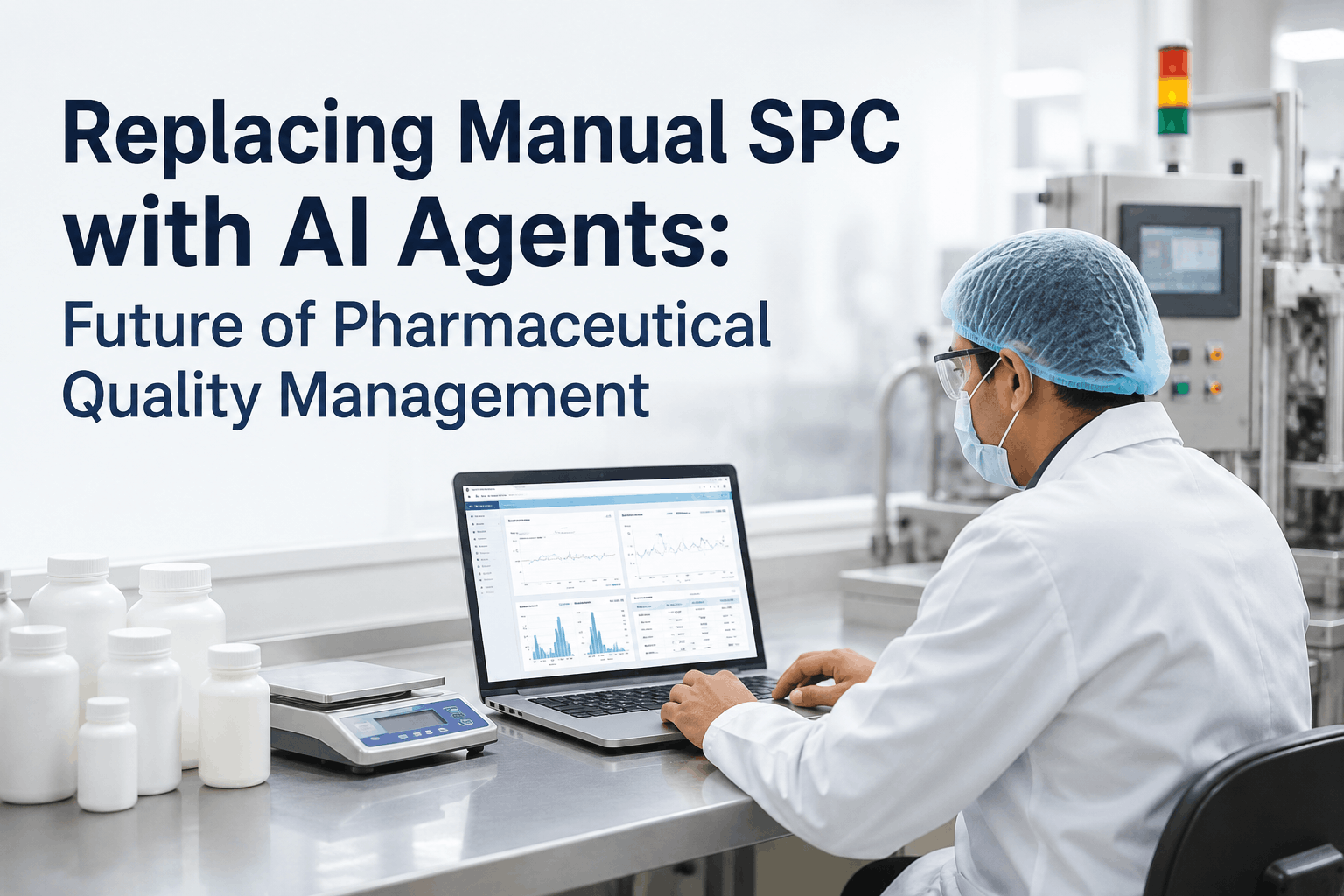
Replacing Manual SPC with AI Agents: Future of Pharmaceutical Quality Management
The pharma supervisor's guide to the post-SAP-xMII quality management paradigm — specialized AI agents handling monitoring, investigation, compliance evidence assembly, and continuous learning. Regulatory compliance posture strengthens while QA workload drops 40–70%. GAMP 5 pre-validated, 6–12 week deployment.
What "AI Agents" Actually Means for Pharma SPC
The phrase gets used loosely. In pharma batch quality management specifically, an AI agent is an autonomous software entity with a specific role, decision authority, and continuous learning loop. It's distinct from "AI features" because each agent owns a defined workflow end-to-end rather than just providing a calculation or a chart. The five iFactory agents work as a coordinated system, sharing context through a unified knowledge graph, with the supervisor providing oversight rather than manual orchestration.
Meet the Five Agents
Each agent has a defined role, specific decision authority, and a continuous learning loop. The supervisor doesn't manage individual agents — they manage outcomes while the agents coordinate among themselves via the shared knowledge graph.
Monitoring Agent
Watches every PLC tag, lab result, and equipment signal continuously.
Prediction Agent
Forecasts parameter trajectory + final batch outcome from in-process data.
Investigation Agent
Runs multivariate RCA autonomously when anomaly or deviation occurs.
Compliance Agent
Builds audit trail and regulatory evidence as activities occur, real-time.
Learning Agent
Continuously retrains models from verified outcomes, improving accuracy.
Want to see the five-agent ecosystem walking through a real pharma batch scenario? Book the AI SPC Migration Workshop — sessions include a live demonstration with all five agents responding to a representative deviation event on a tablet, vial, or lyophilized product configuration. Sessions available this week.
The Self-Learning Loop — Quality Systems That Get Better Over Time
The single feature that makes this generation of pharma quality management fundamentally different from SAP xMII or SAP DMC is the continuous learning loop. The Learning Agent observes every prediction, every recommended action, and every verified outcome — then retrains the prediction models from the new data. Accuracy improves over time without manual intervention. Patterns from one batch inform predictions on the next.
Over time, this self-learning behavior produces a quality management system that's measurably more accurate at month 12 than month 1. Prediction accuracy on critical quality attributes typically improves from 78–84% at deployment to 92–96% by month 12. False positive rates drop from 12–15% to under 5%. Operators trust the recommendations more because they observe the accuracy improving in real-time.
The Supervisor's Role — Manual Process vs Agent-Augmented
For pharma supervisors specifically, the work itself changes. Today, supervisors spend much of their day on manual data assembly, deviation triage, CAPA review, and audit preparation. With an agent-augmented quality system, the supervisor focus shifts to oversight, exception decisions, and strategic improvement — work that's harder to automate and adds more value.
Time spent on assembly
- Pulling SPC reports from xMII manually each shift
- Triaging deviation reports as they open
- Coordinating with engineering on root cause investigations
- Reviewing CAPA documentation, often days after the event
- Assembling evidence packages for upcoming audits
- Manually checking 21 CFR Part 11 record completeness
- Tracking ALCOA+ data integrity attributes by spreadsheet
- Following up on operator actions and outcomes manually
Time spent on decisions
- Reviewing Monitoring Agent flags and approving Prediction Agent recommendations
- Approving Investigation Agent RCAs (or escalating to engineering)
- Validating Compliance Agent audit packages before submission
- Coaching operators on AI recommendations they didn't act on
- Focusing on systemic quality improvement projects
- Strategic engagement with QA leadership and regulators
- Reviewing Learning Agent model accuracy trends
- Cross-line / cross-product process optimization
Want to see what the supervisor role looks like with the agent ecosystem running on your operation? Book the AI SPC Migration Workshop — sessions include a supervisor-day walkthrough showing the agent interactions, approval flows, and decision points on a representative pharma manufacturing scenario. Sessions available this week.
Six Pharma Regulatory Compliance Applications
These are the six highest-regulatory-impact pharma applications where AI agents move the compliance posture measurably within a 12-month deployment. Each maps to a specific regulatory exposure with measurable observation reduction.
FDA 483 Prevention
Monitoring + Investigation agents catch process drift and weak deviation records that historically drive 483 observations. Compliance Agent ensures evidence completeness.
ALCOA+ Data Integrity
Compliance Agent enforces all 9 ALCOA+ attributes at the moment of record creation. Audit trail is tamper-evident, attributable, and complete by design.
Deviation Cycle Acceleration
Investigation Agent collapses deviation root cause from days to minutes. Faster cycles reduce backlog, improve QA bandwidth, and shorten release timelines.
Continuous Process Verification
Self-learning agents provide Stage 3 continuous process verification evidence automatically. Trends, capability, and corrective actions all logged in real-time.
EU Annex 1 Compliance
AI Vision agent for visible particulate inspection meets revised Annex 1 requirements. Compliance Agent assembles inspection evidence for EMA inspections.
Warning Letter Risk Reduction
Reducing 483 observation count over time materially lowers warning letter risk and avoids the operational consequences of escalated regulatory action.
Want a compliance-specific projection for your operation? Send your recent inspection findings and SAP xMII footprint to iFactory support and the pharma team will return a customised regulatory exposure analysis with projected 483 reduction and 12-month roadmap — typically within 3 business days, no obligation.
GAMP 5, 21 CFR Part 11, Annex 11 — Built Into the Agents
What every agent enforces automatically
- GAMP 5 Category 4 validation framework with IQ/OQ/PQ artifacts
- 21 CFR Part 11 — electronic records and signatures (every agent action)
- EU Annex 11 — computerized systems supplier governance
- ALCOA+ — all 9 data integrity attributes enforced at write time
- ICH Q9 quality risk management framework alignment
- ICH Q10 pharmaceutical quality system support
- EU Annex 1 — visible particulate inspection compliance
- USP <1058> analytical instrument qualification alignment
The validation envelope around the agent ecosystem is structured so that model updates from the Learning Agent operate inside the validated framework without triggering full system re-validation. Model performance qualification protocols govern model behavior; the system validation governs the platform. This pharma-specific separation is built into the deployment.
Two Real Pharma Regulatory Outcomes
Solid dose manufacturer with recurring 483 observations on SPC documentation and CAPA timeliness
A mid-size oral solid dose manufacturer with two consecutive FDA inspections producing 483 observations on SPC documentation completeness, ALCOA+ data integrity gaps, and slow CAPA closure cycles. Quality team consumed approximately 35% of QA bandwidth on manual evidence assembly and audit preparation. SAP xMII handled SPC monitoring but couldn't address the documentation and cycle-time issues.
Sterile injectable manufacturer facing revised EU Annex 1 compliance pressure
A specialty sterile injectables manufacturer running 3 vial filling lines for high-value parenteral products. Revised EU Annex 1 (effective late 2022) intensified visible inspection requirements. Manual inspection couldn't sustain 100% coverage; existing SAP xMII didn't support AI Vision integration. EMA inspection scheduled within 18 months created urgency.
Neither scenario matches your operation? Send your recent inspection history and current SAP xMII footprint to iFactory support and the pharma team will return a customised regulatory analysis with projected compliance improvement and 12-month roadmap — typically within 3 business days, no obligation.
iFactory's Pharma Agent Deployment — On-Premise or Cloud
Same five-agent ecosystem on either deployment model. Same self-learning loop, same GAMP 5 pre-validation, same regulatory framework support. The deployment choice depends on validation strategy and multi-site approach.
iFactory On-Premise Appliance Default for pharma plants preserving existing validated state
- Pre-configured NVIDIA AI server — racked, software-loaded, ready to plug in.
- Validated boundary stays in plant — minimizes CSV effort.
- All five agents running locally — knowledge graph stays on-prem.
- Works during WAN outages — agents continue operating uninterrupted.
iFactory Cloud For multi-site pharma with central QA strategy
- Fully managed — no rack, no facility requirements.
- Same five-agent ecosystem — monitoring, prediction, investigation, compliance, learning.
- Cross-site compliance posture benchmarking in one tenant.
- Fastest deployment — first site live in 2–4 weeks.
Manual SPC is the workload. Agents are the future.
Five specialized AI agents — Monitoring, Prediction, Investigation, Compliance, Learning — handling the manual cognitive work of pharma quality management while supervisors focus on oversight and decisions. Self-learning means the system gets better every batch. Regulatory compliance posture strengthens; 483 observation count drops 65–85%; CAPA cycle collapses to minutes. The AI SPC Migration Workshop sizes the agent-augmented future for your operation.
Frequently Asked Questions
How is an "AI agent" different from "AI features"?
AI features are calculations or analytics inside a platform — a control chart, a forecast, a recommendation. AI agents are autonomous software entities with defined roles, decision authority, and continuous learning. The Compliance Agent doesn't just provide compliance information; it owns the audit evidence workflow end-to-end. The Investigation Agent doesn't just run analytics; it owns the RCA workflow. Each agent has a job description, and the supervisor manages outcomes rather than orchestrating tools.
Can the Learning Agent change models without re-validation?
Within the model performance qualification (PQ) envelope, yes. The validation envelope around iFactory is structured to allow model retraining inside the pre-approved PQ boundary. Models that drift outside that boundary trigger formal re-qualification rather than autonomous update. This pharma-specific governance is built into the deployment and matches how progressive regulators expect AI/ML governance to work going forward.
How does the supervisor role actually change day-to-day?
Less time on manual data assembly, deviation report review, and audit preparation; more time on agent oversight, exception decisions, systemic quality improvement projects, and operator coaching. Supervisors typically report higher job satisfaction because the work shifts from administrative to substantive. Headcount typically stays the same; output value rises.
Will regulators accept AI-generated investigations and evidence?
Progressive regulators (FDA Center for Drug Evaluation and Research, EMA, MHRA) increasingly expect AI/ML integration in pharma quality systems and have published guidance frameworks for it. AI-generated evidence with proper human oversight, complete audit trail, and validated model behavior is well within current regulatory expectations. The supervisor remains the responsible party for decisions; the agents augment rather than replace QA judgment.
Do I have to buy NVIDIA servers separately?
No. iFactory's on-premise appliance ships fully loaded — pre-configured NVIDIA AI server, software pre-installed, network gear, cabling, industrial cameras for vision inspection, edge devices for line-side inference. You provide rack space, line power, Ethernet, and PLC/SCADA integration points. The deployment team handles installation, validation, and configuration. For cloud, no hardware investment at all.
Can we start with just one or two agents?
Yes — agent activation can be phased. Most pharma plants start with Monitoring and Prediction agents during the first 4–6 weeks of go-live, then add Investigation Agent (autonomous RCA) once supervisor and QA confidence is established. Compliance Agent typically activates next as the audit trail framework. Learning Agent runs in shadow mode from day one and gradually takes on retraining authority. Full ecosystem typically operational by month 3.
What does the AI SPC Migration Workshop actually cover?
The half-day workshop covers — current-state SAP xMII assessment, compliance posture analysis against your recent inspection findings, five-agent ecosystem walkthrough with pharma scenarios, GAMP 5 validation approach review, deployment roadmap with milestone dates, and projected ROI on compliance and operational dimensions. Outcome is a concrete migration plan. Suitable for QA leadership, operations supervisors, IT, and regulatory affairs representatives.
Quality management isn't ending. The manual version is.
SAP xMII handles the SPC workflow the way pharma has always done it — manual, sequential, after-the-fact. The next generation is agent-augmented, predictive, continuous, and self-improving. Five specialized AI agents working as a coordinated quality system, supervisors providing oversight, compliance evidence building itself. The Migration Workshop is the fastest way to see what this future looks like specifically for your operation.